 Bilal Siddiqui
Key takeaways
Amazon brand protection is a set of tools for intellectual property and counterfeit problems, not a way to remove any seller you did not authorize.
An unauthorized reseller, a listing hijacker, and a counterfeiter are different problems that need different responses.
Report a Violation is for suspected trademark, copyright, patent, and design-right infringement, and it requires the right Brand Registry role.
Transparency and Project Zero are separate, gated programs, and Project Zero is for counterfeit listings only.
Amazon does not enforce your minimum advertised price. Pricing and distribution control come from your contracts, not Amazon's IP tools.
Most brands come to Amazon brand protection with a specific pain. A seller you never approved shows up on your listing, an offer undercuts your pricing, your title or images get changed, or a suspicious version of your product appears and starts collecting your reviews. The instinct is to want it all gone immediately. The reality is more precise: brand protection on Amazon is a system of tools, each built for a specific type of problem, and the brands that get results are the ones who identify the problem correctly and use the route that actually fits it.
This guide covers what brand protection on Amazon really includes, how to tell one kind of bad actor from another, what Amazon will and will not act on, how to find and monitor unauthorized resellers, what evidence to collect, and how to escalate sensibly. It is written from an operator's point of view, and it is general operational information, not legal advice.
What Amazon Brand Protection Actually Covers
Brand protection on Amazon refers to the tools and processes a brand uses to defend its intellectual property, its listing accuracy, and customer trust in its products. At its core it addresses counterfeit products, infringement of registered rights, and misuse of your brand's content. It is not a general enforcement service for every commercial dispute you might have with another seller.
The foundation is Amazon Brand Registry, and our Amazon Brand Registry guide covers enrollment in detail, so this page does not repeat it. Once a brand is enrolled, Amazon uses information supplied during Brand Registry enrollment, data about the brand and its intellectual property, and learnings from accurate infringement reports to improve predictive protections. As Amazon explains in its Brand Registry overview, these protections use the information a brand shares to help stop suspected bad listings before they are published. They are helpful, but they do not catch every infringement, prevent every catalog change, or block every incorrect listing contribution. They also do not replace your own monitoring. The Impact dashboard inside the Brand Registry portal shows how Amazon is using the information you share and provides a snapshot of protection activity.
Unauthorized Reseller vs Hijacker vs Counterfeit Seller
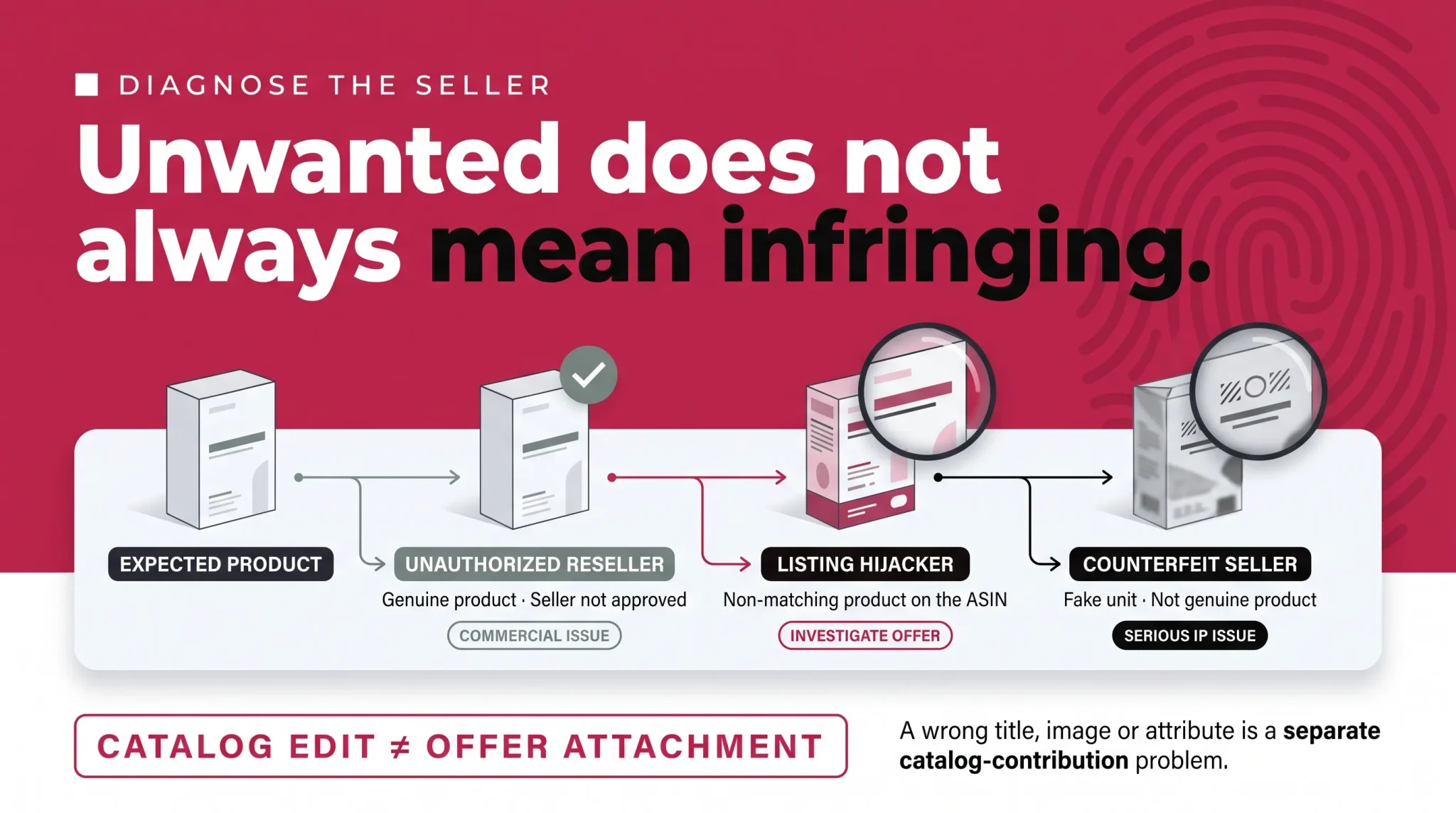
A great deal of wasted effort comes from treating every unwanted seller as the same problem. They are not, and using the wrong label leads to the wrong action. It helps to keep these distinct:
An unauthorized reseller is a seller you have not approved who is offering genuine units of your product. Being unauthorized is a commercial and distribution matter, not by itself an intellectual property violation.
A listing hijacker is a seller that attaches an offer to an existing ASIN while supplying a counterfeit, materially different, incorrectly branded, or otherwise non-matching product. An inaccurate edit to the title, images, attributes, or other catalog content is a separate catalog-contribution problem, although both issues can occur together.
A counterfeit seller is offering fake units that are not genuine product. This is a distinct and serious problem that Amazon's counterfeit tools are built to address.
Trademark infringement is unauthorized use of your registered brand name, logo, or mark. Copyright infringement is unauthorized use of your original creative work, such as your images or copy. Patent or design-right infringement involves your protected inventions or product designs. An inaccurate catalog contribution is a wrong or misleading edit to a detail page. A product-condition, warranty, or authenticity issue covers used, damaged, materially different, or non-warrantied goods sold as new or genuine. A MAP or distribution-policy violation is a breach of your pricing or channel rules.
The key point: an unauthorized reseller is not automatically a counterfeiter, a hijacker, or an intellectual property infringer. Sometimes one seller is several of these at once, and sometimes an unauthorized seller is doing nothing Amazon will act on at all. Diagnosing which one you are dealing with is the first real step in brand protection.
What Amazon Will and Will Not Act On
Amazon acts most reliably on the problems covered by its Intellectual Property Policy for sellers, namely infringement of registered rights and counterfeits, along with conduct that harms customers. It generally does not step into pure pricing disputes or channel disagreements between a brand and a seller.
This is where expectations need to be accurate. Amazon generally does not remove an offer merely because the brand has not authorized the seller. Amazon may act when the evidence supports counterfeit activity, intellectual-property infringement, a condition or material-difference issue, inaccurate catalog information, or another policy violation. Whether a particular resale creates an actionable legal issue can depend on the country, product condition, material differences, warranties, representations, distribution agreements, and the intellectual-property rights involved. That is general operational information, not legal advice, and it is not an attempt to teach the full first-sale doctrine. If your situation turns on those legal questions, that is a conversation for qualified counsel.
What this means in practice is simple. If your problem is genuinely about infringement or counterfeits, Amazon has tools that fit. If your problem is really about pricing or an unauthorized but otherwise legitimate reseller, the effective levers are your contracts and distribution controls, not Amazon's IP reporting tools. Using an IP tool to chase a pricing problem tends to fail, and inaccurate reporting can work against you.
How to Find and Monitor Unauthorized Resellers
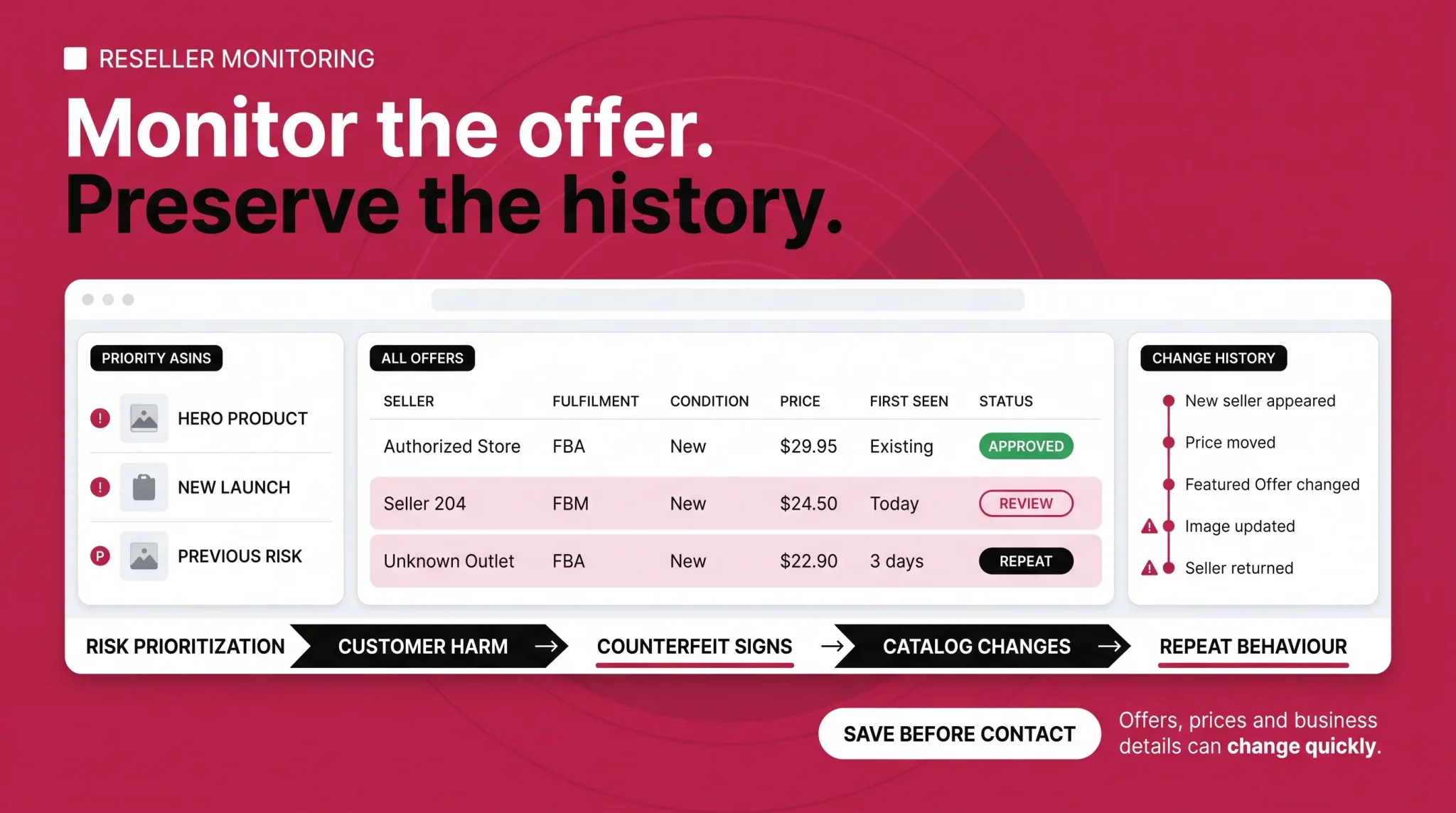
You cannot act on what you cannot see, so monitoring is the ongoing discipline that makes everything else work. Start by creating a baseline list of every authorized seller, distributor, and selling account connected to the brand. Then identify the priority ASINs and marketplaces that need attention. A high-volume hero product, a recent launch, and an ASIN with previous counterfeit activity will usually deserve more scrutiny than a slow-moving item with a stable offer history.
Review all offers attached to each priority ASIN, not only the Featured Offer, formerly known as the Buy Box. For each unfamiliar offer, record the seller name, seller ID or profile URL, displayed business details, fulfillment method, condition, price, shipping promise, stock status, and marketplace. Record when the seller first appears and continue the history when the offer changes or disappears. This makes it easier to identify sellers that return across multiple ASINs or marketplaces instead of treating each appearance as an isolated event.
Compare unfamiliar offers with authorized distribution records, recent wholesale orders, distributor lists, and known selling accounts. The purpose is not to assume that every unknown seller is infringing. It is to determine whether the inventory may have moved through an approved channel, leaked through a distributor, been diverted between marketplaces, or presents signs of a non-matching or counterfeit product.
Monitoring should also cover customer-facing changes. Watch the title, images, bullets, description, attributes, variation structure, condition claims, warranty presentation, price, shipping promise, and offer pattern. A seller attaching a non-matching product is a potential hijacking or counterfeit issue. A wrong title, image, or attribute may instead be an inaccurate catalog contribution and should be investigated through the route that fits that problem.
Prioritize findings by the risk of customer harm, counterfeit indicators, catalog-content changes, pricing impact, the sales importance of the ASIN, and repeat behavior across products or marketplaces. Preserve the evidence before contacting the reseller, distributor, Amazon, or legal counsel because offers, business details, inventory status, and catalog content can change quickly.
Smaller catalogs can begin with a structured spreadsheet, clear ownership, and a regular review process. Larger brands may use automated monitoring tools to scan offers and catalog changes at scale, but automation still needs human review to classify the issue and select the right response. There is no universal daily or weekly schedule. The right cadence depends on catalog size, sales velocity, launch periods, previous infringement, and the risk level of each marketplace.
What Evidence to Collect
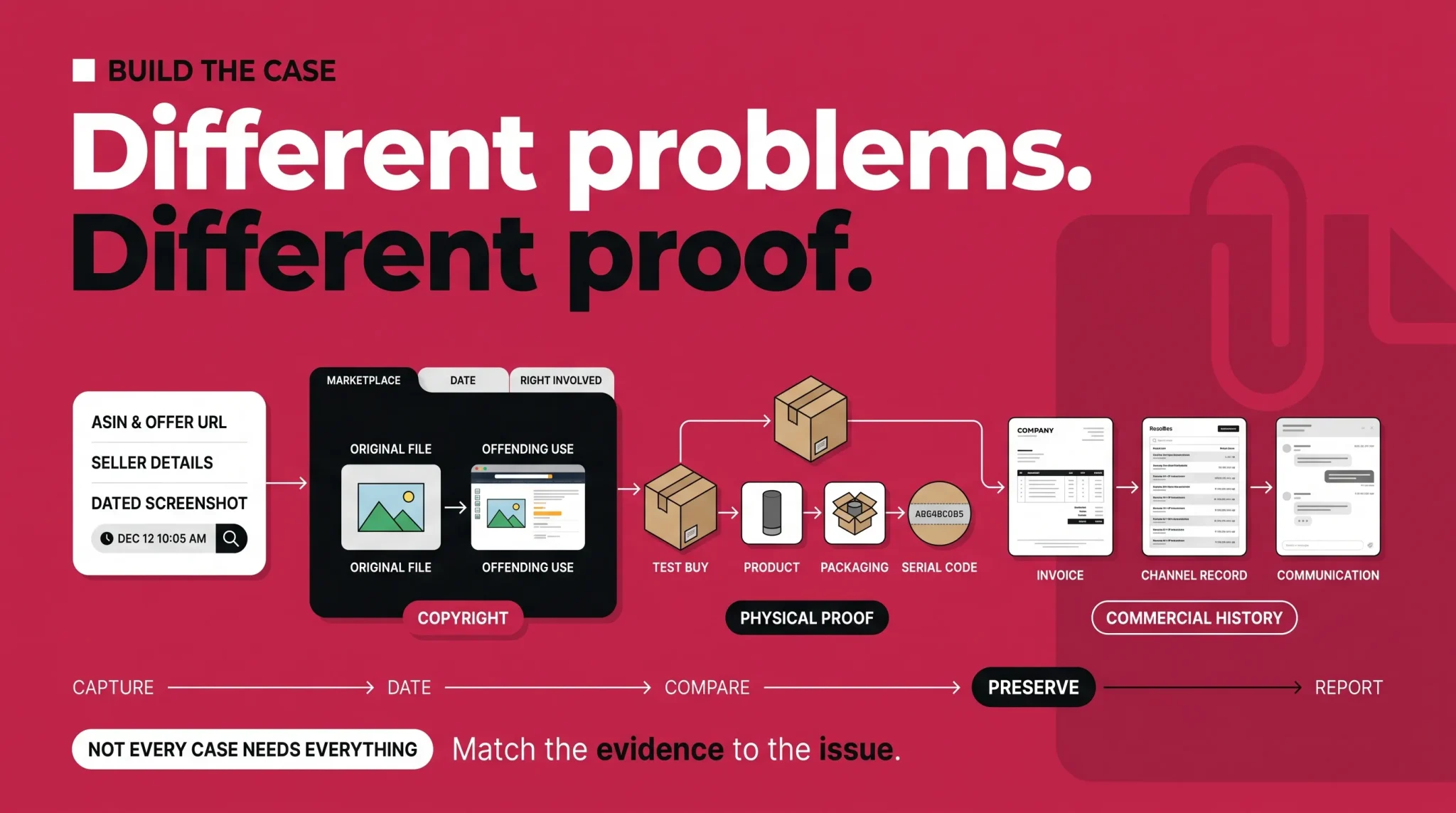
Different problems require different proof, and one of the most common mistakes is either gathering nothing usable or assuming every case needs everything. Match your evidence to the type of issue.
Depending on the case, useful evidence may include the ASIN and offer URL, the seller name and business information, dated screenshots of the price and the Featured Offer, the date and marketplace, the relevant trademark, copyright, patent, or design-right registration, your original creative files, product and packaging photographs, an order number, a test-buy product, an invoice, packaging, serial code, or other authenticity evidence, documentation of condition, warranty, or material differences, and any communication with the distributor or reseller.
Not every case requires every item. A copyright issue on your images turns on your original files and the offending page, while a suspected counterfeit turns on a physical unit and its packaging. A test buy is particularly useful for suspected counterfeit, condition, packaging, warranty, or material-difference cases, but it is not a universal prerequisite for every report.
Monitoring and Evidence Checklist
Watch for new or unfamiliar sellers appearing on your ASINs.
Maintain a baseline list of authorized sellers, distributors, and selling accounts.
Identify the priority ASINs and marketplaces that require monitoring.
Review every offer on each priority ASIN, not only the Featured Offer.
Record the seller name, seller ID or profile URL, displayed business details, fulfillment method, condition, price, shipping promise, stock status, marketplace, and first-seen date.
Note repeat appearances across ASINs and marketplaces, and compare them with authorized distribution records.
Track changes to your title, images, bullets, and description.
Note pricing moves, shipping promises, stock status, and Featured Offer changes over time.
Record the ASIN and offer URL for any issue you find.
Save dated screenshots of the offer, price, and any altered content.
Prioritize cases by customer harm, counterfeit risk, content changes, pricing impact, sales importance, and repeat behavior.
Identify the specific right involved and have its registration details ready.
Keep original creative files if the issue involves your images or copy.
For suspected counterfeit, condition, packaging, warranty, or material-difference cases, complete a test buy and keep the product, packaging, invoice, and any serial codes.
Log any communication with the distributor or reseller.
Amazon's Current Protection Tools
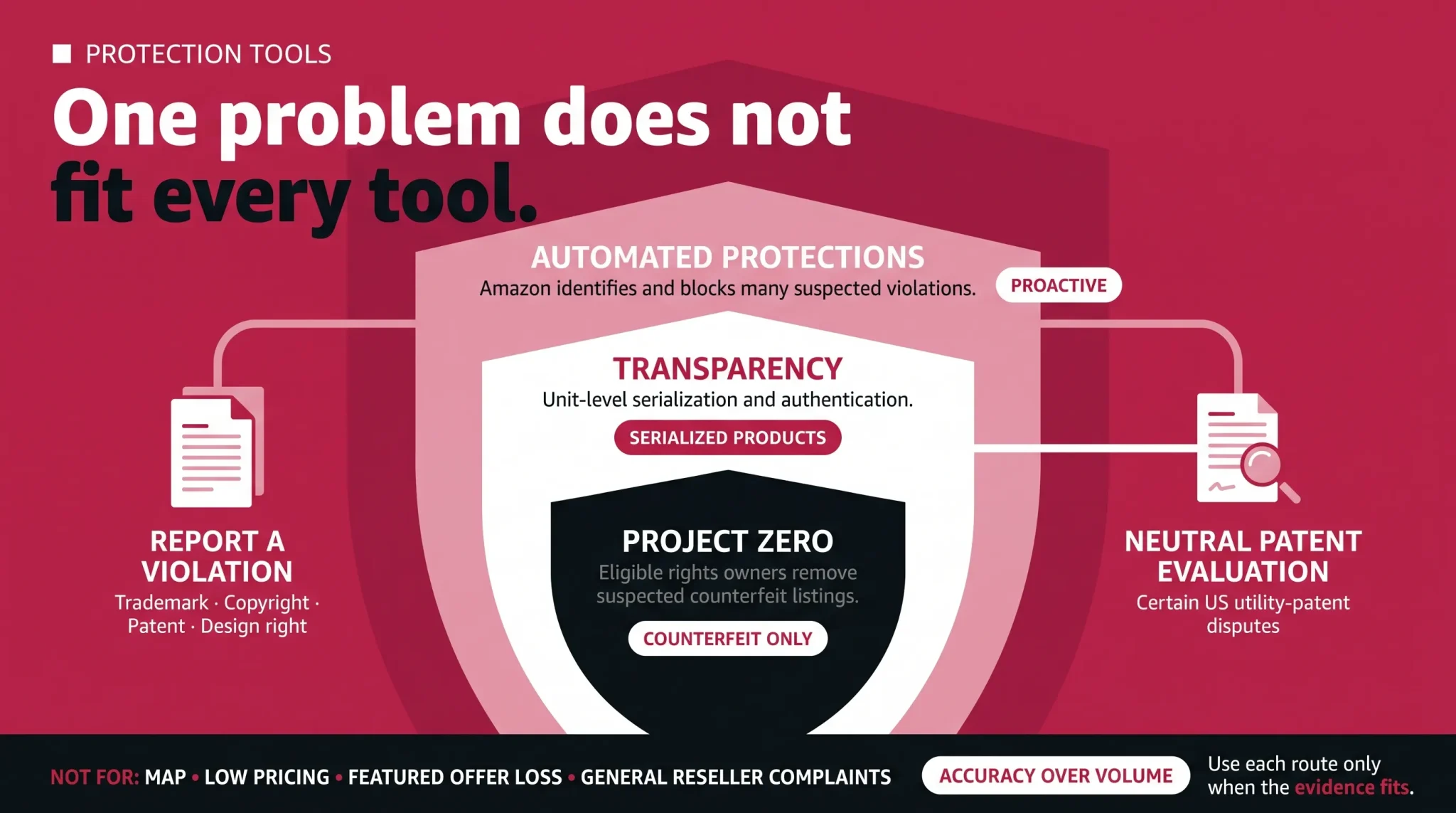
Once you have diagnosed the problem and gathered the right evidence, these are the main tools Amazon offers. Each has a purpose and clear limits.
Tool | What it is for | Who can use it | Key limits |
|---|---|---|---|
Report a Violation | Reporting suspected trademark, copyright, patent, and design-right infringement | Brand Registry accounts with the Rights Owner or Registered Agent role | Not for pricing, MAP, Featured Offer, or general reseller complaints; a pending trademark cannot be used for that mark until registered |
Automated protections | Amazon proactively identifying and blocking many suspected violations using enrollment information, brand and IP data, and learnings from accurate reports | Brands enrolled in Brand Registry | Does not prevent every infringement, catalog change, or incorrect contribution and does not replace your own monitoring |
Transparency | Unit-level serialization that authenticates items before they reach customers | Brand Registry accounts with the Rights Owner role, an active registered trademark, a GTIN for each enrolled product, and the ability to serialize required manufactured units | Separate enrollment; supported stores only; per-unit code costs vary; brands can use Amazon-issued codes or connect qualifying existing serial codes |
Project Zero | Self-service removal of listings you believe are counterfeit, with automated protections and serialization | Eligible Rights Owners who meet Amazon's gated criteria | Counterfeit only; separate eligibility; high removal accuracy required to keep access |
Neutral Patent Evaluation | An alternative process for certain utility-patent disputes | Rights owners in the US Amazon store, through Report a Violation | Utility patents only; not for trademark, counterfeit, reseller, or pricing issues |
One more point worth stating plainly: Amazon may apply additional selling restrictions to certain brands or products, but brands should not treat this as a guaranteed or self-service reseller-removal program. The criteria and application of such restrictions are not fully public, so it is not a lever you can simply switch on.
Report a Violation and the Public Notice Form
Report a Violation is Amazon's Brand Registry tool for reporting suspected trademark, copyright, patent, and design-right infringement. To use it, your Brand Registry account normally needs the Rights Owner or Registered Agent protection role. It lets you search Amazon's catalog by text, ASIN, order number, or image, submit a report, and track outcomes through your Submission History.
There are two important limits. First, a brand enrolled with a pending trademark cannot use Report a Violation for that trademark until it is fully registered, though the brand may still report already-secured copyright or patent rights where applicable. Second, rights owners or agents who are not using Brand Registry can still notify Amazon of suspected infringement through Amazon's Public Notice Form, which is open to any rights owner or authorized agent.
Just as important is what Report a Violation is not for. It is not a channel for unauthorized reseller complaints, MAP violations, low pricing, loss of the Featured Offer, ordinary customer-service disputes, or every unwanted catalog edit. Unsupported or inaccurate reports can lower a brand's Report a Violation acceptance rate and may affect eligibility for programs such as Project Zero. Report promptly when the evidence fits the claimed right, but prioritize accuracy over volume. A rejected infringement report does not automatically create an Account Health violation.
Transparency and Project Zero
These are two separate, gated programs, not automatic features of Brand Registry, and they solve different problems.
Transparency is a product serialization and authentication program. Enrolled products carry unique serialization codes, and Amazon checks those codes to authenticate units before they reach customers, for both Amazon-fulfilled and merchant-fulfilled orders in supported stores. Current public eligibility includes a Brand Registry account with the Rights Owner role, an active registered trademark, a GTIN for each product being enrolled, and the operational ability to serialize the required manufactured units. That last requirement is a real supply-chain commitment.
Brands can apply Amazon-issued Transparency codes or, where eligible, connect existing serial codes already used on their units. Both routes support product authentication and accuracy checks, but customer app scanning and customer-engagement features are not currently available for products connected through existing serial codes. Transparency has per-unit code costs that vary by code volume, geography, and code type, so confirm the applicable cost during enrollment.
Project Zero is a separately gated program focused on counterfeits only. Its self-service removal tool should be used only for listings you believe are counterfeit. Amazon's current published eligibility includes a Brand Registry account, Rights Owner status for an active registered trademark, use of Report a Violation to report suspected registered-trademark infringement during the previous six months, an acceptance rate of at least 90 percent on those reports, and a responsible usage history. Amazon also considers additional factors, so meeting the acceptance-rate threshold alone does not guarantee eligibility. Because the self-service tool is powerful, Amazon holds users to a high standard, currently requiring at least 99 percent removal accuracy to keep access, and it recommends conducting a test buy when confirming a suspected counterfeit. Project Zero should not be used to remove genuine unauthorized resellers, MAP violators, copyright-only or patent-only disputes, or ordinary catalog disagreements.
A Practical Escalation Framework
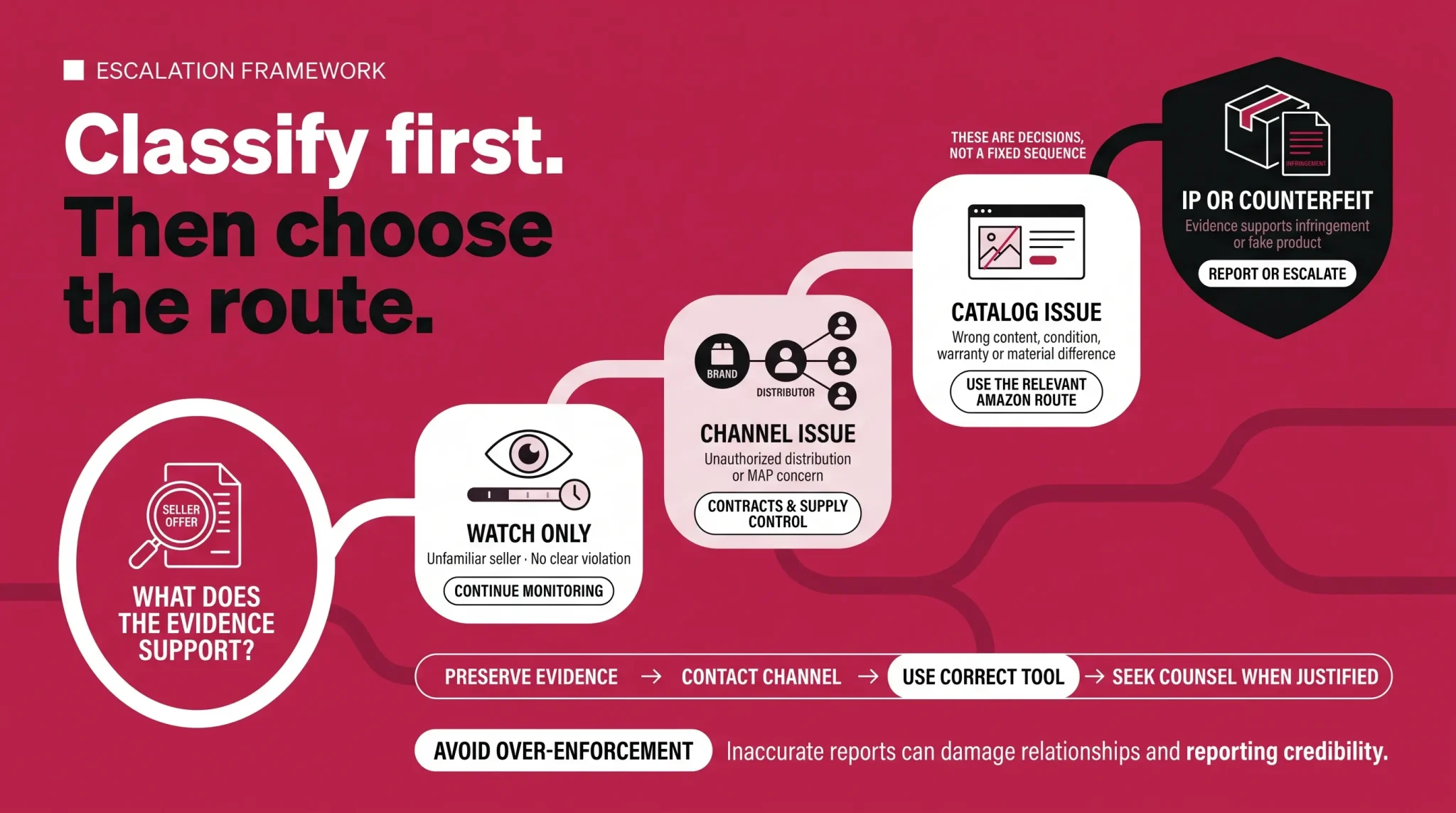
Enforcement is not a single fixed sequence that always ends in a lawyer's letter. It is a set of decisions based on what the problem actually is and what the evidence supports. A workable framework looks like this:
Most findings fall into four response categories. Watch only applies when an unfamiliar seller appears but there is no clear violation or evidence of customer harm. A commercial channel issue covers unauthorized distribution or a MAP concern handled through contracts, distributor relationships, and supply controls. A catalog or customer-experience issue covers incorrect content, wrong condition, a warranty mismatch, a materially different product, or another customer-facing problem. An IP or counterfeit issue applies when the evidence supports Report a Violation, the Public Notice Form, Transparency, Project Zero, or qualified legal escalation. This triage prevents brands from using intellectual-property tools for every unwanted reseller.
After triage, preserve your evidence before anything changes. Contact the distributor or reseller where that is commercially appropriate, since many situations are resolved through channel relationships. Use the relevant Amazon route only when the facts fit it, such as Report a Violation for genuine infringement or Project Zero for supported counterfeit cases. Conduct a test buy where authenticity, condition, packaging, warranty, or material differences are in question. Escalate repeat or serious infringement with qualified legal counsel, and reserve litigation for cases where the value, evidence, jurisdiction, and commercial risk justify it.
The reason to think in decisions rather than a straight line is that over-enforcement carries its own cost. Threatening legal action as a universal first step, or filing reports that do not fit the facts, can damage relationships and your own standing. Matching the response to the problem is what protects both your catalog and your account.
MAP, Pricing, and Distribution Control
Pricing pressure is one of the most common reasons brands look into protection, so it deserves a clear and honest note. Report a Violation is not a MAP enforcement route. MAP and distribution disputes are generally handled through the brand's contracts, distributor relationships, supply controls, and legal remedies rather than Amazon's intellectual-property reporting tools.
It is also worth separating two different things. Amazon runs its own Marketplace Fair Pricing Policy, which focuses on pricing practices that may harm customer trust, such as prices that are far above recent or external references, or misleading reference prices. That is Amazon protecting its customers, and it is different from Amazon enforcing your brand's minimum advertised price, which Amazon does not do. For the full picture on managing MAP and pricing on Amazon, see our dedicated Amazon MAP pricing guide.
When Outside Help Makes Sense
Plenty of brands can run monitoring and reporting in-house, especially early on. The case for outside help grows when the problem is persistent rather than occasional: recurring hijackers, organized counterfeit activity, a wide unauthorized reseller network, or the operational load of programs like Transparency across a large catalog. At that point the work becomes ongoing investigation, accurate reporting at scale, supply-chain coordination, and knowing which route fits which case, which is a real job rather than an occasional task.
A good brand protection partner does not promise to make every seller disappear, because no one can honestly promise that. What it does is bring consistency and accuracy to monitoring, evidence, and enforcement so your effort actually lands where it can work.
Protect Your Brand With a Plan That Fits the Problem
If resellers, hijackers, or counterfeits keep resurfacing despite your monitoring and reporting, the issue is usually consistency and correct diagnosis, not effort. That is where a managed approach earns its place. Flairox helps brands build and run a practical brand protection process, from monitoring and evidence to selecting the correct Amazon route for each case, without promising outcomes Amazon alone controls. If you want a clear plan focused on your listings, product authenticity, distribution visibility, and customer trust, talk to our team.
Frequently asked questions
It is the set of tools and processes brands use to defend their intellectual property, listing accuracy, and product authenticity. It centers on counterfeit and infringement problems, not general disputes with sellers you simply did not authorize.