 Bilal Siddiqui
Most people frame Shopify vs Amazon as a single question with one right answer. Pick the marketplace or pick the store, and get on with it. That framing is where a lot of channel decisions quietly go wrong, because it treats the two platforms as competing versions of the same thing. They are not.
Amazon is a marketplace. It brings its own shoppers, its own rules, and its own control over how products are found and how the customer relationship works. Shopify is commerce infrastructure for a store you own, where you control much more of the experience but have to generate the demand yourself. One hands you traffic and takes back control. The other hands you control and asks you to go find the traffic. Those are different businesses to operate, not two settings on the same dial.
The useful question is not which platform is better in the abstract. It is which operating model fits what you sell, how you make money, and where your business is right now, and whether the smartest move is actually to run both. This guide walks through that decision the way an operator would, so you can place your own situation on the map instead of trusting a verdict that was written for someone else.
The decision in one view
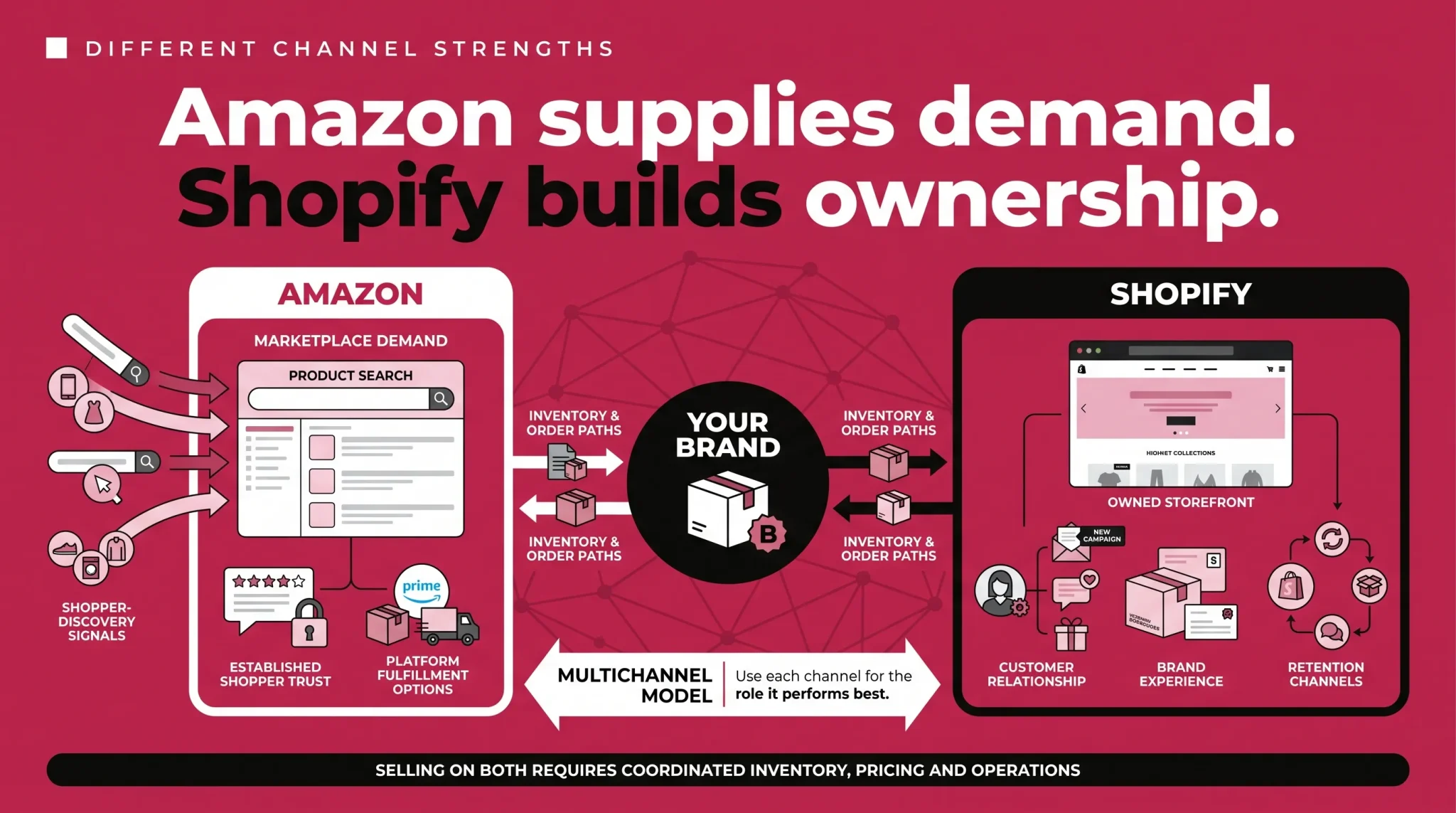
Before getting into the reasoning, here is the shape of the tradeoff. Read it as a comparison of operating models, not a scoreboard.
What you are deciding | Amazon (marketplace) | Shopify (owned store) |
|---|---|---|
Demand | Built-in shopper traffic you tap into | Demand you generate yourself through SEO, ads, email, and social |
Storefront control | Amazon's layout, limited by their format | Your design, domain, and full checkout experience |
Customer relationship and data | Controlled by Amazon, communication restricted to permitted purposes | More direct access through your store, with the responsibility that comes with it |
Cost shape | More visible per-sale marketplace fees, less demand-generation cost | Lower visible platform fees, but you fund customer acquisition |
Fulfillment | FBA, merchant fulfillment, or Amazon fulfillment tools | Self-fulfillment, a third-party logistics provider, or Amazon fulfillment for Shopify orders |
Marketing responsibility | Compete for visibility inside Amazon | Own the entire funnel from discovery to repeat purchase |
None of those rows names a winner. Each one is a job you either take on or hand off, and the right column depends on which jobs you are equipped to do well.
Marketplace economics and owned-store economics are two different systems
The reason a straight comparison misleads people is that Amazon and Shopify sit on top of different economic engines. On Amazon you borrow demand. Shoppers are already there, searching with intent, and your product can appear in front of them almost immediately. In exchange, Amazon controls discovery, holds the customer relationship, and charges you for access to that demand on every sale. On Shopify you build demand. Nobody arrives at your store by accident, so you pay, in money and effort, to bring them there. In exchange, you keep control of the experience and a more direct line to the customer.
Amazon rents you a place in an existing stream of demand and keeps the customer relationship. Shopify sells you the infrastructure to own the relationship, on the condition that you create the demand yourself.
That distinction shows up most sharply in how the customer relationship works, and it is worth being precise rather than repeating the usual shorthand. It is not accurate to say Amazon owns the customer and Shopify sellers own the customer. The real difference is one of control and access. Amazon controls the marketplace transaction and customer relationship. Seller communications are restricted to permitted purposes and Amazon-approved channels, and sellers cannot use order data to divert buyers to an external store. Amazon's Seller Code of Conduct is explicit that sellers may not circumvent the Amazon sales process or route customers to another website, and that customer information provided to fulfill an order is limited to fulfilling that order.
On Shopify, a merchant generally has more direct access to customer information collected through its own storefront and more control over retention channels such as email. That access is not unlimited ownership. It remains subject to customer consent, privacy law, Shopify's terms, payment-provider rules, app permissions, and the merchant's own privacy disclosures. And more access comes with more responsibility: consent, data security, lawful marketing, retention, deletion requests, app access, and cross-border data handling all become your job. So the honest framing is controlled marketplace access versus a more direct merchant relationship, not Amazon ownership versus unrestricted Shopify ownership.
There is one more nuance in Amazon's model that matters for anyone thinking about traffic. While Amazon restricts diverting customers off its platform, it does not stop you from sending traffic toward Amazon. Sellers cannot use listings, packaging inserts, customer contact details, or Buyer-Seller Messaging to pull an Amazon customer into an external transaction, but they can intentionally drive outside traffic to their Amazon listings. Eligible advertisers can even measure that external traffic with Amazon Attribution. The point is directional: on Amazon, traffic is allowed to flow in but not out.
What each operating model actually asks of you
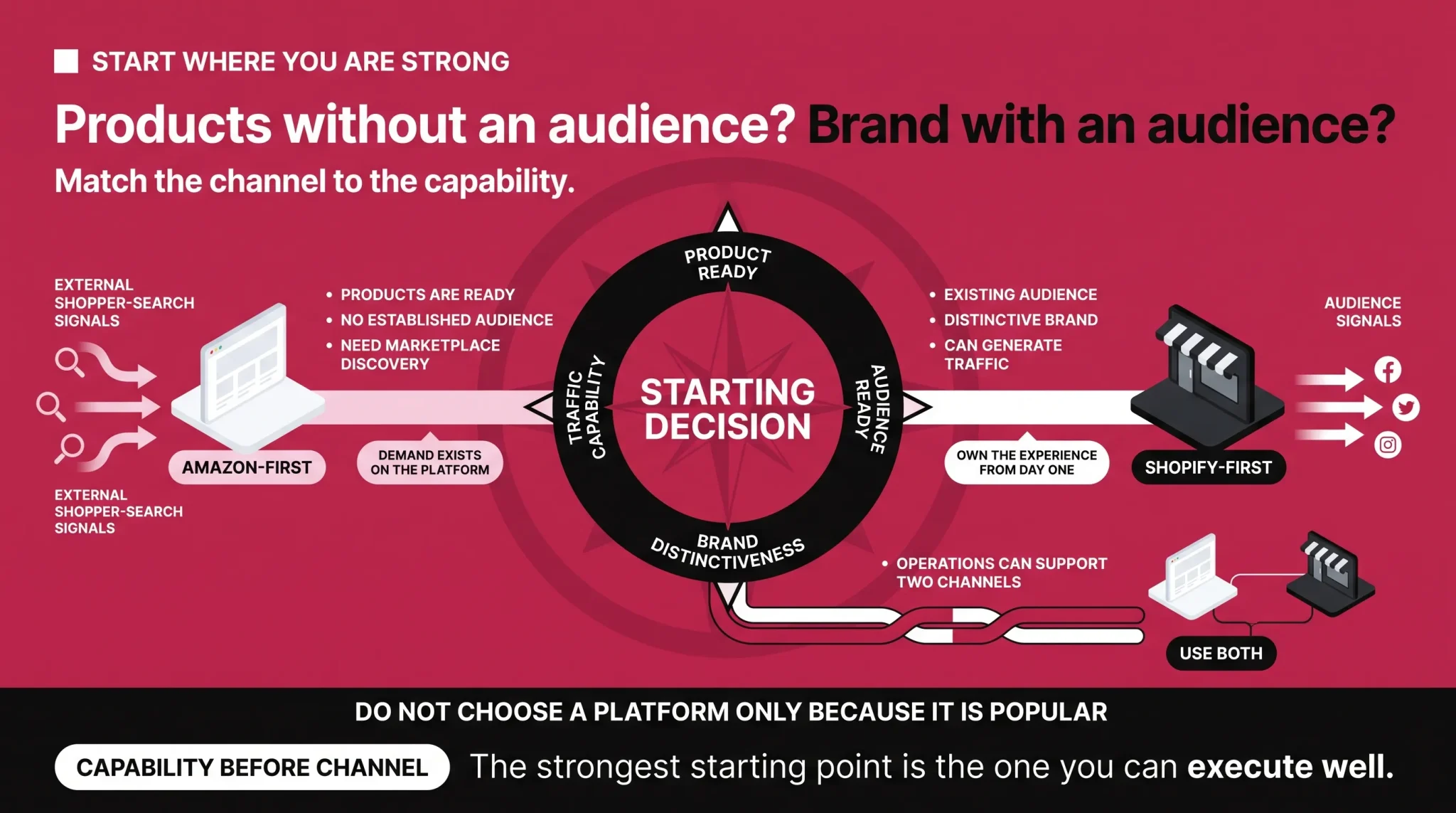
Because the two platforms hand you different jobs, they demand different capabilities. Choosing well means being honest about which of these you can staff, fund, and sustain.
Selling on Amazon rewards operational and retail discipline. You need listings that are retail ready and built to convert, competence with Amazon advertising because visibility inside the marketplace is contested even with built-in demand, tight control of fees against margin, and consistent policy compliance so your account stays healthy. The demand is there, but standing out among similar products and protecting your unit economics is the daily work.
Running a Shopify store rewards marketing and brand capability. You have to generate demand through search, paid media, email, and social, convert that traffic on a store you are responsible for optimizing, own fulfillment decisions end to end, and manage a stack of apps, themes, and integrations that make the store work. The control is real, but so is the burden of being the only reason anyone shows up.
A simple gut check: if your strongest muscle is sourcing good products and operating efficiently, Amazon plays to it. If your strongest muscle is building an audience and a brand people seek out, Shopify plays to it. Most businesses are stronger at one than the other, and that imbalance is a legitimate input to the decision.
The real cost comparison is about margin, not monthly fees
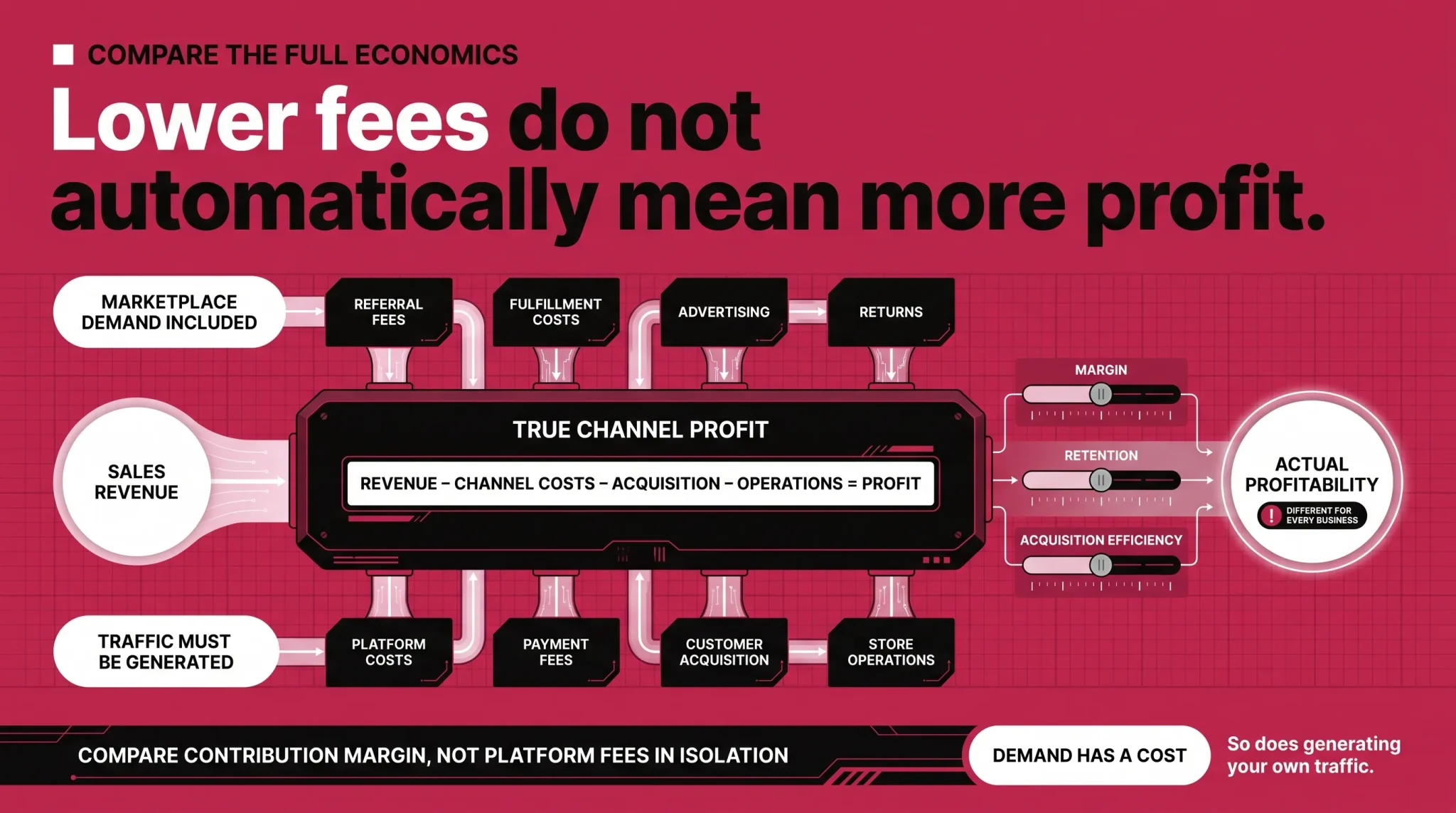
The fastest way to make a bad channel decision is to compare subscription prices. What actually decides profitability is contribution margin after every cost of operating that channel, and the cost structures are shaped very differently.
On the platform side, Amazon uses two selling plans in the US. The Individual plan currently costs $0.99 per item sold plus applicable selling fees, and the Professional plan currently costs $39.99 per month plus applicable selling fees, based on Amazon's US selling plans and fees as of July 2026. The Professional plan is what provides advanced selling tools such as bulk listing, advertising access, and reporting. It is worth clearing up a common mix-up here: the Professional plan does not grant Amazon Brand Registry. Brand Registry eligibility is separate and based primarily on brand and trademark requirements, a brand owner can even enroll without selling on Amazon, and some brand-building tools then require an eligible linked selling account with the correct roles.
On top of the plan, Amazon charges a referral fee on each sale. There is no single universal referral percentage. Referral fees vary by product category, selling price, fee tier, and an applicable per-unit minimum. Many everyday categories sit at 15% of the total sale price, while consumer electronics is lower at 8%, apparel is tiered from 5% up to 17% depending on price, and some accessory categories run much higher, all subject to a US minimum of $0.30 per item as of July 2026. One quiet advantage often missed: Amazon's referral fee includes payment processing, so you are not paying a separate card-processing fee on top.
Shopify's costs stack differently. Its US plans as of July 2026 are Basic at $39 per month billed monthly or $29 per month billed annually, Grow at $105 or $79, and Advanced at $399 or $299, with Plus starting at $2,300 per month under its own terms, per Shopify's pricing page. Those are US prices, and Shopify pricing and features vary by region, so they should not be applied globally. The subscription is only the visible layer. If you use Shopify Payments you pay the card processing rate, and if you use a third-party gateway Shopify adds its own transaction fee on top. The larger cost on Shopify usually is not the plan at all. It is customer acquisition: the ads, content, email, and creative work required to bring shoppers to a store that has no built-in traffic.
That is the central distinction to hold onto:
Amazon can charge more visible marketplace fees while reducing part of the demand-generation burden. Shopify can have lower visible platform fees while requiring the merchant to fund and operate customer acquisition.
A complete comparison has to weigh both columns against each other: platform or selling-plan fees, referral or transaction fees, payment processing, fulfillment and storage, returns and refunds, advertising and customer acquisition, apps and themes and development and maintenance, creative and conversion work, staff or agency costs, discounts and promotions, the economics of repeat purchases and retention, and the cost of splitting or pooling inventory across channels. Neither platform is universally cheaper or more profitable. A brand with strong retention and high repeat-purchase value may earn far more from an owned store over time, while a brand that lives on one-off discovery purchases may struggle to justify the acquisition cost that Shopify demands and do better tapping Amazon's existing demand.
Fulfillment as a business decision
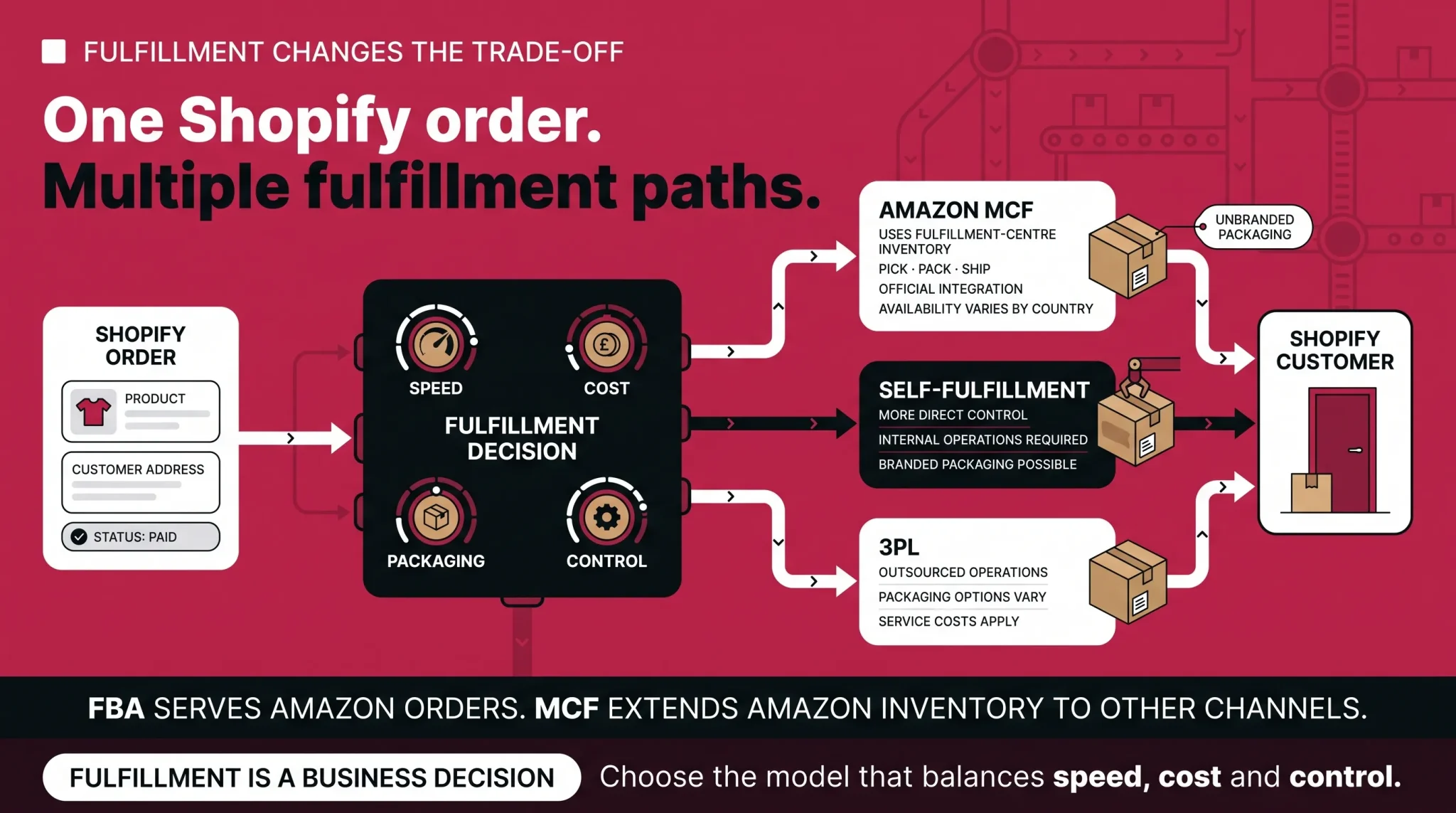
Fulfillment deserves attention at the decision level, not as a fee spreadsheet. The options break down into a few paths: FBA for Amazon orders, merchant fulfillment for Amazon, self-fulfillment or a third-party logistics provider for Shopify orders, Amazon Multi-Channel Fulfillment for Shopify orders, and Buy with Prime where you are eligible.
What actually differs between these choices is operational, and that is where the decision lives. Inventory pooling versus separate stock changes how much buffer you carry and how often you run out on one channel while sitting on stock for another. Delivery speed affects conversion and customer expectations. Branded versus unbranded packaging affects the experience a customer gets when they open the box, which matters more for an owned brand than for a marketplace sale. Returns ownership, stock synchronization, order routing, fulfillment dependency on a single provider, international availability, and overall operational complexity all move depending on the path you pick.
The most important thing to avoid is assuming that using Amazon's fulfillment for your Shopify orders makes the two channels identical. It does not. You can share a logistics engine and still be running two different businesses with different demand sources, different customer relationships, and different economics on top. Fulfillment is a shared service you can plug in, not a merger of the two channels.
Choosing your path by situation
There is no universal answer, but there are clear patterns. Here are five common situations, each ending with the operating reason behind the suggested direction rather than a blanket recommendation.
An Amazon private-label seller considering Shopify usually has the opposite of a demand problem and the opposite of a control benefit. They have sales but limited ownership of the customer and pressure on margin. Adding Shopify makes sense when they have the marketing capability, or the budget to buy it, to drive their own traffic, and when their product has enough repeat-purchase or brand potential to make owning the relationship pay off. The reason is that Shopify only rewards them if they can supply the demand Amazon was supplying for free.
A DTC Shopify brand considering Amazon typically has brand and audience but is leaving marketplace demand on the table. Adding Amazon makes sense when the product converts well against search intent and the brand can protect its pricing and listings inside a more commoditized environment. The reason is that Amazon accelerates discovery, but only for products that can hold their own without the surrounding brand experience the store provides.
An established offline retailer moving online often starts from a stronger position than a brand-new online seller. They may already have local awareness, supplier and inventory relationships, physical locations that can handle pickup and returns, in-store customer contact, local fulfillment capability, and real product expertise. For them, Amazon can provide national marketplace reach while Shopify provides an owned online experience that extends the existing brand, with local pickup or store fulfillment where supported. The decision hinges on coordinating inventory, keeping pricing and product information consistent, and not overselling across physical and online channels. The reason is that their existing assets reduce exactly the weaknesses that make online-only launches hard.
A new seller with no existing audience faces the demand problem in its purest form. Starting on Amazon lets them reach shoppers without first building a following, which shortens the path to a first sale. The reason is simply that borrowed demand is the fastest way to validate a product when you have no traffic of your own yet.
A brand with strong repeat-purchase potential and healthy retention economics is the clearest case for investing in an owned store. When customers come back and lifetime value is high, owning the relationship and the retention channel compounds in your favor rather than paying a marketplace fee on every reorder. The reason is that retention-heavy businesses capture the most value precisely where Shopify gives you the most control.
Using Amazon and Shopify together
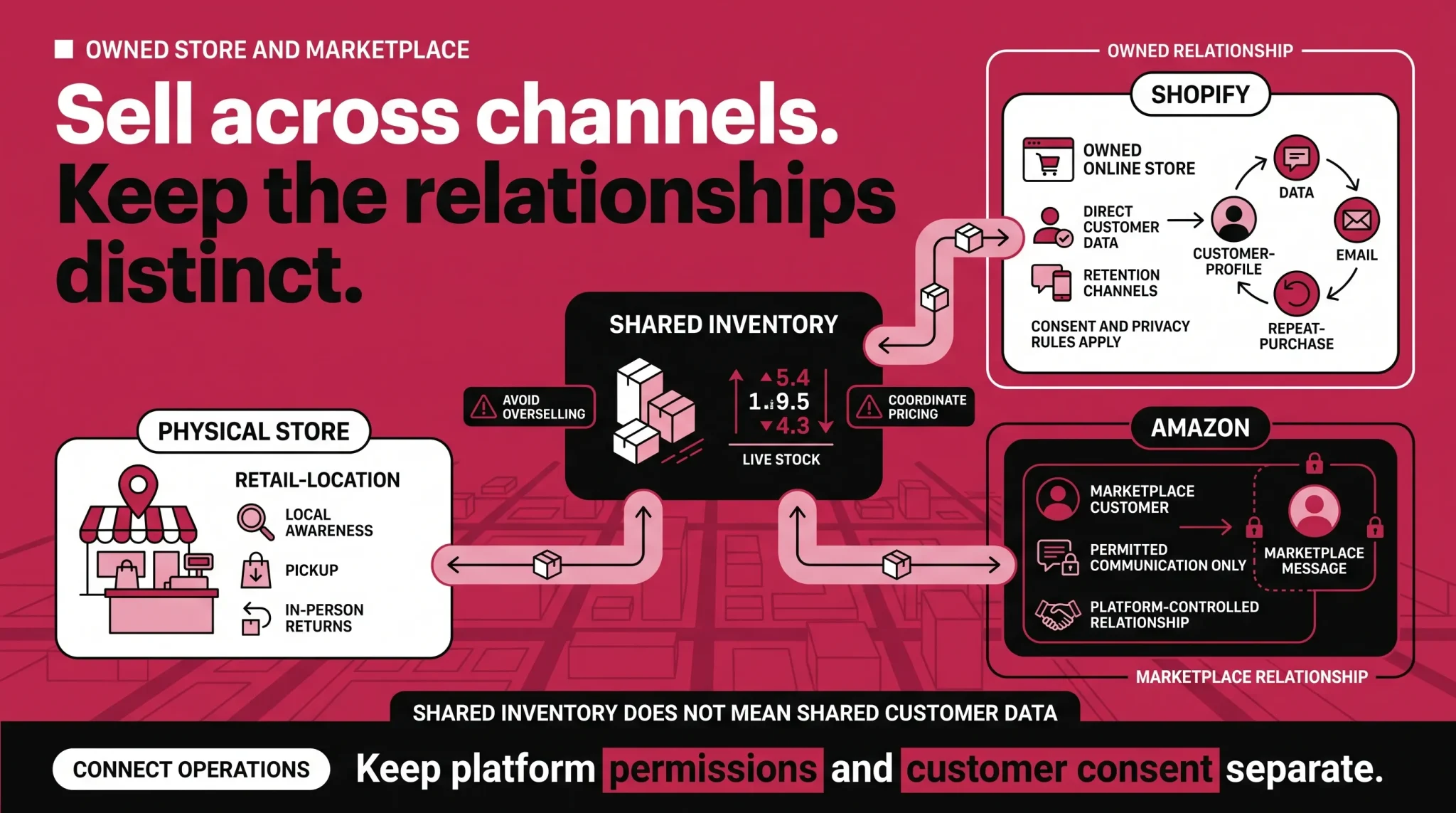
Running both is not a compromise. For many brands it is the point, because it pairs marketplace demand with an owned relationship. The practical questions are what actually connects, what stays separate, and where the official tools stop and third-party tools begin. This is a strategy question, not a setup tutorial, so here is what you need to decide well.
Yes, Shopify can connect to Amazon. Shopify Marketplace Connect is a Shopify-developed integration that can link eligible Shopify stores with supported marketplaces such as Amazon, and it can help manage listings, product information, inventory, pricing rules, orders, fulfillment settings, and tracking. It does not force Shopify to be the single mandatory source of truth for everything. The configuration can vary. For example, a merchant can turn off listing-detail synchronization and manage certain Amazon content directly on Amazon while still syncing inventory and orders. On pricing, Marketplace Connect is free to install, includes the first 50 marketplace-synced orders per month at no cost, then charges a 1% fee on additional synced orders capped at $99 per month, with marketplace, app, selling, and Shopify fees charged separately, as of July 2026.
Fulfillment is a different connection, and it is important not to lump it in with listing sync. The Amazon MCF and Buy with Prime app for Shopify is an Amazon-developed app used for fulfillment and, where eligible, Buy with Prime functionality. These are two capabilities, and they have different requirements.
Amazon Multi-Channel Fulfillment can fulfill your Shopify orders using inventory stored in Amazon's fulfillment centers, and it does not require you to actively sell those products on Amazon. It needs an eligible Amazon selling or supply chain account and fulfillment inventory, it can give you one inventory pool across Amazon and Shopify, its availability varies by country, and orders fulfilled through the official Shopify integration currently ship in unbranded packaging. Buy with Prime is narrower. It is currently a US-only feature that requires a US-based business entity along with applicable Amazon account, product, site, fulfillment, and policy eligibility, and it uses Amazon fulfillment for eligible orders. It is not automatically available to every Shopify merchant, and the exact route to enable it depends on your current setup and eligibility rather than a single fixed requirement. You can find current details on the Amazon MCF and Buy with Prime app and the Buy with Prime site.
Third-party apps enter the picture when the official integrations do not support a marketplace, workflow, routing rule, or catalog structure you need. They add capability but also add cost and another point of failure, so they are worth reaching for only when the native tools genuinely fall short.
One caution that applies to any of these connections: synchronization can create its own problems. If inventory is not synced reliably, you can oversell on one channel while another still shows stock, and messy or inconsistent product data will not fix itself through an app. The value of connecting the channels is real, but it depends on clean SKUs and careful configuration.
A staged roadmap for adding a second channel
Adding a channel works best in sequence, not all at once. Start where your current strength already lives, so the first channel funds and stabilizes the business. An operator with product and efficiency strengths and no audience usually starts on Amazon. A brand with an audience and a distinctive product usually starts on Shopify.
Prove the first channel before you split your attention. That means stable unit economics, a product that converts, and fulfillment you trust. A second channel added on top of a shaky first one tends to multiply problems rather than revenue.
Add the second channel to fix a specific limitation, not out of habit. If Amazon is squeezing margin and you have retention potential, add Shopify to own the relationship. If Shopify traffic is expensive and your product converts on intent, add Amazon to tap existing demand. Then connect the two deliberately, syncing inventory and orders first so you do not oversell, and layer in shared fulfillment only once the demand side is working. The sequence protects you from taking on the operational weight of two channels before either one is truly stable.
Are you ready for a second channel?
Before committing to run both, it helps to check readiness honestly. Treat these as signals, not a scored test.
Can you generate or fund demand for an owned store, or do you rely entirely on borrowed marketplace traffic today?
Does your margin leave room for marketplace fees, or for customer-acquisition costs, depending on which channel you are adding?
Do you have fulfillment capacity, or a reliable third-party provider, to serve a second channel without breaking the first?
Do you have the brand, creative, and conversion resources an owned store demands?
Do you have the policy and compliance bandwidth to keep an Amazon account healthy and handle customer-data responsibilities on Shopify?
Is your first channel actually stable, with predictable economics and fulfillment you trust?
If most of these are yes, running both is a real option. If several are no, the stronger move is usually to fix the gap or strengthen your first channel before adding the second.
Deciding your channel strategy
The choice between Amazon, Shopify, or both comes down to which operating model fits your product, your margins, and the strengths you can actually staff. If you want help pressure-testing that decision, or operationalizing whichever path you choose, Flairox works on both sides of it: marketplace growth and advertising on the Amazon side, and owned-store design and development on the Shopify side. Book a call and we will map your situation to the right channel setup.
Frequently asked questions
Yes. Many brands run both, using Amazon for marketplace demand and Shopify for an owned store. Shopify Marketplace Connect can link the two so you manage listings, inventory, and orders from your Shopify admin.