 Bilal Siddiqui
Key takeaways
Selling on Amazon Canada can mean testing demand remotely or building a local Canadian operation. Each route carries different costs, compliance duties, tax exposure, and return requirements.
Existing Amazon.com sellers may already have access to Amazon.ca through a unified North American account. Remote Fulfillment is a fulfillment option—not a requirement for marketplace access.
Remote Fulfillment with FBA is useful for low-risk demand testing, while local Canada FBA offers faster domestic delivery but requires inventory imports, an importer of record, customs planning, and a Canadian removal address.
Selling on Amazon Canada can be as light as activating eligible offers from an account you already have, or as involved as importing inventory, registering as an importer, and rebuilding your packaging to meet Canadian label law. Both are called "selling on Amazon.ca," and they are not the same business.
The correct setup depends on where your business is established, where inventory will sit, who takes legal responsibility for importing it, and how fast Canadian customers need to receive it. So the first decision is not which button to click. It is this: are you testing Canadian demand using inventory you already own, or building a domestic Canadian inventory and compliance structure? Cost, tax exposure, labeling risk, and return workflow all follow from that answer.
Test Canada Remotely or Build a Local Operation?
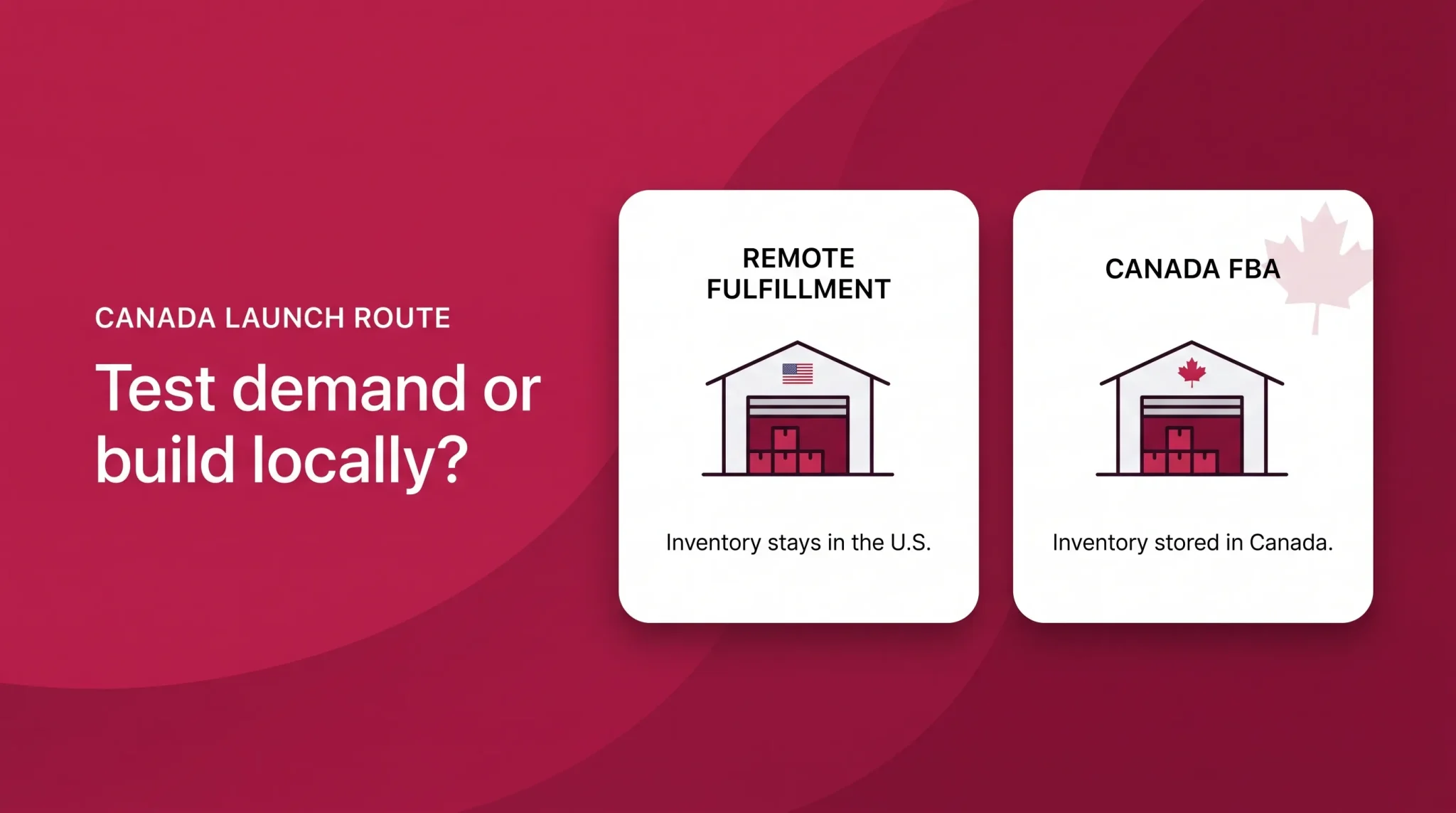
There are four practical routes into Amazon.ca, each producing a different set of obligations. A Canadian seller operating domestically fulfills through Canadian FBA or its own shipping. An existing Amazon.com seller using Remote Fulfillment with FBA keeps inventory in U.S. fulfillment centers and serves Amazon.ca across the border, with the customer acting as importer of record. A U.S. or international seller importing into Canada FBA moves inventory into the country and becomes, or appoints, the importer of record. A seller fulfilling Amazon.ca orders directly carries delivery performance, customer service, returns, and any customs arrangements itself.
Launch route | Where inventory sits | Importer and tax handling | Delivery and returns | Best use | Main risk |
|---|---|---|---|---|---|
Remote Fulfillment with FBA | U.S. fulfillment centers | Customer is importer of record and pays applicable import duties, taxes, and fees | Amazon handles fulfillment, service, and returns; returns go back to the U.S. | Testing Canadian demand without local inventory | ASIN eligibility is limited and cross-border costs can remove margin |
Local Canada FBA | Canadian fulfillment centers | Seller or an appointed party is importer of record; DDP shipments required | Domestic FBA delivery and Amazon-handled returns; removals need a Canadian address | Proven demand that justifies domestic delivery speed | Inventory, customs, tax, and compliance commitment before revenue |
Canada-based FBM | Seller or provider location in Canada | Seller handles any import separately from the sale | Seller controls shipping and returns domestically | Sellers with existing Canadian operations or slow-moving stock | Delivery performance and return handling sit entirely with the seller |
Cross-border FBM | Outside Canada | Arrangements vary by shipment and Incoterm | Seller must offer a supported international return method | Low volume, oversized, or restricted items | Slow delivery, customs friction, and expensive returns |
You May Already Have Canada Access
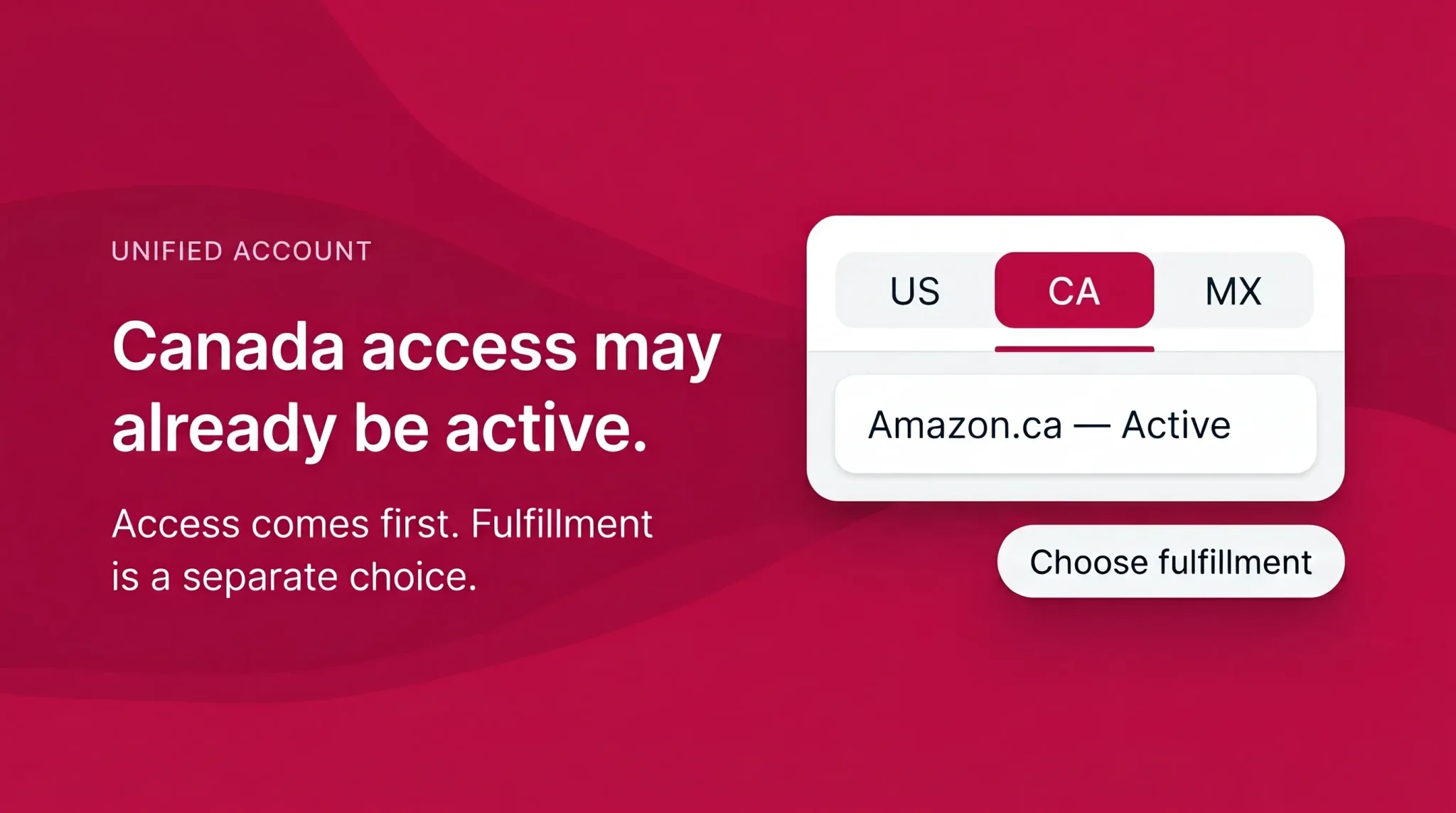
The most persistent piece of bad advice about Amazon Canada is that a U.S. seller needs Remote Fulfillment to use their existing account there, or that a separate Canadian account is required. Neither is accurate. Amazon's Amazon.ca pricing page states that new Selling on Amazon subscriptions include access to sell on Amazon.com, Amazon.ca, and Amazon.com.mx, with fees, categories, and selling requirements varying between the three. An existing Amazon.com Professional seller with an eligible North America and Brazil unified selling account can begin selling on Amazon.ca from that account. A new seller can create a unified North American account, or register through Amazon.ca where that route is offered.
Remote Fulfillment with FBA is a fulfillment program, not the source of marketplace access. The relationship runs the other way: Amazon lists the unified account as a prerequisite for enrolling in Remote Fulfillment, alongside a Professional plan and U.S. FBA enrollment with FBA Export enabled. Once Canada is active, you choose Remote Fulfillment, local Canada FBA, or FBM on eligibility and economics.
What account access does not do matters just as much. It does not produce buyable Canada offers, share inventory under every fulfillment model, carry category approvals across stores, resolve tax registrations, mirror account health, make listings compliant, or set a price that works in Canadian dollars. Amazon.ca remains a separate marketplace with its own offers, prices, fees, inventory availability, approvals, tax behavior, and performance data.
Selling Plans, Billing, and Registration Expectations
As published on Amazon.ca as of August 2026, the Individual plan is CAD 1.49 per item sold plus applicable selling fees, and the Professional plan is CAD 29.99 per month plus applicable selling fees. Confirm both on the Amazon.ca pricing page and use the Canada Revenue Calculator for product-level numbers rather than working from a fee table.
What an existing unified-account seller is actually billed is a separate question, and it can depend on where the account was originally registered, your selling plan, your regional account structure, which stores are active, and Amazon's current billing rules. Do not assume you will pay CAD 29.99 on top of an existing U.S. subscription, and do not assume you will pay nothing extra. Check your own account.
Registration requirements vary by seller type and country, so expect categories of information rather than a fixed list: government-issued identification, business or individual details, a business address, contact information, a deposit account, a chargeable credit card, tax information, beneficial-owner or representative details, and possibly identity, address, or video verification.
Four things are commonly presented as requirements and generally are not, at least for activating Amazon.ca: a Canadian corporation, Canadian residency, a Canadian bank account, and a Canadian Business Number. None of these is automatically part of Amazon seller-account registration.
They become relevant for a different reason. Importing inventory, acting as importer of record, storing inventory in Canada, carrying on business in Canada, your tax-registration facts, and your entity structure can each create a requirement for a Business Number, an RM import account, CARM registration, tax registration, or a Canadian legal presence. The trigger is your operating model, not switching on a marketplace, and where your situation sits is a question for a qualified Canadian adviser.
Is the Product Right for Amazon.ca?
A product that performs on Amazon.com does not automatically belong on Amazon.ca. Canada has a smaller population spread across a larger area, with different climate, different regulation, and a bilingual consumer market, so demand does not scale down neatly. Before activating anything, work through Amazon.ca demand and local competition, the CAD price range buyers accept, category and ASIN eligibility, Remote Fulfillment eligibility, and whether local FBA economics survive at Canadian volumes. Then the physical realities: size and weight against fulfillment cost, customs duties on your classification and origin, product safety requirements, bilingual labeling burden, Quebec exposure, return rate, seasonality, climate suitability, Canadian compatibility for anything electrical or standards-dependent, and how much inventory depth demand justifies.
One caution deserves its own sentence. A smaller field of competitors does not guarantee better ranking, lower advertising cost, higher conversion, faster reviews, or better profitability. Fewer competitors often reflects thinner demand, and thin demand plus higher fulfillment cost is worse than a crowded category with real volume.
Localizing the Listing, and What That Does Not Cover
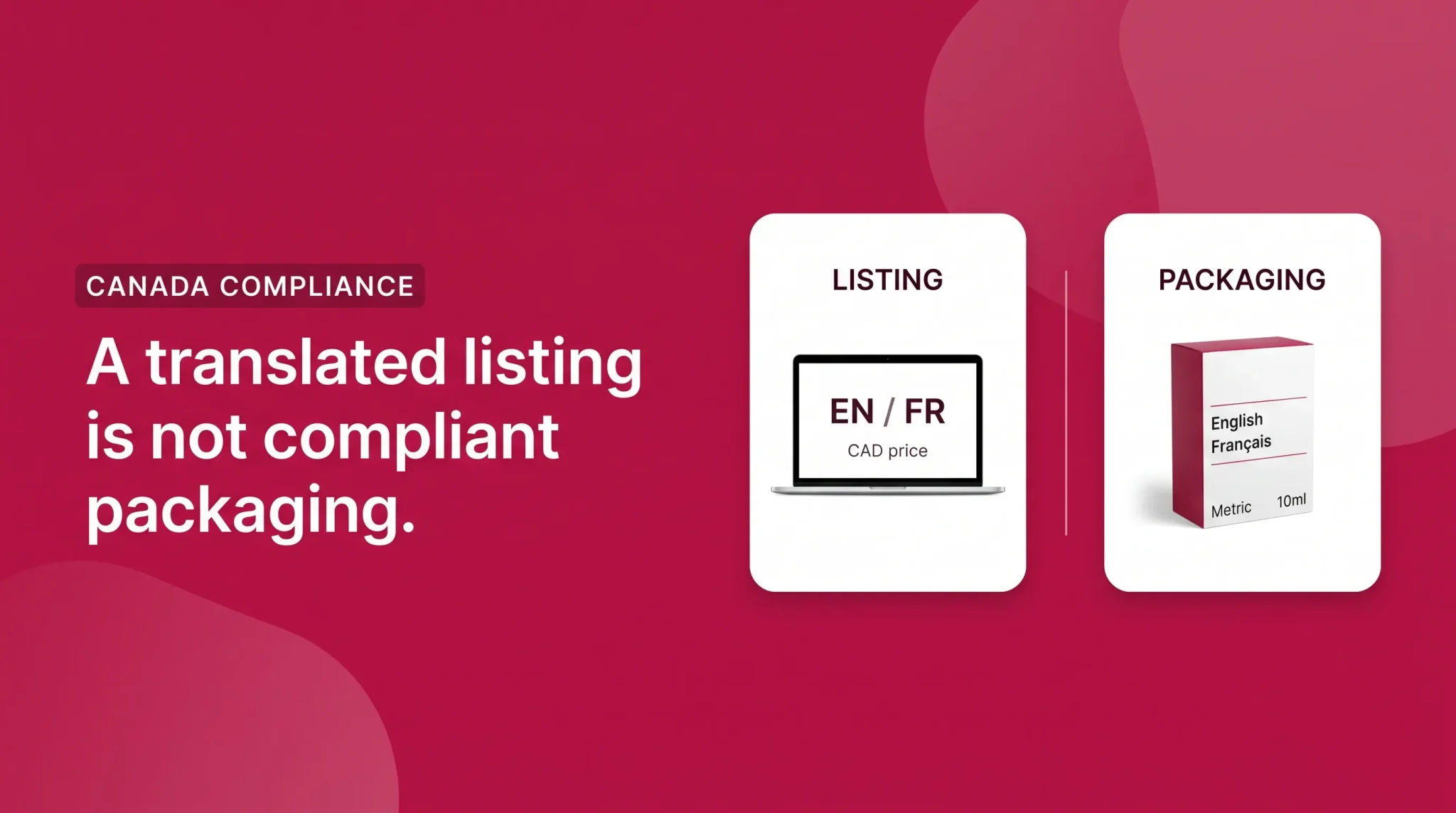
Canadian localization is not a spelling pass. On the listing side it can include Canadian English, French where useful or required, metric measurements, Celsius where relevant, CAD pricing, Canadian size conventions, voltage and electrical standards, compatibility statements, Canadian model numbers, warranty scope, seasonal timing, the search language Canadian shoppers use, text baked into images, and realistic delivery expectations.
Physical product and packaging compliance is a different exercise governed by law rather than conversion rate. It can involve mandatory product identity, net quantity, dealer information, English and French requirements, category-specific labels, safety warnings, instructions, certifications, and additional Quebec requirements.
The distinction matters enough to say directly: translating an Amazon.ca detail page does not make non-compliant physical packaging compliant. Language requirements that attach to the product attach to the product, wherever the listing sits. Detail page content requirements should be verified against Amazon's current policies and applicable law rather than assumed to demand a fully bilingual page.
Set review expectations early. U.S. reviews do not automatically become your Amazon.ca rating count. Amazon may display eligible verified-purchase reviews from other country stores for active brand-registered products with consistent brand data, but display varies by store, catalog structure, brand data, variations, and Amazon's systems. You cannot transfer reviews manually, and Brand Registry does not guarantee matching counts.
Remote Fulfillment with FBA
Remote Fulfillment with FBA, previously known as NARF, lets eligible U.S. FBA inventory serve Amazon.ca customers without moving units into Canada. Offers appear on Amazon.ca while the stock stays in U.S. fulfillment centers.
The program currently requires an eligible Professional selling plan, a North America and Brazil unified account, U.S. FBA enrollment, and FBA Export enabled. Enrollment sits under Inventory in Seller Central. Amazon handles export logistics, fulfillment, customer service, and returns for program orders, and returns go back to the U.S. under the applicable FBA returns policy.
The import mechanics are what sellers get wrong in both directions. Under the program the customer acts as importer of record and pays applicable import duties, taxes, and fees, which genuinely removes the seller from the import transaction. It does not follow that a Remote Fulfillment seller has no Canadian obligations at all. Product compliance, restricted-product rules, and your own tax and reporting position are separate matters the program does not resolve.
Eligibility is decided at the ASIN level. A product must be FBA-enabled in the U.S. with a valid offer in the destination store and meet trade compliance and destination-country regulations, and restricted products, prohibited products, dangerous goods, and non-compliant products may be excluded. After enrolling, generate an ASIN Eligibility Report from the Remote Fulfillment section to see what qualifies and to enable or disable individual products.
Costs follow the destination store: Remote Fulfillment fees and the Amazon.ca referral fee apply in place of the U.S. equivalents. Cross-border fulfillment generally costs more than domestic, so a price that works in the U.S. can fail in Canada.
Consider an established U.S. FBA brand with a proven ASIN. Remote Fulfillment lets it test Canadian demand before committing a unit of inventory or a dollar of customs exposure. If offers convert and margin holds after program fees, the case for local inventory writes itself.
What Build International Listings does and does not do
Build International Listings can create eligible offers where the ASIN already exists in the destination catalog, attempt to create or translate detail pages, apply target-store pricing rules, adjust for currency movement, and synchronize eligible offer changes from the source store.
Its limits matter more. It does not guarantee a detail page will be created, does not establish legal compliance, does not make an ineligible product eligible, and does not synchronize every inventory structure. You still review content, category and approval status, compliance, variations, price, and delivery promise on the offers it produces. One operational detail catches people out: manually changing a target-market ASIN price can break its connection with the source store, so the automatic rule stops applying until you reconnect it.
Local Canada FBA
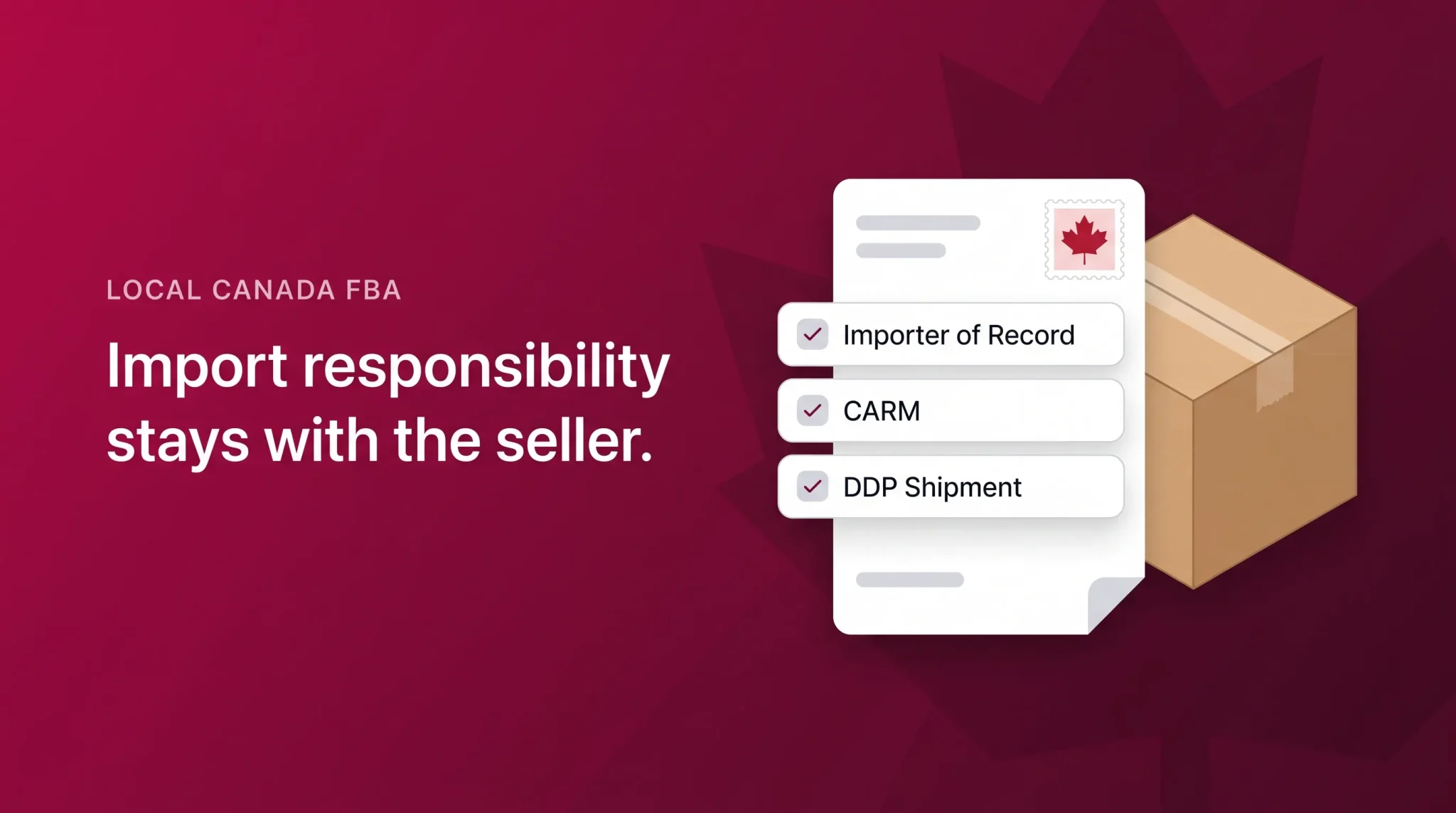
Local FBA puts inventory in Canadian fulfillment centers, which is what produces domestic delivery treatment. Getting it there is where the obligations start.
The seller, or an eligible appointed party, must act as importer of record. Amazon and its fulfillment centers will not. The importer is responsible for tariff classification, country of origin, customs value, duties, taxes, documentation, and legal compliance at entry, and that liability does not end once goods are released. A freight forwarder or customs broker does not automatically become importer of record by handling the shipment; that has to be an actual arrangement agreed in advance.
Shipments to Amazon fulfillment centers must move on Delivered Duty Paid terms. Amazon will not accept collect duties, taxes, or shipping charges, and a shipment can be refused or returned when importer information or charges are unresolved.
One more constraint catches non-resident sellers late. Amazon Canada generally cannot send FBA inventory back to an address outside Canada, so aged, unsellable, or excess stock has to go somewhere in Canada. Arrange a supported Canadian removal destination before you place meaningful inventory into Canada FBA. Local FBA can materially improve the customer experience, and it also creates Canadian inventory, tax, customs, compliance, and cash-flow questions that Remote Fulfillment does not.
Seller-Fulfilled Amazon.ca Orders and Returns
If you fulfill Amazon.ca orders yourself from outside Canada, the return path decides whether the route is viable.
For seller-fulfilled international orders, you generally need to provide one of the supported return methods: a valid return address in Canada, a prepaid return label when the product must be returned internationally, or a full refund without requiring the return where appropriate. A buyer should not be left paying international return shipping when the return travels outside the store country under the applicable policy.
Use tracking on prepaid labels, and remember that returned goods can carry customs obligations on the way back. Do not plan on returnless refunds as a general policy; they are one option among three. FBA orders follow Amazon's applicable FBA return process instead.
Importer of Record, Business Number, RM, and CARM
If you are importing into Canada, for FBA or your own warehouse, there is a registration sequence to understand before you book freight.
A commercial importer needs a nine-digit Business Number before registering for an import-export RM program account. RM registration and customs-account administration are handled through the CBSA Assessment and Revenue Management system, known as CARM. Certain non-resident businesses need to obtain the Business Number through the Canada Revenue Agency first, then complete RM enrollment.
Beyond registration, what applies depends on your setup. CARM enrollment, delegated broker access, payment arrangements, and financial-security requirements vary with the importer's structure. Financial security is relevant when the importer wants Release Prior to Payment privileges, which allow goods to be released before duties and taxes are settled, and it is not universal in every arrangement.
Two cautions. Employing a customs broker does not transfer importer liability; the broker files on your behalf and you remain accountable. And the duty you owe depends on classification, origin, and customs value rather than a country-level headline rate. For the landed-cost and duty framework in full, see our Amazon Seller Finance, Tax & Tariffs Guide.
Consider a non-resident seller importing into Canada FBA. Before the first shipment that seller needs a Business Number, RM enrollment through CARM, a decision on financial security, a broker relationship, compliant labeling, a landed-cost model that survives duty, and a Canadian removal destination. None of it is prohibitive, but all of it takes time.
Canadian Taxes and Marketplace Tax Collection
Canada does not have one sales tax, and treating it as though it does is how sellers end up with unexpected registrations. The concepts that stay separate are GST and HST, Quebec's QST, provincial sales tax in British Columbia and Saskatchewan, Manitoba's retail sales tax, Amazon's Marketplace Tax Collection, Amazon's Tax Calculation Service, import GST paid at the border, and income tax. Different authorities, different questions.
Whether you need to register, and where, can depend on residency, whether you are carrying on business in Canada, inventory location, fulfillment model, whether you are already registered, whether you sell outside Amazon, the province, Canadian revenue, and other Canadian activity. A CAD 30,000 figure circulates widely in Canadian tax discussion; it is one fact among several rather than a rule that settles anyone's position. Not every seller must register at that level, and not every seller below it is exempt.
Marketplace Tax Collection is what most sellers encounter first. Where the rules apply, Amazon may calculate, collect, and remit certain Canadian taxes on marketplace transactions. What happens in a specific account differs according to whether you supplied a standard GST/HST number or a QST number, whether you are registered under a normal or non-resident regime, ship-from and ship-to locations, the province, product taxability, fulfillment model, and the applicable rules.
A standard GST/HST registrant can remain responsible for tax calculation and remittance on its Amazon.ca sales. In other circumstances Amazon may be responsible for collecting and remitting as the marketplace operator. Tax Amazon collects and remits directly is different from tax collected through Tax Calculation Services and passed to you to remit. Marketplace collection covers qualifying Amazon transactions and does not resolve tax on your own website, wholesale, or other channels, and none of it is income-tax compliance.
On recovery, be careful with confident claims. A seller registered under the applicable normal GST/HST regime may be able to claim input tax credits for eligible GST or HST paid on imports and business expenses where the legal, documentary, and use requirements are met. That matters in the registration decision, particularly for importers paying GST at the border, but it is not automatic. Review your position with a qualified Canadian tax professional.
Federal Bilingual Labeling
Prepackaged non-food consumer products sold in Canada can be subject to the Consumer Packaging and Labelling Act, administered by the Competition Bureau for non-food products.
The requirements to check are these. Product identity generally needs to appear in English and French. Net quantity generally uses metric declarations with the applicable bilingual presentation rules. Dealer name and principal place of business requirements may apply. Exemptions exist, so the general rule is a starting point rather than the final answer for your item.
Two things this does not mean. It does not mean every piece of optional marketing copy must appear in both languages under this Act, and it does not mean this Act is the only label law you need to satisfy. Food, cosmetics, textiles, natural health products, medical products, and other regulated categories follow additional or separate legislation. Confirm which regime governs your product before you print anything.
Quebec French Requirements and Product Compliance
Quebec applies French-language requirements that go beyond federal bilingual-label rules, and federal compliance does not resolve them.
Information on products, packaging, and accompanying materials may need to be available in French under the applicable rules, and where French is required, information in another language must not be presented more favorably than the French. Since June 1, 2025, generic or descriptive elements contained within a recognized non-French trademark may also need to appear in French on the product or on a medium permanently attached to it. The business name and the product's commercial name can be treated differently from generic or descriptive wording, and instructions, warranties, and accompanying documents raise their own questions. Because the analysis turns on your exact packaging, trademark, category, and customer-facing material, sellers with Quebec exposure should obtain advice specific to their products. Official Quebec guidance is the authority.
Product safety sits alongside language. Before activating or importing an ASIN, identify the applicable Canadian regulator and the evidence you need to hold. Categories that commonly trigger requirements include cosmetics, food, natural health products, supplements, medical devices, children's products, toys, textiles, electronics, wireless devices, batteries, dangerous goods, chemicals, and pesticides. Amazon-side tools such as Manage Your Compliance, Compliance Reference, product-compliance requests, restricted-product policies, and category approval help you satisfy Amazon. They do not replace government compliance, and Amazon approving a listing is not a regulator clearing a product.
CAD Pricing and Contribution Margin
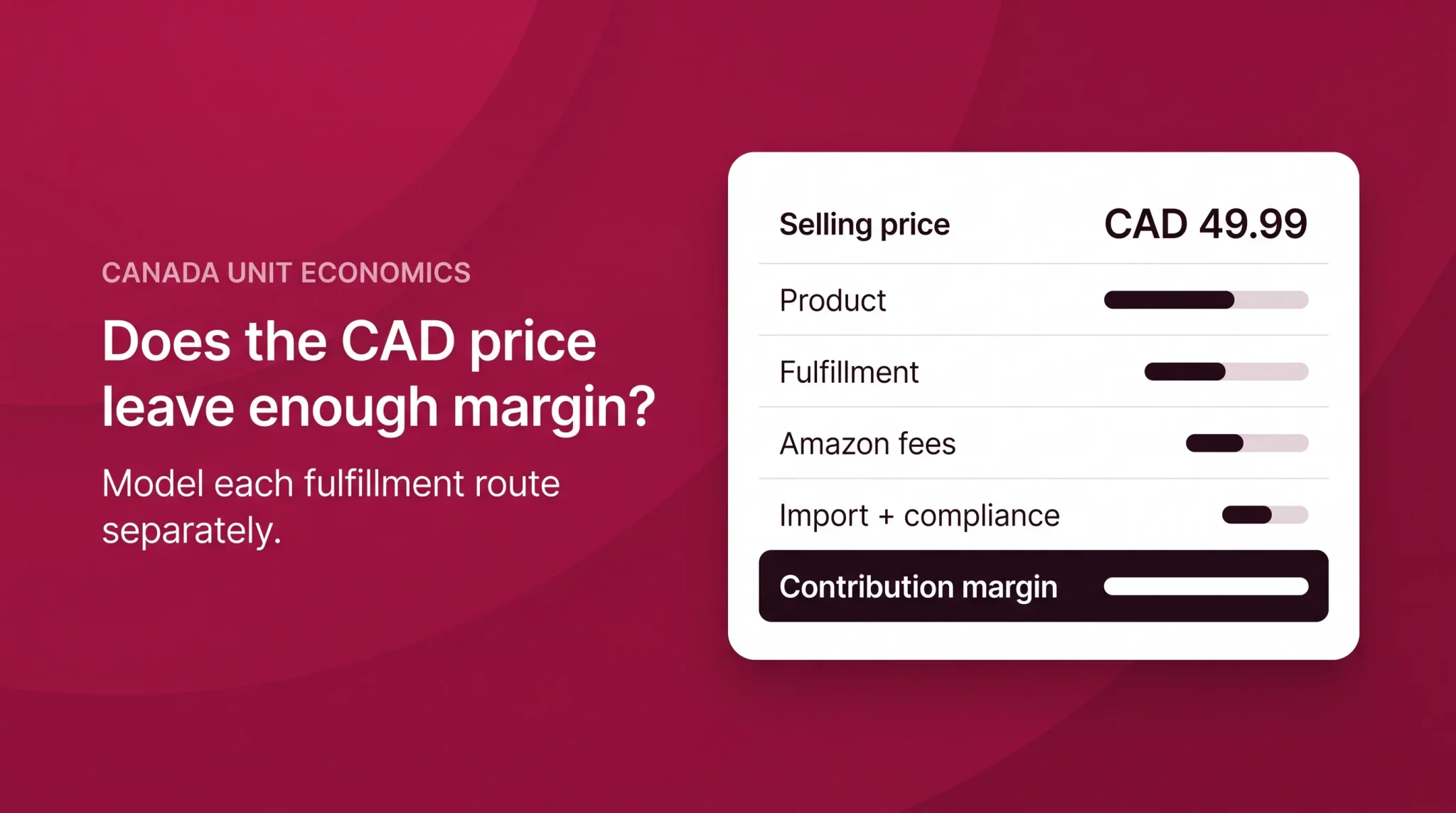
Amazon.ca prices are set in Canadian dollars, and a price converted mechanically from Amazon.com will rarely be both profitable and competitive. Use one framework and build it separately for each route you are considering:
Canada contribution margin = net CAD revenue - product cost - fulfillment - Amazon selling fees - advertising - returns allowance - import and compliance costs - currency conversion
Remote Fulfillment and local Canada FBA require separate models because the cost structures differ at almost every line. Import duties are not Amazon fees and belong in the import and compliance line. Import GST creates a cash requirement at the border even where later recovery may be available to a registrant. Currency movement can change home-currency profit while CAD margin looks unchanged, and Build International Listings pricing rules should be reviewed against this model rather than treated as a margin guarantee.
Consider a Canadian domestic seller. The model is simpler with no cross-border line, but the discipline is the same: CAD revenue, domestic fulfillment, referral fees, advertising, and returns still have to leave a margin worth reordering against, and category, tax, and bilingual requirements still need confirming before launch.
When Canada Is a Weak Fit
Canada is often described as the easiest first international marketplace. Sometimes it is. It is a poor first move when search demand for the category is limited, when Remote Fulfillment fees remove the contribution margin, when cross-border delivery cannot compete with domestic offers, or when local FBA would require more inventory than demand supports.
It is also poor when compliance is unresolved: labeling that is not Canada compliant, Quebec requirements you have not addressed, restrictions or permits you have not cleared, or duties that make the landed price uncompetitive. Add currency movement large enough to threaten margin, returns that cost more than the item, a missing Canadian removal solution, a product depending on U.S.-specific compatibility, and no access to tax or customs support. Two or three together is a reason to wait rather than improvise.
A Phased Canada Launch
Confirm Canada marketplace access on your existing or new account.
Validate demand and product eligibility on Amazon.ca specifically.
Confirm Canadian product and label compliance for the ASINs in scope.
Choose Remote Fulfillment, Canada FBA, or FBM.
Create or review your Amazon.ca offers, including content, category, and variations.
Set CAD pricing using the cost model for the route you chose.
Confirm importer, customs, and tax responsibilities before anything ships.
Start with a controlled remote or inventory test rather than a full commitment.
Monitor delivery, conversion, returns, advertising, and contribution margin.
Move to local Canadian inventory only when demand and economics justify it.
In the first weeks the checks that matter are Canada-specific. Watch the search terms Canadian shoppers actually use against the ones you assumed, CAD price against conversion, and delivery promise, which is the clearest difference between routes. Watch return reasons for compliance or expectation problems rather than defects, Remote Fulfillment eligibility, and currency and duty variance against your landed-cost assumptions.
Canada Launch-Readiness Checklist
Canada marketplace access confirmed in your own account
Selling plan and actual subscription billing understood
Amazon.ca demand and local competition checked for the specific ASINs
Category approvals and ASIN eligibility confirmed
Remote Fulfillment eligibility checked if that is the route
Fulfillment route selected and justified
CAD price modeled using the route-specific cost model
Referral and fulfillment costs confirmed on the Revenue Calculator
Importer of record confirmed in writing where inventory enters Canada
Business Number, RM account, and CARM position reviewed
GST/HST, QST, and provincial tax status reviewed with a professional
Marketplace Tax Collection settings and tax numbers reviewed in Seller Central
Product safety regulator and required evidence identified
Federal bilingual labeling and Quebec requirements reviewed
Return solution confirmed, including a Canadian removal destination for FBA
Contribution margin modeled and an initial test quantity set
This guide provides general educational information and is not tax, customs, accounting, or legal advice. Consult qualified professionals about your business and products.
Canada rewards sellers who pick the right route before they start. If you want a clear read on whether Canada fits your catalog, how Remote Fulfillment and local FBA compare on your actual margins, and where the catalog and compliance gaps sit before you commit inventory, Flairox can work through it with you. Schedule a call to plan a controlled Canada launch.
Frequently asked questions
Generally yes. An eligible North America and Brazil unified selling account can sell on Amazon.ca. Remote Fulfillment is a fulfillment program, not the source of access, and a separate Canadian account is not automatically required.