 Bilal Siddiqui
Key takeaways
Amazon sales, profit, disbursements, and available cash are different numbers. A profitable seller can still face a cash shortage because inventory, freight, duties, and advertising are paid before Amazon releases the proceeds.
Finance the complete cash cycle, not only the purchase order. Include supplier payments, shipping, customs, FBA receiving, Amazon reserves, refunds, and the next reorder.
Use contribution margin and inventory sell-through to evaluate reorders. Gross sales alone do not show whether a product generates enough profit and usable cash to support growth.
Financing works best for a temporary timing gap in an already profitable product. It should not be used to cover negative unit economics, unvalidated demand, or continuing operating losses.
An Amazon account can post its best sales month on record while the business runs short of cash. The sales are real, the margin calculation may be correct, and the bank balance can still be too thin to place the next purchase order.
That gap is timing, not an accounting mistake. Inventory is usually paid for months before it sells. Import duties are due at the border, before a single unit reaches a fulfillment center. Amazon holds a portion of completed order proceeds in reserve before releasing them. And a tax form arriving in January reports gross payments processed, not the profit the business actually earned.
Most sellers meet these three systems separately. Cash flow feels operational, financing feels like a banking problem, and tax and customs feel like paperwork. In practice they are one system, and the question that ties them together is simple. After paying for inventory, freight, customs, Amazon fees, advertising, financing, returns, and taxes, does the business still have enough contribution margin and usable cash to reorder?
This guide is general educational information for sellers operating in the United States store, with international considerations flagged where they change the answer.
Finance the Whole Cash Cycle, Not Just the Purchase Order
Sellers think about funding when a supplier invoice arrives, but the purchase order is one payment in a chain that runs for months. A deposit goes out before production starts, a balance payment often falls due before goods leave the factory, freight is billed in transit, and duties are assessed at entry. Domestic trucking, prep, and labeling follow, storage accrues while inventory waits, advertising starts before the first organic sale, and refunds claw back revenue afterward. Money comes back in one direction only, through Amazon, and later than the sale suggests. A seller who finances only the purchase order has funded roughly the first third of the cycle.
The Amazon Cash Cycle
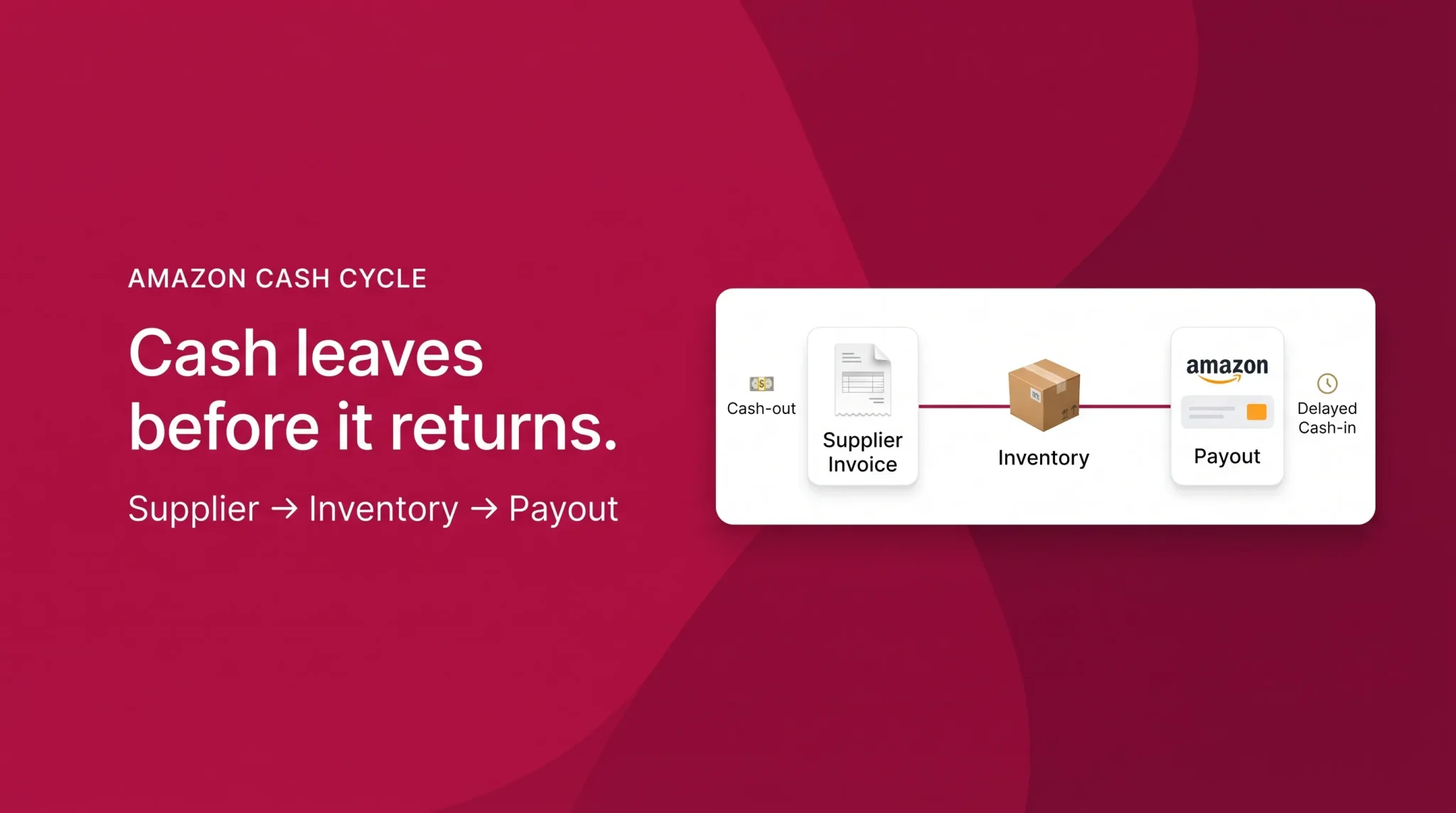
For an imported private label product, the interval between the first supplier payment and the first customer order is commonly measured in months. Cash returns when a customer buys, but not immediately. When an order ships, proceeds are recorded and then held. Amazon's standard policy holds funds in reserve until a set period after confirmed delivery, and the balance becomes eligible for disbursement once that period ends. Refunds, returns, chargebacks, and fee adjustments keep moving against the account after the sale, which is part of why the reserve exists.
So a profitable product can create a cash shortage. Profitability describes what a unit earns. Cash flow describes when the business can spend it, and a strong-margin product with a slow cycle can starve a business faster than a thin-margin product that turns quickly.
Gross Sales, Disbursements, Reserves, Profit, and Cash Flow
Sellers get into trouble when several different numbers get treated as interchangeable.
Gross sales are what customers paid before deductions, the largest number in the account and the least useful on its own. Deferred transactions are proceeds from shipped orders that have not yet moved into reserve or available balance, so they belong to the seller economically but cannot be spent. Reserve balance is the portion Amazon holds back, under the standard delivery date policy or as an account level reserve. An Amazon disbursement is what transfers to the bank after fees, refunds, reserves, and adjustments, which makes it a cash movement rather than revenue or profit.
Gross profit is revenue less product cost. Contribution margin is what remains after the variable costs of selling a unit, and it is the most useful number for a reorder decision. Net profit comes after broader operating expenses and financing costs. Cash flow is the timing of money entering and leaving, independent of all of the above. Taxable income depends on the entity, jurisdiction, and accounting method, and will not automatically match any figure above. Form 1099-K gross payments is a reported figure with its own definition, and it is not profit.
The Delivery Date Reserve and the Working Capital Gap
Amazon's standard reserve policy is based on delivery date. Funds from a completed order generally become available for disbursement seven days after confirmed delivery, commonly shortened to DD+7. Before that point, transactions subject to the policy may appear as deferred transactions.
Some qualifications matter. Amazon may extend the reserve period after reviewing account risk and historical performance. If valid tracking is missing, Amazon may use the latest estimated delivery date rather than a confirmed one, which lengthens the hold. Reserve handling differs between accounts and marketplaces, and many established accounts moved onto the standard delivery date policy during 2026, so older assumptions may no longer apply. A reserve is not by itself evidence of an Account Health problem, and no universal payout date applies to every seller. The reliable source is the Payments Dashboard in your own account.
The standard way to size the gap is the cash conversion cycle:
Cash conversion cycle = inventory days + payout days - payable days |
|---|
Amazon businesses need a more detailed model than this, because cash leaves at points the standard version does not anticipate. Deposits may be paid before production starts, final payment may fall due before goods ship, and customs and tariffs may be paid before inventory reaches a fulfillment center. FBA receiving delays the point at which units become sellable, reserve timing extends the payout side, and a reorder may be due before the current batch has sold, so two cycles overlap. There is no universally healthy target. A fast-turning consumable runs a very different cycle from a bulky seasonal product shipped by ocean freight.
Scenario one: proven replenishment ASIN
A seller has an established product with stable demand and predictable turns. The next supplier payment falls due before current sales become available for disbursement. Nothing is wrong with the product or the account, and the gap is purely timing. The decision rests on whether contribution margin stays healthy after the financing cost, whether the repayment schedule fits the sell-through rate, and whether the business could still service repayment if sales came in below forecast.
Amazon Seller Financing and Amazon Lending
Amazon seller financing covers any funding used to bridge the working capital gap, whether it comes through Amazon or from outside it.
Amazon Lending gives eligible United States sellers access to financing offers from third-party providers through Seller Central. The provider evaluates the application, supplies the financing, and enters into the financing agreement with the seller. That distinction matters and is widely misunderstood.
Availability is eligibility or invitation based, so check current offers inside your own Seller Central account rather than relying on secondhand summaries. As part of an application you may be asked to consent to sharing Amazon selling data with the provider. Available product types can include term loans, lines of credit, and merchant cash advances, though the mix changes.
Eligibility, rates, fees, repayment structure, personal guarantee requirements, collateral, and underwriting are all provider specific. Amazon does not guarantee approval, Amazon is not necessarily the lender, and provider availability changes over time. Any figure you read elsewhere about loan limits, rates, or funding speed should be treated as unverified until it appears in an actual offer. One misconception is worth clearing up: Amazon Lending has not been discontinued. Financing now comes from third-party providers rather than being underwritten in house, which several outdated guides reported as the program ending.
Financing Options and How to Compare Them
Outside Amazon Lending, sellers commonly consider bank term loans, financing backed by a government small business program, business lines of credit, merchant cash advances, revenue-based financing, inventory financing, purchase order financing, business credit cards, supplier terms, trade credit, owner equity, and retained earnings. Availability varies by country, entity type, and trading history, and the structural distinctions matter more than the marketing. A term loan provides a lump sum with a stated repayment term and a schedule of principal and financing cost. A line of credit provides a revolving limit where the business draws funds as needed and generally pays financing cost on the drawn amount. A merchant cash advance is repaid through agreed remittances connected to future sales or receivables, often priced using a fixed fee or factor-style cost rather than a conventional interest rate.
Merchant cash advances deserve particular care. They are not all legally identical, and structure differs by provider and jurisdiction. An advance is not cheap simply because no conventional interest rate is attached, and a factor rate should not be converted into an annual percentage rate without complete repayment timing. Real cost depends on how quickly remittances retire the balance, which depends on sales volume you cannot fully predict.
Financing type | How funds are accessed | Repayment structure | Main cost to compare | Main risk |
|---|---|---|---|---|
Term loan | Lump sum at origination | Scheduled payments over a set term | Total repaid, stated rate, origination fees | Fixed payments continue if sales slow |
Line of credit | Draw as needed up to a limit | Repay and redraw, cost on drawn balance | Rate on drawn funds, draw and maintenance fees | Limit can be reduced or reviewed |
Merchant cash advance | Lump sum advance | Remittances tied to sales or agreed schedule | Total repaid, fixed fee or factor cost | Effective cost rises when sales accelerate |
Supplier terms | Goods shipped before payment | Payment due on agreed terms | Discount forgone for delayed payment | Terms can be withdrawn under pressure |
Inventory or purchase order financing | Funds tied to specific goods or orders | Repaid as inventory converts to sales | Total cost against the financed goods | Slow-moving stock extends exposure |
Owner equity or retained earnings | Internal funds | No repayment obligation | Opportunity cost of the cash | Depletes the reserve that absorbs shocks |
The headline rate is the least informative number in any offer. What decides the outcome is the total repaid, all fees, term, payment frequency, whether a personal guarantee or collateral is required, how prepayment is treated, whether repayment continues during a stockout, whether the offer restricts your disbursement account, and the worst-case payment if sales fall below forecast.
When Financing Supports Growth and When It Hides a Problem
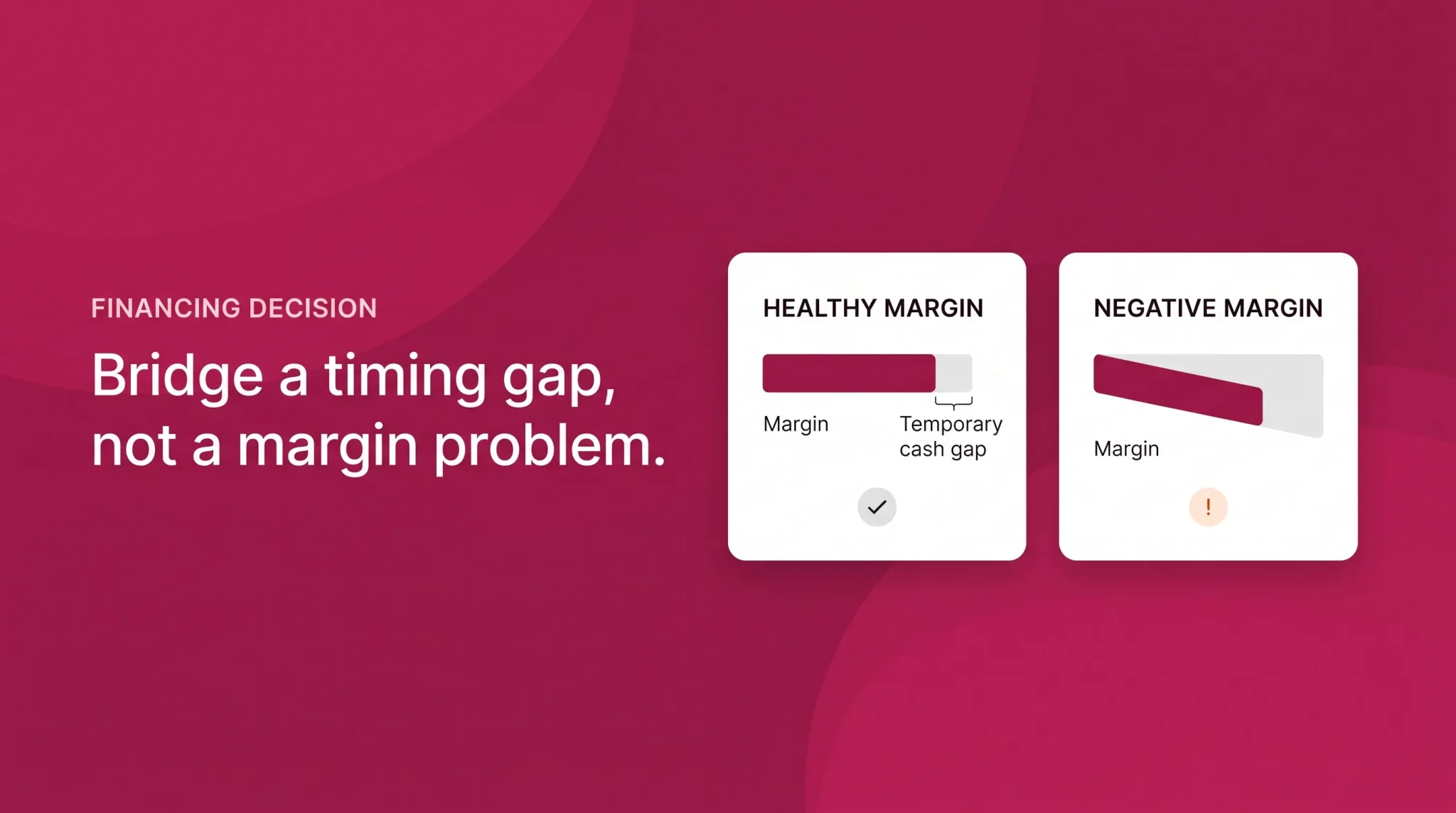
Financing is a timing tool. It works when the underlying economics already work.
It tends to support growth when demand is established rather than assumed, contribution margin stays positive after the financing cost, inventory turns are measured, reorder timing is predictable, the repayment schedule matches the cash cycle, and the model already accounts for tariffs, freight, returns, reserves, and advertising volatility.
It tends to be a weak fit when unit economics are already negative, inventory is not selling, the product is unvalidated, repayment begins before inventory can realistically generate cash, the plan depends on a best-case launch, a small duty increase would erase what margin remains, or borrowing is covering continuing losses rather than a timing gap.
None of this is a personal recommendation or a set of underwriting criteria. It is a way of testing whether the problem is a cash timing problem or a business model problem, because financing only fixes the first one.
United States Tax Reporting and Form 1099-K
Income tax reporting, sales and use tax, and customs duties are three different systems administered by three different sets of authorities. Satisfying one says nothing about the others, and conflating them causes most of the confusion in Amazon seller finance.
All sellers complete the tax identity interview in Seller Central with a valid taxpayer identification number. Documents including Form 1099-K, where issued, appear in the Tax Document Library under Reports, with electronic delivery subject to consent. Keeping that information current matters even for sellers who will not receive a form.
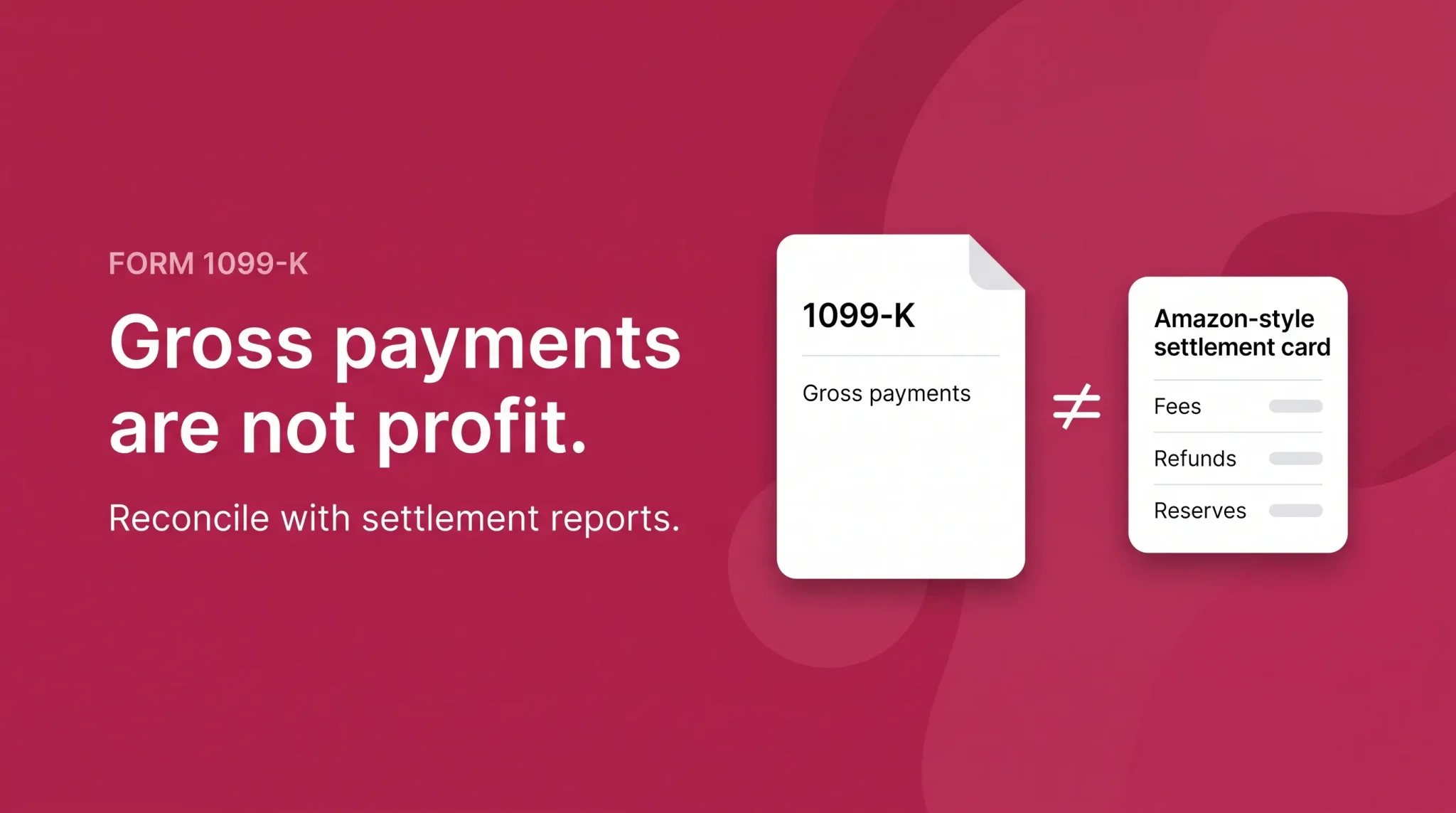
Form 1099-K itself is an information return filed by a payment settlement entity. It is not a calculation of your profit.
As of August 2026, the federal rule for third-party network transactions is that reporting is generally required when gross reportable payments exceed $20,000 and the number of transactions exceeds 200. Both conditions must be met before the federal filing requirement is triggered. Confirm the rule applicable to your tax year with the Internal Revenue Service or a qualified tax professional, because this threshold has moved several times and older articles still circulate with superseded figures.
Several qualifications sit alongside it. Payment card transactions can follow a separate reporting rule, a form may be issued below the federal threshold, and some states set lower thresholds. Not receiving a form does not automatically remove an income reporting obligation.
What the form contains matters just as much. It reports gross or unadjusted reportable payments, without subtracting Amazon fees, refunds, discounts, shipping, or other adjustments. It will not normally match bank deposits, because deposits reflect disbursements after those deductions and after reserve timing. Reconcile it against Amazon payments and settlement reports, date range reports, and your own records.
Scenario two: gross-sales reconciliation
A seller compares the form against the year's bank deposits and concludes Amazon has overstated the business. Nothing has been overstated. The form reports gross payments processed. The deposits reflect what remained after selling fees, fulfillment charges, advertising, refunds, reserve timing, and settlement cycles. The gap is expected rather than an error.
Marketplace Tax Collection and What the Seller Still Owns
Amazon may calculate, collect, remit, and refund covered sales or use taxes and certain regulatory fees where marketplace facilitator rules apply, depending on the jurisdiction and the specific transaction. Two clarifications prevent most of the confusion. Amazon's Marketplace Tax Collection is not your income tax filing, and Amazon collecting sales tax on an order does not make the profit on that order tax free.
Depending on the business and jurisdiction, you may still need to investigate registration requirements, filing returns even where no tax is owed, information reporting, gross receipts or business taxes, sales made outside Amazon, historical obligations from before marketplace collection applied, taxes falling outside marketplace collection, and whether other business activity creates nexus.
This guide gives no state-by-state registration instructions, and it will not tell you that storing FBA inventory always or never creates state obligations. Both claims circulate and both are too broad to be reliable. A qualified state and local tax professional is the correct source.
Financial issue | Amazon may handle | Seller still owns | Professional to consult |
|---|---|---|---|
Disbursements | Settlement, reserve, transfer timing | Cash forecasting against that timing | Accountant or bookkeeper |
Marketplace sales tax | Collection where facilitator rules apply | Registration, returns, non-Amazon sales | State and local tax professional |
Income reporting | Issuing Form 1099-K where required | Calculating and filing taxable income | Tax professional or CPA |
VAT or GST | Collection where deemed supplier rules apply | Registration, invoicing, filings | Local tax adviser |
Customs classification | Nothing | Full HTS classification and origin | Licensed customs broker |
Import duties | Nothing | Payment as importer of record | Licensed customs broker |
Tariff review | Nothing | Monitoring exposure per product | Customs broker or trade counsel |
Financing agreement | Presenting eligible offers | Reading and signing the contract | Financial or legal adviser |
Accounting treatment | Providing reports | Choosing and applying treatment | Accountant or CPA |
Records and Reports to Reconcile
The same categories need capturing whatever system you use: gross sales, refunds, promotions, Amazon selling fees, FBA charges, storage, advertising, freight, customs duties, tariffs, returns, reimbursements, inventory purchases, currency conversion, loan proceeds and principal repayments, financing interest and fees, and other operating costs. Several distinctions are easy to get wrong. Loan proceeds are not product sales revenue, and principal repayment is not an ordinary operating expense. Financing interest and fees may receive different treatment from principal. Inventory, freight, duties, and tariffs may affect product cost or landed cost rather than being treated as period expenses. And management costing, which informs pricing and reorder decisions, is not always the same as tax accounting.
Reports that help include payments and settlement reports, date range reports, deferred transaction reporting, the Tax Document Library, Form 1099-K, Marketplace Tax Collection reports, advertising invoices, and inventory and reimbursement reports, with currency conversion and financing provider statements reconciled alongside them. This guide offers no universal deduction list, entity selection advice, or return preparation instructions, because those depend on facts a general article cannot know.
International VAT and GST at Decision Depth
International tax questions rarely have short answers, but they have predictable triggers. Before expanding, investigate where the business is established, where inventory is stored and imported, where customers are located, whether marketplace or deemed supplier rules apply, whether VAT or GST registration is required, what local invoicing and tax representation are expected, which customs registrations apply, and how often filings are due.
Storing inventory in the United Kingdom or European Union and importing into those markets can create VAT questions. Canada can involve GST or HST alongside provincial considerations, and Australia can involve GST and rules specific to low-value imported goods. These are prompts to investigate, not answers, and thresholds change often enough that only a current official source is worth relying on.
Import Duties, Tariffs, HTS, and Importer Responsibility
Customs terminology gets used loosely, and the loose version costs money.
A customs duty is a charge based on tariff classification, customs value, country of origin, and applicable rules, and a tariff is a customs duty or additional trade measure on imported goods. HTS classification is the full United States tariff classification used to determine the normal duty rate and identify additional tariffs or restrictions. That is not the same as a six-digit international HS subheading, which is a shared starting point rather than a complete United States classification.
Country of origin is determined under applicable origin rules. It is not automatically where the supplier is located, not where the shipment departed from, and not whatever appears on a commercial invoice without supporting facts. Customs value is declared under applicable valuation rules and is not the Amazon retail price. The importer of record is legally responsible for the entry declaration, classification, value, origin, duties, and compliance, while a customs broker is a licensed professional who can file entries on the importer's behalf.
Here the operational reality is unambiguous. Amazon and its fulfillment centers will not act as importer of record for FBA inventory. The seller, or an eligible entity the seller appoints, must take that role, and a freight forwarder or customs broker does not automatically become importer of record simply by handling the shipment. Shipments with missing importer information or unpaid charges may be delayed, rejected, returned, or refused. Sending inventory to a fulfillment center does not transfer import responsibility to Amazon.
Current United States Low-Value Import Rules
Older guidance frequently states that any shipment valued at $800 or less enters the United States duty free. That is no longer accurate, and repeating it produces badly wrong landed cost models.
As of August 2026, commercial shipments valued at $800 or less are not universally eligible for duty-free de minimis treatment when entering the United States. The suspension applies broadly to low-value commercial shipments from all countries, and duties, taxes, fees, entry data requirements, and importer requirements can apply to shipments that previously moved with minimal paperwork.
Genuine gifts and traveler exemptions follow separate rules. Entry procedures can differ by shipment value and by whether goods arrive through the international postal network or another mode, and certain products and trade remedy measures can require more formal treatment regardless of value. Check current guidance from United States Customs and Border Protection and consult a licensed customs broker before building a model around low-value parcel economics.
Landed Cost and Contribution Margin
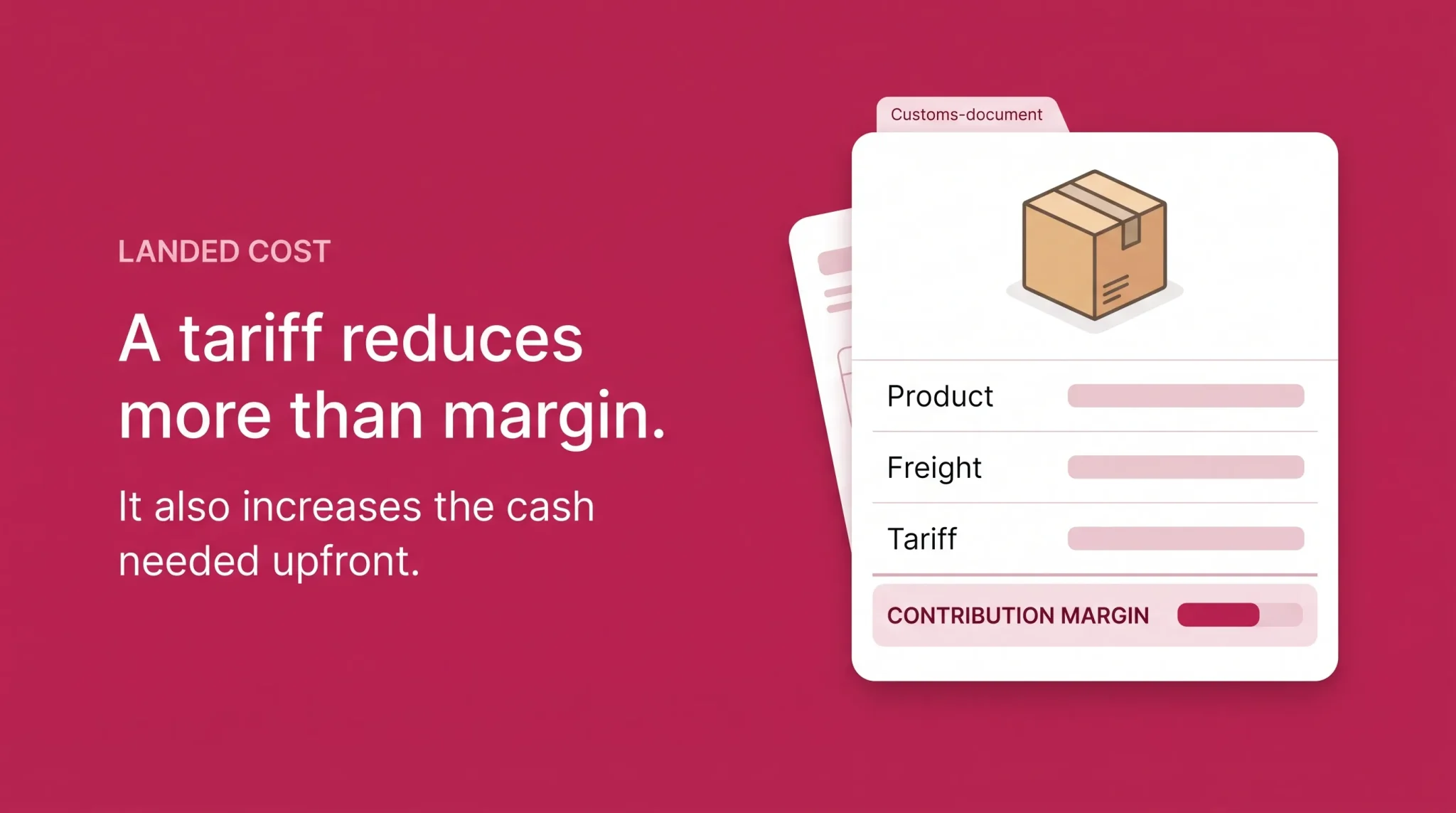
Landed cost is where customs stops being a compliance topic and becomes a financial one.
Landed cost per unit = product cost + packaging + inspection + freight + insurance + customs duty + additional tariffs + brokerage and port fees + domestic transport + preparation and labeling + currency cost |
|---|
A few rules keep the calculation honest. Include only costs that genuinely apply, and allocate shipment-level costs reasonably across units or SKUs, since freight and brokerage are charged per shipment. Customs duty may be calculated from customs value rather than total landed cost. Amazon referral fees are not customs costs, FBA fulfillment fees are not import duties, and advertising is not part of landed import cost. Import VAT can create a cash-flow burden even where it is recoverable later. There is no universal landed-cost percentage that applies across categories.
Contribution margin is what remains from net product revenue after landed product cost, Amazon selling fees, fulfillment, advertising, discounts, a returns allowance, and any variable financing cost. Tariffs affect that figure in more than one place. More cash is required before any sale occurs, because duty is paid at entry. Cost per unit rises, contribution margin falls, the financing requirement grows, downside risk from slow-moving inventory increases, pricing pressure builds, and break-even volume moves up.
Not all of that can be passed to the customer. Whether any of it can depends on category, competitive set, brand strength, and price sensitivity, and raising price has second-order effects on conversion rate and Featured Offer competitiveness. Advertising efficiency shifts too, since a thinner margin lowers the point at which ad spend stops being profitable, which is worth revisiting in your Amazon ACOS targets.
Financial Response to a Tariff or Cost Change
U.S. tariff rules remain highly dynamic as of August 2026. The correct duty requires the product's complete HTS classification, country of origin, customs value, entry date, and any applicable Chapter 99 provisions.
An imported product may face several possible layers: the normal HTS duty, additional Section 301 duties, Section 232 duties, other current statutory trade actions, antidumping and countervailing duties, and safeguards or quotas. These layers do not all stack in the same way, and whether a measure applies requires checking against that product's classification and origin rather than a country name.
When a cost estimate changes, verify the complete classification and origin first, confirm which duty layers apply, rebuild landed cost, recalculate contribution margin, and stress-test against slower sales. Only then does it make sense to review supplier pricing and terms, consider alternative legal sourcing, review shipment sizing, and decide whether to adjust price, reduce spend, delay the reorder, or exit the product. Recheck exposure before every major purchase order.
Some responses are legitimate and worth exploring with qualified help: confirming classification, seeking a customs ruling, reviewing country-of-origin treatment, reviewing valid exclusions, negotiating supplier prices or terms, diversifying suppliers, reviewing product design with professionals, reviewing duty drawback with a qualified adviser, and working with a licensed customs broker. None is a guaranteed duty reduction, and moving production does not automatically change origin, since substantial transformation and product-specific origin rules require professional analysis.
Other approaches are not options. Misclassification, undervaluation, false invoices, false country of origin, transshipment to disguise origin, artificial shipment splitting, incorrect gift declarations, using another importer's number without authorization, ignoring antidumping or countervailing duty scope, and declaring commercial inventory as samples all carry serious legal exposure.
Scenario three: tariff shock
A seller receives an updated landed-cost estimate meaningfully higher than the last shipment. The instinct is to raise price immediately. The better first step is verification: confirm the complete classification and the origin determination, then establish which duty layers apply. Only once the new landed cost is real does the pricing, sourcing, and reorder decision become answerable, and the answer may be to reduce reorder quantity rather than change price.
Currency Risk
Supplier costs and Amazon revenue are often denominated in different currencies, which introduces a cost that appears on no invoice. Conversion spreads and separately stated foreign exchange fees are different costs, and a provider quoting no fee may be earning on the spread. Currency movement can change the home-currency value of profit even when local-currency margin holds steady. Refunds can be processed at a different rate from the original sale, and borrowing in one currency while earning in another adds repayment risk unrelated to sales performance.
A Year-Round Financial Operating Rhythm
Treating finance as an annual event is what produces surprises. A working rhythm looks roughly like this.
Weekly: cash balance, upcoming supplier payments, customs payments due, Amazon disbursements received, advertising deductions, and unexpected refunds or fees.
Monthly: settlement reconciliation, contribution margin by product, inventory value, financing balance, landed-cost variance against forecast, and the tax reserve.
Quarterly: cash forecast, an estimated-tax discussion with a professional, sales tax or VAT status review, financing review, and a tariff exposure review.
Annually: tax forms, inventory records, financing statements, customs records, and a professional tax and legal review.
Universal filing dates are deliberately absent, because they vary by entity, jurisdiction, and circumstance.
Finance Readiness Checklist
Before committing to a reorder or accepting a financing offer, work through the following:
Current cash balance and what is already committed against it
Next supplier payment amount and due date
Production and freight timing to arrival
Customs and duty payment timing
Estimated FBA receiving time before units become sellable
Current payout and reserve position in the Payments Dashboard
Inventory sell-through rate on the product being reordered
Contribution margin after all variable costs including financing
Total amount repayable on any financing under consideration
Worst-case repayment scenario if sales fall well below forecast
Tax identity information and TIN status current in Seller Central
Form 1099-K reconciled against settlement reports and accounting records
Sales tax, VAT, or GST status reviewed for every market sold into
HTS classification and country of origin confirmed for the product
Importer-of-record arrangements confirmed in writing before shipment
Current landed cost rebuilt, with a tariff and currency stress test applied
This guide provides general educational information and is not tax, legal, customs, accounting, or financing advice. Consult qualified professionals for decisions involving your business.
Growth plans fail on cash timing more often than they fail on demand. Flairox works with Amazon brands on cash-cycle analysis, contribution-margin review, inventory and reorder planning, and tariff-adjusted growth decisions, so you can see where the real constraint sits before committing to it. Schedule a call to talk it through.
Frequently asked questions
It is funding used to cover the gap between paying suppliers, freight, and duties and receiving usable proceeds from Amazon. It includes offers accessed through Seller Central and financing arranged independently.