 Bilal Siddiqui
Key takeaways
Amazon Global Selling reduces, but doesn’t eliminate, the operational work of entering a new country registration, banking, tax, and compliance requirements still vary by marketplace.
Readiness matters more than ambition. A profitable, stable domestic business with room in its margin is a much better foundation for expansion than a business still finding its feet at home.
Amazon groups many marketplaces under regional accounts (a North America and Brazil unified account, and a regional Europe account) so you don’t need a brand-new registration for every country, but several major markets, including Japan, Australia, and the UAE, still require their own standalone account.
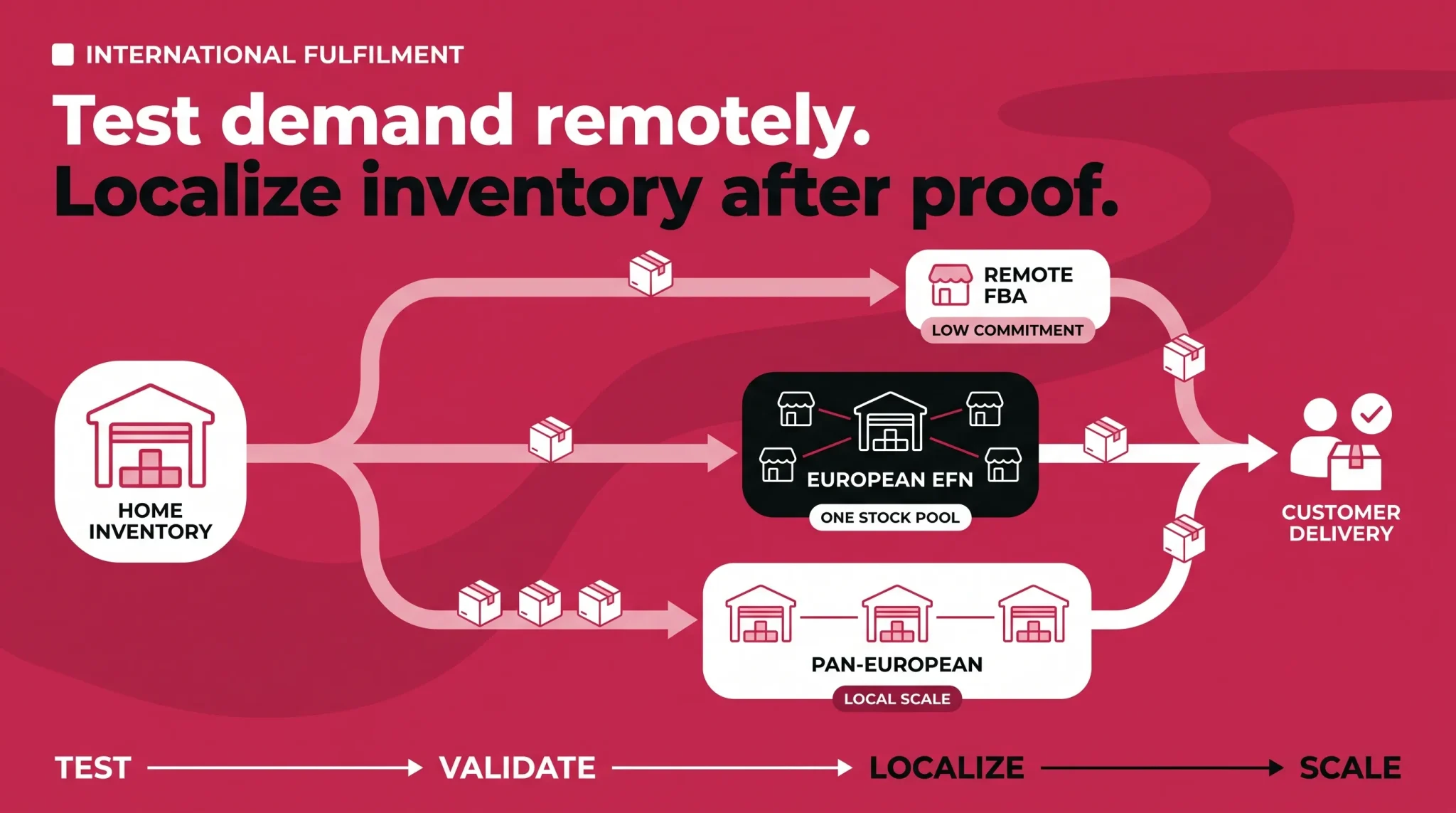
Fulfillment tools like Remote Fulfillment with FBA and the European Fulfillment Network let you test international demand with far less upfront commitment than building out local inventory everywhere at once.
If your Amazon business has found its footing in one country, the idea of selling in others eventually shows up on your radar. Maybe a competitor mentioned expanding to the UK. Maybe you noticed a chunk of website traffic coming from overseas. Maybe you just did the math and realized your home marketplace, however healthy, is still only one piece of what’s possible.
Amazon Global Selling is the program built to support that kind of expansion. Amazon’s tools can meaningfully reduce the need to build separate local infrastructure. You're generally not opening a new company or leasing a warehouse just to test a market but that doesn’t mean expansion is friction-free. Registration requirements, banking arrangements, tax obligations, and product-compliance rules still vary by marketplace and by how your business is structured, and sellers who skip past that reality tend to learn it the expensive way.
That’s really the purpose of this guide. Amazon Global Selling isn’t a single button you press. It’s a set of decisions about readiness, about which market to enter first, about what it will actually cost, and about how much operational complexity you’re willing to take on that determine whether international expansion becomes a genuine growth lever or an expensive distraction. This guide walks through those decisions in the order most sellers actually need to make them, and points to our dedicated Amazon Growth Strategy Guide if you want to see how international expansion fits into a broader growth plan.
What Amazon Global Selling Actually Is
Amazon Global Selling is the umbrella term for everything involved in taking an existing Amazon business into new Amazon marketplaces: account access, listing tools, currency handling, fulfillment options, and the seller-support resources Amazon provides to make that transition less painful than doing it independently. It is not a single marketplace or a single feature, it is the connective layer that lets you manage a US listing, a UK listing, and a German listing without treating them as three unrelated businesses.
It’s worth pausing on a point of confusion that shows up constantly in seller forums: Amazon Global Selling is not the same thing as Amazon Global Store. Global Store is a buyer-facing feature that lets a customer in one country browse and import products listed on Amazon’s other international sites, with Amazon estimating the import duties and fees at checkout. As a seller, you don’t “join” Global Store the way you enroll in Global Selling; it’s a shopping experience Amazon builds on top of the marketplaces that already exist. If you’re researching how to reach international customers as a seller, Global Selling is the program you actually want.
The mechanics of Global Selling itself are fairly simple to describe, even if the execution has more moving parts. You get access to an international marketplace (say, Amazon.de for Germany), you create or connect a listing there, you decide how orders in that marketplace will be fulfilled, and you manage pricing and inventory much like you do at home just with a new currency, language, and set of local expectations layered on top. Exactly which marketplaces you can reach, and how much setup each one requires, comes down to Amazon’s account structure, which is covered in detail in the account setup section below.
Is Your Business Actually Ready to Expand?
The sellers who get the most out of Global Selling are usually not the ones who jump in first. They’re the ones who wait until a few specific conditions are true at home, because international expansion tends to amplify whatever is already working or not working in your existing business.
A readiness assessment worth running before you do anything else:
Is your domestic business generating consistent, predictable revenue across enough comparable recent periods that you trust the trend, rather than a single unusually good stretch? (As a rough example, some sellers use two to three recent months as a starting point but the right window depends on your sales cycle and category seasonality, not a fixed rule.)
Do you have margin room after your current costs to absorb new fees, currency conversion spread, and potential shipping costs, without your product becoming unprofitable?
Is your current operation stable enough that you (or your team) can take on a new marketplace without domestic performance suffering?
Do you already have a product with proven demand signals, rather than something you’re still validating at home?
Are your systems inventory, customer service, reporting organized enough that adding a second or third marketplace won’t create chaos?
None of these need a perfect “yes.” But if most of them are honest “not yets,” the better move is usually to fix those first. Expanding into a new marketplace with a shaky domestic foundation tends to just multiply the shakiness rather than solve it.
Choosing the Right Marketplace: A Decision Framework
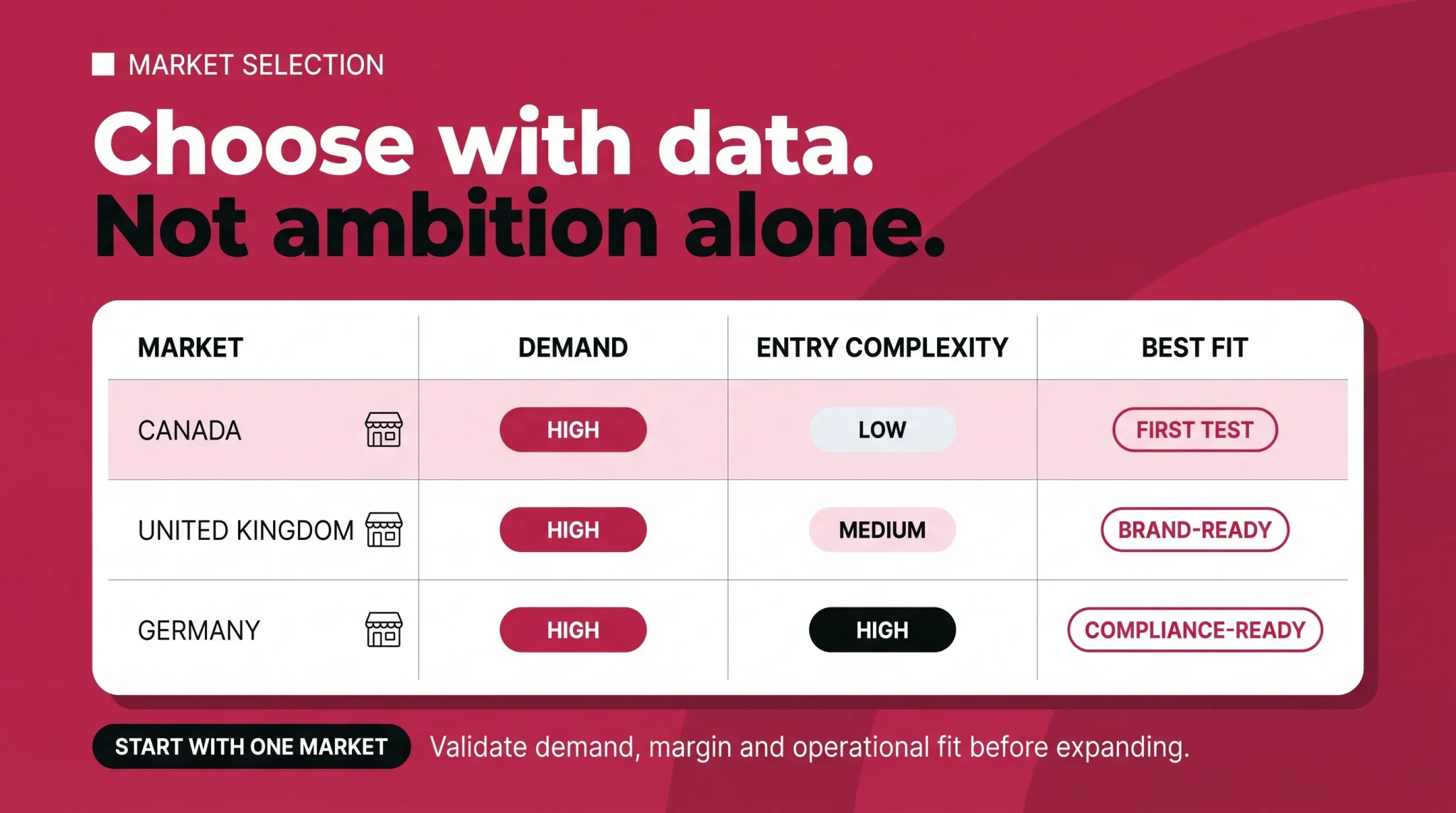
Once you’ve decided you’re ready, the next question is where. This is where a lot of sellers get it wrong by picking a market based on gut feeling (“everyone talks about the UK”) rather than evidence. A more reliable approach scores each candidate market against the same set of factors, so you’re comparing markets on equal footing rather than on how exciting each one sounds.
Marketplace-selection scorecard
Factor | What to Evaluate | Strong Signal | Warning Sign | Suggested Score (1–5) |
|---|---|---|---|---|
Demand signal | Search volume and sales activity for your category in that marketplace, using Amazon’s own demand and opportunity tools plus general market research | Steady or growing category demand with clear buyer intent | Little to no measurable demand, or demand concentrated in a narrow sub-category you don’t sell | ___ |
Competitive density | How saturated your category is, and how entrenched the top-ranking listings are | A mix of newer and established sellers, room for a well-differentiated listing to rank | A handful of dominant, heavily-reviewed listings controlling most of page one | ___ |
Language & localization complexity | How much translation, measurement conversion, and cultural adaptation your listing will need | English-speaking or a market where your category needs minimal adaptation | A different language plus category-specific compliance or labeling differences | ___ |
Fulfillment feasibility | Whether you can reach this market through an existing remote or network fulfillment option before committing local inventory | A lower-commitment fulfillment path already exists for this market | Entering requires shipping and storing inventory locally from day one | ___ |
Regulatory & compliance friction | Import restrictions, certification requirements, or licensing rules specific to your product category in that market | No unusual restrictions beyond what you already manage domestically | Category is gated, restricted, or requires certification you don’t yet have | ___ |
A market that scores well across most of these rows is a far better first move than the market with the single highest sales volume but a low score everywhere else. This is also where account structure matters practically: markets that fall under a regional account you already have access to (more on this in the account setup section) tend to involve less account-setup friction than markets requiring a brand-new standalone registration, so factor that into your scoring too.
It helps to think about demand and competition specifically as two separate questions rather than one combined gut check. Demand tells you whether people are searching for and buying what you sell in that market at all. Competition tells you how hard it will be to win visibility once you’re there. A market can have strong demand and still be a poor first choice if a handful of entrenched, well-reviewed competitors already dominate the top search results for your core keywords. Conversely, a market with modest demand but a thin competitive field can sometimes be the easier place to build initial traction and reviews before tackling a larger, more contested market. For markets with dedicated guides on our site Amazon Canada and Amazon UK & EU this scorecard is the right starting point, and those guides pick up where this one leaves off with country-specific setup and execution detail.
The Landed-Cost and Margin Check
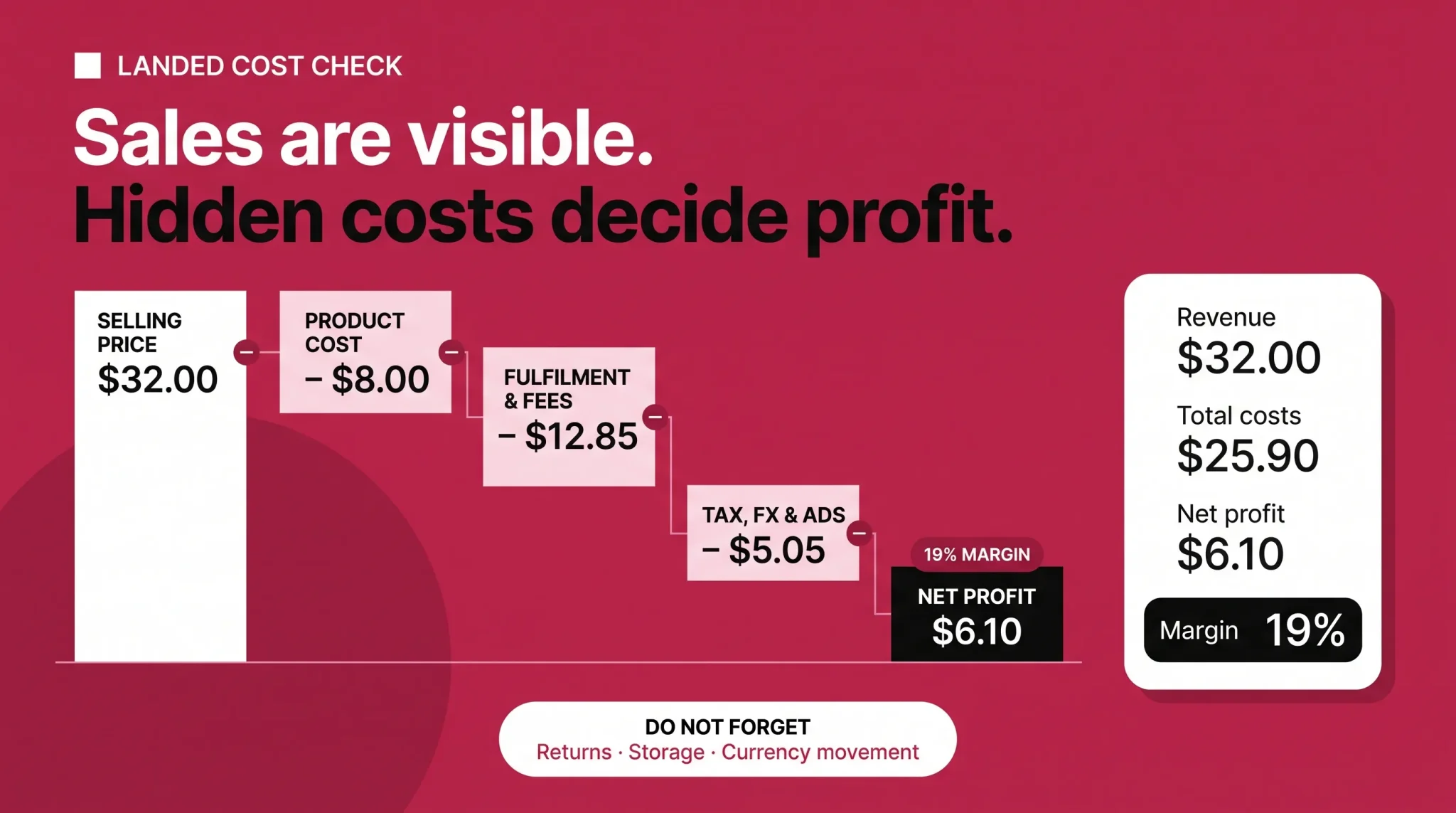
This is the step sellers skip most often, and it’s the one that causes the most regret. A product that’s profitable at home can quietly become unprofitable once you account for everything international selling adds to the cost side.
A simple formula for estimating contribution margin in a new marketplace:
Contribution Margin = Selling Price − Product Cost − Inbound Freight and Preparation − Referral Fee − Fulfillment/Shipping Cost − Duties & Taxes Borne by You − Currency Conversion Cost − Storage Allowance − Return Allowance − Advertising Cost
Each of these varies by marketplace and category, so the goal isn’t to memorize numbers it’s to make sure you actually run the calculation before committing inventory:
Product cost includes the amount you pay to manufacture or purchase each unit.
Inbound freight and preparation covers getting inventory from your supplier into the fulfillment network, including labeling or prep where applicable.
Referral fees vary by category and by country, not just by product.
Fulfillment or shipping fees differ depending on whether you’re using a remote fulfillment option, a local fulfillment network, or handling shipping yourself.
Import duties and taxes may apply depending on the product, its value, and the destination country; these vary significantly and are worth confirming for your specific product category rather than assumed from a general rule.
Currency conversion costs, whether through Amazon’s Currency Converter for Sellers or a separate multi-currency account, quietly erode margin over time through the conversion spread.
Storage allowance gives you room for storage charges, especially if the product moves more slowly than expected during the test.
Return allowance is an estimated cost per unit based on your expected return and refund rate in that market, since customer behavior can differ from your home market.
Advertising cost is what you expect to spend to establish visibility in a market where you likely have no ranking history yet.
Illustrative example (hypothetical numbers only not a benchmark for your product):
Say a product sells domestically for $30 with solid margin. Modeling the same product in a new marketplace, hypothetically:
Line Item | Hypothetical Amount |
|---|---|
Selling price (local currency, converted) | $32.00 |
Product cost | −$8.00 |
Inbound freight and preparation | −$1.50 |
Referral fee (15%) | −$4.80 |
Fulfillment / shipping | −$6.50 |
Duties & taxes (seller-borne) | −$1.20 |
Currency conversion cost (~1.1%) | −$0.35 |
Storage allowance | −$0.25 |
Return allowance | −$0.80 |
Advertising cost | −$2.50 |
Estimated contribution margin | $6.10 (≈19% of selling price) |
Your own numbers will look different depending on category, marketplace, and fulfillment choice. The point of the exercise is running your actual figures through this structure before you commit, not matching this example.
The Product-Compliance Risk Check
Every market has its own rules about what can be sold, how it must be labeled, and what documentation is required. A product that sails through approval in your home marketplace can require additional certification, restricted-category approval, or country-specific labeling elsewhere.
Before expanding, it’s worth checking, for your specific product:
Whether your product category is gated or restricted in the destination marketplace, which sometimes requires additional Amazon approval before you can list at all.
Whether the product requires country-specific certifications, safety marks, or labeling (electrical products, cosmetics, and children’s products are common categories where this comes up).
Whether packaging, ingredient lists, or safety warnings need to be presented in the local language or meet local regulatory formats.
Whether there are import restrictions specific to your product type in that country, separate from general Amazon category rules.
This is genuinely one of the areas where getting it wrong is expensive inventory that can’t clear customs, or a listing that gets suspended for a compliance issue, is a costly way to learn a market’s rules. Amazon’s own marketplace-specific requirements and reliable customs and compliance resources for the destination country are the right starting point; a full compliance and tax deep-dive belongs on our Amazon Seller Finance, Tax & Tariffs Guide, not here, since the details genuinely differ by product and country in ways a general overview can’t responsibly cover.
Setting Up Your International Seller Account
Once you’ve picked a market and satisfied yourself on cost and compliance, account setup is the more mechanical part of the process but the terminology trips people up, so it’s worth being precise about it.
Amazon groups a number of marketplaces under regional account structures so you’re not registering from scratch in every single country. If you already sell on Amazon.com with a professional selling account, expanding into Canada, Mexico, and Brazil generally happens through what Amazon calls a North America and Brazil unified account, one login that lets you manage offers across those marketplaces. Expanding into Europe typically means creating a regional Europe account (sometimes referred to as a Europe selling account), which similarly gives you access to the UK and a group of EU marketplaces commonly Germany, France, Italy, Spain, and a handful of others from one dashboard, even though each remains its own storefront with its own listings, pricing, and compliance obligations.
Outside of North America and Europe, several significant markets Japan, Australia, the UAE, Singapore, and India among them currently sit outside those regional structures and require their own standalone, country-specific account. That means separate registration, and in some cases separate banking or tax arrangements, for each of those markets individually. This is worth factoring into the marketplace-selection scorecard above: a market that fits neatly into an account structure you already have is genuinely lower-friction to activate than one requiring a brand-new standalone setup.
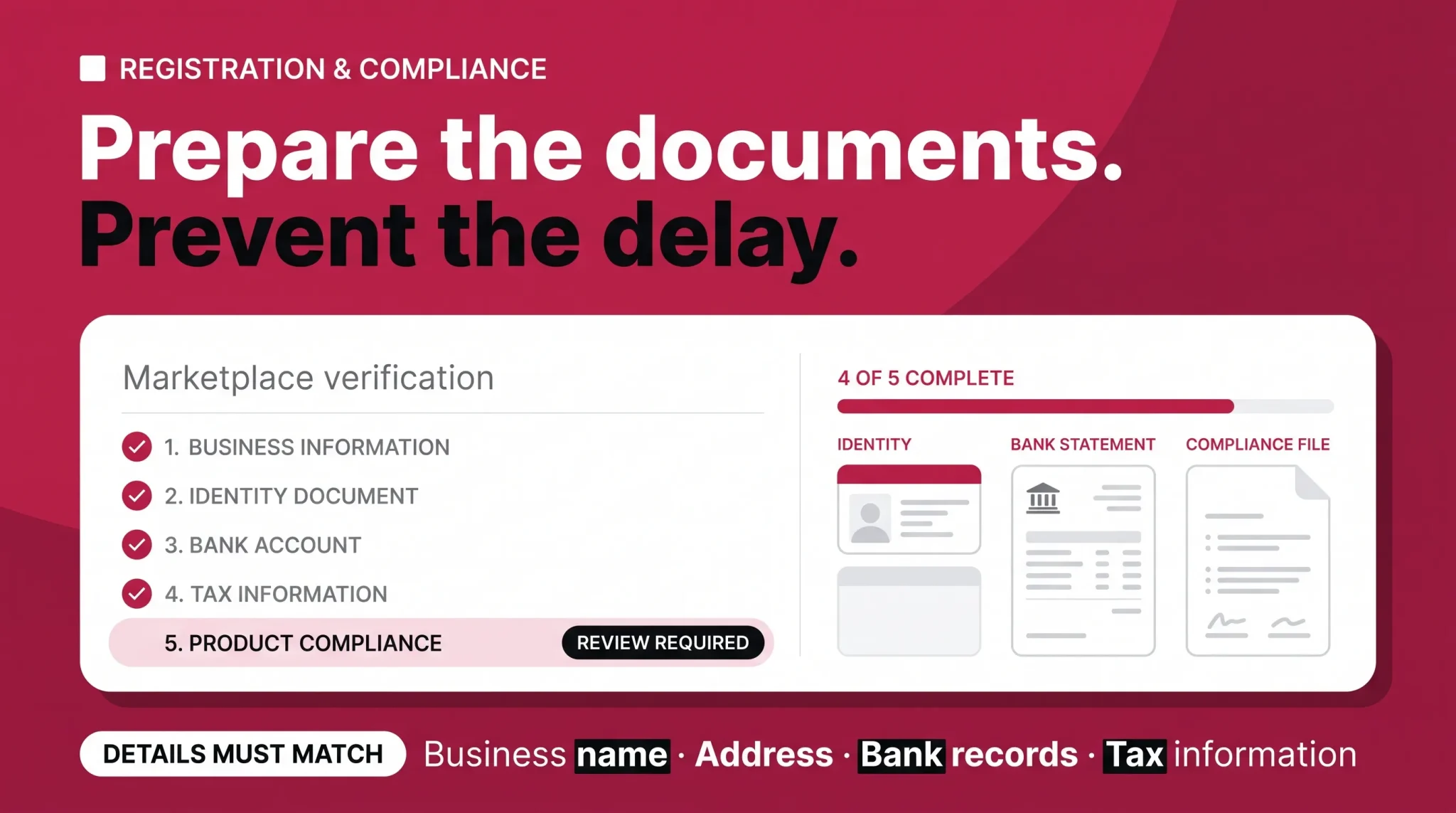
On documentation: expect to provide standard seller verification information for any new account business or personal identification, business registration details where applicable, and banking information to receive payouts in that market’s currency (or through a currency conversion service such as ACCS). Exact document requirements can vary by marketplace and by your business structure, so the authoritative list is always what Seller Central asks for during registration for that specific account, not a generic checklist.
On cost: selling plan fees for international accounts are not a single flat, universal number across every setup Amazon charges separate professional selling plan fees for the Europe account and for the North America and Brazil unified account. As of 2026, per Amazon’s own Global Selling guidance, if you link your global selling accounts together, your monthly fee is calculated as either the equivalent of USD 39.99 or the sum of the individual selling plan fees for each region and country where you have active listings whichever is lower. That linking rule can meaningfully reduce cost for sellers active in several regions, but it’s still worth confirming current fees directly in Seller Central for the specific accounts and marketplaces you’re planning to activate, since fee structures are exactly the kind of detail that changes over time.
Localization: Beyond Translation
A listing that’s simply translated word-for-word rarely performs the way a properly localized listing does, and this is a step sellers frequently underestimate because Amazon does offer tools that make the technical part easier just not the whole job.
Amazon’s Build International Listings (BIL) tool is the main resource here, and it’s worth understanding precisely what it does and doesn’t do. BIL helps you create and manage offers across connected marketplaces, generally by adding your offer to an existing product listing in the destination marketplace and syncing your pricing (adjusted for currency and marketplace-specific fees) so you’re not manually updating prices everywhere. In some cases it can generate a first-pass, machine-translated version of listing content like titles and bullet points. What it does not reliably do is create a fully market-ready listing on its own: it won’t create a brand-new product listing where none exists, it doesn’t guarantee accurate translation of nuanced product details, and it doesn’t localize measurements, sizing conventions, or currency-specific pricing psychology on its own. Sellers who rely on it as a complete localization solution frequently end up with listings that are technically live but read awkwardly, use the wrong sizing conventions, or miss local search terms entirely.
Real localization, beyond what an automated tool provides, usually means:
Having a human reviewer (ideally a native speaker familiar with the category) check and refine any machine-translated content, particularly for anything customer-facing.
Researching local search terms directly, rather than assuming a direct translation of your home-market keywords captures how people actually search in the new marketplace.
Adjusting pricing to reflect local psychology and competitive norms, not just a currency-converted version of your domestic price.
Reviewing measurements, sizing, and units for the destination market’s conventions, since a mismatch here is a common source of returns and negative feedback.
Checking that any text embedded in images or video is either translated or replaced, since Amazon expects on-page text content to match the marketplace’s language.
During an initial market test, it’s reasonable to prioritize the highest-impact customer-facing assets first title, bullet points, and main images rather than overhauling every element of the listing on day one. That said, this is a matter of sequencing effort, not skipping requirements: any legally required translation, labeling, safety information, or country-specific product-compliance detail has to be in place before launch, full stop. Those aren’t optional polish; they’re what keeps a listing legal and a shipment able to clear customs.
One more point worth being precise about, since it’s a frequent point of confusion: Amazon may display verified-purchaser reviews from other countries for eligible products with consistent brand information across marketplaces, often in a separate “reviews from other countries” section beneath the local reviews on a listing. This generally depends on factors like Brand Registry enrollment and matching brand details, but availability and display are not guaranteed, and sellers report the behavior working inconsistently across products. Local ratings and review counts can also remain separate from what’s shown in that cross-country section. Plan your launch expecting to build market-specific social proof over time, rather than assuming your domestic reputation transfers automatically into a new market.
Fulfillment Options for Going International
How you fulfill international orders has a direct effect on both cost and how much commitment a new market requires upfront and this is an area with genuinely useful lower-risk options for sellers who aren’t ready to build out local inventory yet. (Getting inventory from your manufacturer into Amazon’s fulfillment network in the first place is a separate topic, covered in more depth in our Fulfillment & Logistics content; this section is about serving international customers once your inventory is already in Amazon’s network.)
Remote Fulfillment with FBA (the program many sellers still know by its earlier name, NARF) lets you sell into Canada, Mexico, and Brazil using your existing US FBA inventory, without shipping or storing stock in those countries. Amazon handles the cross-border fulfillment, and customers are treated as the importer of record for duties and taxes, which simplifies your side of the transaction considerably. This makes it one of the lowest-commitment ways to find out whether demand exists in a neighboring market before investing further see our Amazon Canada guide for the country-specific execution details once you’re ready to go deeper.
In Europe, the European Fulfillment Network (EFN) lets you fulfill orders across EU marketplaces from inventory held in a single country, which keeps things simple operationally but generally means slower delivery and higher per-order shipping costs than storing inventory locally. Pan-European FBA solves that by letting Amazon distribute your inventory across fulfillment centers in multiple EU countries, so orders ship faster and at lower cost but it also means navigating VAT obligations in each country where your inventory physically sits, which is a genuine layer of complexity and one of the main reasons sellers eventually bring in dedicated tax support once they scale in Europe. Our Amazon UK & EU guide covers the country-specific setup, VAT, and fulfillment execution for that region in depth.
A fulfillment-feasibility check worth running for any market you’re considering: can this market be reached through an existing remote or network fulfillment option without new local inventory, or does entering this market require you to ship and store stock there from day one? The first option is a far easier way to test a market; the second is a bigger commitment that’s usually better made after you’ve already validated demand through a lower-cost method.
Taxes, Customs, and Compliance: What You Need to Plan For
This guide won’t walk you through VAT registration mechanics, customs classification, or country-specific tax filing, because those genuinely deserve their own dedicated treatment and the details differ enough by country and product that a general overview risks giving false confidence. What’s useful here is knowing which risks exist so you know what to investigate before you commit.
At minimum, expect to look into: whether you need to register for VAT or an equivalent local tax in any country where you hold inventory (this is common once you use a program like Pan-European FBA); whether import duties apply to your product and who is responsible for paying them; whether your business needs any form of local tax representation; and whether the destination country requires product-specific import documentation beyond what your home country requires. These are exactly the kind of questions worth taking to a tax or customs professional with international e-commerce experience, and to Amazon’s own guidance for the specific marketplace, rather than treating a general seller’s summary as sufficient. Our Amazon Seller Finance, Tax & Tariffs Guide goes deeper into financing, tariffs, and tax basics if that’s the piece you need next.
Building a Phased International Expansion Plan
Sellers who succeed at international expansion rarely do it all at once. A phased approach lets you validate assumptions before committing real capital, and it maps naturally onto the frameworks above.
A practical phased test-market plan:
Pick one market, using the marketplace-selection scorecard, rather than trying to launch in three countries simultaneously.
Enter through the lowest-commitment fulfillment path available for that market Remote Fulfillment with FBA or EFN rather than local inventory, wherever that option exists so you’re testing demand without a large upfront bet.
Prioritize the highest-impact localization first, while making sure everything legally required is fully in place before launch (see the localization section above).
Run the test until you have enough data to decide, not until a fixed date passes. That generally means enough qualified traffic, orders, conversion rate, margin performance, return rate, and customer feedback to see a real pattern rather than early noise. For some categories that’s a matter of a few weeks; for slower-moving or seasonal categories it can reasonably take longer. (As a labeled example only: many sellers find that somewhere in the range of 60 to 90 days is enough to get past initial volatility but treat that as a starting reference point, not a rule, and let your own data tell you when the picture is clear.)
Decide whether to invest further in local inventory, deeper localization, or advertising in that market based on what the data actually shows, not on how exciting the market felt at the start.
A final go/no-go checklist, before you commit inventory and effort to a new market:
Domestic business is stable and the readiness assessment holds up honestly.
The market scores well on the selection framework, not just on gross demand.
The landed-cost and margin math still works after fees, duties, and currency conversion.
No unresolved compliance or restricted-category issues for your specific product.
A fulfillment path exists that doesn’t require a large upfront inventory commitment to test.
Localization plan covers more than machine translation, and every legally required element is confirmed complete.
You know, specifically, what tax and compliance questions still need a professional answer before you scale.
If all of that checks out, you’re not just hoping international expansion works you’ve actually built the case for it.
International expansion isn’t a single decision, it's a series of smaller ones, and the sellers who do it well tend to be the ones who work through them in order rather than skipping to the exciting part. If you’ve run through the frameworks above and a market still looks solid, the next useful step is usually digging into that specific market in more depth, starting with whichever country actually scored best on your own evaluation.
Frequently asked questions
It depends heavily on your product, margin, and how stable your domestic business already is. For sellers with proven demand and room in their margin, international expansion can meaningfully grow revenue without the cost of building a fully separate international operation from scratch. For sellers still stabilizing at home, it usually makes more sense to wait, since a new market tends to amplify existing operational strain rather than fix it.