 Bilal Siddiqui
Key takeaways
Amazon Luxury Stores, shown to shoppers today as Amazon Luxury, is an invite-only, curated area of Amazon for premium fashion and beauty brands.
There is no public application. Amazon selects brands, so the useful work is positioning, not filling out a form.
It is different from a standard Brand Store, which any Brand Registry brand can build for free.
The platform is evolving. The Saks Fifth Avenue partnership is winding down, while Amazon has said its luxury store continues.
Much of what circulates online as "requirements" is not officially published, so evaluate the channel on brand fit, control, and operations rather than a checklist.
Luxury brands tend to approach Amazon with caution, and for understandable reasons. The platform is built for scale, price comparison, and convenience, none of which sit naturally next to exclusivity and controlled distribution. Amazon Luxury Stores is Amazon's answer to that tension, a curated, invite-only part of the store built to give premium fashion and beauty brands a more elevated environment. This guide explains what the program is, how it differs from a standard Amazon store, what is and is not publicly known about getting in, and how to think through fit before evaluating the channel. It is written for brand owners and category managers rather than shoppers, so the focus is on the decision, not the browsing.
What Is Amazon Luxury Stores?
Amazon Luxury Stores, presented to shoppers today as Amazon Luxury, is a curated area of Amazon for established and emerging luxury brands. Amazon describes it as a shopping experience spanning apparel, handbags, shoes, jewelry, accessories, and beauty, available on the web and in the Amazon Shopping app, with individual brand storefronts and seasonal curations. It debuted in 2020 with Oscar de la Renta as its first brand and has expanded gradually since.
The simplest way to understand it is this: Amazon is trying to host luxury without making luxury feel like the rest of Amazon. Participating brands get a more controlled, editorial presentation, and shoppers get a cleaner experience than a standard product page. You may also see it referred to as Luxury Stores at Amazon, and its beauty side overlaps with what many people think of as Amazon's premium beauty selection, though the broader luxury experience spans fashion as well.
How It Differs From a Standard Amazon Brand Store
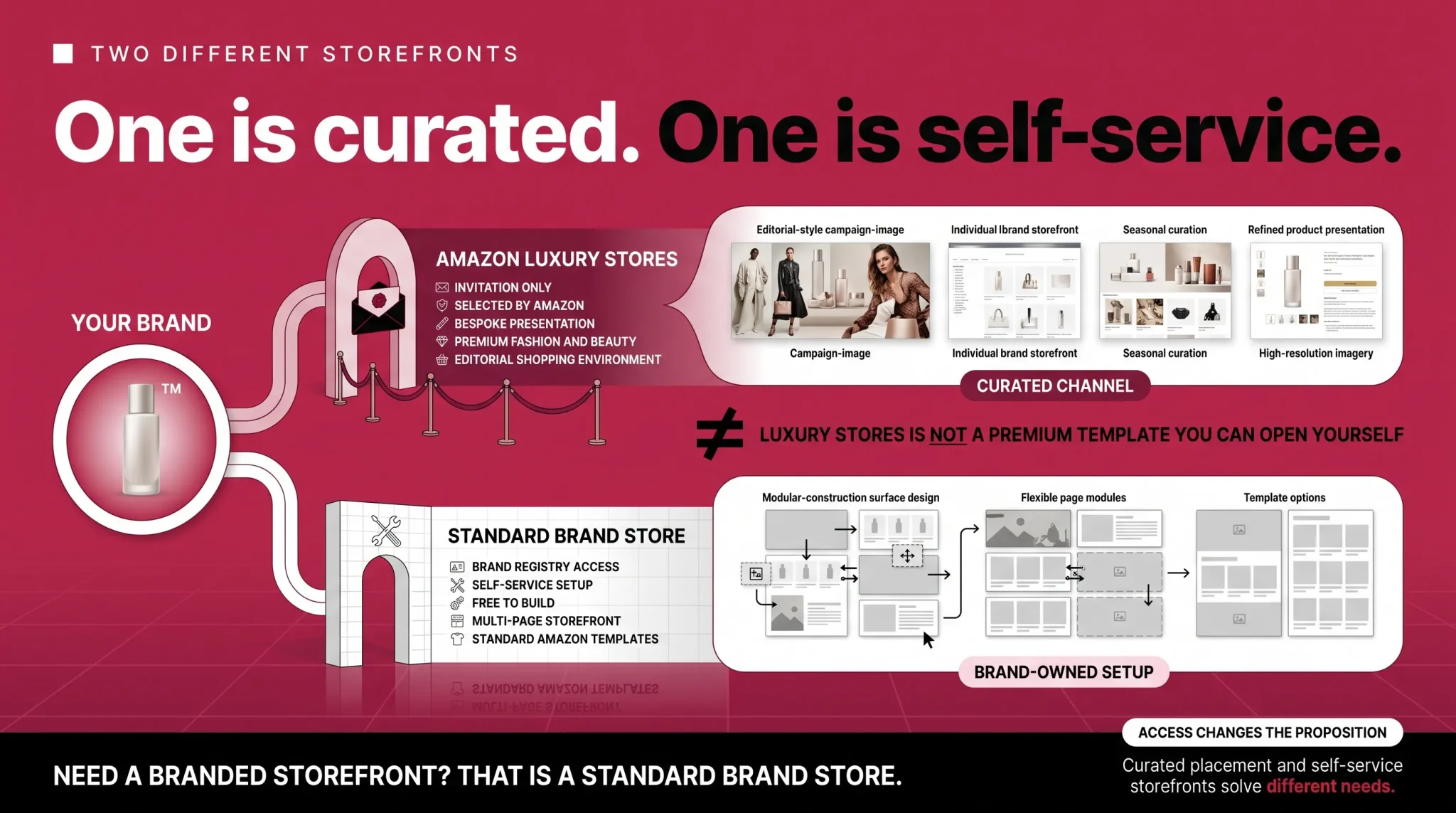
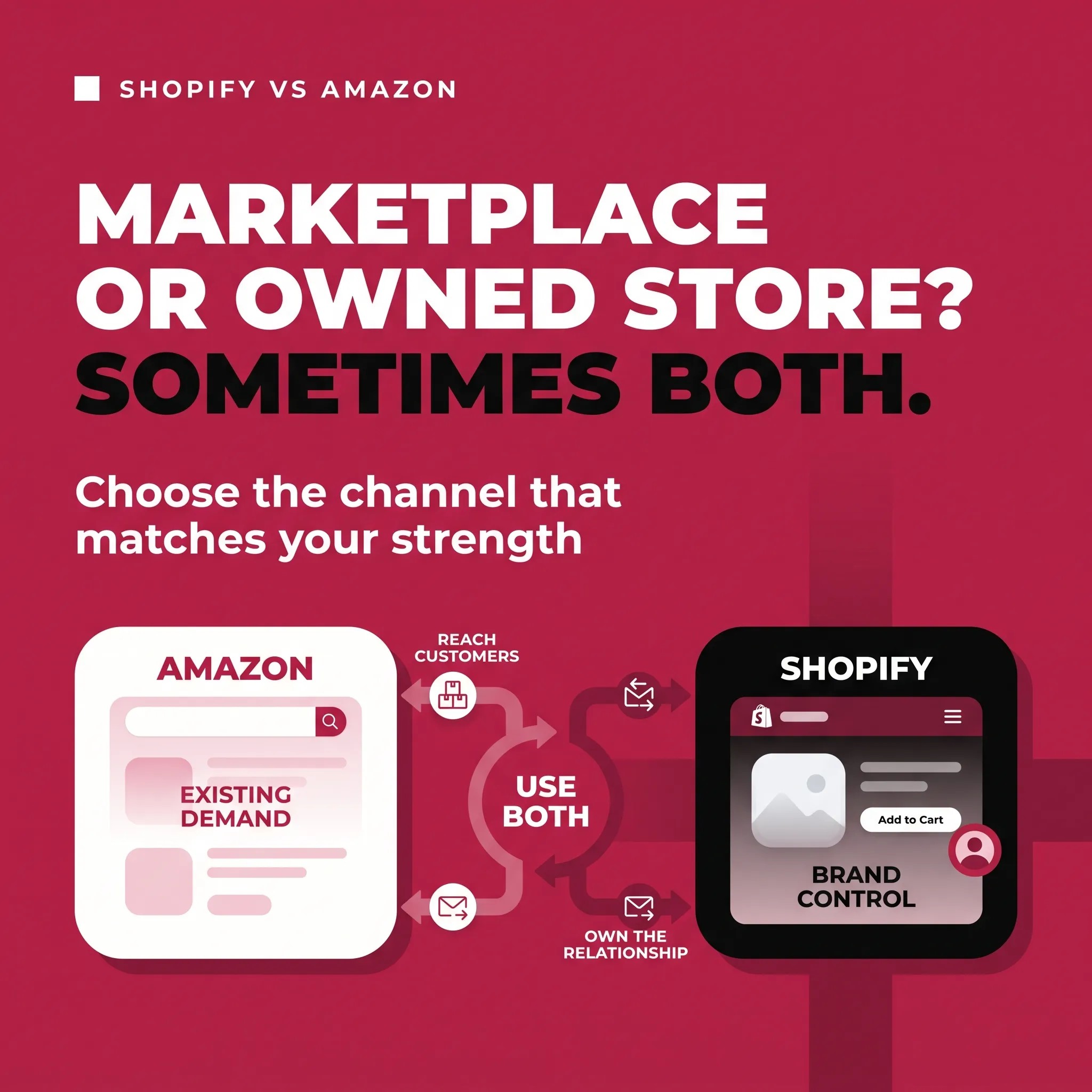
This is the distinction that matters most, because the two are easy to confuse. Any brand enrolled in Amazon Brand Registry can build a standard Brand Store, which is a free, self-service, multi-page storefront. Amazon Luxury Stores is neither self-service nor open to everyone. It is an invitation-based, curated channel with a more bespoke presentation and a distinct shopping experience.
Consideration | Amazon Luxury Stores | Standard Amazon Brand Store |
|---|---|---|
Access | Invitation only, curated by Amazon | Open to any Brand Registry brand |
Setup | Selected and onboarded by Amazon | Self-service, you build it yourself |
Cost to create | Not publicly published | Free to build |
Experience | Bespoke, editorial, premium environment | Flexible templates within standard Amazon |
Best suited to | Established premium and luxury brands | Any brand wanting a branded storefront |
If your goal is simply a branded storefront, that is a standard Brand Store, and our Amazon Storefront guide covers how to build one. Luxury Stores is a different proposition: a selective placement inside a premium environment, not a template you can open on your own.
The Invite-Only Reality: What Is and Isn't Public
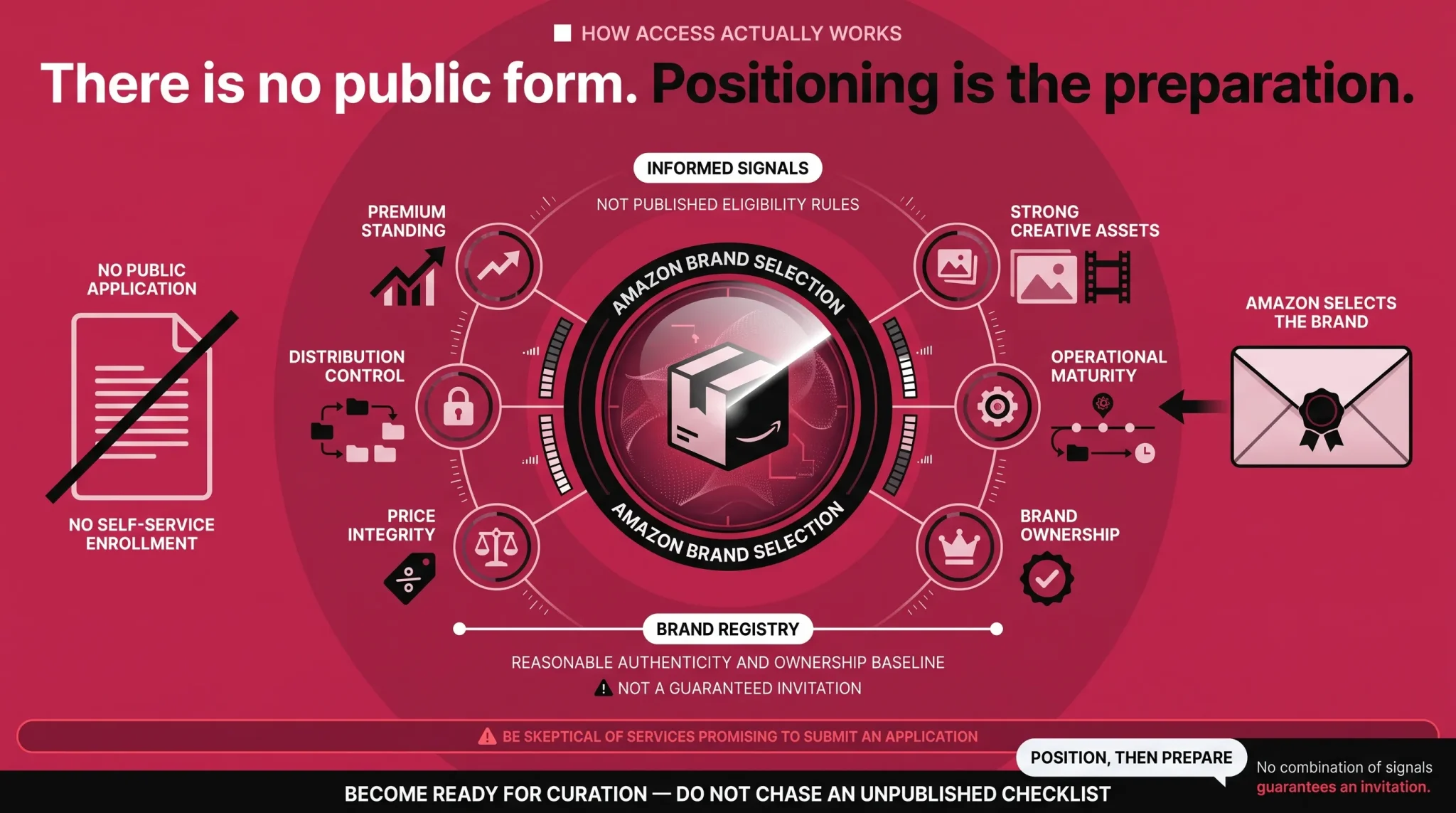
Access is invitation-only, and there is no public application. You cannot fill out a form to join, and any page or service that promises to submit an application on your behalf should be treated with skepticism. Amazon selects brands, which means the useful work for a brand is positioning itself well, not chasing a submission.
Amazon does not publish a formal list of eligibility requirements, so much of what circulates online as a checklist is inference rather than official policy. Based on how the program has been described and on what participating brands tend to have in common, the signals that appear to matter are recognized standing in the premium or luxury space, tight control over distribution and pricing, strong brand and creative assets, and the operational maturity to deliver a high-end experience consistently. Enrollment in Brand Registry is a reasonable baseline to expect, since it underpins authenticity and brand control. Treat all of this as informed guidance, not a set of boxes you can tick to guarantee an invitation.
Is Amazon Luxury Stores a Fit for Your Brand?
The honest answer for many brands is "not yet," and that is worth saying plainly. The program suits brands that already hold genuine premium positioning, control who sells their products, and can protect price integrity. It tends not to suit brands still building recognition, brands with wide or uncontrolled distribution, or brands whose margins cannot absorb the creative and operational investment a premium presentation demands.
There are also strategic questions that have nothing to do with eligibility. Some luxury brands deliberately limit marketplace exposure to protect scarcity and prestige. Others worry that appearing anywhere near mass-market inventory, even in a walled-off section, works against their positioning. These are legitimate concerns, and the recent history of the channel, covered below, shows they are shared widely across the industry. Fit here is as much a brand-strategy decision as an eligibility one.
The Customer and Brand Experience
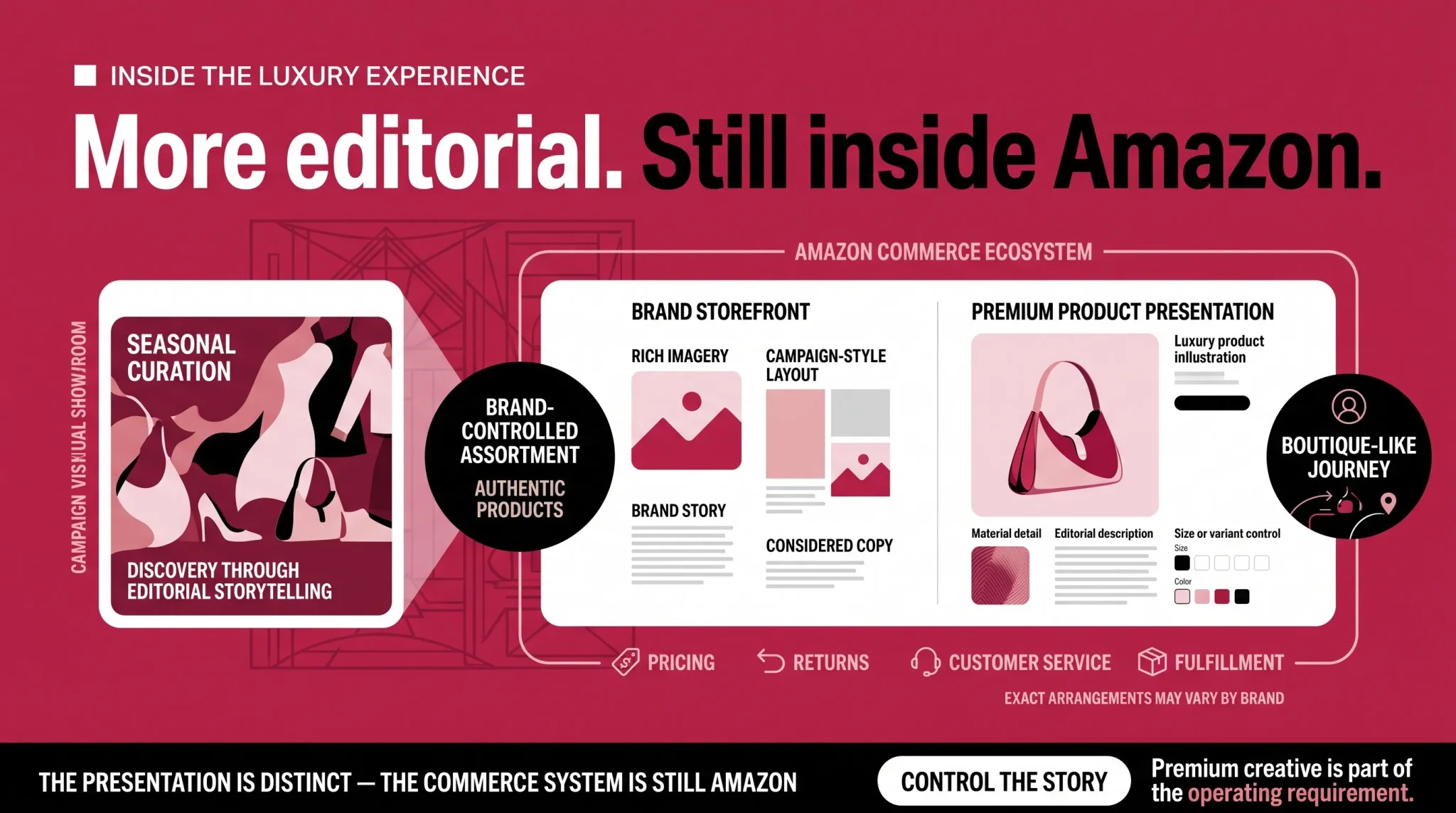
Inside the luxury experience, the presentation is more editorial and less transactional than standard Amazon. Brands get more control over how their space looks and how their story is told, with room for richer imagery and campaign-style layouts. The shopping flow is designed to feel closer to a boutique than a typical listing, which is the entire point of housing luxury separately.
The products are genuine. This is a vetted, brand-controlled environment, so the "is it real" question that shoppers sometimes ask has a clear answer: the goods are authentic, sold through the brand or Amazon rather than an open pool of third-party sellers. That authenticity is a large part of why the invitation-only model exists at all. Standard Amazon mechanics such as pricing, returns, and customer service still operate within Amazon's wider ecosystem, but the exact fulfillment and service arrangements are not published as a single uniform model, and they can vary by brand. Do not assume one fixed operating setup applies to every participant.
Opportunities and Risks for Luxury Brands
The opportunity is real. Access to a very large, high-income customer base, combined with more brand control than a normal Amazon presence allows and Amazon's logistics working behind the scenes, is hard to replicate elsewhere at the same scale. For a brand that is genuinely ready, that combination is compelling.
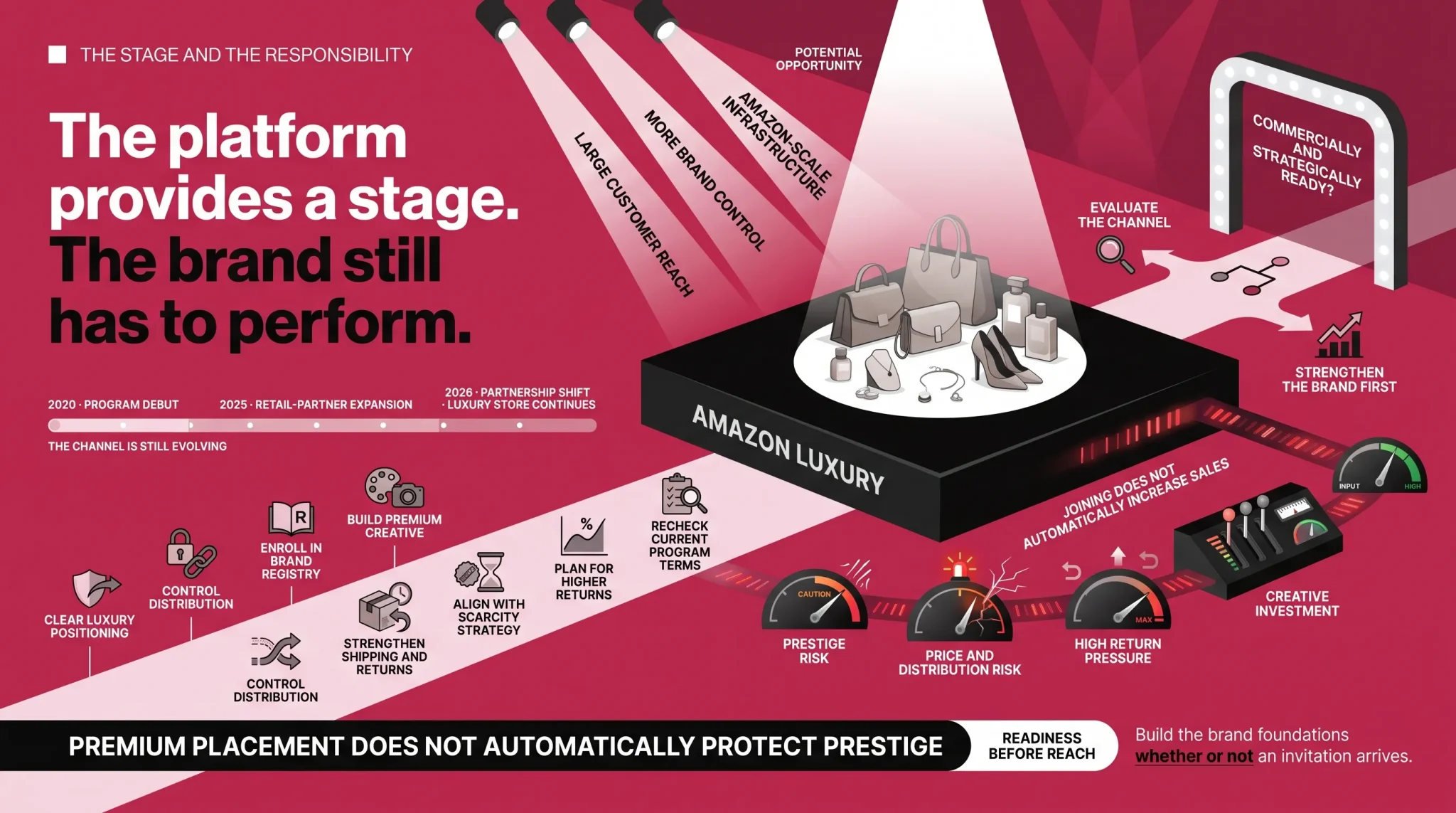
The risks deserve equal weight. Prestige risk comes from marketplace association. Pricing and distribution risk come from operating inside Amazon's broader environment, where control is never absolute. Luxury fashion also carries high return rates driven by fit and expectation, which pressures both margins and operations. And a premium presentation is not free: without serious investment in photography, video, and copy, a luxury listing can look flat and quietly undercut the brand. Joining does not automatically increase sales, and it does not automatically protect prestige. It provides a stage, and what happens on that stage depends on the brand's own execution.
An Evolving Platform
Luxury Stores is not a finished, static program, and it should not be judged through any single partnership. The clearest recent example is Saks Fifth Avenue. In 2025, Saks curated a high-profile luxury section on Amazon, and it was widely treated as the channel's centerpiece. By early 2026 that had shifted. As part of Saks Global's Chapter 11 bankruptcy, Saks is exiting its Amazon partnership, with trade reporting citing limited brand participation as a factor. Amazon, for its part, has said its luxury store continues without Saks and that it is adding more brands.
The useful takeaway for a brand is not the corporate dispute but the lesson underneath it. Even a storefront curated by one of the most recognized names in luxury saw uneven brand uptake, which says a great deal about how cautious luxury brands remain about marketplace selling. Evaluate the channel on its current shape and on your own brand fit, not on the status of any one retail partner, and recheck the specifics before you act, since this part of the picture is still moving.
How to Prepare and Position Your Brand
Because there is no application, preparation is about becoming the kind of brand Amazon curates and being ready to deliver if an opportunity comes. Use this as a readiness check:
Confirm your brand holds clear premium or luxury positioning within its category.
Get control over your distribution so unauthorized sellers are not undercutting your price or presentation.
Enroll in Brand Registry to establish ownership and authenticity as a baseline.
Invest in premium creative assets, including high-resolution photography, video, and considered copy.
Tighten operations so shipping, returns, and service can meet a luxury buyer's expectations consistently.
Decide internally whether marketplace exposure fits your brand-protection and scarcity strategy.
Plan for luxury-specific realities such as higher return rates and faster inventory cycles.
Recheck the program's current shape and terms before committing, since the channel is still evolving.
Weighing Amazon Against Your Brand Strategy
If you are considering the channel, the most useful starting point is not the invitation itself but your own positioning, distribution control, and operational readiness. Those are the things that make a brand a credible fit, and they are worth getting right whether or not Amazon ever comes calling. Flairox works with premium brands on exactly that groundwork. If you want a considered, honest read on whether and how Amazon fits your brand, our team is happy to talk it through.
Frequently asked questions
Amazon Luxury, also called Luxury Stores at Amazon, is a curated, invite-only area of Amazon for premium fashion and beauty brands. It offers brand-controlled storefronts and a more editorial shopping experience than standard Amazon listings.