 Bilal Siddiqui
Key takeaways
Amazon DSP is a demand-side platform for buying display, video, and audio ads programmatically, both on and off Amazon.
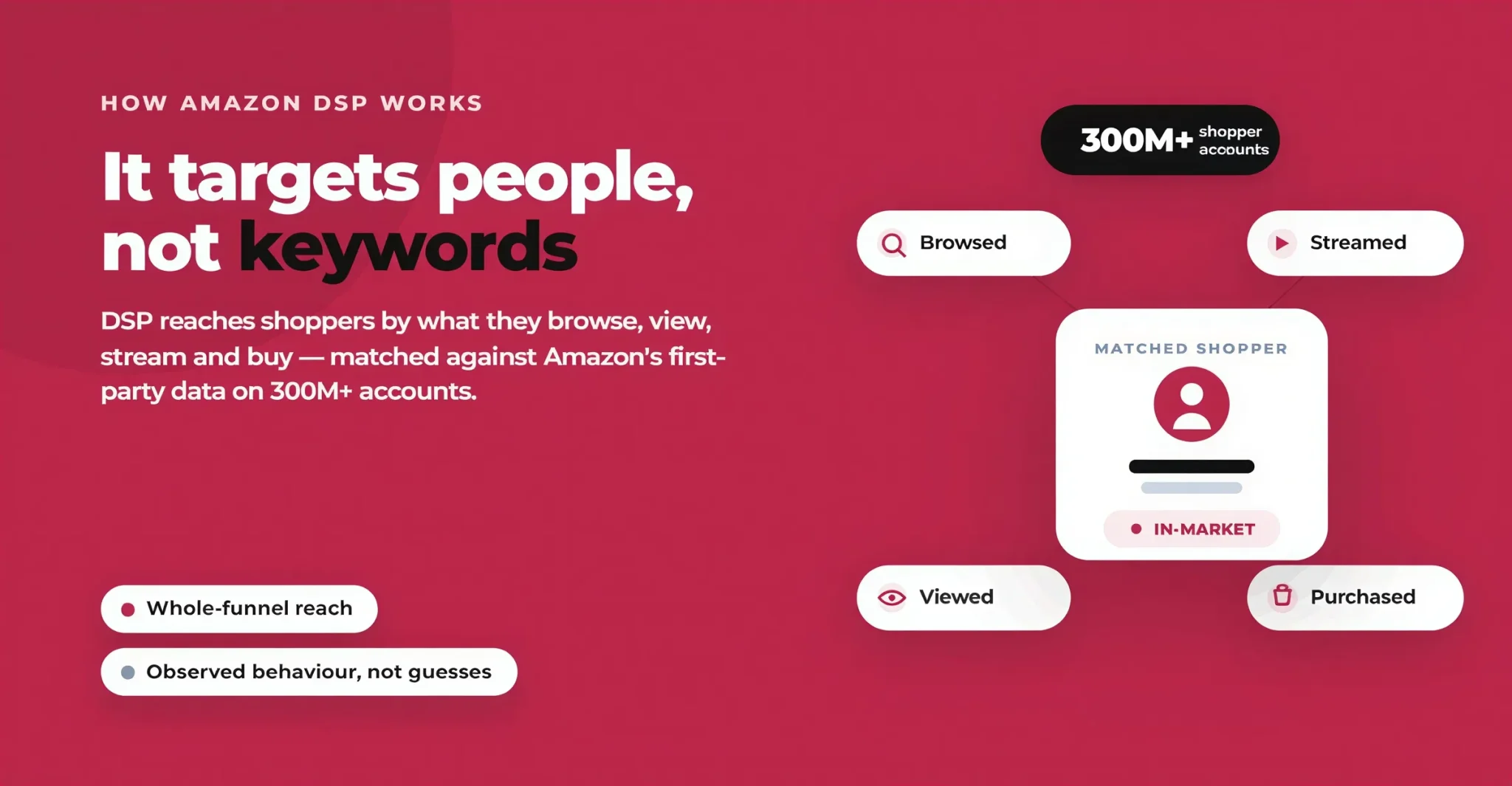
It targets audiences, not keywords. DSP uses Amazon's first-party data on over 300 million customers to reach people by behavior and intent rather than search terms.
It runs on a CPM model. You pay per thousand impressions plus a technology or service fee, rather than paying per click.
The 2026 access barrier has dropped. Amazon removed the self-service minimum at unboxed 2025, though a practical budget of around $10,000 to $15,000 a month is needed for the system to optimize.
It complements, not replaces, Sponsored Ads. Brands running DSP alongside search ads see materially higher returns, but only when DSP is used for upper-funnel and retargeting work.
It suits established brands. DSP delivers most for brands with proven profitability on existing channels, healthy margins, and the budget and measurement maturity to run upper-funnel media.
Most Amazon advertising has a hard ceiling that's easy to miss until you hit it. Sponsored Products, Sponsored Brands, and the rest of the search-based toolkit are excellent at one thing: capturing demand that already exists, putting your product in front of people actively typing your category into the search bar. But that audience is finite. Once you're winning the keywords that matter, spending more delivers less and growth flattens out. The shoppers you haven't reached are the ones who aren't searching yet, and search ads have no way to find them.
Amazon DSP is how you break through that ceiling. It shifts advertising from capturing demand to creating it, reaching shoppers before they search, while they browse elsewhere, and long after they leave your product page without buying, all using the richest first-party shopper data in retail. This guide is the complete reference: what Amazon DSP is and how it works, where your ads appear, the formats and audiences available, what it costs in 2026, how to measure it, and how to decide whether your brand is ready.
Amazon DSP at a Glance
Highlight | Detail |
|---|---|
What it is | Amazon's demand-side platform for programmatic display, video, and audio ads, on and off Amazon |
Targeting | Audiences and behaviours drawn from 300M+ shoppers, not keywords |
Pricing model | CPM (pay per 1,000 impressions) plus a technology or service fee |
2026 minimum spend | No Amazon self-service minimum since unBoxed 2025; ~$10k–$15k/month practical; managed service ~$50k/month |
Where ads appear | Amazon.com, Fire TV, Prime Video, Twitch, IMDb, Alexa audio, plus thousands of third-party sites and apps |
Best for | Established brands with profitable Sponsored Ads, healthy margins, and full-funnel goals |
What Is Amazon DSP?
Amazon DSP Defined in Plain Terms
Amazon DSP, short for Demand-Side Platform, is software that lets advertisers programmatically buy display, video, and audio ad placements both on Amazon's own properties and across the wider internet, from Fire TV and Prime Video to thousands of third-party sites and apps. The defining difference is how it decides who sees your ad: rather than responding to a keyword someone types, DSP uses Amazon's understanding of who a shopper is and how they behave to serve your ad to the right person, whether or not they are searching. That is what makes it a tool for the whole funnel rather than just the bottom of it.
What Programmatic and Demand-Side Buying Mean
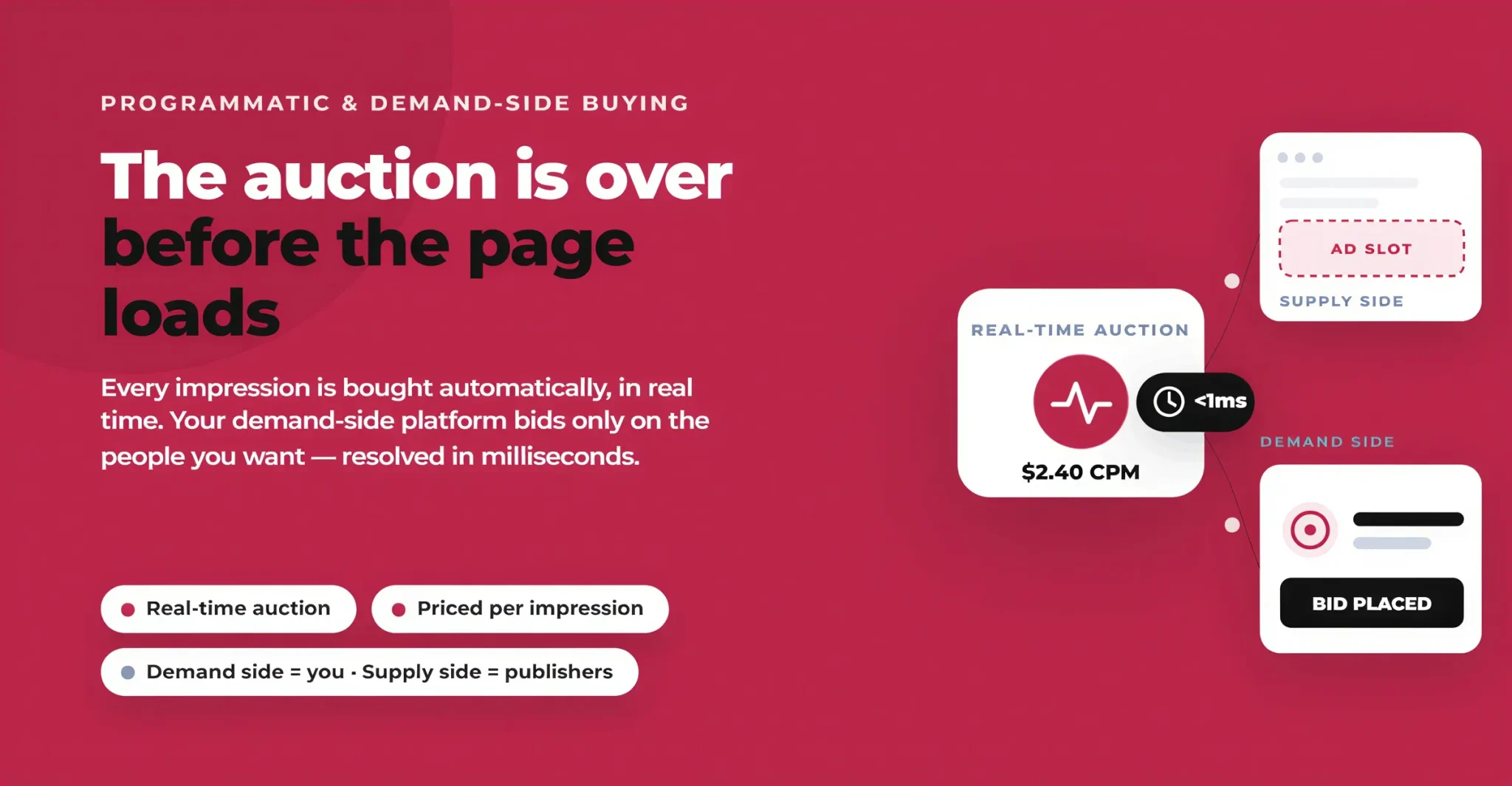
Two pieces of jargon explain how DSP operates. "Programmatic" means ad space is bought and sold automatically, in real time, through an auction that resolves in the milliseconds before a page loads, with no manual negotiation. "Demand-side" describes which side of that auction you sit on: publishers selling ad space are on the supply side, while advertisers buying it are on the demand side, through a platform like Amazon DSP that bids on impressions matching the audiences and goals you've defined. In practice you set the strategy, audiences, budget, and creative, and the platform handles the high-speed mechanics of acquiring the right impressions at the right price.
Eligibility: Sellers, Brands, and Non-Sellers
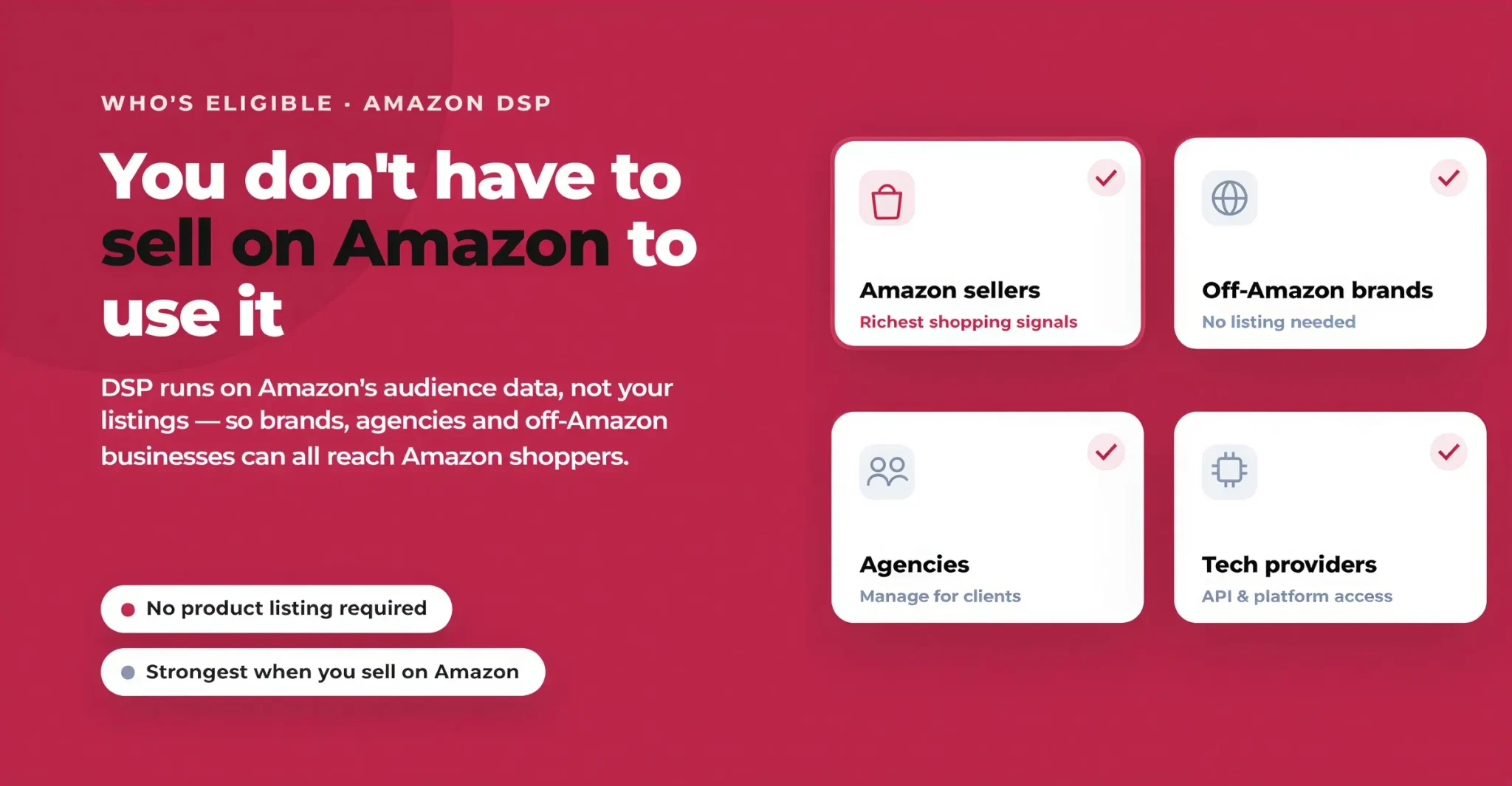
A common misconception is that DSP is only for established Amazon sellers. In fact, eligibility is deliberately broad: brands that sell on Amazon, brands that don't, agencies, and technology providers can all access it, because DSP draws on Amazon's audience data rather than requiring a product listing. That said, the value compounds when you do sell on Amazon, because sellers gain shopping-behavior signals tied to detail pages, including who viewed, considered, or purchased specific ASINs, which powers DSP's most effective retargeting and conquesting strategies.
How Amazon DSP Works
Audience-Based Targeting vs. Keyword Targeting
The mental shift that unlocks DSP is moving from keywords to audiences. With search advertising, the keyword is the unit of targeting, so your reach is bounded by how many people search those terms, and it only works on demand that already exists. DSP targets people instead of phrases, identifying shoppers by what they browse, view, stream, and buy, and the stage of the journey they're in. That lets you reach a shopper who has never searched your category but fits the buyer profile, someone who viewed your product but didn't purchase, or a loyal customer due for a repeat order, anywhere across the funnel.
Amazon's First-Party Shopper Data
What makes this targeting so effective is the data behind it. Amazon holds first-party shopping signals on more than 300 million active customer accounts, knowing what people browse and buy, how often they purchase in a category, whether they hold Prime, and what they watch on Prime Video. This is observed purchase behaviour, not the inferred interest data most ad platforms rely on, which makes it far more predictive. For an advertiser, it translates into targeting that reaches genuine in-market shoppers, surfaces lookalikes of your best customers, and re-engages people whose behaviour shows real intent. It is the engine that makes everything else in DSP work.
The Real-Time Bidding Engine
When a shopper opens a page, app, or streaming screen containing ad space, an auction fires in real time to decide which ad fills it, and DSP participates on your behalf. In the moment before the content loads, it assesses who the viewer is, whether they match your audience, and the value of reaching them against your goal, then bids if it's a fit, all within milliseconds. You don't manage this impression by impression; you configure the campaign, including audiences, budget, bid strategy, and the outcome you're optimising toward, and the engine executes across billions of impressions, learning which audiences, placements, and creatives drive your goal and shifting spend toward them.
Where Amazon DSP Ads Appear: Inventory & Placements
Amazon Owned-and-Operated Properties
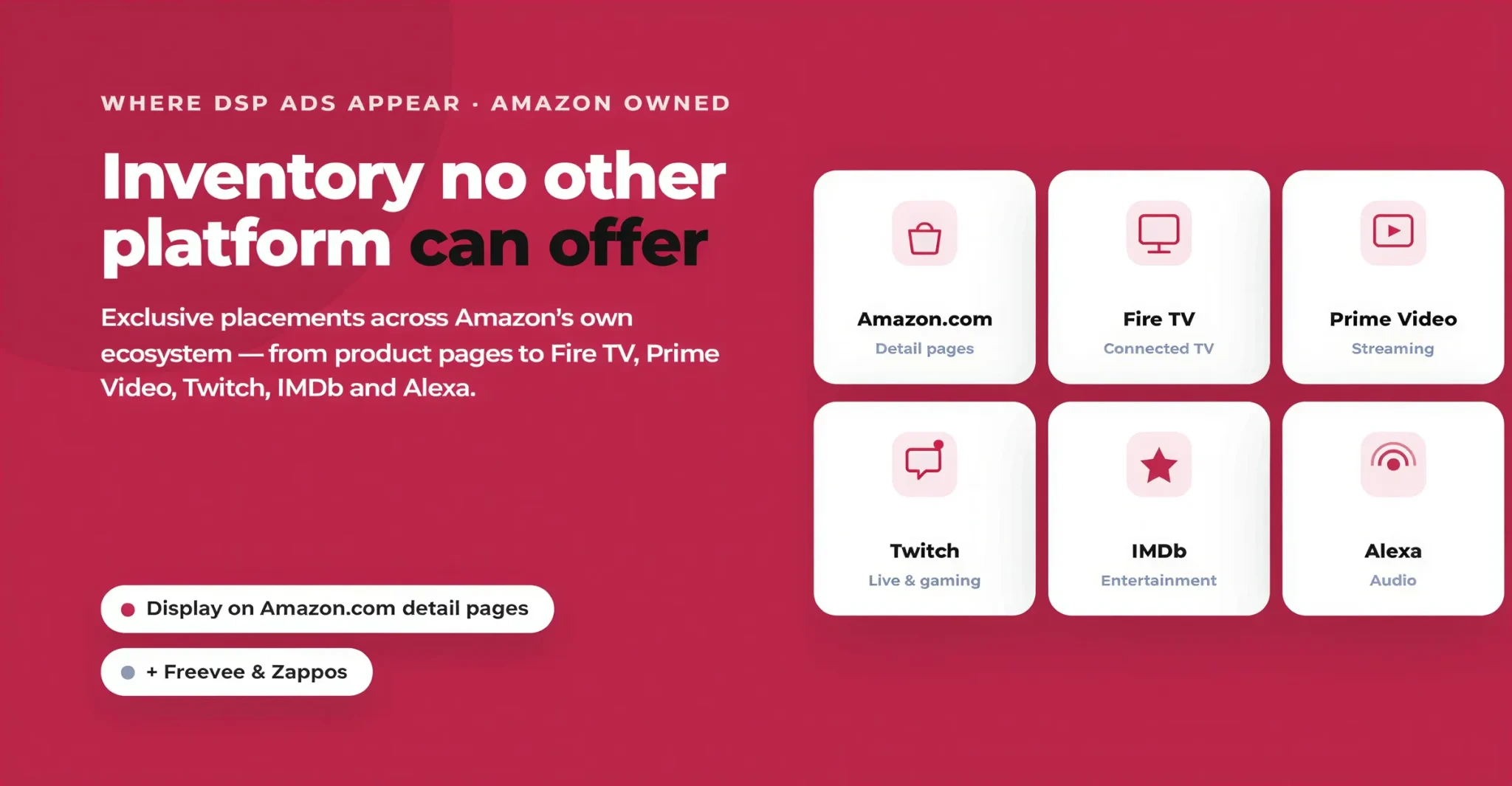
One of DSP's biggest advantages is exclusive access to Amazon's own ecosystem, inventory no other demand-side platform can offer. It starts with Amazon.com, where DSP places display ads on detail pages distinct from sponsored search placements, and extends across some of the most-used digital properties in the world: Fire TV, Prime Video, and Freevee for streaming, Twitch for engaged gaming audiences, IMDb for entertainment browsing, and Alexa-enabled devices for audio. Each captures attention in a different context, and DSP lets you reach the same shopper across all of them with a coordinated message.
Third-Party Sites and the Open Web
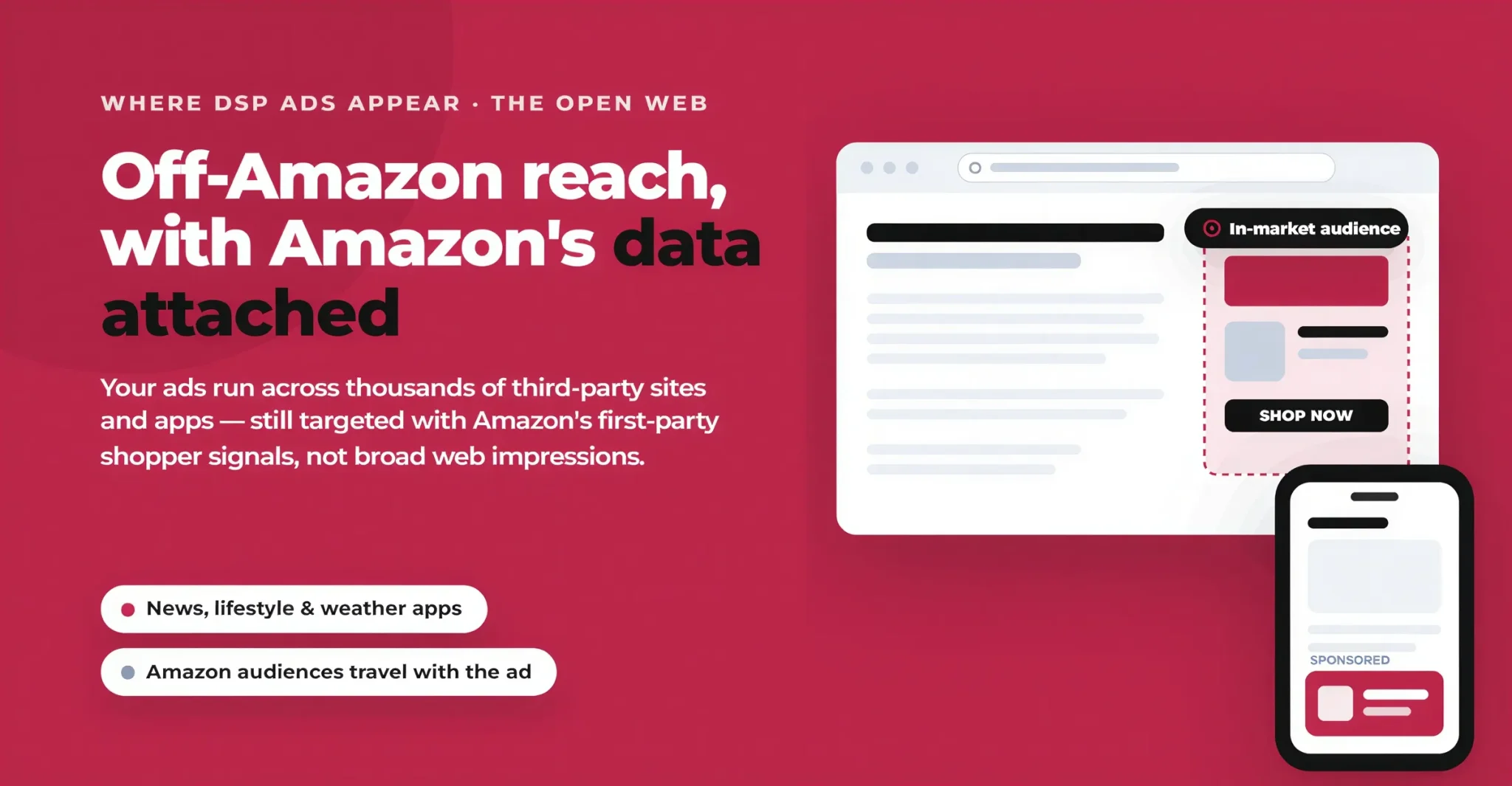
DSP's reach doesn't stop at Amazon's borders. Through Amazon Publisher Services and supply-side platform partnerships, it extends to thousands of third-party websites and mobile apps, from news sites to lifestyle blogs to recipe apps. The crucial difference from any other programmatic platform is the data layer that travels with the inventory: when DSP serves an ad on a third-party site, it's still using Amazon's first-party shopper signals to decide who sees it. You're not buying broad, untargeted impressions but reaching specific Amazon audiences, such as in-market shoppers or recent viewers of your product, wherever they browse. That combination of Amazon-grade targeting with off-Amazon reach is one of the platform's most distinctive strengths.
Connected TV and OTT Streaming
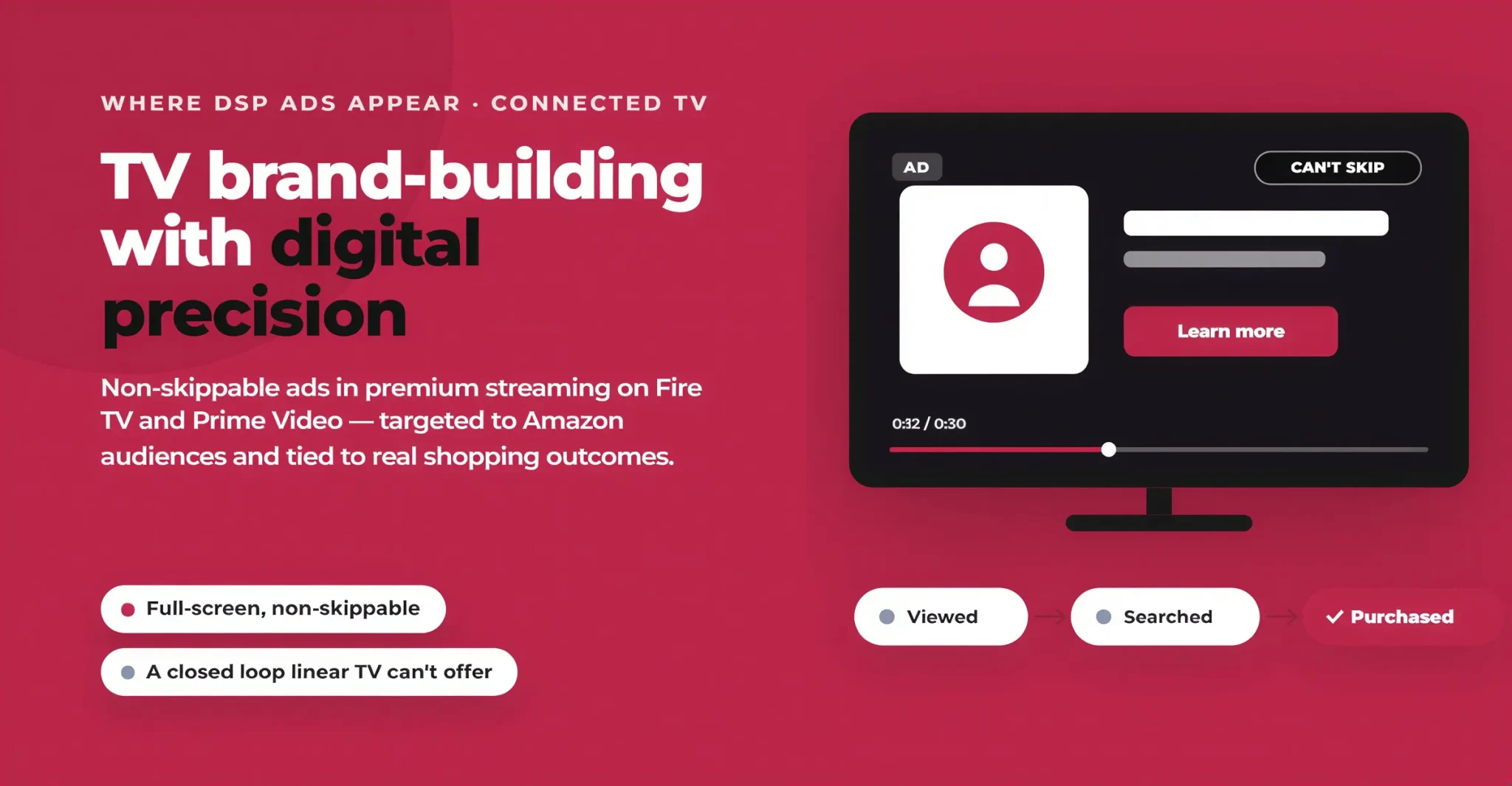
Connected TV and over-the-top streaming have become one of the most compelling reasons to invest in DSP. Through Fire TV, Prime Video, and partner services, DSP gives brands access to streaming TV inventory once reserved for large advertisers buying traditional television, with non-skippable ads during premium content that capture full-screen attention. Crucially, this is television-style brand building with digital precision: instead of broadcasting to a loose demographic, you target specific Amazon audiences and connect that exposure to downstream shopping behaviour, measuring whether viewers later searched for, viewed, or purchased your product. That closed loop between premium video and real purchase outcomes is something linear TV has never offered.
Amazon DSP Ad Formats & Specs
Display and Dynamic E-Commerce Ads
Display is the workhorse format and the most flexible place to start. Standard creatives run in the familiar IAB sizes, including 300x250, 728x90, 160x600, 300x600, and 320x50, letting a single campaign serve across desktop, mobile, and app placements, which suits both awareness and retargeting. The more powerful option for sellers is the dynamic e-commerce ad, which pulls live elements directly from your product detail page, such as current price, rating, review count, and imagery, and assembles them automatically, keeping the ad accurate and routing shoppers straight to your listing. These are especially effective for retargeting, re-presenting the exact product a shopper viewed, complete with reviews, at the moment they're most likely to reconsider.
Streaming TV and Online Video Ads
DSP offers two video formats. Streaming TV ads, also called over-the-top or OTT ads, play during streaming content on services like Fire TV and Prime Video; they are generally non-skippable, designed for full-attention brand building on the largest screen in the home. Online video runs within digital video environments across the web and can include clickable elements that drive direct response. Creatives typically run 15 to 30 seconds in 16:9 or 1:1 ratios. Streaming TV excels at awareness and recall for launches and upper-funnel campaigns, while online video sits lower in the funnel, so many brands lead with streaming TV and follow with online video and display to move shoppers toward purchase.
Audio Ads Across Streaming and Alexa
Audio is the quietly growing third format, reaching shoppers when no screen is involved. Amazon DSP audio ads are 10 to 30 second spots across digital audio content and Alexa-enabled devices, reaching people while they listen at home, in the car, or working out, moments display and video can't occupy. It works best as a brand-awareness and reinforcement layer rather than a direct-response driver, adding incremental touchpoints that keep your brand present, which is especially valuable in categories where habit and recall drive purchase.
Format | Typical Specs | Best For |
|---|---|---|
Standard display | 300x250, 728x90, 160x600, 300x600, 320x50 | Awareness and retargeting across web and app |
Dynamic e-commerce | Auto-assembled from your detail page (price, reviews, image) | Retargeting and conversion for sellers |
Streaming TV / OTT | 15–30s video, non-skippable, 16:9 | Brand building and upper-funnel reach |
Online video | 15–30s video, 16:9 or 1:1, can be clickable | Consideration and direct response |
Audio | 10–30s audio across streaming and Alexa | Incremental reach and brand recall |
Audience Targeting in Amazon DSP
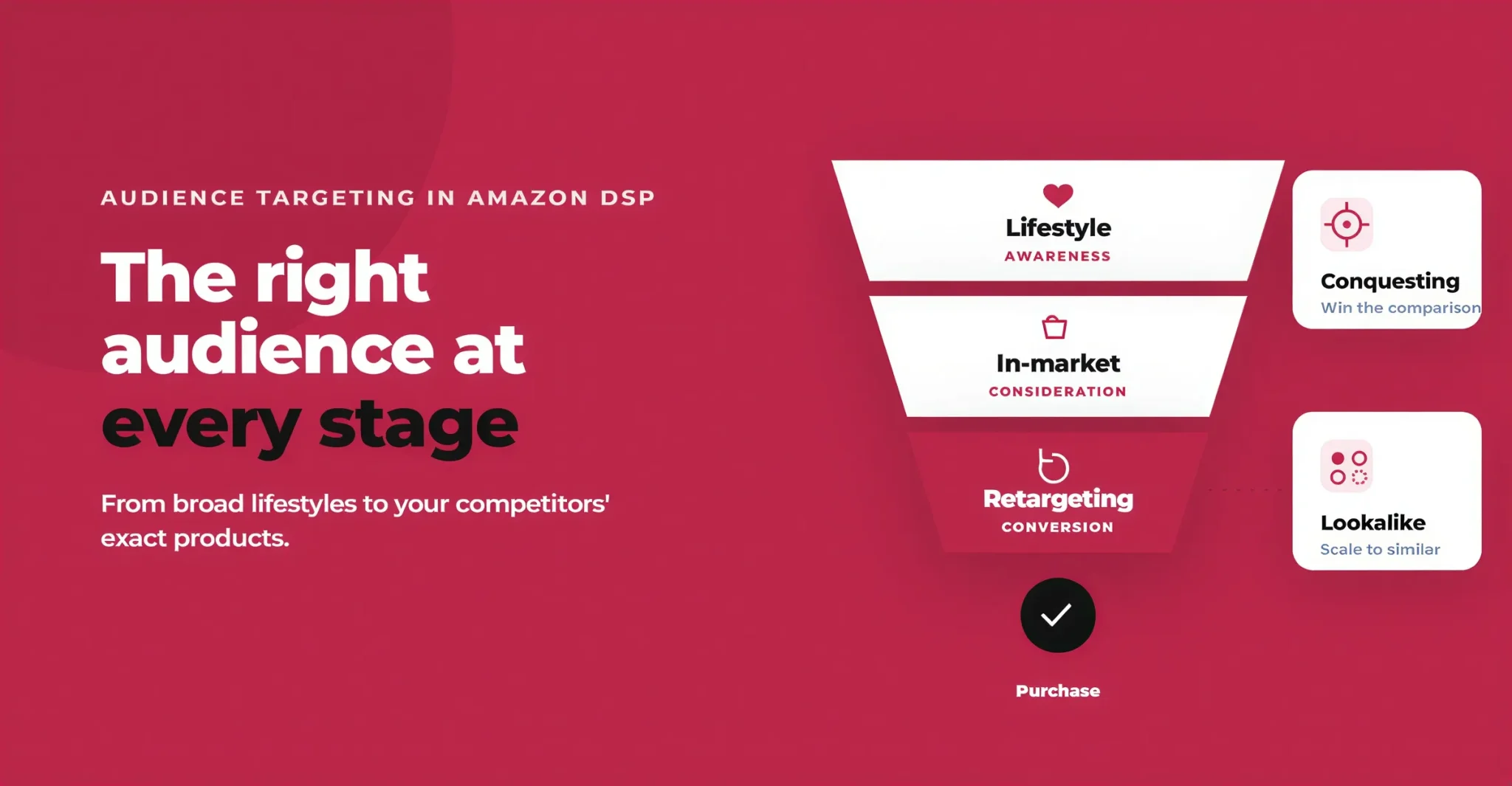
In-Market and Lifestyle Segments
DSP's audience library is its centre of gravity, and the broadest segments fall into two families. In-market audiences are shoppers who have recently browsed or purchased within a specific category, signalling active, near-term intent, which makes them a natural fit for consideration and conversion campaigns. Lifestyle audiences work at a broader, more durable level, grouping people by sustained patterns such as fitness enthusiasts, frequent travellers, or home cooks, which suits upper-funnel awareness among people who fit your customer profile even before they're actively shopping. Used together, lifestyle audiences build the top of the funnel while in-market segments capture the demand as it sharpens.
Retargeting and Remarketing Audiences
Retargeting is where DSP most often delivers its strongest returns, because it re-engages shoppers who have already shown direct interest. The platform builds audiences from people who viewed your product page but didn't buy, abandoned a cart, or browsed your Store, all warm prospects who have already raised their hand. The sophistication goes beyond a simple "saw it, didn't buy" rule: you can tailor messaging and bidding to how recently and deeply a shopper engaged, and pair it with dynamic creative that re-presents the exact product alongside its reviews and price. Because these audiences carry such clear intent, retargeting consistently produces the highest ROAS in a DSP program.
ASIN and Competitor Conquesting
DSP's ASIN-level targeting lets you reach shoppers based on the specific products they interact with, including your competitors'. By targeting rival ASINs, you put your brand in front of shoppers actively considering an alternative, a tactic known as conquesting. It works because the audience is, by definition, in-market for your type of product, just leaning toward someone else, and a well-crafted ad highlighting your differentiators can redirect that consideration your way. It also works defensively, retargeting viewers of your own products to protect your position.
Lookalike and Custom Audiences
The final pillar is expansion through similarity. Lookalike audiences take a group you value, such as your existing customers, and find new people who behave like them, letting you scale beyond current buyers to fresh prospects who share the patterns that make your best customers valuable. Custom audiences give even more control, letting you build segments from combinations of behaviours and your own first-party data, such as shoppers who bought a complementary product but not yours, or who purchased once and are due to reorder. Blending Amazon's signals with your own knowledge of your customers turns audience building into a strategic exercise rather than a menu selection.
Amazon DSP vs. Sponsored Ads
CPM vs. CPC, Audience vs. Keyword
Sponsored Products, Sponsored Brands, and Sponsored Display use keyword and product targeting inside Amazon's marketplace and bill on a cost-per-click basis, so you pay only when someone clicks. That model is excellent at demand capture, putting you in front of high-intent shoppers searching right now with tight keyword and ASIN control. DSP works on a different model entirely: it targets audiences rather than keywords, reaches well beyond the marketplace, and bills on a cost-per-thousand-impressions basis, so you pay to be seen rather than only when clicked. That shift enables the upper-funnel work a click-based, search-bound system simply can't do. Neither model is better in the abstract; they're built for different jobs.
Dimension | Sponsored Ads | Amazon DSP |
|---|---|---|
Targeting | Keywords and ASINs | Audiences and behaviours |
Pricing model | Cost per click (CPC) | Cost per thousand impressions (CPM) |
Reach | Within Amazon's marketplace | On and off Amazon, plus CTV and audio |
Funnel role | Demand capture (lower funnel) | Demand generation and retargeting (full funnel) |
Primary strength | High-intent conversion | Awareness, reach, and advanced retargeting |
Why Running Both Wins
The right question is not whether to choose DSP or Sponsored Ads, but how to layer them. DSP introduces your brand to new audiences at the top of the funnel and recaptures interested shoppers through retargeting in the middle, while Sponsored Products closes the high-intent searches that upper-funnel activity helps generate. This compounds: the awareness DSP builds feeds your search campaigns warmer, more brand-aware traffic that converts at a higher rate. Amazon's own data shows brands that combine DSP with Sponsored Ads see roughly 29% higher return on ad spend than those running Sponsored Ads alone. The caveat is how that lift is earned: it comes when DSP is used for upper-funnel awareness and retargeting, not as a pricier way to chase the same high-intent shoppers your CPC campaigns already capture. (For more on managing search efficiency, see our guide to what a good ACOS looks like.)
When to Use Amazon DSP: Use Cases & Triggers
Product Launches and Upper-Funnel Prospecting
Launching a new product is where DSP earns its place most clearly. A brand-new listing has no reviews, no organic rank, and no search history, exactly the environment where Sponsored Ads struggle. DSP sidesteps that by building demand from the top down, introducing the product to in-market and lifestyle audiences that match your buyer before those people ever think to search. This prospecting does double duty: it drives the early awareness a new product needs and begins generating the search and shopping behaviour that makes your Sponsored Products campaigns viable, shortening the painful early period when a product is invisible.
Advanced Retargeting and Cart Recovery
The most immediately profitable use case for most brands is retargeting, and it's often where new DSP advertisers should begin. Every day, shoppers view your product, even add it to their cart, and then leave without buying, representing demonstrated intent that would otherwise evaporate. DSP lets you follow up across Amazon and the open web with a timely reminder of the exact product they were considering. Cart recovery is the sharpest version: a shopper who abandoned a cart was moments from purchase, and a well-timed dynamic ad showing that product, its price, and its reviews can close the gap. Because these audiences are so warm, retargeting consistently delivers the strongest returns and recovers revenue your other channels failed to convert.
Competitive Conquesting Against Rival ASINs
DSP gives you a direct way to compete for shoppers considering your rivals. Through ASIN targeting, you can reach people viewing competitor product pages and present your brand as the better choice at the precise moment they're weighing options, one of the few tactics that lets you intervene inside a competitor's consideration process. The trigger for conquesting is having a clear, defensible reason a shopper should choose you, whether stronger reviews, a better price, a feature difference, or superior quality. Point conquesting ads at the competitor ASINs whose buyers most resemble your ideal customer, pair them with creative that makes the comparison obvious, and a rival's traffic becomes your opportunity.
Customer Retention and Reactivation
Advertising isn't only about acquiring new customers, and DSP is unusually good at retention. Using purchase data, you can build audiences of existing customers and re-engage them at the right moments, reminding them to reorder a consumable, introducing complementary products, or winning back lapsed buyers. Existing customers are cheaper to convert and already trust your brand, so a shopper who bought six months ago is a warm, high-probability target. Layering retention onto acquisition turns DSP into a full lifecycle tool, working not just to win customers but to keep them buying.
Amazon DSP Access, Pricing & Requirements
Self-Service vs. Managed Service
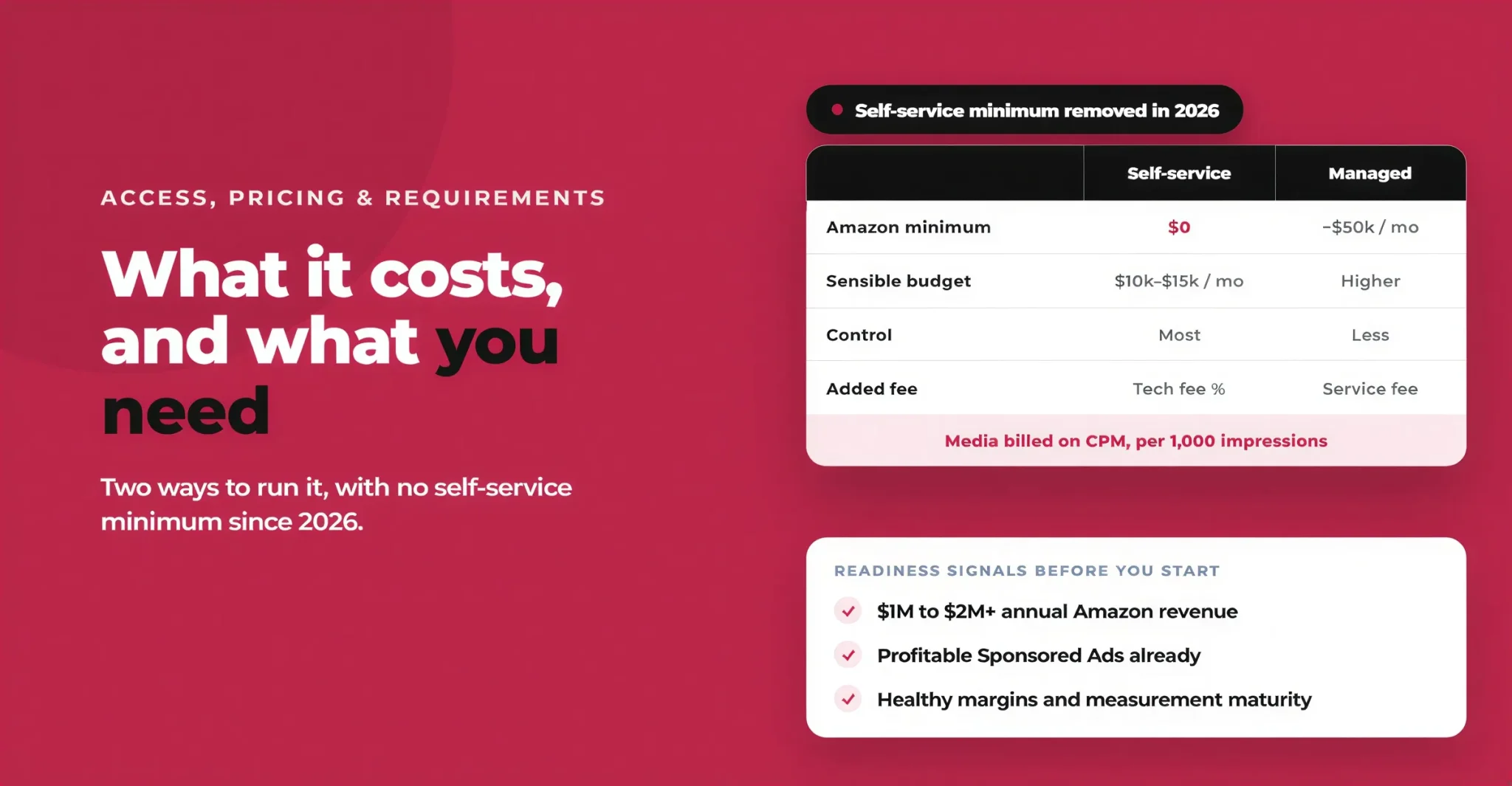
There are two ways to run Amazon DSP, and the choice shapes both cost and control. With self-service, your team or an agency operates the platform directly, which offers the most control and the lowest fees but requires genuine expertise, since the platform's sophistication can just as easily produce wasted spend. Managed service is the alternative, where Amazon's own team runs your campaigns with dedicated support, in exchange for a higher entry point and less hands-on control. Many growing brands take a third path, working with a specialist agency that runs self-service DSP on their behalf, combining expert management with the flexibility and economics of the self-service platform.
Minimum Spend and the 2026 Threshold Change
Access changed meaningfully in 2026. Historically, self-service DSP carried a minimum spend commitment, often cited around $10,000 a month, that put it out of reach for many smaller advertisers. At its unBoxed 2025 event, Amazon removed that self-service minimum, so there is now no Amazon-imposed minimum to access self-serve DSP. In practice, budget still matters for a different reason: optimisation depends on gathering enough conversion signal, so a working budget of roughly $10,000 to $15,000 a month remains a sensible starting point, and spending much below that can leave campaigns short of data. Managed service sits much higher, still typically starting around $50,000 a month and varying by country.
CPM Billing and Technology Fees
Unlike the cost-per-click model of Sponsored Ads, DSP bills primarily on a cost-per-thousand-impressions, or CPM, basis: you pay for ads to be served and seen, consistent with its role as a full-funnel channel where much of the value is in exposure and influence. On top of media costs, the structure differs by service model: self-service adds a technology fee charged as a percentage of spend, managed service adds a higher service component, and an agency adds its management fee. Factoring in these layers matters, because the all-in cost per outcome, not just the media rate, determines whether a DSP program is profitable.
Readiness Signals Before You Start
DSP rewards brands that come to it prepared. The strongest candidates are already doing meaningful volume, often cited as roughly $1 million to $2 million or more in annual Amazon revenue, with proven profitability on their Sponsored Ads; if your search campaigns aren't yet efficient, that's the place to fix things first, because DSP amplifies a working system rather than rescuing a broken one. Beyond revenue, three signals matter: healthy margins that give room to invest in media that pays back over a longer horizon, sufficient budget to gather optimisation signal, and measurement maturity, the ability to look beyond last-click and judge full-funnel impact.
Why Amazon DSP Works: Core Benefits
DSP's advantages all trace back to one thing: Amazon's first-party data applied across premium, full-funnel inventory. The table below distils why brands invest in the channel, with each line a candidate for a banner or pull-out highlight.
Benefit | What it means for your brand |
|---|---|
Data-driven precision | Targeting built on observed purchases across 300M+ shoppers, not inferred interests, so less wasted spend |
Full-funnel, off-Amazon reach | One coherent strategy from awareness to repeat purchase, on Amazon and across the open web, CTV, and audio |
Premium and streaming inventory | Fire TV, Prime Video, Twitch, and IMDb placements most brands can't otherwise buy, tied back to real sales |
Brand building and defensibility | Compounds into organic demand and loyalty that rivals can't copy, unlike keywords or price |
Together these turn DSP from a media buy into a long-term growth engine. The awareness and loyalty it builds make every other channel work harder and leave your brand far more resilient to price wars, new entrants, and rising ad costs than one that depends entirely on capturing demand at the bottom of the funnel.
Limitations & Trade-Offs to Weigh
Budget Threshold and Commitment
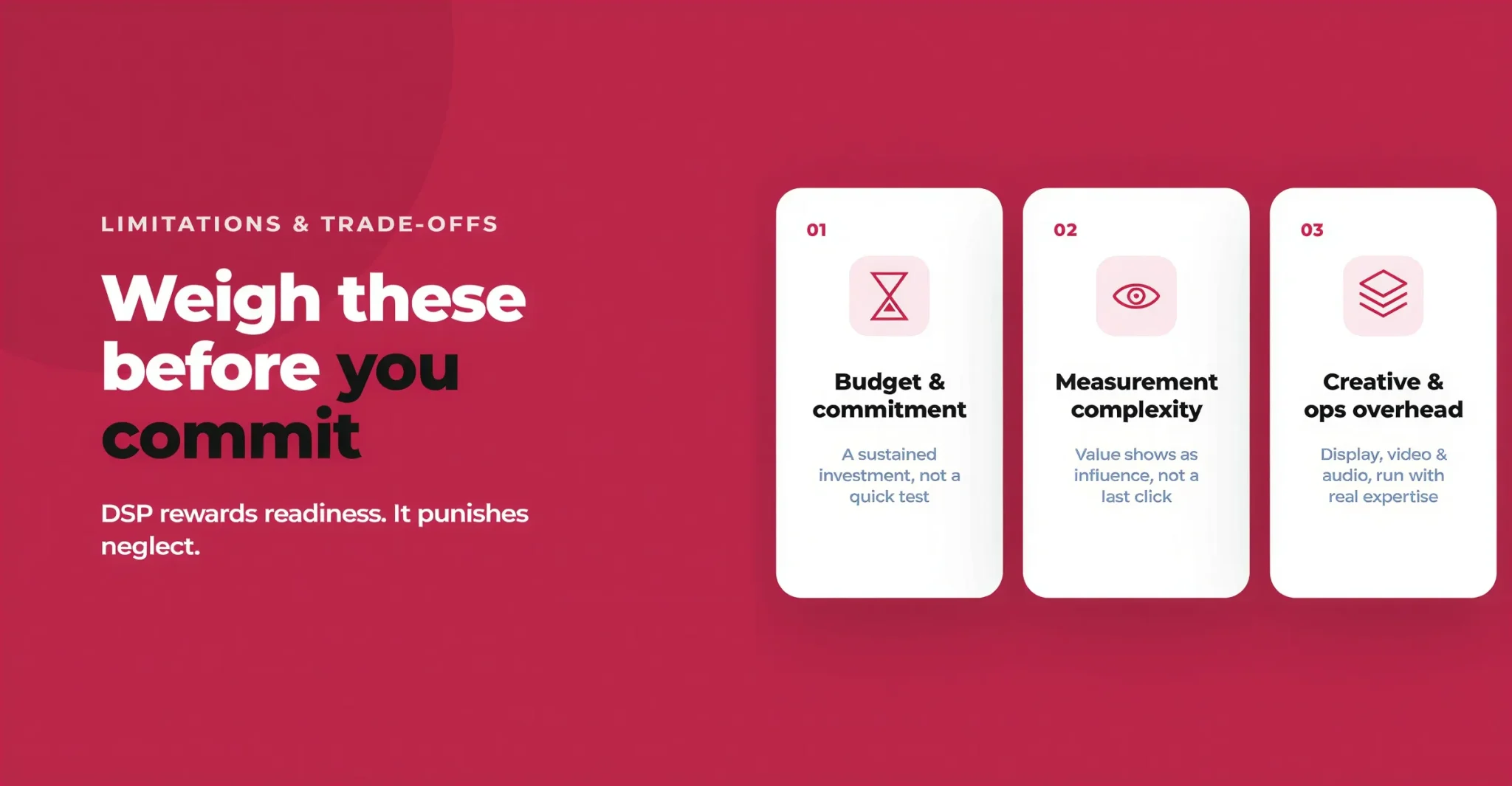
For all its strengths, DSP isn't right for every brand, and the first reason is commitment. Even with the self-service minimum removed, running it effectively requires enough budget for the system to gather signal, sustained over time rather than in a brief test, and upper-funnel media pays back over a longer horizon than search. A brand still finding its footing on Sponsored Ads, or operating on thin margins with little room to invest ahead of return, will usually get more from perfecting its search program first.
Attribution and Measurement Complexity
The second trade-off is measurement. Because DSP bills on impressions and works across the funnel, much of its value shows up as influence on later behaviour rather than an immediate, attributable click. View-through conversions are central to DSP's impact but invisible to a simple last-click view, which demands a more sophisticated approach and a willingness to judge campaigns on full-funnel contribution. Brands that apply a narrow, last-click lens to DSP often conclude it isn't working when in fact they're simply not measuring what it does.
Creative and Operational Overhead
The third consideration is the work DSP requires. Unlike search ads, which lean on keywords and your existing product pages, DSP campaigns need quality creative across display, video, and audio, and that creative materially affects performance. The platform itself is powerful and complex, with controls that reward expertise and punish neglect, so running it well means developing real in-house capability, committing to managed service, or partnering with a specialist agency. Underestimating this overhead is one of the most common reasons DSP programs disappoint.
Measuring Amazon DSP Performance
ROAS Benchmarks by Campaign Type
Return on ad spend is the headline metric for DSP, but a single blended number hides important differences between campaign types, each of which should be judged against its own benchmark.
Campaign type | Target ROAS | Why |
|---|---|---|
Retargeting | 4:1 – 8:1 | Re-engages warm, high-intent shoppers |
Prospecting | 2:1 – 3:1 | Reaches new audiences, investing in future demand |
Blended (with view-through) | 3:1 – 5:1 | A full-funnel program combining both |
The mistake to avoid is holding a prospecting campaign to retargeting-level ROAS, which makes healthy upper-funnel activity look like failure and tempts you to cut exactly the spend building your future pipeline. Set expectations by objective, track each layer separately, and evaluate the program on its combined contribution.
View-Through Conversions and New-to-Brand Metrics
Two metrics capture value that last-click measurement misses. View-through conversions record when a shopper is served an ad, doesn't click it, and later purchases anyway, a common outcome for awareness and video campaigns where the goal is influence rather than a click; including them is essential to seeing DSP's true contribution. New-to-brand metrics measure how many orders come from customers who haven't bought your brand recently, a direct read on whether a channel built to grow your customer base is doing its job. A DSP program generating a healthy flow of new-to-brand customers is expanding your market even if its immediate ROAS looks modest, so watching it alongside ROAS keeps you focused on growth, not just efficiency.
Why Last-Click Attribution Undersells DSP
The most common mistake in evaluating DSP is judging it by last-click attribution, the same lens many brands apply to search ads. Last-click gives all the credit for a sale to the final touchpoint, undervaluing everything earlier in the journey. Since DSP specializes in those earlier touchpoints, building awareness and consideration that later show up as a branded search or direct visit, last-click hands the credit DSP earned to whichever channel closed the sale. The result makes upper-funnel media look weaker than it is, and brands that act on it often cut the very campaigns generating their future demand. Measuring DSP fairly means embracing fuller attribution, watching new-to-brand growth, and tracking the halo effect on organic and search. (If your measurement is still anchored to search efficiency, our guides to ACOS and to tracking total ad efficiency with TACOS are useful companions.)
How to Get Started: Implementation
In-House, Managed Service, or Agency
The first decision is who will run your DSP, and there are three realistic paths. Running it in-house through self-service gives maximum control and the lowest platform fees but demands real programmatic expertise, since the platform is unforgiving of inexperience. Managed service hands the work to Amazon's own team, suiting brands that can meet the higher spend threshold and prefer dedicated support. The third path, partnering with a specialist agency that runs self-service DSP on your behalf, is how many growing brands get the best of both, which is why most mid-sized brands scaling into DSP for the first time find an experienced agency offers the fastest, lowest-risk route.
Pre-Launch Readiness Checklist
Before launching a single campaign, have the foundations in place: a budget sufficient to gather optimisation signal rather than a token test; product detail pages that convert well, since even the best targeting can't fix a weak page; quality creative across the formats you intend to use; clearly defined audiences and the funnel stage each campaign serves; and a measurement framework that accounts for view-through conversions, new-to-brand customers, and full-funnel impact. Getting these right prevents the most common early failures, where campaigns underperform not because DSP doesn't work but because the surrounding pieces weren't ready.
A Phased Rollout Plan
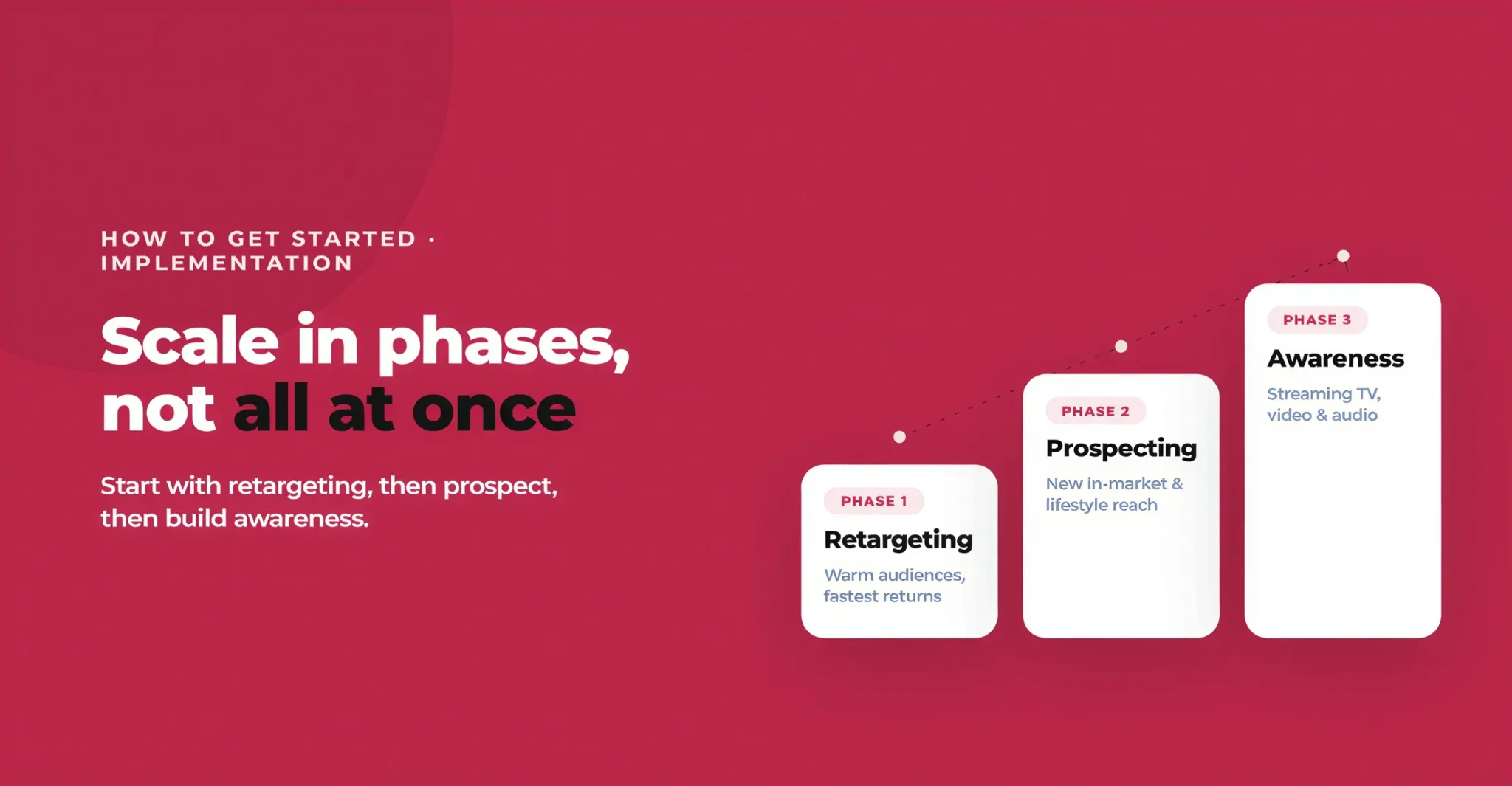
The most reliable way to scale into DSP is in deliberate phases rather than all at once. Begin with retargeting, since it re-engages warm audiences and delivers the fastest, strongest returns, building early wins and confidence while the program accumulates the signal the platform uses to optimise. From there, layer in prospecting to reach new in-market and lifestyle audiences once retargeting is performing, accepting its lower ROAS as the cost of building future demand, then add upper-funnel awareness through streaming TV, video, and audio. Throughout, measure each layer against its benchmark and watch how the whole system, including your search and organic performance, responds. This phased approach manages risk and lets you scale spend with evidence rather than hope.
Is Amazon DSP Right for Your Brand?
Amazon DSP is the channel that takes a brand beyond the ceiling of search advertising. It moves you from capturing demand to creating it, reaching shoppers before they search and beyond Amazon's pages, powered by first-party data and premium inventory no other platform can fully match. Used well, it builds awareness, recovers lost sales, conquers competitors, retains customers, and constructs the durable brand demand that makes every other channel work harder.
But access is not the same as readiness. DSP rewards brands that come to it with proven Sponsored Ads performance, healthy margins, sufficient budget, and a mature view of measurement, and it punishes those who treat it as a pricier version of search or judge it by last-click alone. If your fundamentals are solid and you're ready to invest in full-funnel growth, DSP is one of the most powerful tools available to scale your brand; if they're not, strengthen them first. If you'd like a team that builds and manages full-funnel Amazon advertising, from Sponsored Ads through DSP, around real business outcomes, Flairox can help. Book an Amazon advertising review with Flairox to find out whether DSP is the right next step for your brand.
Frequently asked questions
No. DSP is open to non-endemic brands, advertisers who don't sell on Amazon at all, which is one of its defining differences from Sponsored Ads. Companies in categories like automotive, travel, financial services, and insurance use DSP specifically to reach Amazon's audiences and drive traffic to their own sites.