 Ali Sohail
Key takeaways
Sponsored Products target bottom-funnel shoppers, driving immediate sales for individual products.
Sponsored Brands focus on brand visibility, ideal for building awareness and promoting a product portfolio.
Sponsored Display expands reach beyond Amazon, enabling retargeting and audience growth both on and off the platform.
Combining these ad types strategically maximizes brand presence, engagement, and sales across various stages of the customer journey.
If you’ve recently tried launching your own Amazon advertising campaign for the first time, you’ve probably gotten stuck at the first step: Choosing your campaign type.
Amazon lets you choose among four main campaign types:
Sponsored Products
Sponsored Brands
Sponsored Display
Sponsored TV (New)
But which one should you choose? What’s the difference between each campaign type? What does each campaign let you accomplish? And what are the pros and cons of each of them?
If you’ve been stuck trying to figure these things out, you’ve come to the right place. In this post, we’ll tell you everything you need to know about these campaign types, and how they’re different from each other.
By the end of this post, you will have everything you need to make an informed decision regarding the right campaign type for your business on Amazon.
Sponsored Products vs Brands vs Display- What’s The Difference?
The Broader Structure of Amazon’s Advertising Services
Before diving into the different types of advertising campaigns- Sponsored Products, Sponsored Brands, and Sponsored Display- it’s important to understand where these formats fit within Amazon’s broader advertising ecosystem.
At a high level, Amazon’s advertising services can be divided into two primary categories: self-service advertising and Amazon DSP (Demand-Side Platform).
Let's explore what they are.
Self-Service Advertising (Amazon Ads Console)
This includes Sponsored Products, Sponsored Brands, and Sponsored Display campaigns. These ad types are accessible through Amazon Ads Console and are commonly used by both third-party sellers (3P) and first-party vendors (1P). They offer a flexible, performance-based approach to driving visibility and sales directly within Amazon’s marketplace.
Amazon DSP (Demand-Side Platform)
Amazon DSP is a more advanced advertising solution that allows brands to programmatically buy display, video, and audio ads both on and off Amazon. It’s designed for advertisers looking to reach audiences across the wider web- including Amazon-owned properties like IMDb and Fire TV.
DSP is typically geared toward larger-budget brands. Sellers and vendors must register for DSP through Amazon and typically need to meet a minimum spend requirement (which is usually around $50,000 USD).
While Amazon offers managed DSP services, it’s also possible to access DSP in a self-service format through approved Amazon DSP agencies.
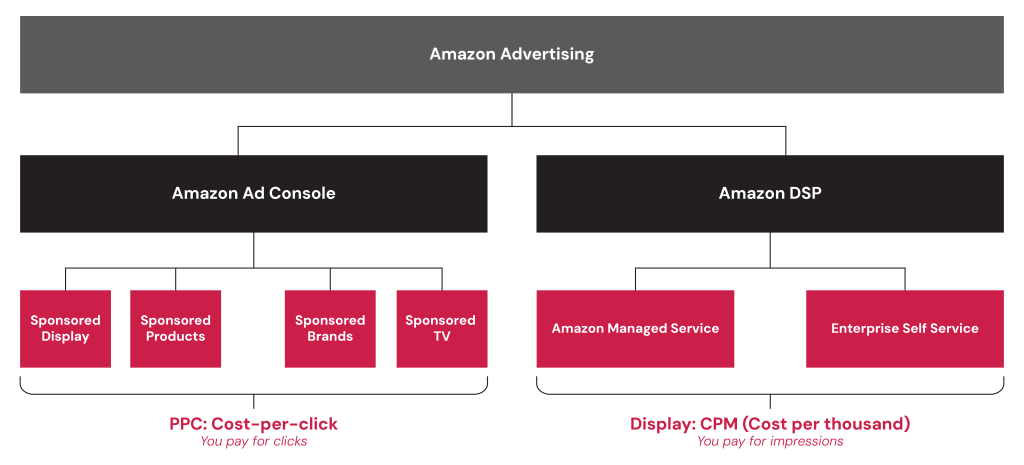
Why is this important to know? because Sponsored Products, Sponsored Brands, and Sponsored Display are just parts of a much larger system. As someone who’s running a business on Amazon or trying to become a PPC expert, you need to be familiar with the entire ecosystem and understand how each piece fits together in the larger picture.
When you know the purpose of each advertising service option on Amazon, you’ll make smarter, more informed decisions regarding your Ad strategy. Now, you do know, so let’s finally get into the differences between Sponsored Product, Sponsored Brands, and Sponsored Display Campaigns.
If you're trying to become an Amazon PPC expert, or just learning it so you can launch ads on your Amazon store, we strongly recommend you read our complete guide on Amazon PPC for beginners- it will build you a strong foundation in PPC and serve as a great starting point for further research.
Sponsored Product vs Sponsored Brand vs Sponsored Display
If you’ve tried creating a campaign on Amazon seller or vendor central, you’re already seen the interface below.
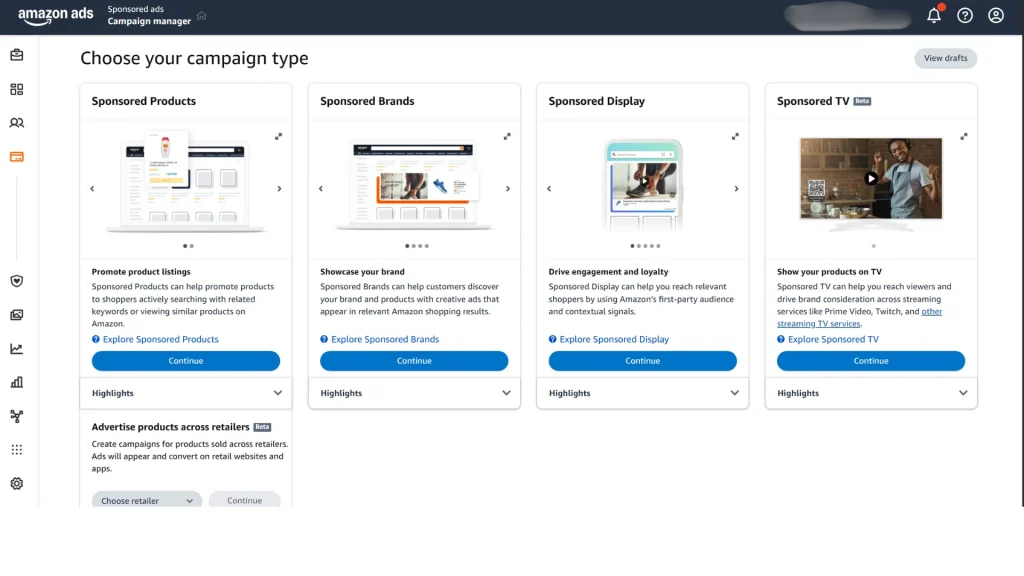
This is where you decide whether you want to create a sponsored products campaign, a sponsored brands campaign, a sponsored display campaign, or a sponsored TV campaign.
Let’s dive deeper into each of these campaign types. Since sponsored product campaigns are the most popular, we’ll start with those.
Sponsored Product Ads
What Are Sponsored Product Ads?
Sponsored product ads are CPC (Cost per click) ads meant to promote individual product listings on Amazon. These ads are specifically meant for your bottom-of-the-funnel audience because they make your products visible in places where Amazon users are looking to make a purchase.
With Sponsored products ads, you can choose whether you want to target by keywords, products (or ASINs), or product categories.
Targeting by keyword lets you display your ads when shoppers search for specific terms i.e., “30W USB-C Power Bank”
Targeting a specific product ASIN lets you display your ad on specific competitor product detail pages (or even your own). Say your product offers the same value at a lower price. That’s when you would want to target the specific competitor products that you’re outperforming.
Targeting a product category lets you display your ads more broadly within a product category. Usually, you’d want to target the same product category your product is in, but if you have the budget to experiment, you could also try targeting complementary product categories.
In the campaign settings you can choose whether you want to target keywords or products manually, or whether you want Amazon to do it automatically.
If you want a click-by-click guide on how to launch your first sponsored products campaign on Amazon (with screenshots), we strongly recommend reading our complete guide on it.
Where Do Sonspored Product Ads Appear?
Sponsored products ads appear in various places both on and off Amazon (although off-Amazon placements are optional).
The main placements for Sponsored Product Ads are:
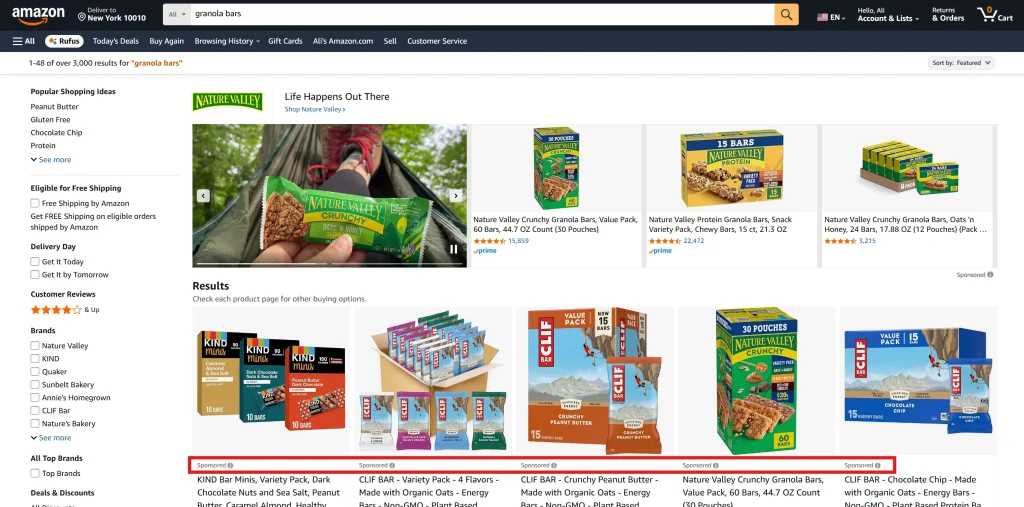
Search Results Page (At the top, middle, and bottom of the page)
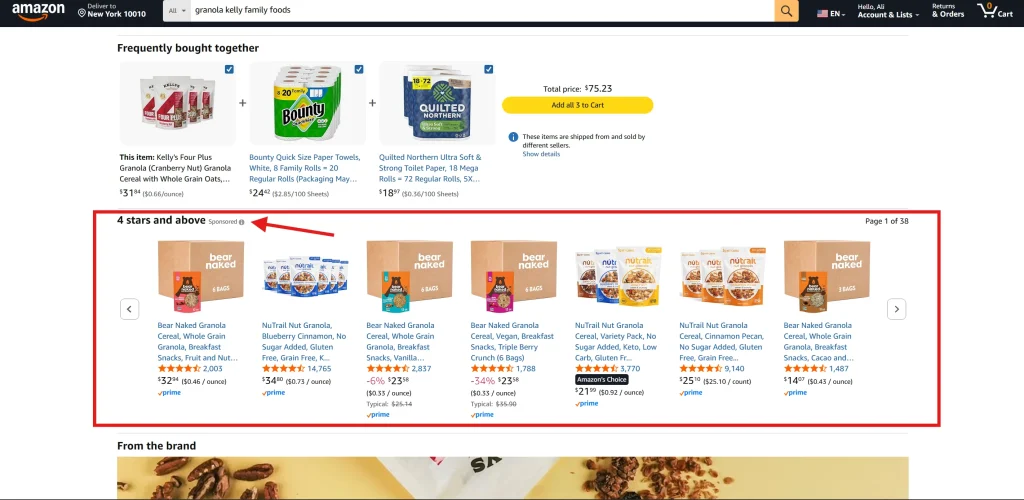
Product Details Page (displayed as sponsored products related to this item or 4 stars and above)
Here’s what these placements look like in practice:
When Should You Use Sponsored Product Ads?
So when should you pick sponsored products ads over sponsored brands or sponsored display? Generally, you’d want to launch a sponsored products ad campaign when:
You’re launching a new product
You’re boosting sales for an existing product
Defending your own listing from competitor ads on your product pages
Trying to steal competitor traffic by placing your ad on their product pages
Running time-sensitive sales like on prime day or holiday season
Tip: Once your sponsored ad campaigns are well-optimized and maintaining a decent ROAS consistently, you should let them run as an always-on sales engine.
Pros & Cons of Sponsored Products Campaigns
Pros | Cons |
High purchase intent targeting | Highly competitive |
Easy to launch and scale | Limited branding opportunity |
Drives immediate sales |
Learning Amazon PPC? We've got you covered! Once you're through learning about the differences between Sponsored Products, Sponsored Brands, and Sponsored Display campaigns, we strongly recommend you read our complete guide on the 10 most important Amazon PPC metrics you should track. Whether you're learning Amazon ads to become a PPC expert, or simply trying to run campaigns for your business, knowing which metrics to track and how to interpret them is crucial.
What Are Sponsored Brands Ads?
Sponsored Brands ads are CPC (Cost per click) ads designed to promote your brand and a selection of your products on Amazon. These ads are best suited for top- and mid-funnel audiences because they focus on increasing brand visibility, driving store traffic, and introducing shoppers to your broader catalog- not just one product. Unlike Sponsored Product Ads, you must be enrolled in the Amazon Brand Registry to be able to run a Sponsored Brand campaign.
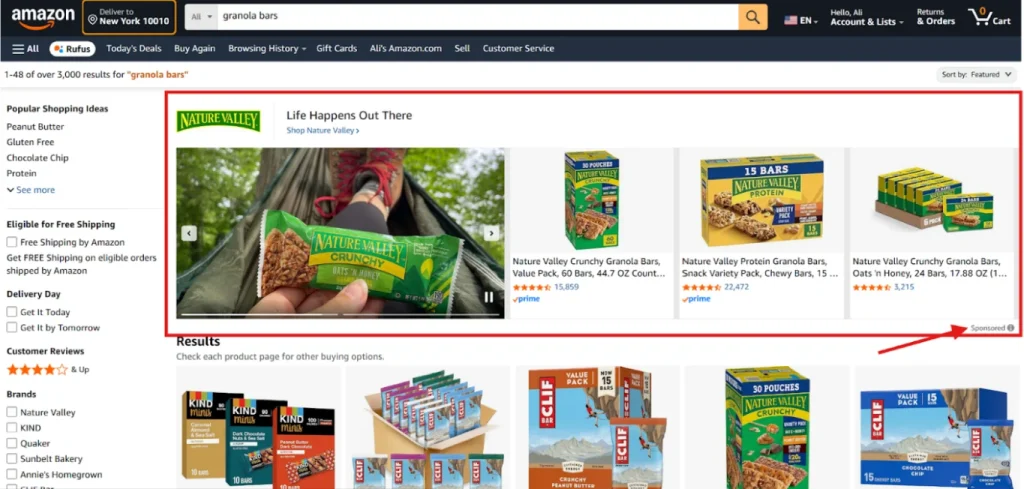
A typical sponsored brands ad will include:
Your brand logo
A custom headline
Your ad creative (can be a video)
Up to 3 products and a link to your storefront.
Unlike a sponsored products ad campaign, where your product listing is directly converted into an ad without any autonomy to design the ad creative yourself, sponsored brands campaigns allow you to choose from three ad formats
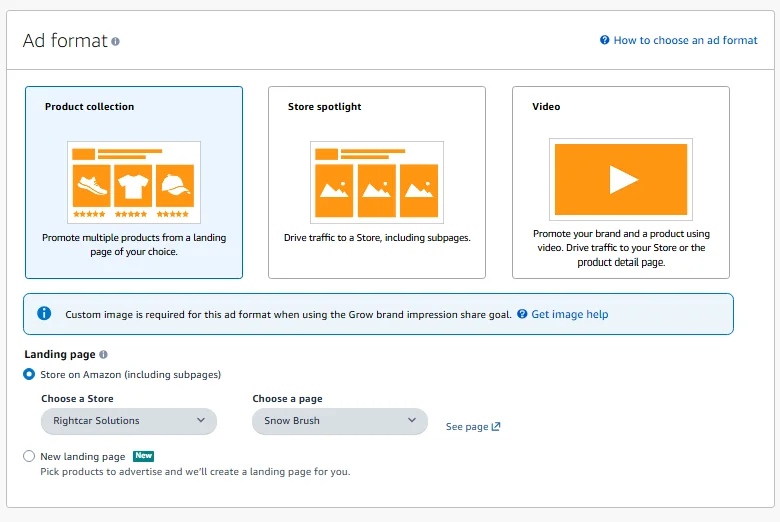
Product collection: Show 3 products alongside your logo and headline. Clicking a product sends shoppers to that product page. Clicking your logo or headline takes them to your Store or a custom landing page.
Video: Show a short, autoplaying video highlighting one product. Clicking takes shoppers directly to the product detail page or your storefront.
Store spotlight: Promote different pages of your Amazon Store- ideal for brands with multiple categories or product lines.
Targeting works similarly to Sponsored Products: You can target keywords or products to determine where your ads appear (although this option is only available for product collections ads; not video or store spotlight ads). Keyword targeting is the main and default targeting method for sponsored brands campaigns, but just like Sponsored Products campaigns, you can set targeting to manual (choose your own keywords or products) or automatic (let Amazon decide based on relevance and performance).
Sponsored Brands are ideal for capturing attention early in the buyer journey- especially when you're looking to build brand recognition, promote product variety, or drive Store traffic at scale.
Where Do Sponsored Brands Campaigns Appear?
Sponsored Brands ads appear in high visibility placements such as:
The home page
At the top of the search results (sponsored brands ads appear in the middle and bottom of search results as well)
At the top of product detail pages
Note: These ad placements apply to both desktop and mobile devices.
Here’s what these ads look like in practice:
When Should You Use A Sponsored Brands Campaign?
Sponsored Brands ads are ideal when you want to boost brand visibility alongside driving sales. You should consider launching a Sponsored Brands campaign when:
You’re building brand awareness and want shoppers to recognize your logo or tagline
You have a product portfolio and want to showcase multiple items together
You want to drive traffic to your Amazon Store or a custom landing page
You’re targeting high-intent keywords to dominate the top-of-search placement
You want to protect branded keyword searches from competitors
Tip: Sponsored Brands ads work best when paired with Sponsored Products. Use them to reinforce your presence on the search results page and create a stronger brand impression across multiple placements.
Pros & Cons of Sponsored Brand Campaigns
Pros | Cons |
Boosts brand visibility | Requires brand registry |
Showcase multiple products | Higher CPCs than sponsored products (generally) |
Custom creative options |
What Are Sponsored Display Ads?
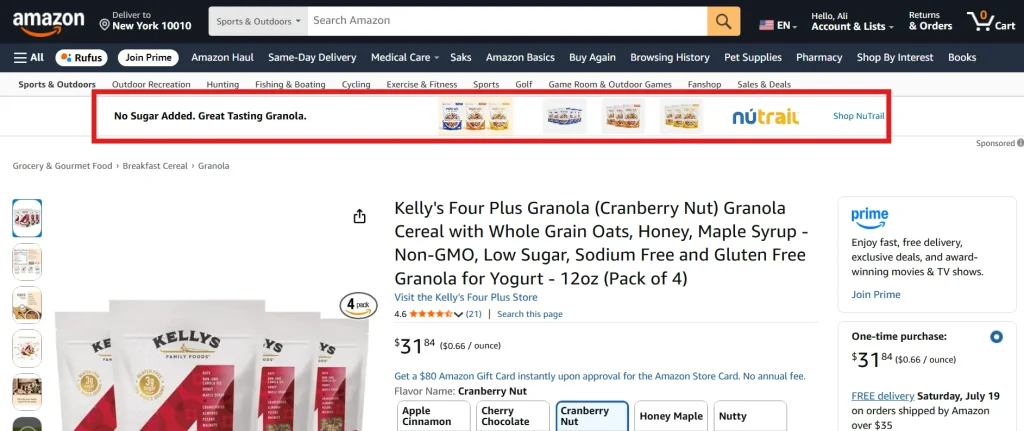
Sponsored Display is Amazon’s display advertising solution for all kinds of sellers (regardless of whether they sell on Amazon or not). These ads show up all across Amazon and Amazon-owned properties like IMDB and Twitch (optional). Like Sponsored Brands ads, you can’t run Sponsored Display ads without being enrolled into Amazon’s Brand registry.
As in the case of Sponsored Brands ads, Display ads will also allow you to choose between ad format options (two in this case). Specifically, you get to choose between image ads and video ads (Amazon recommends video ads).
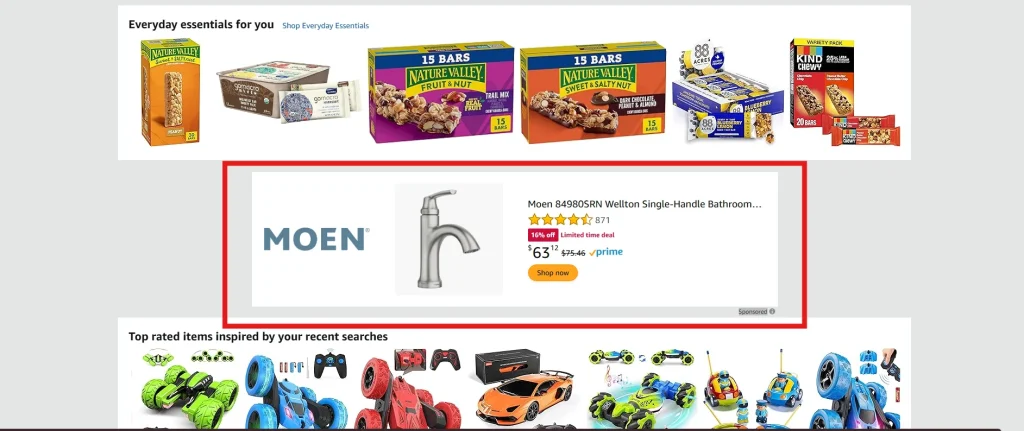
Whichever option you choose, the elements of each display ad remain largely the same:
Product image/ video ad
Product Title
Star Rating (and review count)
Pricing & Discounts
Call to action button i.e., “learn more,” “Shop now.”
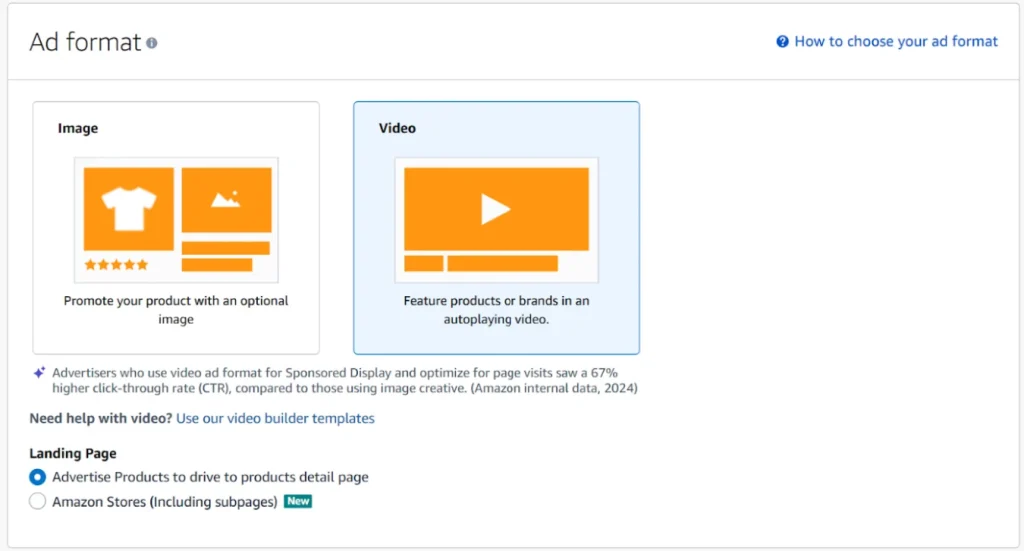
Unlike Sponsored Products and Brands campaigns, Sponsored Display ads are not solely priced on CPC (cost per click)- Amazon lets you choose between CPC and vCPM (which means that you’re charged for every 1000 viewable impressions of your ad.
Where Are Sponsored Display Ads Placed?
Sponsored display ads appear on:
Amazon’s home page
Search results
Product details pages
Several Amazon owned apps and websites like Twitch and IMDB.
Third party apps and websites that are a part of Amazon’s ad network.
When Should You Use a Sponsored Display Campaign?
Sponsored Display ads are ideal for retargeting, audience expansion, and off-Amazon visibility. You should consider launching a Sponsored Display campaign when:
You want to retarget shoppers who viewed your product but didn’t purchase
You’re aiming to reach new audiences based on shopping behavior or interests
You want to expand your brand presence beyond Amazon’s search results, including on product detail pages and external sites.
You’re trying to boost your reach during popular shopping events by cross-selling complementary products on your own pages
You’re promoting clearance and seasonal products
You’re trying to accelerate sell-through of products with higher prices or longer sales cycles.
Tip: Sponsored Display is particularly powerful when layered with Sponsored Products and Sponsored Brands. Use it to stay top-of-mind across the customer journey- both on and off Amazon- and increase your share of voice against competitors.
Pros & Cons of Sponsored Display Ads
Pros | Cons |
Enables retargetingExpands reach off AmazonSupports awareness & conversion | Lower control over placement |
Expands reach off Amazon | Can yield low ROAS without extensive optimization |
Supports awareness & conversions |
What Are Sponsored TV Ads?
As we mentioned earlier, there’s now a fourth type of self service campaign that you’ll find on your campaign manager: Sponsored TV ads.
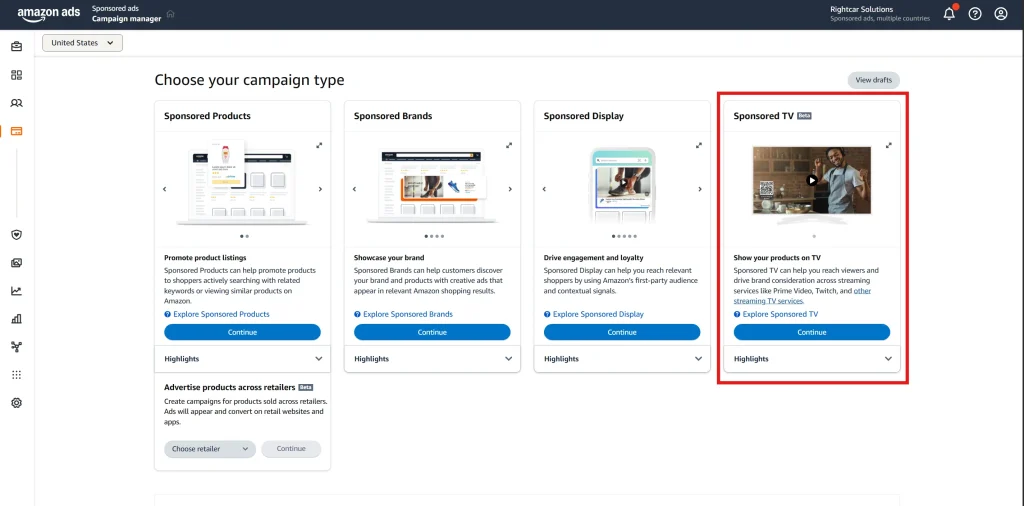
Sponsored TV ads are streaming TV ads that run on Amazon’s ad-supported streaming platforms like:
Freevee
Prime Video
Twitch
Fire TV apps and channels
Third-party streaming services that partner with Amazon.
Sponsored TV ads are meant to be used by both sellers on and off of Amazon (although, their ad service to off-Amazon sellers is still in beta testing).
You’ll see these video ads in placements like:
Before an episode or movie starts
Fire TV home screen banners
Livestream ad breaks (Twitch)
Sponsored TV ads are best for driving brand awareness at scale. Use them when:
You want to build visibility with relevant audiences across streaming content
You’re launching a new product or entering a new category
You need to grow top-of-funnel interest before people start searching
You’re promoting seasonal or brand-led campaigns
You want to reach audiences beyond Amazon’s shopping environment
Summary of Differences Between Sponsored Products, Brands, and Display Ads
We’ve discussed quite a lot about each of the different types of self service campaigns Amazon offers, so if you’re having trouble comparing these campaign types, we don’t blame you.
Here’s a table that’ll fix this problem- it compares Sponsored Products, Sponsored Brands, and Sponsored Display campaigns
Sponsored Products | Sponsored Brands | Sponsored Display | |
Ad Focus | Individual product | Brand + multiple products | Product or audience-based display ads |
Funnel Stage | Bottom-funnel (purchase intent) | Mid- to upper-funnel (brand awareness + discovery) | Full funnel (awareness, retargeting, loyalty) |
Eligibility | Open to all eligible sellers/vendors | Requires Brand Registry | Requires Brand Registry |
Creative Control | No (Amazon uses your listing data) | Yes (custom logo, headline, product selection, Store links) | Yes (images, headlines, call-to-action, sometimes video) |
Targeting - Keywords | Yes (manual & auto) | Yes (manual only) | No keyword targeting |
Targeting - ASINs / Products | Yes | Yes | Yes |
Targeting - Categories | Yes | Yes | Yes |
Targeting - Audiences | No | No | Yes (views, purchases, interests, lifestyle, in-market, etc.) |
Auto Targeting | Yes | No | No |
Placement Types | - Search results- Product pages | - Top of search- Brand Store page- Product pages | - Product pages- Off-Amazon (web, apps)- Amazon home page |
Bidding Model | CPC | CPC | CPC or vCPM (viewable cost per 1,000 impressions) |
Video Option | No | Yes (SB Video) | Yes (custom video creatives allowed) |
Landing Page Options | Product detail page | Brand Store, custom landing page, or product list | Product detail page, brand Store, or custom |
Branding Opportunity | No (product-level) | Strong (logo, Store, messaging) | Strong (custom visuals, brand storytelling) |
Reporting Detail | Strong performance metrics (ACoS, CTR, sales) | Same as SP + brand awareness metrics | Audience metrics (impressions, reach, views) |
Retargeting Capabilities | No | No | Yes (views, purchases, competitors) |
On vs Off Amazon | On Amazon only | On Amazon only | On and off Amazon (web, mobile apps, Fire TV, etc.) |
Use Case | Sales, launches, keyword mining | Brand building, top-of-search visibility, Store traffic | Retargeting, competitor conquesting, off-Amazon reach |
Setup Complexity | Low (fast to launch) | Moderate (requires assets, headline, targeting) | Moderate to high (creative, audience selection) |
Conversion Intent | High | Mid | Lower to mid (depending on audience targeting) |
Final Words
Choosing the right Amazon advertising campaign depends on your goals. Sponsored Products are best for driving direct sales, while Sponsored Brands boost brand visibility and store traffic. Sponsored Display campaigns excel at retargeting and expanding reach both on and off Amazon.
To maximize success, consider using a mix of these campaigns to target different stages of the customer journey. Testing and optimization are key to finding the best strategy for your business. With these insights, you’re now ready to make more informed decisions and grow your brand on Amazon.
Frequently asked questions
CPC (Cost Per Click) charges advertisers when a user clicks on an ad, making it ideal for performance-driven campaigns. vCPM (Viewable Cost Per 1,000 Impressions) charges based on the number of viewable impressions, making it suitable for brand awareness and visibility-focused campaigns.