 Raahim Sheikh
Imagine opening your order inbox and finding a sale you don't recognise. The shipping details are real, the payment has cleared, but the customer email is an anonymised Amazon address, and the product was bought from your own website by an AI you never gave permission to act on your behalf. For a growing number of brands, that's not a hypothetical. It's the first time they learned Amazon's "Buy for Me" feature existed.
Amazon Buy for Me is one of the most consequential, and most controversial, developments in e-commerce right now. It quietly extends Amazon's reach beyond its own marketplace and into the wider web, and it does so in a way that affects your brand whether or not you sell on Amazon at all. This guide explains what Amazon Buy for Me is, how it works, why it has caused a backlash among sellers, and what you should actually do about it.
What Is Amazon "Buy for Me"?
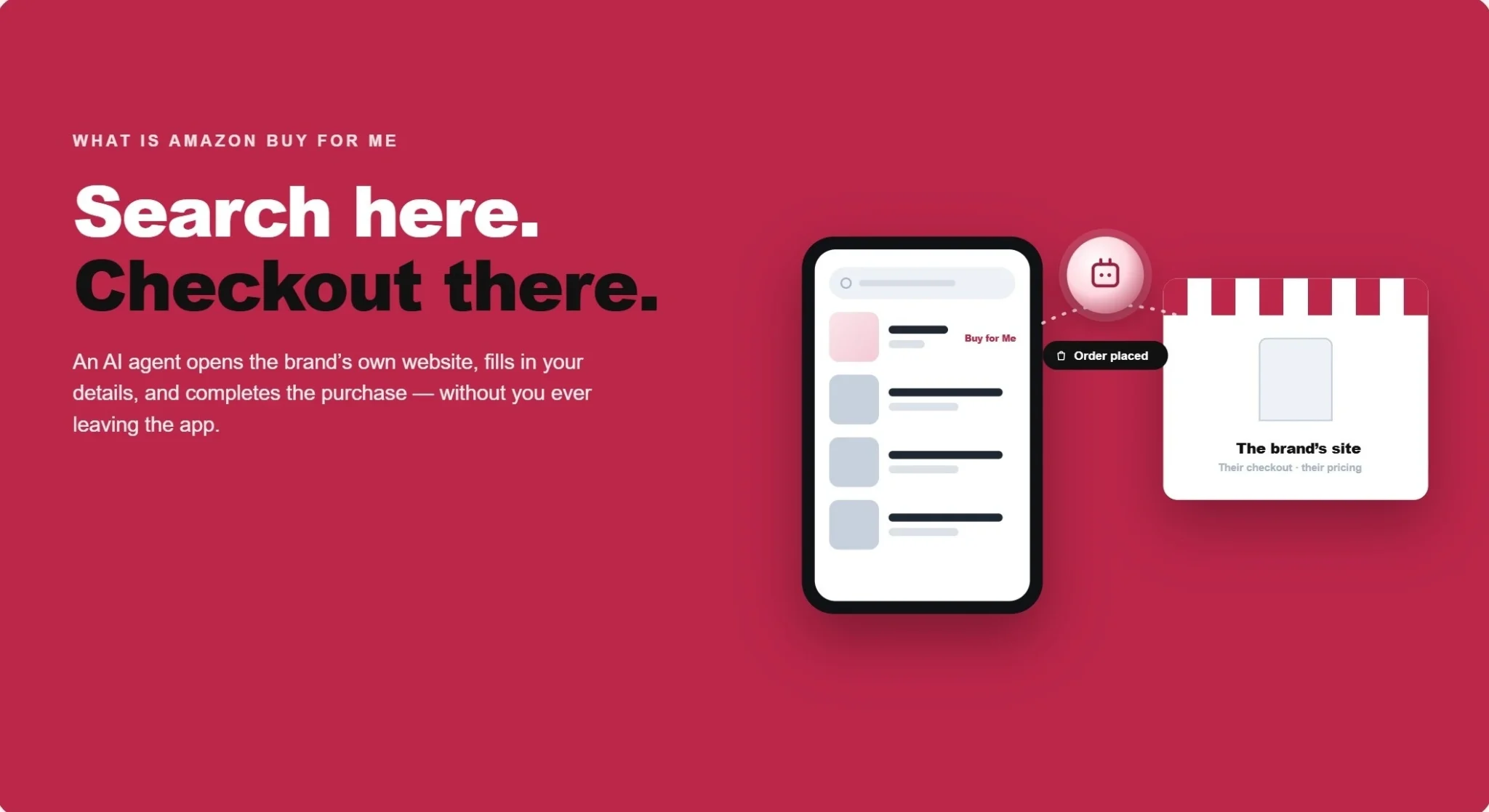
Amazon Buy for Me is an agentic-AI feature inside the Amazon Shopping app that completes purchases from third-party brand websites on a shopper's behalf, without the shopper ever leaving the app. When someone searches for a branded item, Amazon may show products it doesn't stock itself in a dedicated section of the results, and let the customer buy them through an AI agent that fills in the checkout on the brand's own site.
The feature is still a beta, available to a subset of US customers and working with a limited set of brand stores and products, with Amazon planning to expand it over time. Under the hood it runs on Amazon Bedrock, using Amazon's Nova models and Anthropic's Claude to power the agent that navigates each brand's checkout flow. In other words, it is a real, working example of agentic commerce: an AI carrying out a multi-step task across different websites, under a shopper's instruction.
Buy for Me vs Shop Direct
The two names are related but not identical. Shop Direct is the underlying index that lets Amazon surface products from outside its own marketplace. As of early 2026 it covers more than 100 million products from over 400,000 merchants. Buy for Me is the agentic checkout layer that sits on top of it, the part that actually completes the purchase. Tens of millions of those indexed products are currently buyable through Buy for Me, with the rest displayed as links that send the shopper to the brand's site to check out themselves.
How It Differs From Selling on Amazon
This is the distinction that trips up most sellers. With a normal Amazon listing, or with FBA, your product lives inside Amazon's catalogue, Amazon takes referral fees, and in the FBA case Amazon stores and ships the item. Buy for Me is the opposite. Your product stays on your own website, your inventory and pricing come from your own systems, and you handle fulfilment yourself. Amazon simply acts as the shopfront and the checkout assistant. It is less like becoming an Amazon seller and more like Amazon becoming an automated personal shopper that buys from you.
How Buy for Me Works, Step by Step
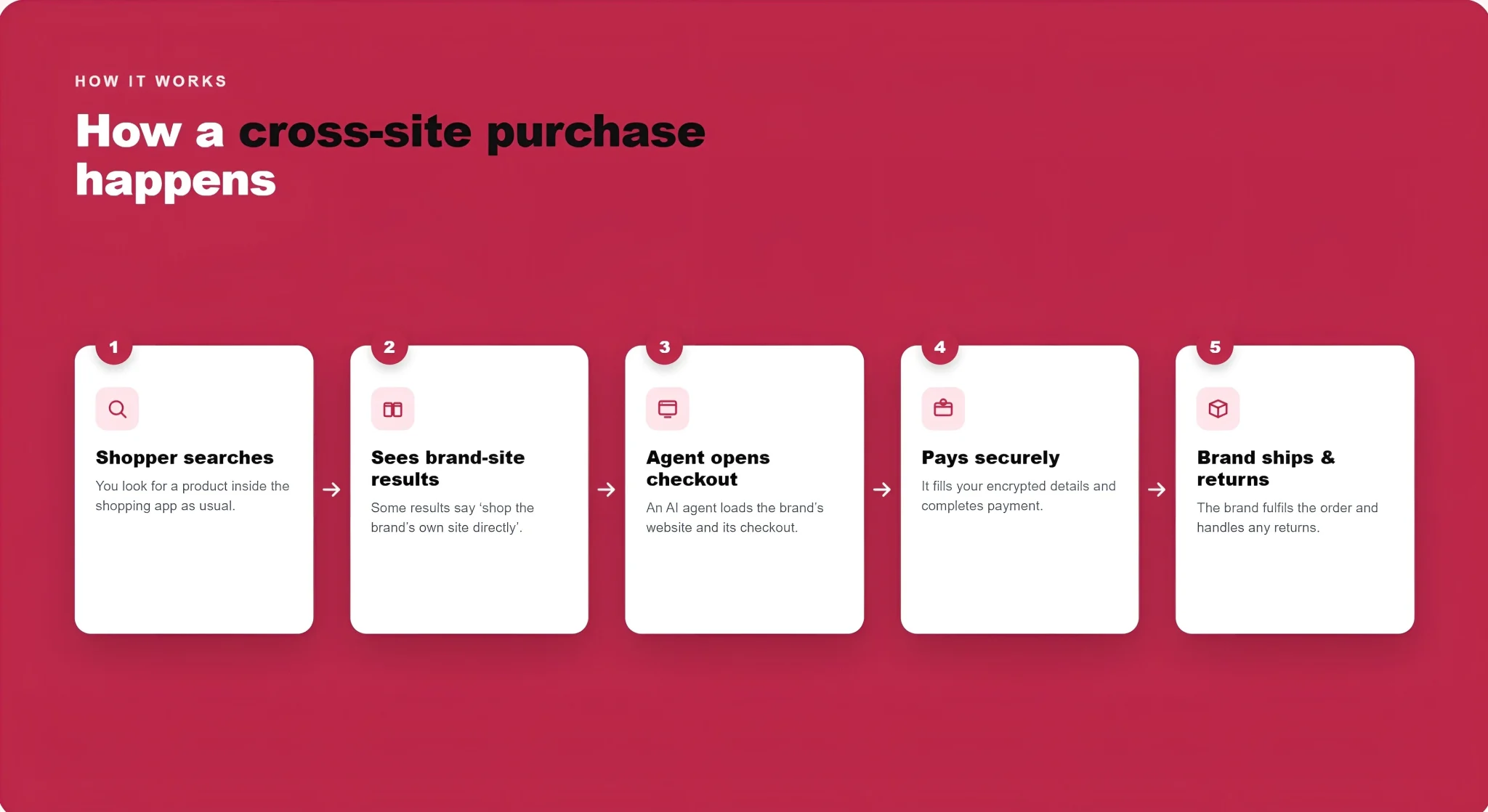
For the shopper the experience is almost invisible, which is exactly the point. When they search for a branded item in the Amazon app, they see the usual results from Amazon and its sellers, and in some cases an additional section labelled something like "Shop brand sites directly." That section contains products Amazon does not sell itself.
If the shopper chooses one of those products, the Buy for Me agent takes over. It navigates to the brand's website, fills in the checkout using the customer's encrypted details, including their name, delivery address and payment information, and places the order, all while the shopper stays inside the Amazon app. From the customer's point of view, they never left Amazon.
After the purchase, the brand takes over again. The customer receives an order confirmation directly from the brand, and everything that follows, fulfilment, delivery, returns and customer service, is handled by the brand rather than by Amazon. Shoppers can keep an eye on these orders in a dedicated Buy for Me Orders tab inside the app. Notably, Amazon does not currently take a cut of purchases made this way, which raises the obvious question of how the feature will be monetised as it grows.
Why Buy for Me Matters for Brands and Sellers
The significance of Buy for Me is bigger than one app feature. It is a marker of where commerce is heading: towards a world where AI agents, not human shoppers clicking through websites, increasingly complete transactions. Amazon is positioning itself as the agent that sits between the customer and every brand on the open web, not just the brands inside its own marketplace.
For brands, the appeal is obvious and the risk is just as real. On one hand, Buy for Me can put your products in front of Amazon's enormous, high-intent audience without you paying referral fees or shipping through FBA, and it sends the customer to your site to transact. On the other hand, Amazon owns the discovery moment, the interface and, increasingly, the data about what that customer wants. You get the order, but Amazon gets the relationship. Your inventory and product information do the work, while the platform defines the experience and captures the intelligence about the shopper.
That trade-off, exposure in exchange for control, is the heart of why this feature is so divisive.
The Controversy: Auto Opt-In and Loss of Control
In January 2026, the goodwill around Buy for Me ran into a serious problem. A wave of independent merchants discovered that Amazon had been listing their products without their permission. In some cases the listings were for items that were out of stock, and in others for products the brand had never sold at all. Many of these were small Shopify, WooCommerce and Squarespace stores that had no idea they had been swept into the programme. The first they heard of it was when orders started arriving from an anonymised Buy for Me email address.
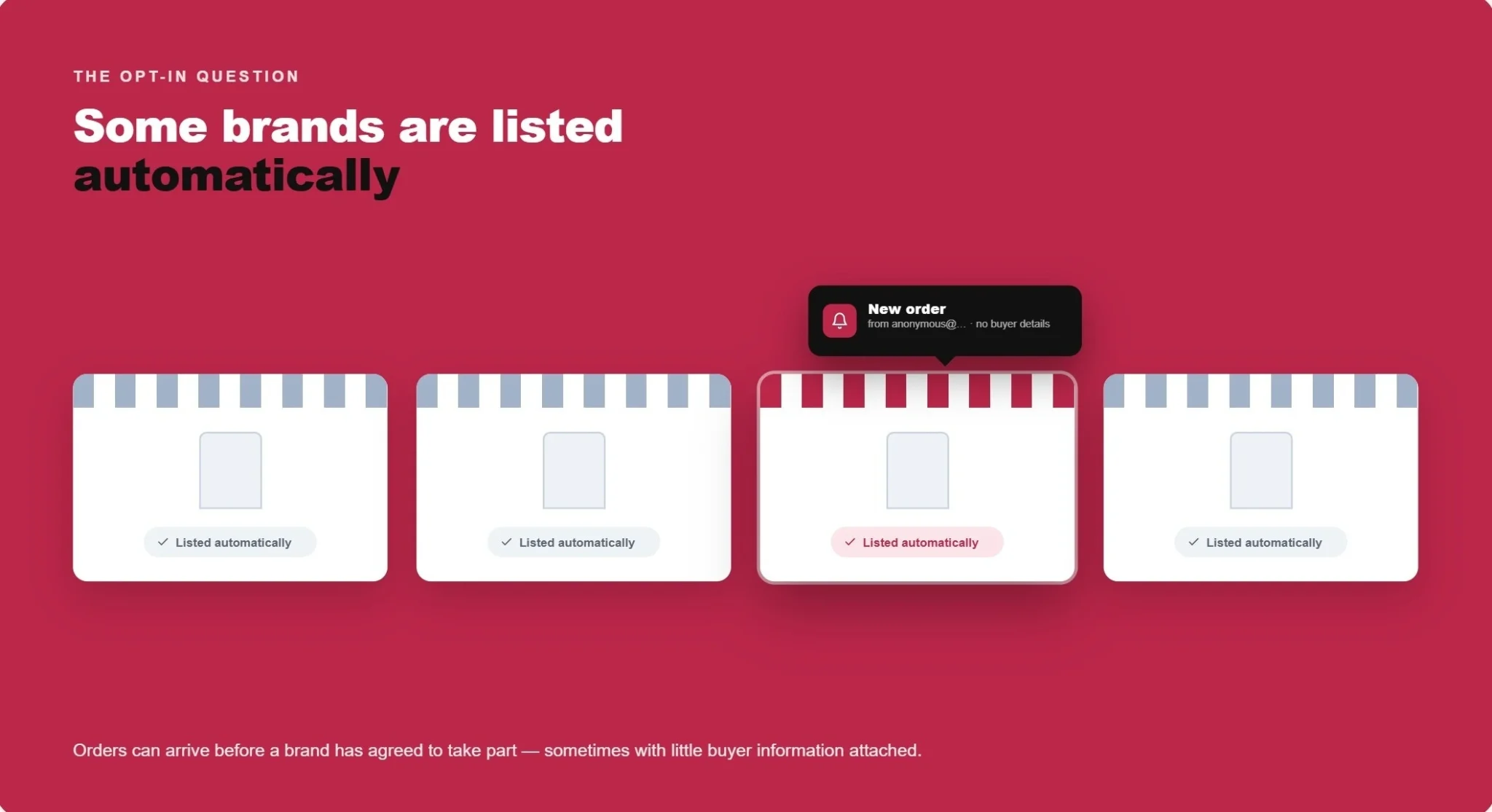
The root of the complaint is the default. In practice, any brand with a public website can be included, and the only way out is to contact Amazon and request removal. For a feature that handles a brand's products, pricing and customer experience, an opt-out-only model struck many sellers as the wrong way round, and the backlash was loud enough to draw coverage across the retail and tech press.
The practical risks are easy to understand. If Amazon shows your product as available when it isn't, the customer's frustration lands on your brand, not Amazon's. If the agent pulls an out-of-date price, you may be selling at a margin you never agreed to. And if the checkout experience goes wrong, you inherit a support problem for a sale you didn't choose to make.
Should You Opt In or Opt Out?
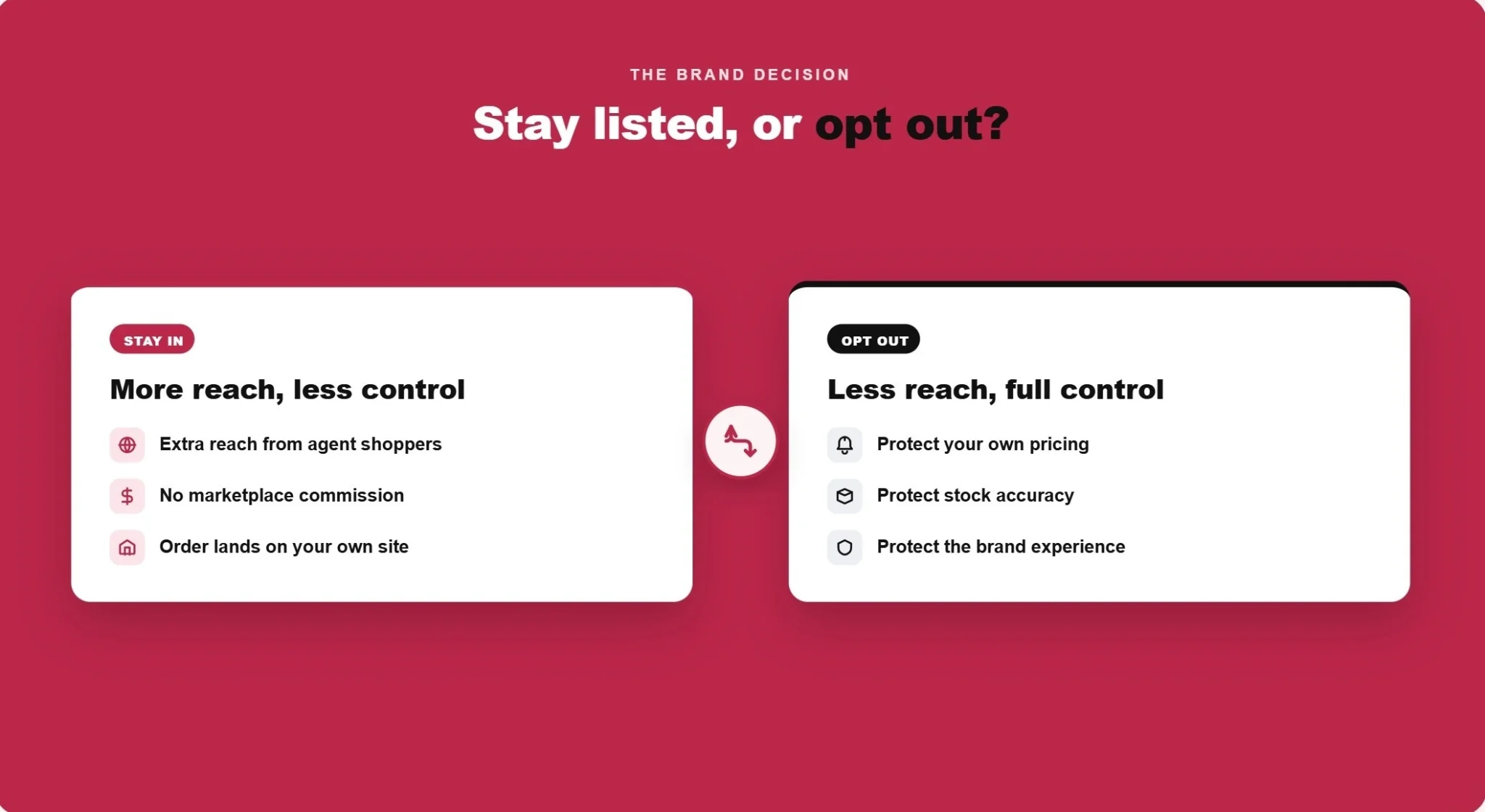
There is no universal answer here, because it depends on how much you value incremental reach versus control over your brand experience.
The Case for Staying In
If your website, inventory feed and fulfillment are in good shape, Buy for Me can be close to free incremental demand. You reach Amazon shoppers who would never have found you otherwise, you keep the order on your own platform, and at least for now Amazon takes no commission. For brands confident in their operations, presence in an emerging agentic channel early can be an advantage rather than a threat.
The Case for Opting Out
If your stock levels move quickly, your prices change often, or your margins are thin, the risk of the agent misrepresenting your products may outweigh the upside. Brands that depend on a carefully controlled customer experience, or that simply object on principle to being included without consent, have a legitimate reason to remove themselves until the model matures and the controls improve.
How to Take Back Control
Whichever way you lean, the action is the same: find out whether your products are appearing through Buy for Me, and contact Amazon to request removal if you want out. If you choose to stay in, treat your brand site as a sales channel Amazon is now actively reading, which means your product data, pricing and stock accuracy have to be tight enough to survive an automated buyer.
How to Prepare Your Brand for Agentic Commerce
Buy for Me is the first widely visible example of a shift that is not going to reverse. Whether or not you participate today, the same groundwork protects your brand as more AI agents start shopping on customers' behalf.
Start with your product data. Accurate, complete and well-structured information on your own site is what any agent reads to decide whether your product fits a request, so the cleaner your feeds, titles and specifications, the better you fare. Keep your pricing and stock synchronised in real time across your site, because an agent acting on stale data is the fastest route to an angry customer and a forced cancellation. Pay attention to the health of your own checkout, since an agent has to navigate it successfully for the sale to complete; a clunky or unusual checkout flow can simply fail. Make sure your returns and customer-service processes can absorb orders that arrive through channels you didn't directly create. And monitor actively for unauthorised or inaccurate listings of your products, so you find problems before your customers do.
None of this is exotic. It is the same operational discipline that good e-commerce has always rewarded, now with higher stakes because a machine, not a forgiving human, is reading your storefront.
The Bigger Picture: Buy for Me vs Universal Commerce Protocol
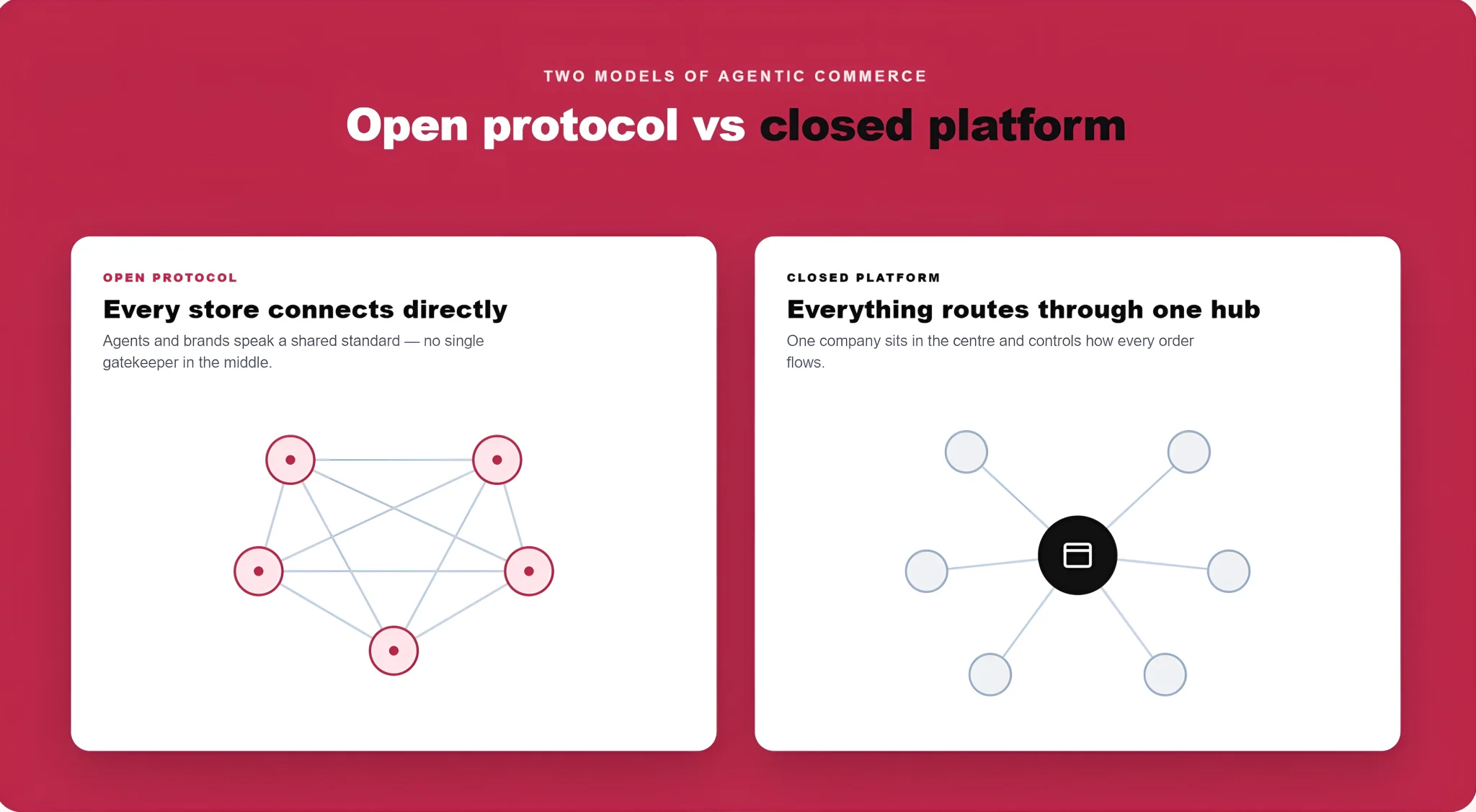
Amazon's approach is not the only model on the table, and the contrast is worth understanding. Google has co-developed an open standard, the Universal Commerce Protocol, with partners including Shopify, Walmart and Target, designed for a future where AI shopping agents are normal and retailers keep control while shoppers keep choice. The vision is an agreed, permission-based way for agents and merchants to interact.
Amazon, by contrast, has shown no sign of adopting that or any similar open standard, preferring to build its own closed system where it owns the index, the interface and the relationship. For brands, this is the strategic tension to watch: an open, consent-based agentic web versus a platform-controlled one. The standard that wins will shape how much control you have over your own products for years to come.
What This Means for Sellers and Brands
If you already sell on Amazon, Buy for Me does not replace your existing listings, but it does signal that Amazon intends to be the front door to your brand wherever it lives, not just inside its marketplace. That makes a coherent strategy across your Amazon presence and your own site more important, not less. If you are a direct-to-consumer brand that has deliberately stayed off Amazon, Buy for Me is the development that makes pure avoidance harder, because Amazon may surface and sell your products regardless of your channel strategy.
Either way, the takeaway is the same. The brands that come out ahead will be the ones that treat agentic commerce as a channel to manage deliberately, with clean data, accurate stock, a reliable checkout and a clear decision about whether to participate, rather than something that simply happens to them.
The Bottom Line
Amazon Buy for Me is a glimpse of commerce's near future, where AI agents shop on behalf of customers and platforms compete to be the agent everyone uses. It offers genuine reach, but on terms that hand Amazon the customer relationship and, for now, leave brands opted in by default. Ignoring it is no longer a safe option, because the feature can involve your products whether you engage with it or not.
The right response is not panic but preparation: know whether your products are appearing, decide consciously whether you want them to, and get your data, pricing and fulfillment ready for a world of automated buyers.
Not sure how Buy for Me and agentic commerce affect your brand? Flairox helps brands navigate Amazon's fast-changing ecosystem, from marketplace strategy and listing optimization to preparing for AI-driven discovery and checkout. Book a free strategy call with Flairox and get a clear plan for where your brand should show up next.
Frequently asked questions
No. It is currently a beta available to a subset of US customers, working with a limited set of brands, with Amazon planning to expand it over time.