 Raahim Sheikh
Key takeaways
The best Amazon ads software for you depends almost entirely on your ad spend, your team size, and how much control you want over the automation. There is no single winner for every seller.
Tools fall into two broad camps. Rule-based platforms give you transparency and tight control, which suits smaller sellers and anyone who needs to justify decisions to a client or to leadership. AI and machine-learning platforms make the bidding calls for you, which suits larger accounts with enough data to feed the algorithm.
Pricing models matter as much as features. Flat monthly fees keep your costs predictable as you scale, while percentage-of-ad-spend models grow alongside your budget and can become expensive at higher volumes.
Match the tool to your spend tier. Under 5,000 dollars a month, lean toward accessible tools like Helium 10 Adtomic, Scale Insights, or AdLabs. Between 5,000 and 100,000, platforms like Perpetua, Teikametrics, and Profasee start to earn their cost. Above 100,000, enterprise options such as Pacvue, Quartile, and Intentwise come into their own.
Free trials and demos are your best filter. Run one real campaign through a tool and judge it on time saved and improved numbers, not on its marketing claims.
Software amplifies a good strategy, but it does not replace one. The seller who wins pairs the right tool with clear goals and disciplined account management.
If your Amazon ad costs keep climbing while your margins keep shrinking, you are not imagining it. Average cost-per-click on Amazon has risen between 15 and 25 percent year over year across most categories, because more sellers are competing for a pool of ad placements that has not grown at the same pace. At the same time, the platform now spans Sponsored Products, Sponsored Brands, Sponsored Display, and DSP, each with its own bidding logic and reporting. Trying to manage all of that by hand, across hundreds or thousands of keywords, is no longer realistic.
This is exactly the gap that good Amazon ads software is built to close. The right platform automates bidding, surfaces profitable keywords, controls wasted spend, and gives you a single dashboard to see what is actually working. Sellers who adopt automation commonly report ACoS reductions of 25 to 40 percent while scaling their ad spend two to three times faster than they could manually.
The challenge is that there are dozens of tools, and they are not interchangeable. A solo seller spending two thousand dollars a month has very different needs from an agency managing a portfolio of brands. This guide reviews the ten best Amazon advertising tools for 2026, breaks down their features, pricing, pros, and cons, and then walks you through how to choose the one that fits your business.
Why You Need Amazon Ads Software in 2026
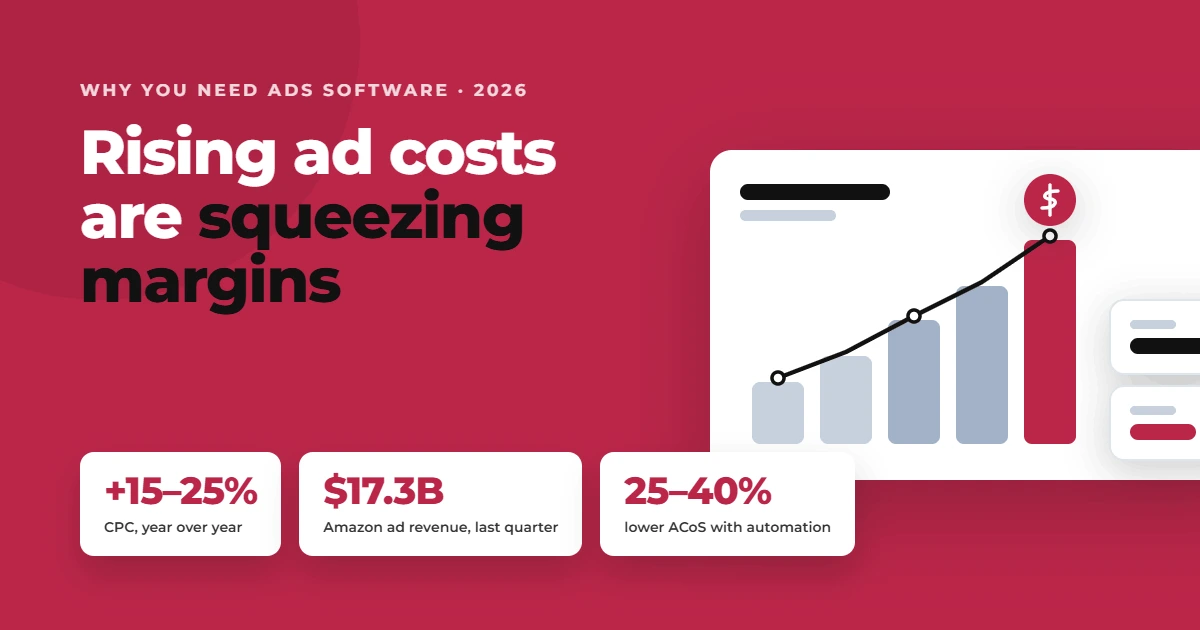
Amazon advertising has shifted from a useful extra to a core cost of doing business on the platform, and that shift has made the right software close to essential. Below are the four forces driving that change, and what each one means for the way you manage campaigns.
Rising Ad Costs Are Squeezing Margins
The most immediate pressure is price. Average cost-per-click on Amazon has risen between 15 and 25 percent year over year across most categories, and in the most competitive niches the increases have been sharper still. The cause is simple supply and demand. More sellers are advertising every year, but the number of premium ad placements on a search results page has not grown to match, so each auction draws more bidders competing for the same slots.
You can see the scale of that demand in Amazon's own numbers. In its most recent quarter, the company reported 17.3 billion dollars in advertising revenue, up from 14.7 billion a year earlier. That money is flowing in because advertising works, but it also means your competitors are spending more and bidding harder than they were last year.
For sellers, the practical effect is that wasted spend hurts far more than it used to. A poorly targeted keyword or an unmonitored bid that was a minor leak two years ago is now a meaningful drain on margin. Software that trims waste and reallocates budget toward what converts is no longer a nice-to-have, it is how you defend profitability in a more expensive auction.
Amazon's Ad Ecosystem Has Grown More Complex
The second force is complexity. Amazon advertising is no longer just Sponsored Products. It now spans Sponsored Brands, Sponsored Display, video formats, and DSP, each with its own targeting options, bidding logic, and reporting. Running a serious account means orchestrating several of these at once and understanding how they interact across the funnel.
The targeting itself has also become more sophisticated. Sponsored Products increasingly adjusts where and how your ads appear based on real-time intent signals and shopper behavior, rather than simply matching against the keyword strings you entered. That makes campaigns more powerful, but also harder to predict and manage by intuition alone.
At the same time, capabilities that were once locked behind enterprise budgets have opened up. Self-service DSP is now available to brands spending as little as five thousand dollars a month, which puts full-funnel and retargeting strategies within reach of mid-size sellers for the first time. The opportunity is real, but capturing it means managing more moving parts than ever, which is exactly what good software is built to coordinate.
Manual Management Cannot Keep Up With Real-Time Auctions
The third force is speed. Amazon's ad auctions run continuously, and the platform now streams performance data in close to real time through Amazon Marketing Stream. Bids that were optimal this morning may be overpriced or underpriced by the afternoon, depending on how competitors and shoppers behave.
No human can watch hundreds or thousands of keywords and adjust every bid as conditions change throughout the day. The realistic alternative is to check in periodically, which means you are almost always reacting late. By the time you notice a term is overspending, it has already burned through the budget, and by the time you spot a winner, you have missed days of potential sales.
Software removes that lag. Automated bidding reacts to auction changes within hours rather than days, dayparting concentrates spend in the windows that convert, and keyword harvesting promotes proven search terms automatically. The result is an account that adjusts at the pace the auction actually moves, instead of the pace a person can manage between other tasks.
Automation Delivers Measurable Returns
The final reason is the payoff. This is not automation for its own sake. Sellers who adopt advertising software commonly report ACoS reductions of 25 to 40 percent while scaling their ad spend two to three times faster than they could manage by hand. The gains come from a combination of fewer wasted clicks, faster reallocation toward winners, and tighter control over when and where money is spent.
Just as important is the time it frees up. Every hour spent manually adjusting bids is an hour not spent on strategy, product development, or listing improvements that move the needle further. Software takes the repetitive execution off your plate so your attention goes to the decisions that genuinely require human judgment.
Put together, these forces explain why the question for most sellers is no longer whether to use a tool, but which one fits their business. The rest of this guide is built to answer that.
What to Look For in Amazon Advertising Software
Before comparing specific products, it helps to know what separates a capable platform from a basic one. The features below do most of the heavy lifting, and understanding each will let you read past the marketing and judge whether a tool actually fits how you work.
Bid Automation: Rule-Based vs. AI-Driven
Bid automation is the heart of any advertising tool, and the most important distinction is whether it is rule-based or AI-driven. Rule-based automation does exactly what you tell it, raising or lowering bids when the conditions you define are met. If a keyword's ACoS climbs above a threshold, the tool lowers the bid. This gives you complete transparency, because you always know why a change was made, and it suits sellers who want to keep their hands on the wheel.
AI-driven automation works differently. Instead of following fixed rules, it uses machine learning to predict outcomes and adjust bids on its own, often re-bidding many times a day based on live data. At scale, and with enough historical data to learn from, this can outperform manual or rule-based management, because it spots patterns a person would miss.
The trade-off is visibility. AI bidding can feel like a black box, which makes it harder to explain a specific decision to a client or to leadership. Neither approach is universally better. The right one depends on your account size, your data volume, and how much control you are comfortable handing over.
Keyword Harvesting and Negative Keyword Management
The next capability to scrutinize is how a tool handles keywords. Strong platforms automatically identify high-performing search terms from your automatic and broad campaigns and promote them into more targeted, better-controlled campaigns. This process, often called keyword harvesting, is one of the most reliable ways to grow an account, and doing it by hand is slow and easy to neglect.
The flip side is just as valuable. Good software flags wasteful search terms, the ones spending your budget without converting, so you can add them as negative keywords. Over a large account, eliminating this waste can recover a meaningful share of spend.
When you evaluate a tool, look at how much of this is automated versus how much it simply surfaces for you to action. The best platforms do both, suggesting harvests and negatives while still letting you approve or override them. This single area often pays for the subscription on its own.
Budget Optimization and Dayparting
Beyond individual bids, consider how a tool manages money across time. Budget optimization decides how your spend is distributed across campaigns, pushing more toward what is working and pulling back from what is not, so you are not capping a profitable campaign while a weak one runs all day.
Dayparting adds the dimension of time. Most products do not convert evenly across the hours of the day or the days of the week, and dayparting lets you concentrate spend in the windows that actually drive sales. For sellers with clear traffic patterns, this can lift efficiency without changing anything else.
Not every tool offers both, and the depth varies widely. If your sales show strong daily or weekly rhythms, treat dayparting as a priority feature rather than a nice extra.
Reporting and Dashboards
You cannot improve what you cannot see clearly, which makes reporting more important than it first appears. The strongest tools consolidate Sponsored Products, Sponsored Brands, Sponsored Display, and DSP into a single dashboard, so you are not stitching together separate reports to understand overall performance.
Look for reporting that goes beyond raw metrics to explain trends and surface recommendations. A platform that tells you not just that ACoS rose, but why and what to do about it, saves hours of analysis and helps you act faster.
If you manage multiple brands or report to clients, also check how easily the tool exports or shares its data. Clean, presentable reporting is often the difference between a tool an agency can use and one it cannot.
Multi-Marketplace and DSP Support
Finally, think about where your business is heading, not just where it is today. If you sell internationally or plan to, you will want a platform that manages multiple marketplaces from one place rather than forcing you to log in and out of separate accounts.
DSP support matters for the same forward-looking reason. With self-service DSP now open to brands spending as little as five thousand dollars a month, full-funnel and retargeting strategies are within reach earlier than they used to be. Choosing a tool that already supports DSP means you will not have to migrate platforms when you expand into it.
The broader point is to match the tool's ceiling to your ambitions. It is easier to grow into a capable platform than to outgrow a basic one and switch everything over mid-stride.
The 10 Best Amazon Ads Software & Tools in 2026
The tools below are organized to cover the full range of sellers, from one-person operations to agencies managing eight-figure portfolios. For each, you will find an overview, the standout features, pricing, the main pros and cons, and who it suits best.
1. Helium 10 Adtomic
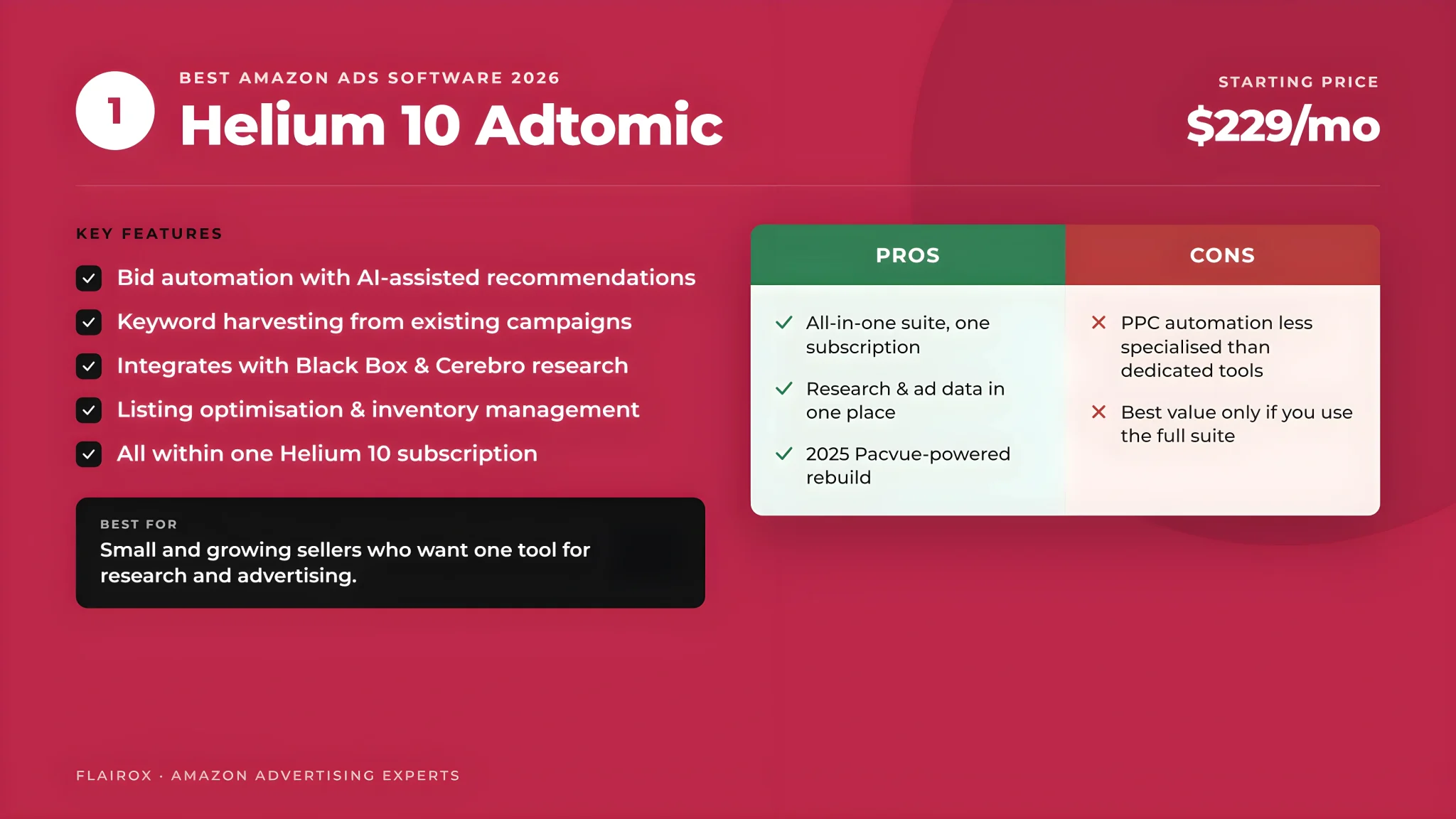
Adtomic is the advertising module inside Helium 10, the broad seller suite that also includes product research, keyword tools, listing optimization, and inventory management. For sellers who want one subscription to cover most of their Amazon workflow, it is hard to beat on value. The 2025 rebuild, powered by Pacvue technology, was a significant upgrade over the original version and brought far stronger automation.
Its features include bid automation, keyword harvesting from your existing campaigns, AI-assisted recommendations, and tight integration with Helium 10's research tools such as Black Box and Cerebro. Pricing comes bundled in the Diamond plan at $229 a month, which also unlocks the rest of the suite.
The main advantage is the all-in-one nature of the platform, which removes the need to juggle separate subscriptions and keeps your research and advertising data in one place. The trade-off is that its PPC automation, while much improved, is still not as specialized as dedicated bid-management platforms aimed purely at advertising. It is best for small and growing sellers who already use Helium 10 or want a single tool for everything.
2. Perpetua
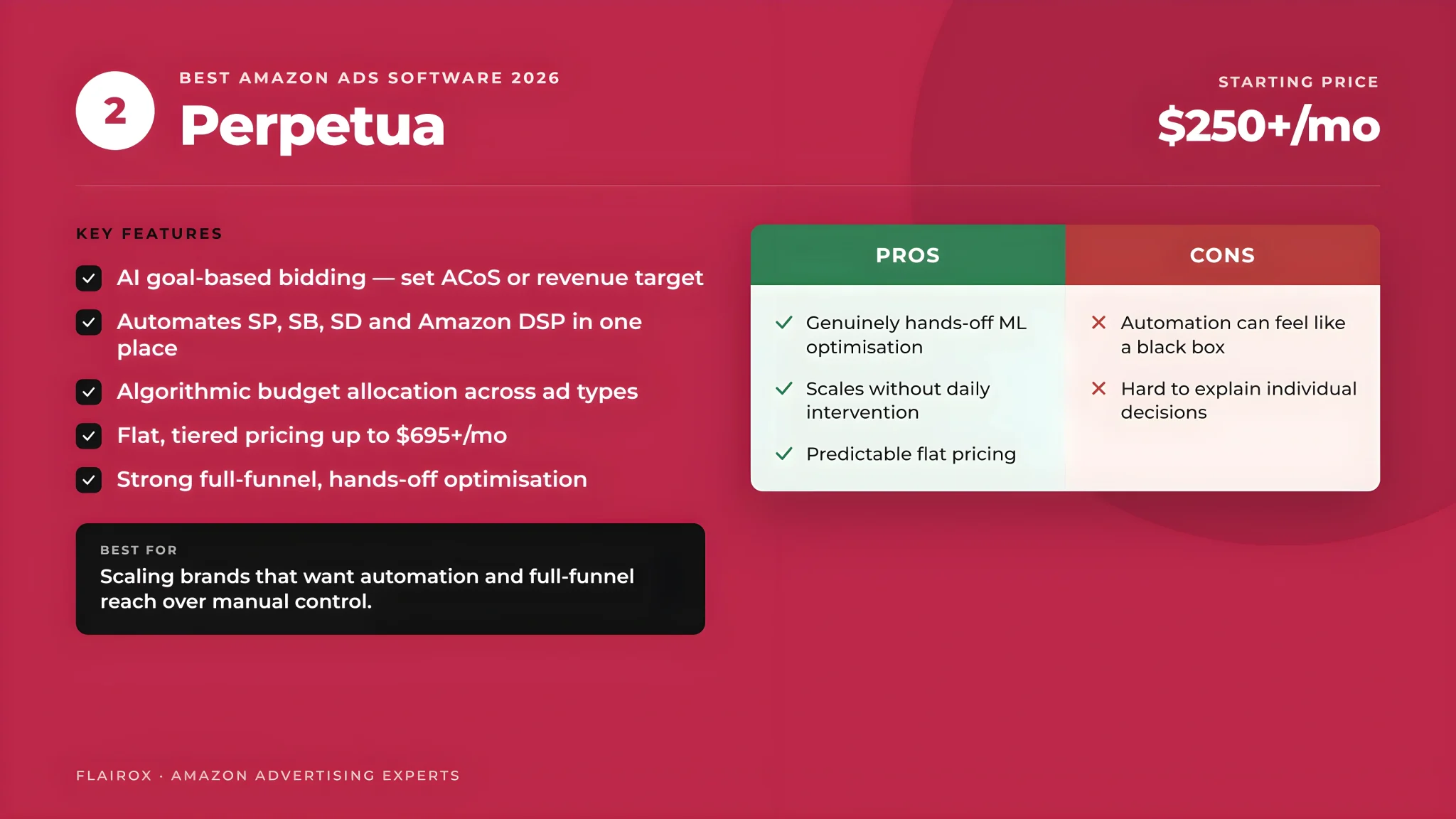
Perpetua has become a go-to platform for growth-stage Amazon brands that want to think strategically rather than manage bids one at a time. You set a business objective, such as a target ACoS or a revenue goal, and the AI handles the bid-by-bid execution across Sponsored Products, Sponsored Brands, Sponsored Display, and Amazon DSP from a single interface.
Its standout feature is algorithmic budget allocation, where the AI decides which combination of ad types delivers the best result toward your stated goal and shifts spend accordingly. Pricing is tiered and flat rather than purely percentage-based, which keeps costs more predictable, starting around $250 a month and reaching $695 or more for larger advertisers.
The strength here is genuinely hands-off optimization that scales well without daily intervention. The most common criticism is that automation can feel like a black box, which makes it harder to explain specific decisions to leadership or clients. It suits scaling brands that value automation and full-funnel reach over granular manual control.
3. Pacvue
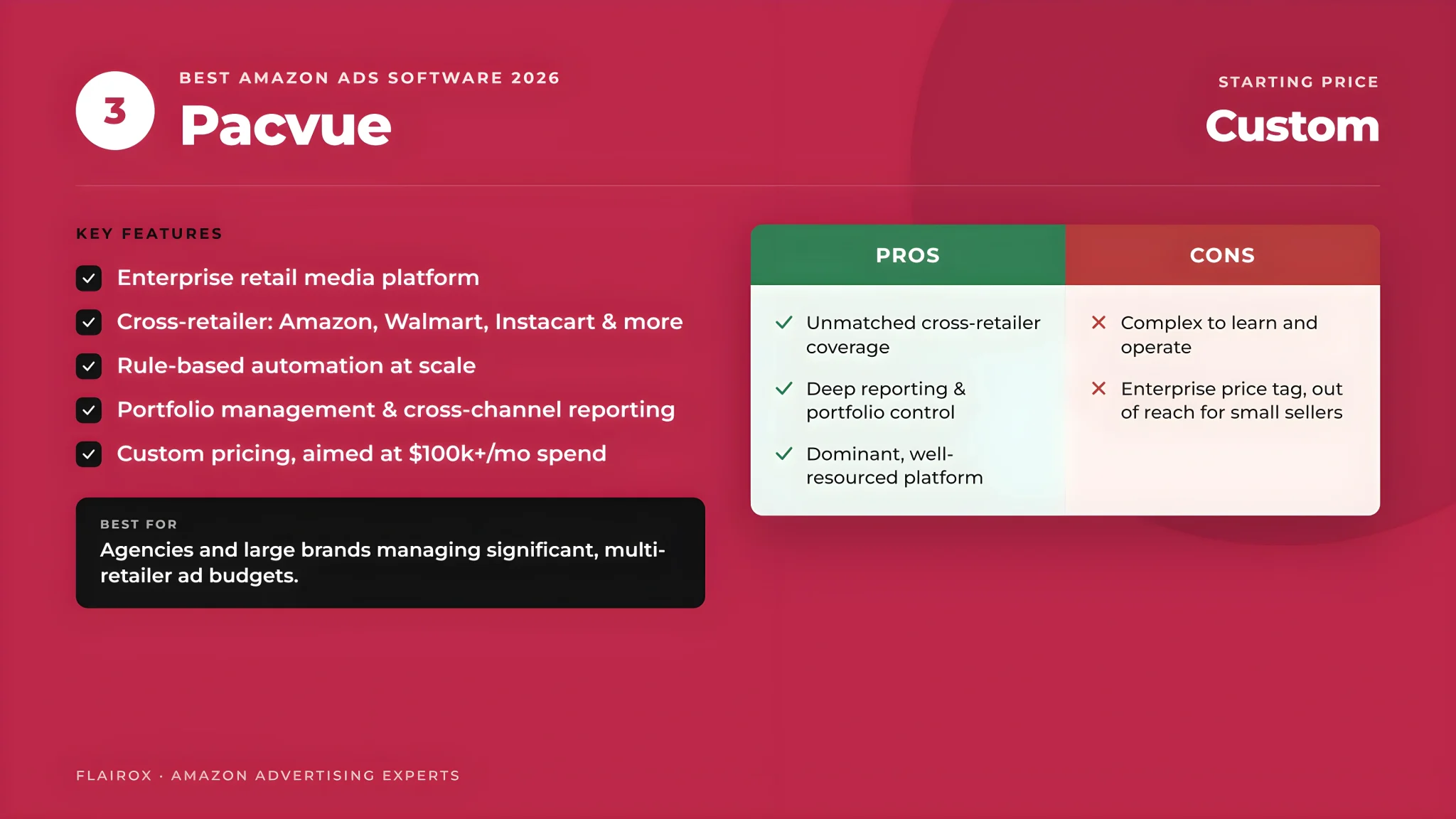
Pacvue is an enterprise retail media platform rather than an Amazon-only tool, spanning Amazon, Walmart, Instacart, and other retailers from one console. Following its merger with Helium 10, it has become one of the dominant players in the advertising ecosystem, and it is built for scale.
It offers rule-based automation, detailed cross-channel reporting, and the kind of portfolio management that agencies and large brands need when they are running campaigns across multiple retailers at once. Pricing is custom and generally aimed at advertisers managing $100,000 or more in spend.
Its biggest advantage is breadth, since few platforms match its cross-retailer coverage and reporting depth. The downside is that this power comes with complexity and an enterprise price tag that puts it out of reach for smaller sellers. It is best for agencies and large brands managing significant, multi-retailer ad budgets.
4. Teikametrics
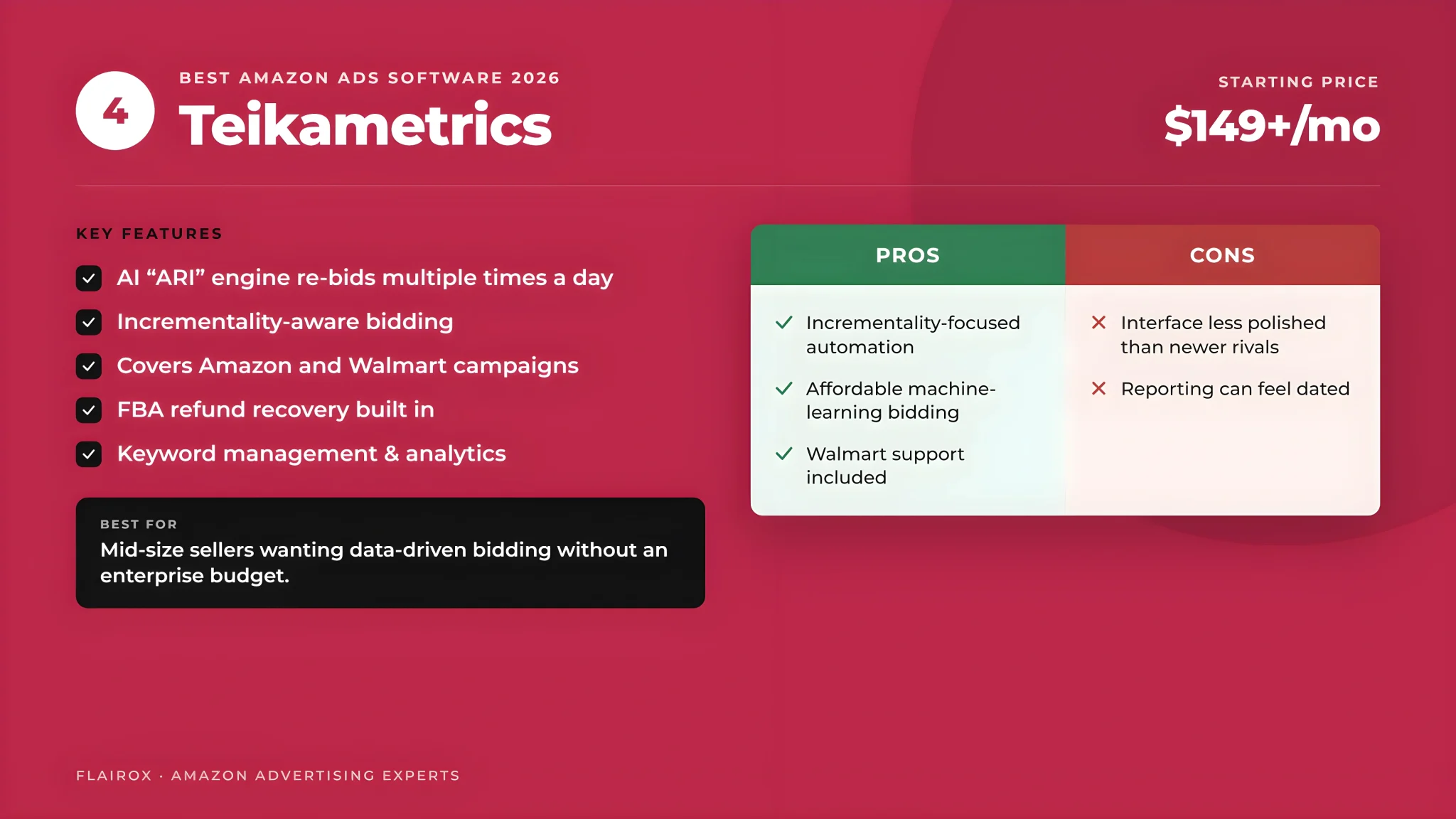
Teikametrics is built around an AI engine called ARI that re-bids across your Amazon and Walmart campaigns multiple times a day. Its defining feature is incrementality-aware bidding, which looks at whether a paid click actually drove a sale you would not have won organically, rather than simply chasing attributed revenue.
In addition to bidding, it includes keyword management, analytics, and even FBA refund recovery, which adds value beyond advertising alone. Pricing starts at $149 a month, which makes solid machine-learning bidding accessible at a lower entry point than many competitors.
The appeal is intelligent, incrementality-focused automation at a reasonable price, with Walmart support included. The main limitation is that some sellers find the interface and reporting less polished than newer rivals. It works well for mid-size sellers and brands that want data-driven bidding without an enterprise budget.
5. Scale Insights
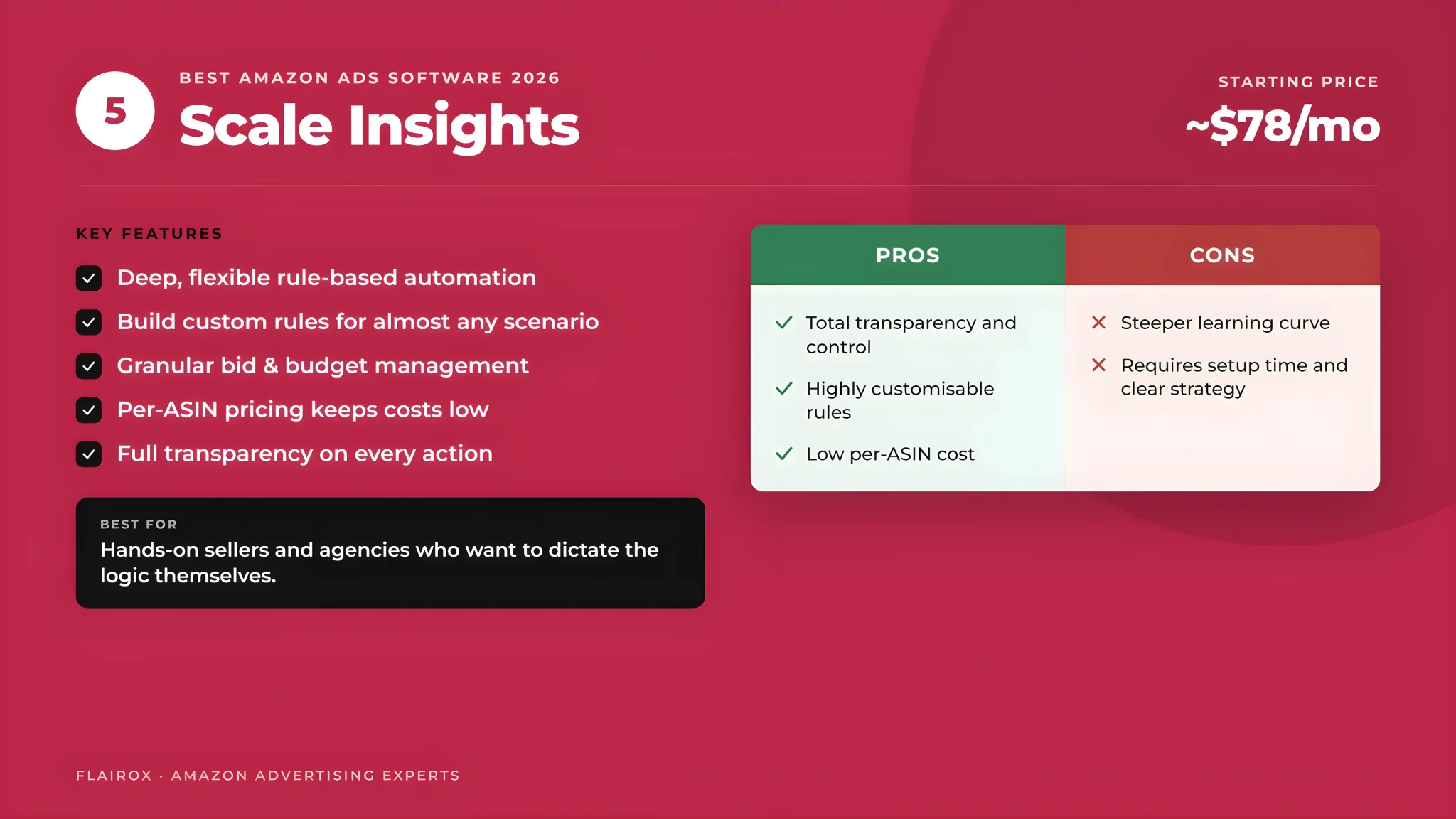
Scale Insights takes the opposite philosophy to the AI-first platforms. It is built around deep, flexible rule-based automation that lets you construct detailed rules for almost any scenario you can imagine, which gives control-minded sellers a great deal of precision.
Its features center on highly customizable automation rules, bid and budget management, and per-ASIN pricing that can keep costs low for focused catalogs, starting around $78 a month. The trade-off for all that flexibility is a steeper learning curve, since building effective rules takes time and a clear understanding of your own strategy.
The advantage is transparency and control, because you always know exactly why the software did what it did. The disadvantage is that it asks more of you up front than a set-and-forget AI tool. It is best suited to hands-on sellers and agencies who want to dictate the logic themselves and are comfortable investing the setup time.
6. Quartile
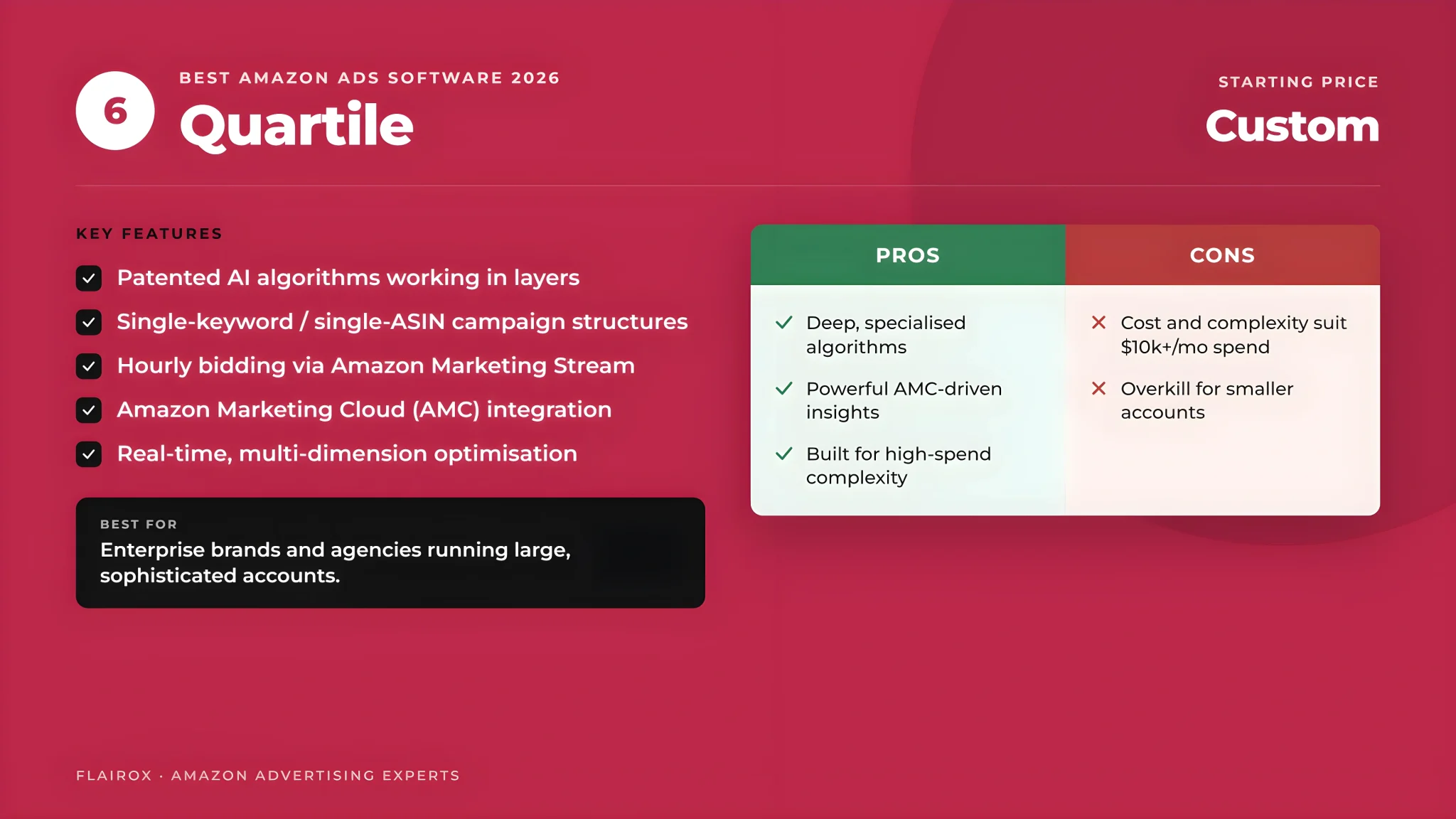
Quartile is an enterprise-grade platform powered by a set of patented AI algorithms, each handling a different dimension of optimization such as bidding, keyword selection, budget allocation, placement, dayparting, and campaign structure. The result is granular, single-keyword and single-ASIN campaign structures that auto-optimize in real time.
It leans heavily on automated hourly bidding using Amazon Marketing Stream data, and it integrates with Amazon Marketing Cloud to pull path-to-purchase insights that inform multi-channel strategy. Pricing is fully custom and requires a demo to get a quote.
Its strength is the depth and specialization of its algorithms, which are well suited to complex, high-spend accounts. The drawback is that it is built for scale, so the cost and complexity rarely make sense below roughly ten thousand dollars a month in ad spend. It is best for enterprise brands and agencies running large, sophisticated accounts.
7. Intentwise
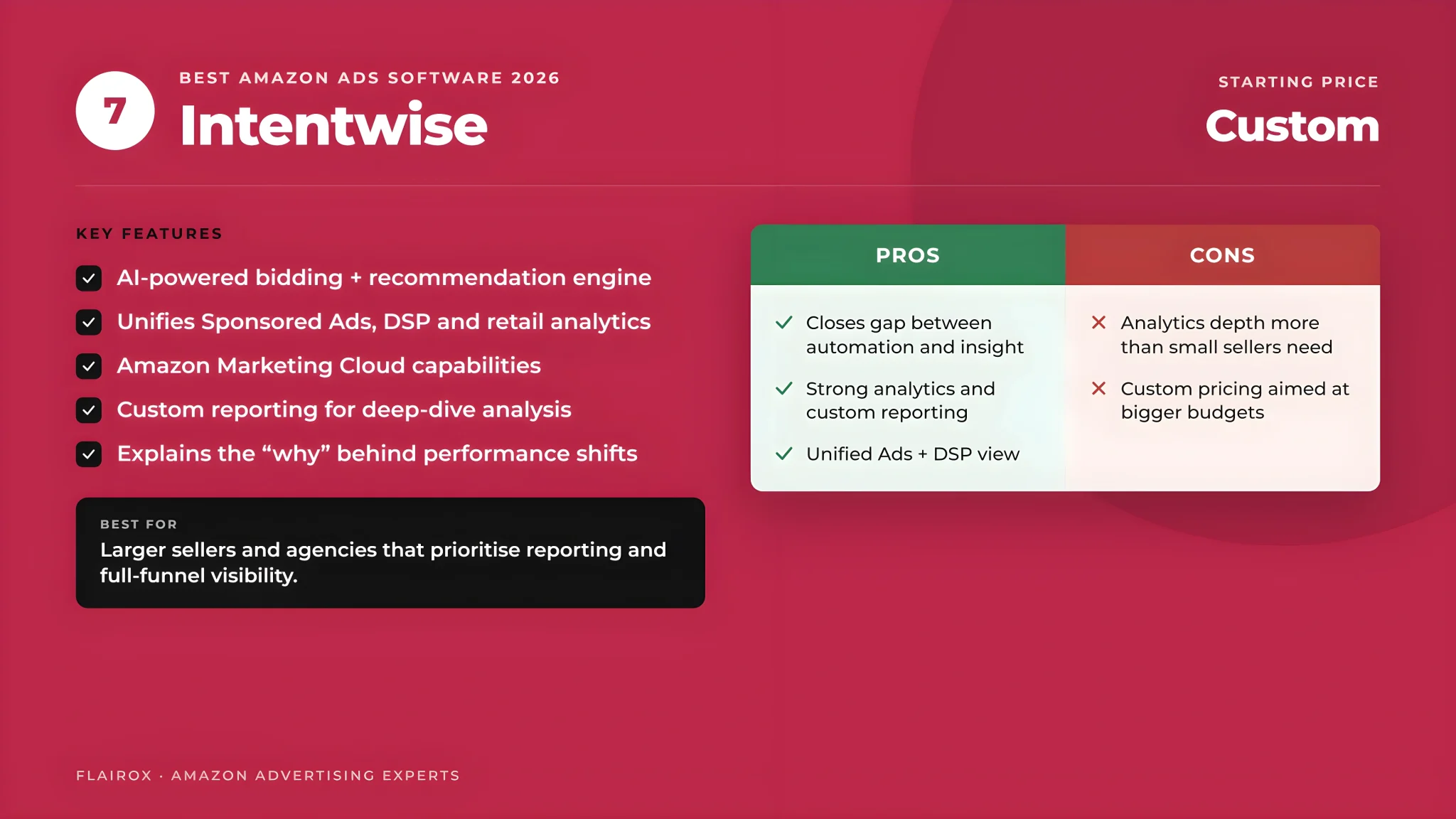
Intentwise is aimed at data-driven brands and agencies that want more than automation. It unifies Sponsored Ads, DSP, and retail analytics into a single environment, positioning itself as a command center for analysis as much as a bidding tool.
Its features pair AI-powered bidding with a recommendation engine, so you can automate execution while still understanding the reasons behind performance shifts. It places heavy emphasis on analytics, including Amazon Marketing Cloud capabilities and custom reporting for deep-dive analysis. Pricing is custom and scaled to the size of the business.
The advantage is that it closes the gap between automation and insight, which appeals to teams that need to explain the "why" behind results. The trade-off is that its analytics depth can be more than smaller sellers need or want to pay for. It is best for larger sellers and agencies that prioritize reporting and full-funnel visibility.
8. AdLabs
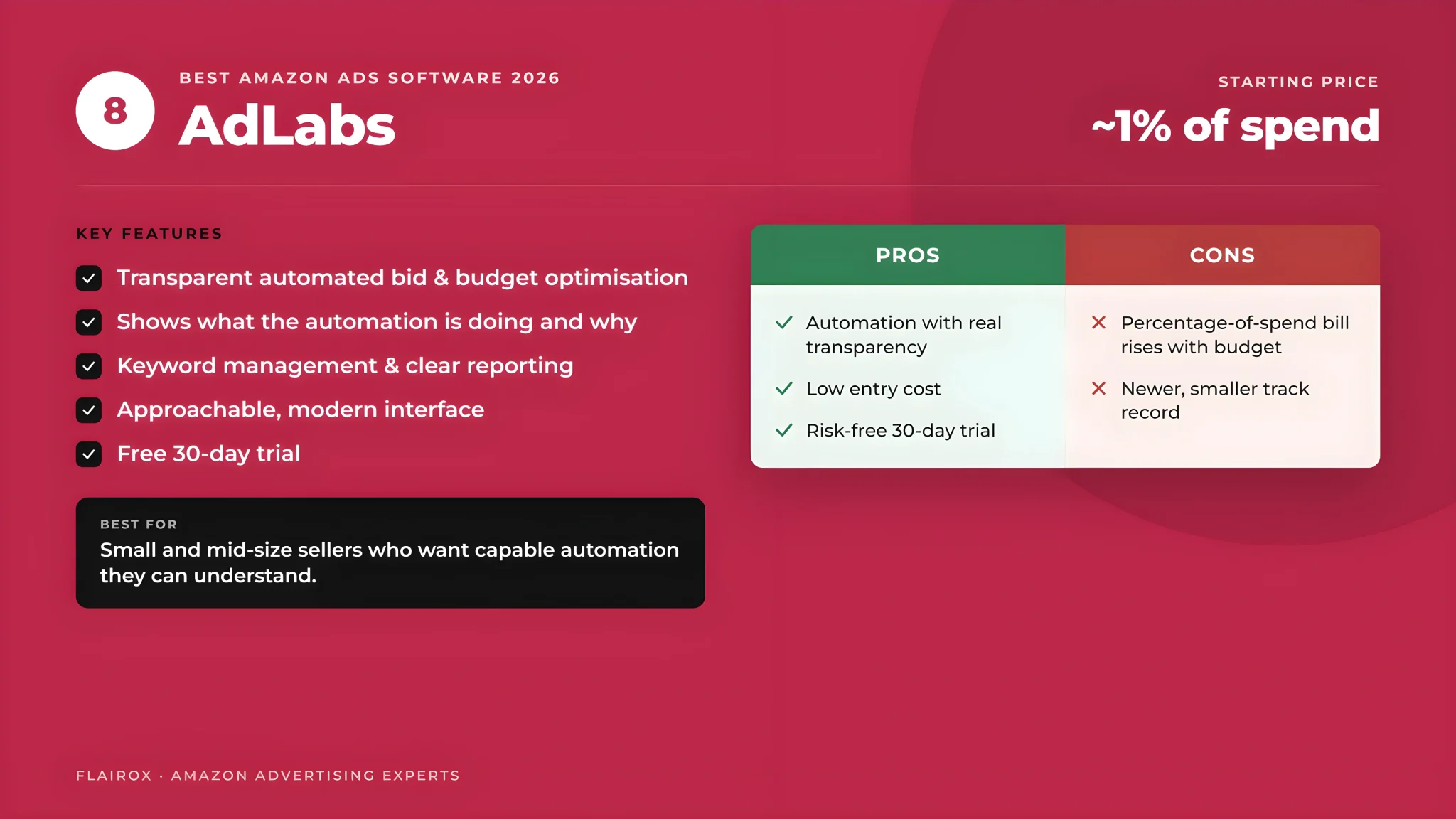
AdLabs is a newer platform that has built a reputation on transparency. Rather than acting as an opaque black box, it aims to show clearly what the automation is doing and why, which addresses one of the most common frustrations with AI bidding tools.
Its features include automated bid and budget optimization, keyword management, and clear reporting, all wrapped in an interface designed to be approachable. Pricing starts at around one percent of ad spend, and a 30-day free trial lets you test it without commitment.
The main strength is the combination of automation and transparency at a low entry cost, which makes it attractive to sellers wary of losing visibility. The percentage-of-spend model is the consideration to watch, since the bill rises with your budget, though it stays modest at smaller spend levels. It suits small and mid-size sellers who want capable automation they can actually understand.
9. BidX
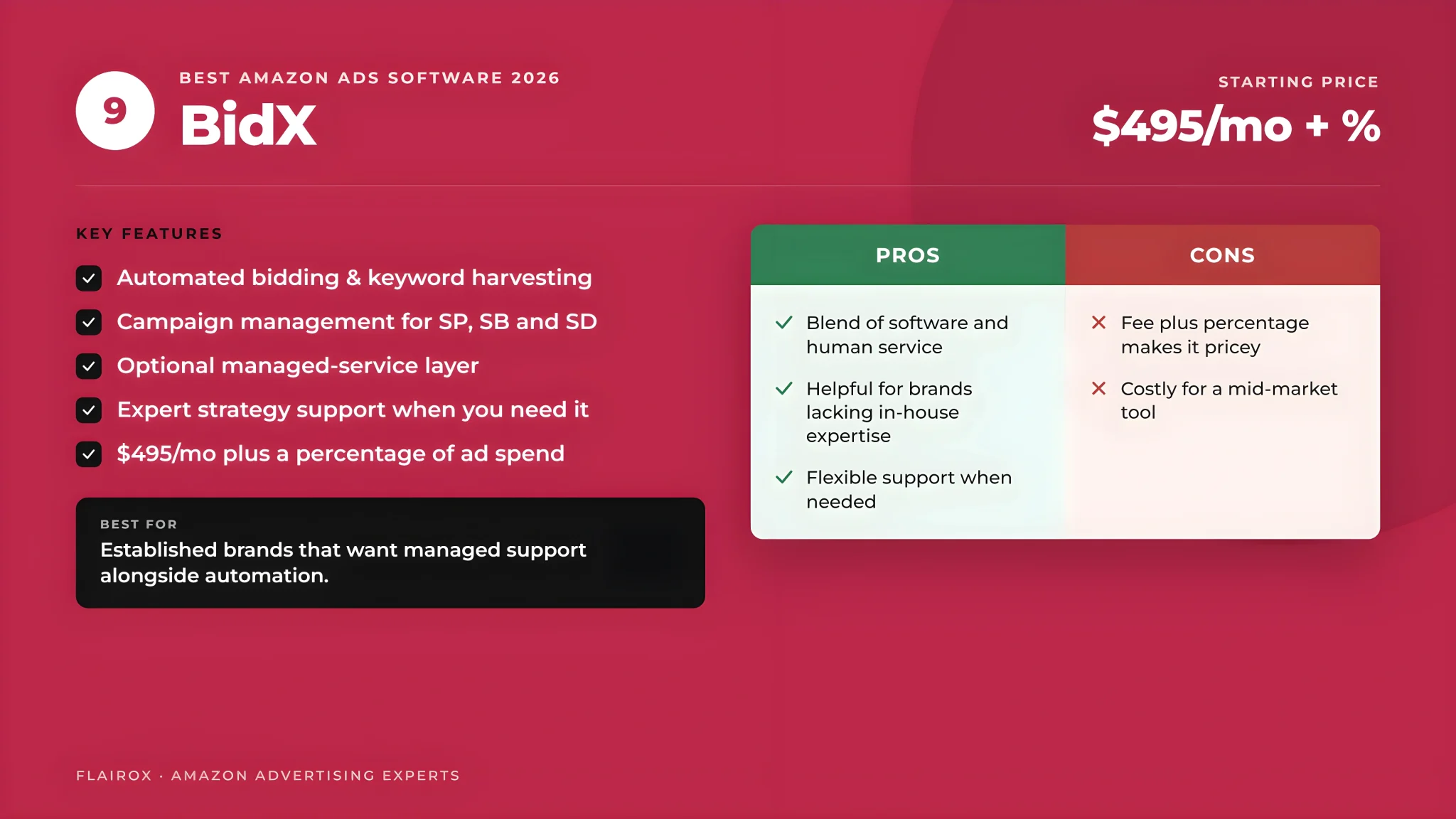
BidX combines automation software with an optional managed-service layer, which makes it a useful middle ground for sellers who want technology and expert oversight together. It automates Sponsored Products, Brands, and Display campaigns while offering the option to lean on its team for strategy.
Its features include automated bidding, keyword harvesting, and campaign management, with the added flexibility of hands-on support when you need it. Pricing starts at $495 a month plus a percentage of the connected ad spend.
The advantage is the blend of software and service, which helps brands that lack in-house advertising expertise. The drawback is that the combined fee and percentage structure makes it one of the pricier options for what is, at its core, a mid-market tool. It is best for established brands that want managed support alongside automation.
10. Profasee
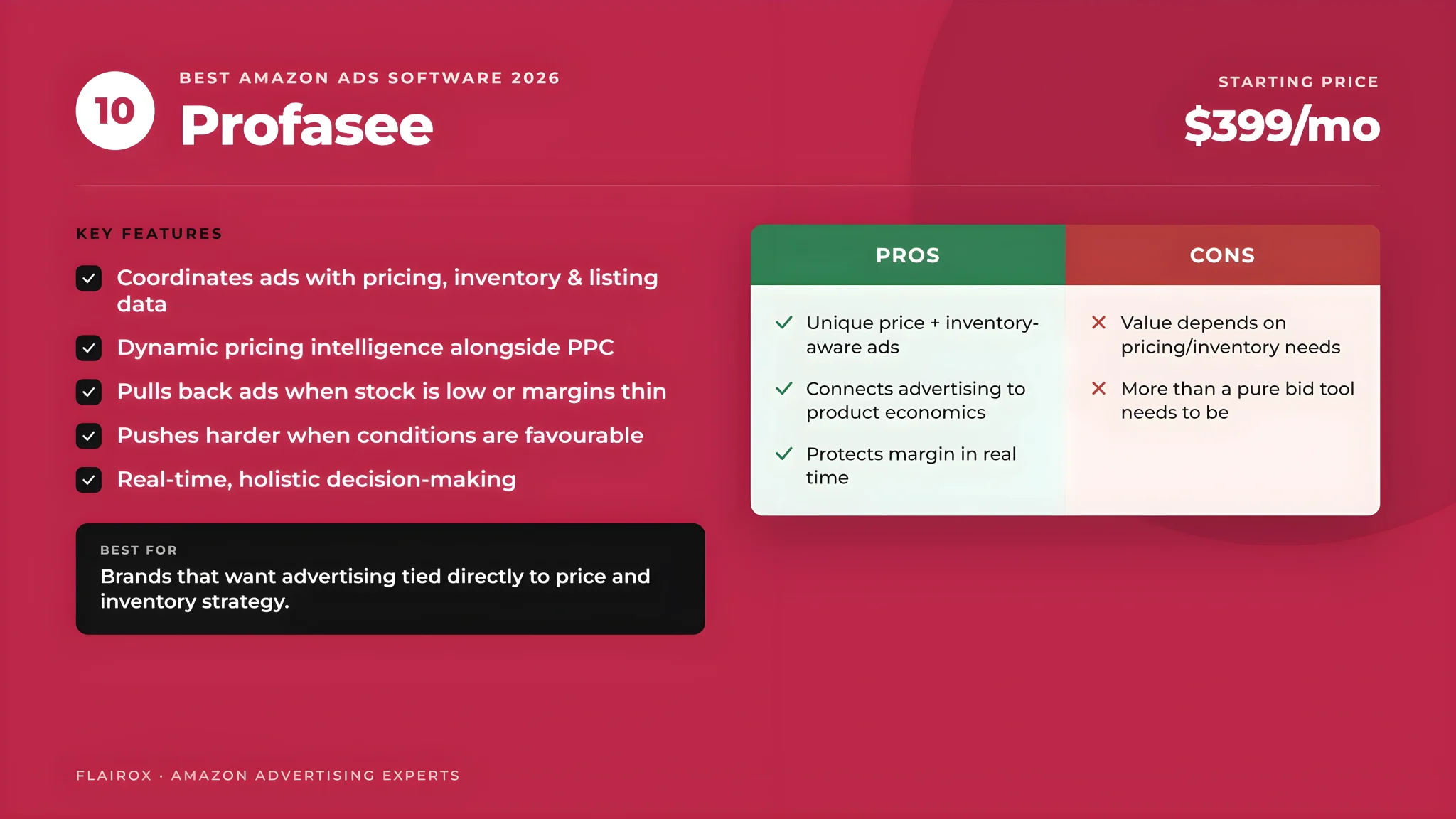
Profasee is the most distinctive tool on this list because it does not treat advertising in isolation. Its platform coordinates ads with pricing, inventory, and listing data in real time, on the logic that your bid strategy should respond to your margin and stock position, not just your ACoS target.
Its features include dynamic pricing intelligence alongside PPC management, so the system can pull back on advertising when inventory is low or margins are thin, and push harder when conditions favor it. Pricing sits at 399 dollars a month.
The strength is the unique, holistic view that connects advertising to the wider economics of each product. The trade-off is that its value depends on having pricing and inventory challenges worth solving, so a seller who only needs bid automation may not use its full capability. It is best for brands that want advertising decisions tied directly to price and inventory strategy.
Quick Comparison Table
Tool | Best For | Automation Type | Starting Price | Free Trial |
|---|---|---|---|---|
Helium 10 Adtomic | All-in-one suite users | AI-assisted | $229/mo (Diamond) | Yes |
Perpetua | Scaling brands, full-funnel | AI / machine learning | $250/mo | Demo |
Pacvue | Agencies, enterprise | Rule-based | Custom ($100k+ spend) | Demo |
Teikametrics | Mid-size, value seekers | AI (incrementality) | $149/mo | Yes |
Scale Insights | Hands-on sellers | Rule-based | ~$78/mo | Yes |
Quartile | Enterprise, complex accounts | AI (patented) | Custom | Demo |
Intentwise | Data-driven brands, agencies | AI + analytics | Custom | Demo |
AdLabs | Transparency-focused sellers | AI (transparent) | ~1% of ad spend | 30 days |
BidX | Brands wanting managed support | Software + service | $495/mo + % | Demo |
Profasee | Price and inventory-led ads | AI (price-aware) | $399/mo | Demo |
How to Choose the Best Amazon Ads Tool for You
With ten strong options, the right choice comes down to matching the tool to your situation rather than picking whichever has the longest feature list. Work through the questions below in order, and the field will narrow quickly.
Start With Your Ad Spend
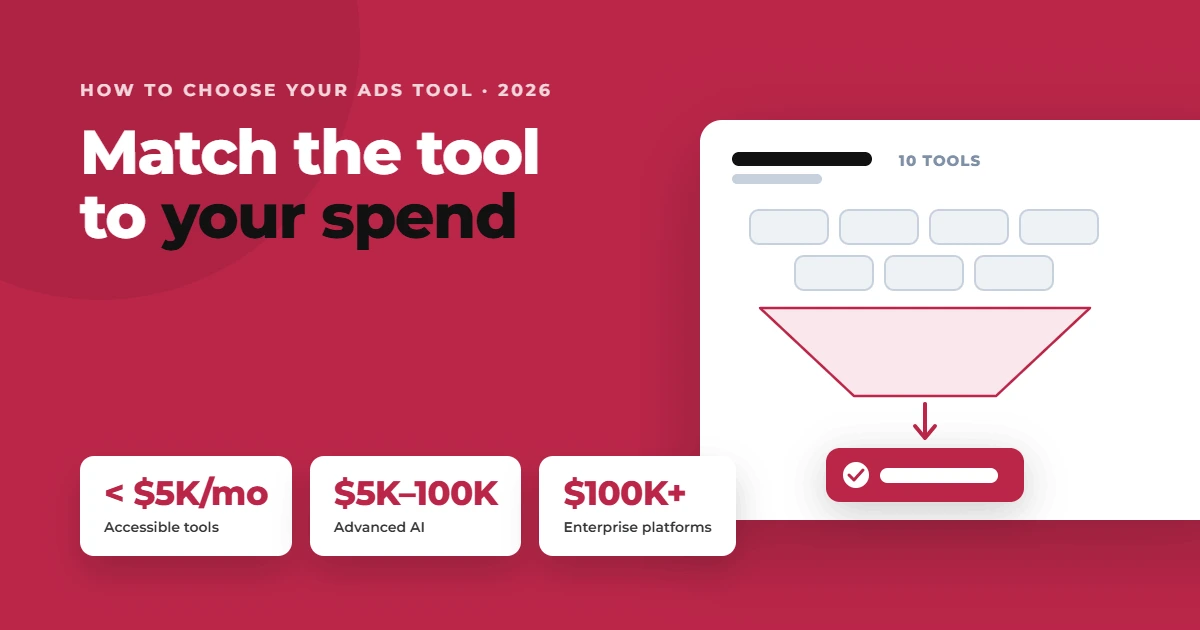
Your monthly ad spend is the single biggest filter, because it determines both what you can justify paying and what level of sophistication you actually need. If you spend under $5,000 a month, an accessible tool such as Helium 10 Adtomic, Scale Insights, or AdLabs will give you most of the benefit without an enterprise price tag. At this level, the priority is reclaiming time and cutting obvious waste, and these tools do that affordably.
In the $5,000 to $100,000 range, the math changes. The efficiency gains from more advanced optimization start to outweigh the higher subscription cost, which is where platforms like Perpetua, Teikametrics, and Profasee come into their own. A few percentage points of ACoS improvement on a budget this size easily covers the fee.
Above $100,000 a month, you are in enterprise territory, and the calculus shifts again. Tools such as Pacvue, Quartile, and Intentwise, often paired with a dedicated account manager, deliver the portfolio management, advanced algorithms, and support that large, complex accounts require. At this scale, the cost of the wrong decision is high enough that the investment in a serious platform pays for itself.
Match the Tool to Your Team
Who actually runs the account matters as much as how much you spend. A solo seller or a lean team benefits most from automation that reduces daily workload and does not demand constant supervision, which favors set-and-forget AI tools or well-built all-in-one suites. The goal is to get expert-level execution without hiring an expert.
A growing brand with a marketing manager usually wants strong AI optimization paired with clear, presentable reporting, so the person responsible can both trust the automation and explain results upward. Platforms that balance automation with transparency tend to fit this profile best.
Agencies and enterprises have different needs again. Agencies require portfolio management, cross-client visibility, and clean reporting they can share, which points toward Pacvue or Intentwise. Enterprises typically need multi-retailer coverage and deep analytics, which is where the heavyweight platforms justify their complexity. Be honest about who will use the tool day to day, because the most powerful platform is wasted if no one has time to drive it.
Decide How Much Control You Want
Tools sit on a spectrum from fully transparent to fully automated, and where you want to sit on that spectrum is a genuine strategic choice rather than a question of right or wrong. If you need to understand and explain every decision, perhaps because you answer to a client or a leadership team, a rule-based platform like Scale Insights or a transparency-focused tool like AdLabs will feel far more comfortable.
If you would rather define a clear goal and let the system handle execution bid by bid, an AI-first platform such as Perpetua or Teikametrics will serve you better. You give up some visibility into individual decisions, but you gain optimization that operates faster and at a scale no person can match.
There is no universally correct answer here, only the answer that fits your temperament and your accountability. Be realistic about how much you will actually intervene. Many sellers choose a hands-on tool and then never build the rules, which delivers the worst of both worlds.
Weigh Pricing Predictability
The headline price is only part of the cost story, and the pricing model can matter more than the number. A flat monthly fee keeps your costs stable as your ad spend grows, which makes budgeting straightforward and means the tool gets cheaper, in relative terms, the more you scale.
A percentage-of-spend model works the opposite way. It is gentle at low budgets, which makes it attractive when you are starting out, but the bill rises in lockstep with your spend. At higher volumes, that can quietly become one of your largest software expenses.
Neither model is inherently better, but they suit different trajectories. If you expect to scale spend significantly, a flat fee usually wins over time. If you are testing the waters with a modest budget, a percentage model lowers the barrier to entry. Project your costs at the spend level you expect in twelve months, not just today.
Check Integrations and Roadmap Fit
Finally, look beyond the tool in isolation and consider how it fits the rest of your operation and where you are heading. Check that it supports the marketplaces and ad types you use now, and the ones you plan to add. If DSP or international expansion is on your roadmap, choose a platform that already handles it so you are not forced into a disruptive migration later.
It is also worth confirming how the tool connects with the other software you rely on, whether that is your research suite, your analytics, or your inventory system. A platform like Profasee that ties advertising to pricing and stock, or a suite like Helium 10 that keeps research and ads together, can remove friction that standalone tools create.
As a final step before committing, use the free trials and demos that almost every vendor offers. Run one real campaign through the tool for a few weeks and judge it on whether it genuinely saves you time and improves your numbers. A short, honest test will tell you more than any feature list or review, including this one.
Software Alone Is Not a Strategy
It is worth saying plainly that no tool, however advanced, will fix a weak advertising strategy. Software executes faster and more consistently than a human, but it still needs someone to set the right goals, structure campaigns sensibly, write compelling listings, and interpret what the data is telling them. A black-box algorithm pointed at a poorly built account will simply lose money more efficiently.
This is why many growing brands pair the right software with experienced management, whether in-house or through a specialist partner. The technology handles the bid-by-bid execution, and the strategist makes sure that execution is aimed at the right outcomes. The combination is what consistently protects margins while still allowing you to scale.
Conclusion
Choosing the best Amazon ads software in 2026 is less about finding a universal winner and more about finding the tool that matches your ad spend, your team, and your appetite for control. Helium 10 Adtomic and Scale Insights serve smaller and hands-on sellers well, Perpetua, Teikametrics, and Profasee suit scaling brands, and Pacvue, Quartile, and Intentwise are built for agencies and enterprises managing serious budgets. The common thread is that each one earns its place by automating the work that no longer makes sense to do by hand.
Whatever you choose, remember that the software is a force multiplier, not a substitute for strategy. Match the tool to your goals, give it a clear direction, and keep a close eye on the numbers, and you will turn rising ad costs from a threat into a manageable, profitable part of your Amazon growth.
If you would rather focus on your products and let specialists handle the advertising, Flairox can help. Our Amazon team builds and manages PPC campaigns that protect your margins while scaling your sales, combining the best tools with the strategy that makes them work. Book a free Amazon advertising audit and we will show you exactly where your ad spend is leaking and how to fix it.
Frequently asked questions
Amazon ads software is a platform that helps sellers create, automate, and optimize their advertising campaigns on Amazon. It typically handles bid management, keyword harvesting, budget allocation, and reporting across ad types such as Sponsored Products, Sponsored Brands, Sponsored Display, and DSP, so you can manage campaigns at scale without adjusting every bid by hand.