 Bilal Siddiqui
Key takeaways
ACoS (Advertising Cost of Sales) is a critical Amazon PPC metric that helps measure the efficiency of your advertising spend.
Calculating ACoS is simple: (Ad Spend ÷ Ad Revenue) × 100.
A "good" ACoS depends on your product margin, goals, and campaign phase.
ACoS plays a key role in decision-making, profitability, and overall ad strategy.
Optimizing ACoS involves a combination of keyword targeting, bid management, listing improvements, and data-driven testing.
Your sales are climbing. Your ad spend is climbing too. But when you look at what's actually left in the bank at the end of the month, the profit isn't there. If that sounds familiar, the number you're missing is Amazon ACOS, the single metric that quietly decides whether every advertising dollar you spend makes you money or costs you money.
The problem is that most advice treats ACOS like a test you pass or fail at one fixed number. It isn't. A "good" Amazon ACOS for a clothing brand would be a disaster for a bookseller, and a number that looks alarmingly high for a one-time purchase can be perfectly profitable for a product people reorder every month. By the end of this guide, you'll know what is Amazon ACOS, the ACOS Amazon meaning, and how to judge your own ACOS rather than a generic benchmark someone pulled from an average.
What Is Amazon ACOS?
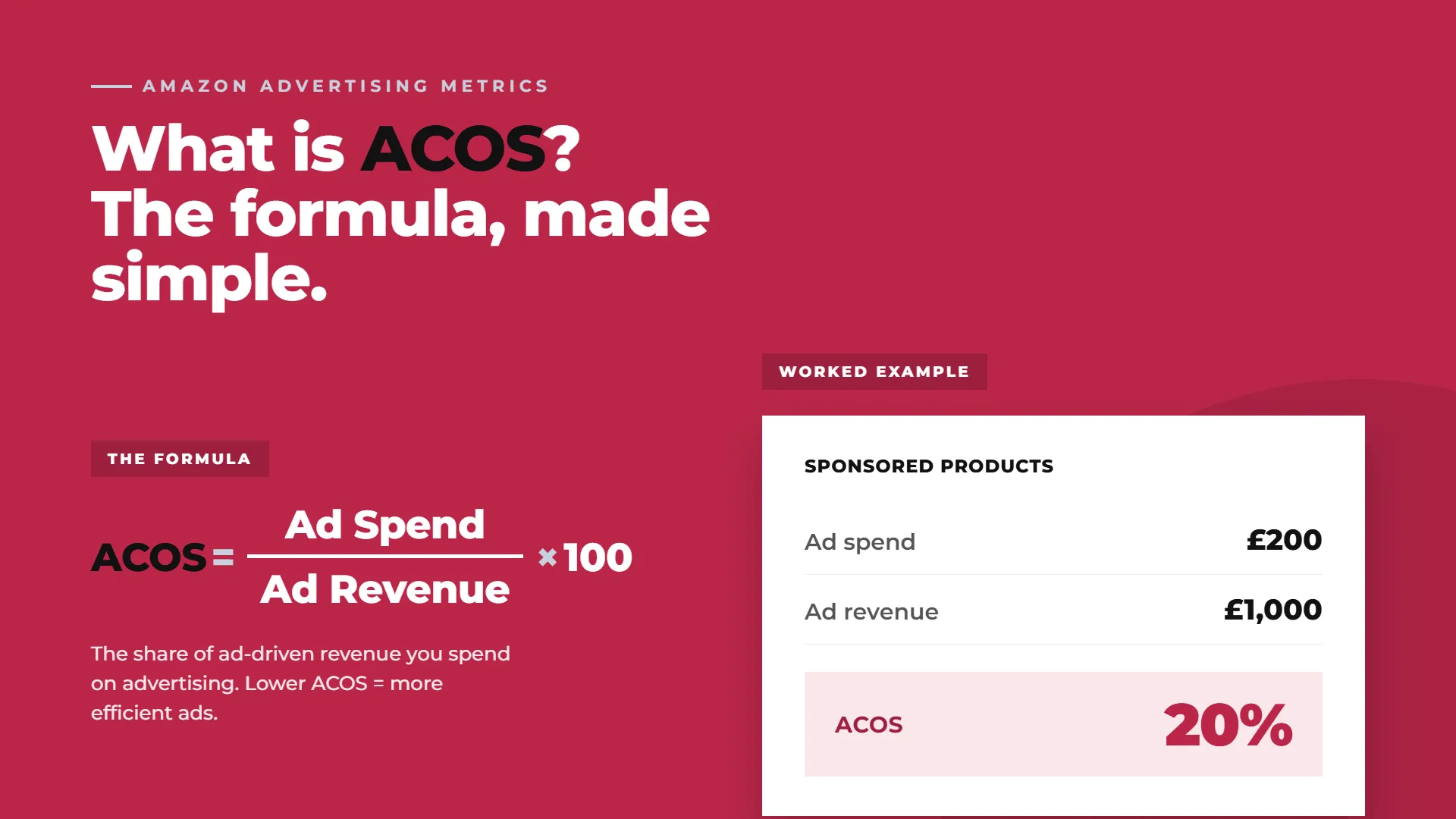
ACOS stands for Advertising Cost of Sale. It's the percentage of your ad-generated revenue that you spend on advertising to generate it. In plain terms: out of every pound (or dollar) your ads bring in, how much did you pay Amazon to get it? That is the basic meaning of advertising cost of sales Amazon sellers use inside their PPC reporting.
The Amazon ACOS formula is simple:
ACOS = (Ad Spend ÷ Ad Revenue) × 100
Say you spend £200 on Sponsored Products campaigns and those ads generate £1,000 in sales. Your ACOS is (£200 ÷ £1,000) × 100, which works out to 20% ACOS. That means 20p of every advertising pound went back to Amazon as ad cost. A lower ACOS means your advertising is more efficient, and a higher ACOS means you're paying more to win each sale. This is the simplest way to calculate ACOS in Amazon PPC.
One quick clarification, because the two get confused constantly. ACOS measures spend against your ad-driven sales only. The metric that measures ad spend against your total sales, including organic, is TACOS, and it tells a different story about how your ads support overall growth. That's a topic in its own right, and we cover it separately in our guide to Amazon TACOS. The difference between ACOS and ROAS is also worth knowing: ROAS flips the same relationship around by showing revenue generated for every pound or dollar spent.
What Is a "Good" ACOS on Amazon?
Here's the honest answer no benchmark table will give you: it depends.
Industry data from 2026 puts the average ACOS on Amazon at roughly a 32% ACOS, with most accounts landing between 25% and 36%. If you're below 28%, you're running more efficiently than the market. Above 36%, something structural usually needs attention.
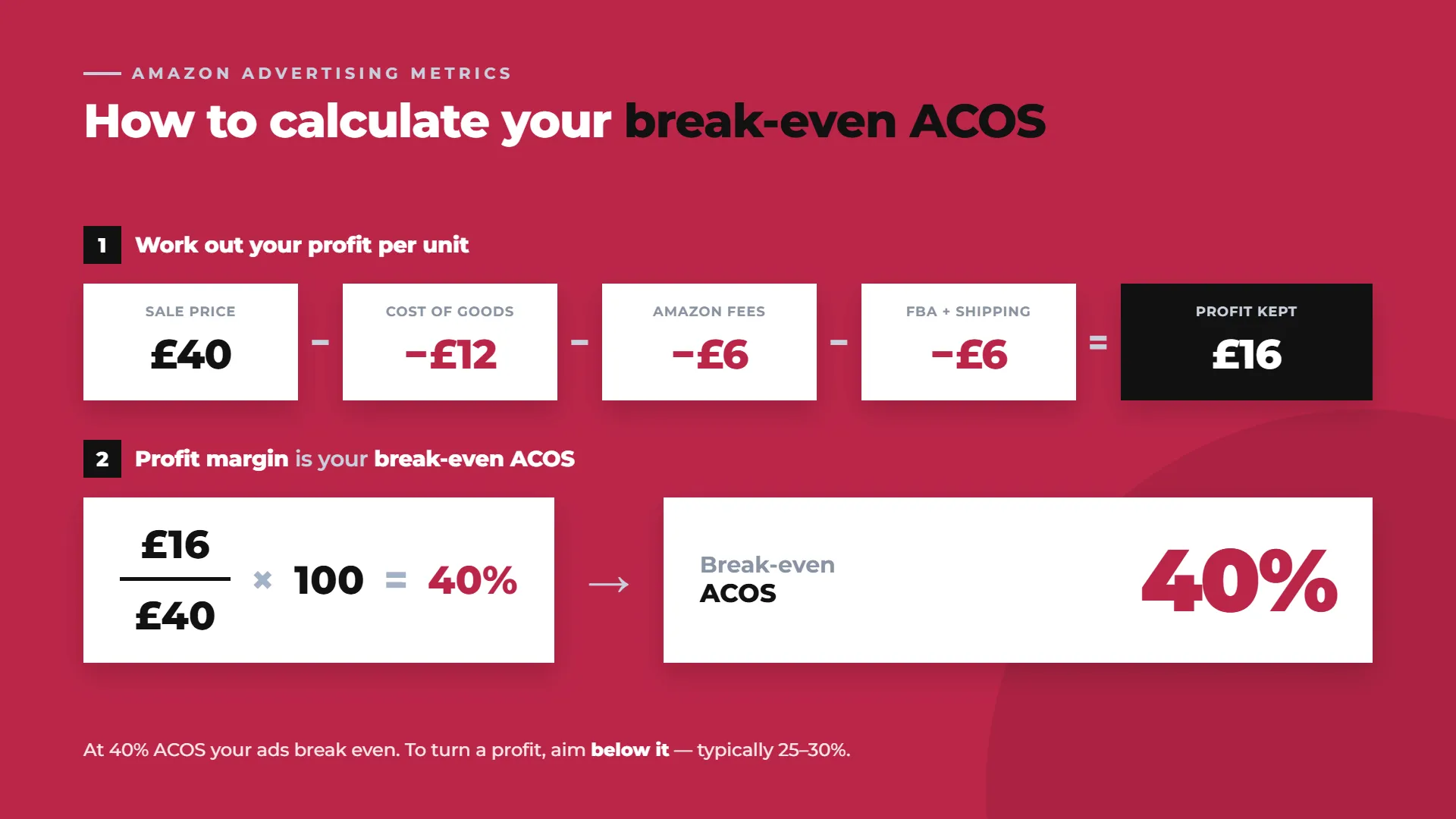
But averages are a starting point, not a target. The number that actually matters is your break-even ACOS, the point at which your advertising stops making a profit and starts eating into your margin. Your break-even ACOS is equal to your profit margin before ad spend, which is the break even ACOS formula in its simplest form.
Picture a product that sells for £40. After cost of goods, Amazon fees, and shipping, you keep £16, which is a 40% margin. That makes your break-even ACOS 40%, because at exactly 40% ACOS your ads make zero profit. To actually earn money on advertising, you want your ACOS comfortably below 40%, with a target ACOS of perhaps 25% to 30%. That is also how to calculate break even ACOS without needing a complicated break-even ACOS calculator.
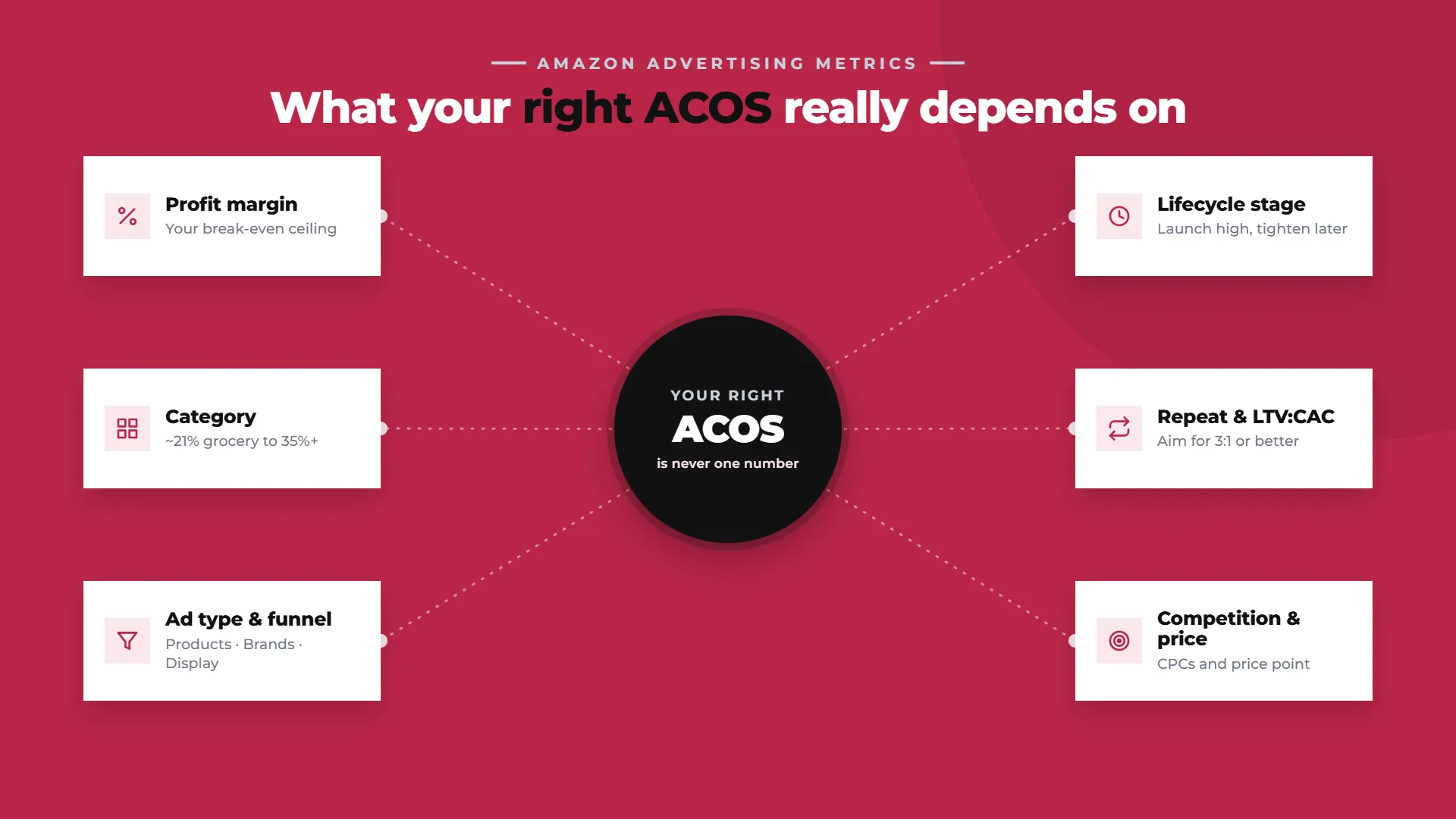
This is why a good ACOS is personal. A seller with a 50% margin can run a 35% ACOS and stay healthily profitable. A seller with a 20% margin running that same 35% ACOS is losing money on every ad-driven sale. Always anchor your target to your own margins first and the category benchmark second when deciding your ideal ACOS on Amazon.
Why ACOS Varies by Category
Once you accept that ACOS is relative, the next question is: relative to what? Category is the biggest factor, because several things differ enormously from one product type to the next.
The first is cost per click. More competitive categories cost more per click, which pushes ACOS up before you've even made a sale. The second is price point, since higher-priced items absorb ad costs more easily and lower ACOS as a percentage. The third is return rates, and apparel is the obvious example here, because heavy returns erode net ad-driven sales and inflate ACOS. The fourth is conversion rate and purchase frequency, as products people buy quickly and often convert ad clicks far more efficiently.
This is why a flat "aim for 25%" recommendation is misleading. A 30% ACOS is excellent in apparel and mediocre in books. You have to compare yourself to your own category, not the cross-market average.
Amazon ACOS Benchmarks by Category (2026)
Here's how median ACOS and typical click costs break down across major categories in 2026:
Category | Typical / Median ACOS | Median CPC | Why |
|---|---|---|---|
Books | ~19% | ~$0.38 | Cheapest clicks, frequent low-cost purchases |
Food & Grocery | ~21% | ~$0.58 | High repeat buying, lowest CPCs, strong conversion |
Beauty & Personal Care | 18–28% | mid-range | Strong repeat-purchase and subscription behaviour |
Pet Supplies | 20–32% | mid-range | Subscriptions and high retention support spend |
Electronics | 28–38% | ~$1.45 | Most expensive clicks, high-ticket competition |
Clothing & Apparel | ~42% | mid-range | High return rates erode net ad-driven sales |
Cross-category average | ~32% | ~$1.18 | The "all accounts" baseline |
The spread is striking. Median ACOS runs from about 19% in Books to 42% in Clothing, and CPC from roughly $0.38 to $1.45. If you take one thing from this table, make it this: find your category's range before you judge your own number.
How ACOS Varies by Ad Type
Category aside, the next big driver of ACOS is which ad format you're running, because Amazon's three ad types reach shoppers at different stages of the buying journey. A click from someone ready to buy is worth more, and converts more efficiently, than a click from someone who's only just discovering your brand. Expecting the same ACOS from each format is a mistake.
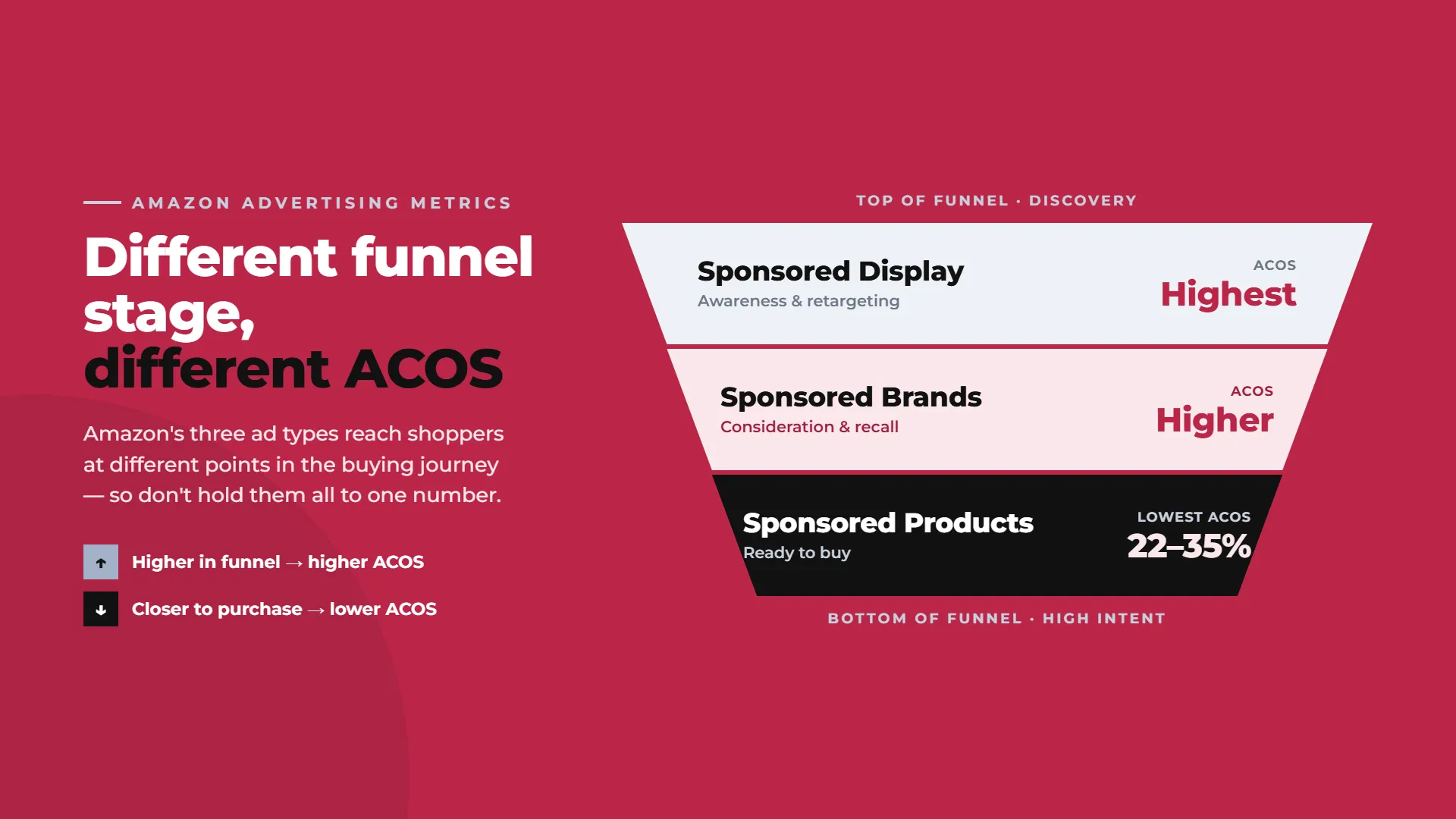
Sponsored Products sit at the bottom of the funnel. They appear in search results and on product pages, targeting shoppers who are actively looking for a product like yours and are close to buying. Because intent is high, these campaigns convert best and usually carry the lowest ACOS, commonly in the 22% to 35% range. For most sellers this is the workhorse format and the benchmark you'll judge everything else against.
Sponsored Brands work higher up the funnel. With a logo, a custom headline, and a row of products, they're built for awareness and brand recall rather than capturing a shopper at the exact moment of purchase. They reach people earlier in their decision, so click-through and conversion tend to be lower and ACOS often runs higher. The payoff is brand discovery and defending your branded search terms against competitors. Judged purely on first-click ACOS they can look expensive, but judged on the new customers and branded searches they generate, they usually earn their place.
Sponsored Display spans the widest part of the funnel. It can retarget shoppers who viewed your product but didn't buy, or reach entirely new audiences browsing related products both on and off Amazon. Retargeting placements can convert efficiently, while pure awareness placements are the furthest from a purchase and typically show the highest ACOS of the three. This is the format where ACOS alone is the most misleading, because much of its value lies in influencing demand that converts later.
The practical takeaway is to set a different ACOS expectation for each format rather than holding all three to one number. A blended account-level ACOS hides the reality that your bottom-of-funnel Sponsored Products should run lean, while your awareness-focused Sponsored Brands and Display campaigns are, by design, buying reach and future customers.
Why a High ACOS Can Be the Right ACOS
Here's where most sellers leave money on the table. They treat ACOS as a number to minimise at all costs, when sometimes a higher ACOS is the smarter business decision.
Look again at the table. Food & Grocery runs one of the lowest category ACOS figures, around 21%, and it's no coincidence that it's also the category with the strongest repeat-buying behaviour. When customers reorder the same product week after week, every category benefits from that loyalty. But the deeper insight is what it means for how you should bid in those categories.
In a high-repeat category such as groceries, supplements, skincare, pet food, or household consumables, the first sale through an ad isn't the whole story. It's the start of a relationship. If a customer discovers your product through a Sponsored Products ad and then reorders it six times over the next year, optimising purely for the ACOS on that first purchase badly understates what the customer is actually worth.
Consider the math. Suppose you acquire a new customer at a 60% ACOS on their first order, a number that looks alarming in isolation. But that customer goes on to reorder five more times at full margin with no ad cost attached. Across the whole relationship, your effective cost of acquiring that lifetime of revenue is a fraction of that first-order figure. You didn't overpay for a sale; you bought a customer.
This is why experienced sellers in repeat-purchase categories deliberately accept higher first-order ACOS, and why metrics like customer lifetime value (LTV) and the LTV-to-CAC ratio matter more than a single campaign's ACOS. A healthy target across most brands is an LTV:CAC ratio of 3:1 or better, meaning that for every pound you spend acquiring a customer, you earn at least three back in margin over their lifetime.
One critical caveat, because this logic gets abused. A high ACOS is only justified when the repeat math actually pencils out. If your product genuinely earns reorders and your retention data proves it, paying up to acquire customers is sound strategy. If you're running a 60% ACOS on a one-time purchase and hoping loyalty materialises, that's not an LTV play. It's just losing money with extra steps. Know your repeat-purchase rate before you justify the spend.
Why Your Target ACOS Should Change Over Time
A good ACOS isn't only specific to your business; it also shifts across a product's life on Amazon. When you launch, a high ACOS is often a deliberate investment rather than a loss. Bidding aggressively buys the early impressions, sales velocity, and reviews that push a new product up the organic rankings, and it's normal to run close to or even above break-even during this phase to establish the listing.
As the product earns reviews and organic visibility, more of your sales start arriving without an ad click attached, which means you can gradually pull your ACOS target down and let efficiency rather than growth lead. A mature, well-ranked product should run a tighter ACOS than the same product did in its first ninety days. The mistake to avoid is treating one ACOS target as permanent. Revisit it as your listing matures, your competition shifts, and your margins change.
Flairox Listings
Your Ads Can Only Convert as Well as Your Listing
Create stronger titles, bullet points, descriptions, product images and A+ Content with AI, then monitor how your listing performs after shoppers click your ads.
Optimize Your Listing Free → Advertising Cost 28% ACOS ↓ LISTING CONVERSION ↑ 18% ✓
The Bottom Line
Amazon ACOS isn't a score to chase to zero. It's a profit decision, and the right number is the one that fits your margins, your category, and the lifetime value of the customers your ads bring in. The sellers who win on Amazon aren't the ones with the lowest ACOS, but the ones who know exactly why their ACOS is what it is and have set it deliberately to grow profit, not just sales.
If you'd rather have that dialled in by a team that manages Amazon advertising for a living, Flairox builds and optimises Amazon PPC campaigns around your real profit targets rather than generic benchmarks. Get in touch for an Amazon advertising review and we'll show you what your ACOS should be, including how to lower ACOS on Amazon without cutting the sales that actually help you grow.
Frequently asked questions
ACoS stands for Advertising Cost of Sales. It’s a percentage that shows how much you’re spending on ads for every dollar of sales generated from those ads.