 Bilal Siddiqui
Key takeaways
TACOS is total ad spend divided by total revenue. It measures your advertising against every sale you make, paid and organic.
It's a brand-health metric, not a campaign metric. TACOS shows how dependent your revenue is on paid media and whether your ads are building lasting demand.
A "good" TACOS depends on your stage. Launches run hot at 15% to 25%, growing brands sit around 10% to 15%, and mature products settle at 5% to 10%.
The trend matters more than the number. TACOS falling while total sales rise is proof your advertising is compounding into organic growth.
Growing organic sales is the fastest way down. Every sale that arrives without an ad click lowers your TACOS automatically.
Your total sales are up and your campaigns look healthy, so on the surface the brand is winning. But underneath that growth sits a question most sellers never ask: is your revenue becoming less dependent on advertising, or more? That single question is what Amazon TACOS answers, and it's the difference between growth you actually own and growth you're renting from your ad budget.
This guide covers what Amazon TACOS measures, what a good TACOS looks like in 2026, how to read the trend over time, and the practical levers that bring it down. By the end you'll be able to use TACOS the way the best sellers do: as a health check for the whole business, not just a line in an Amazon advertising campaign report.
What Amazon TACOS Actually Measures
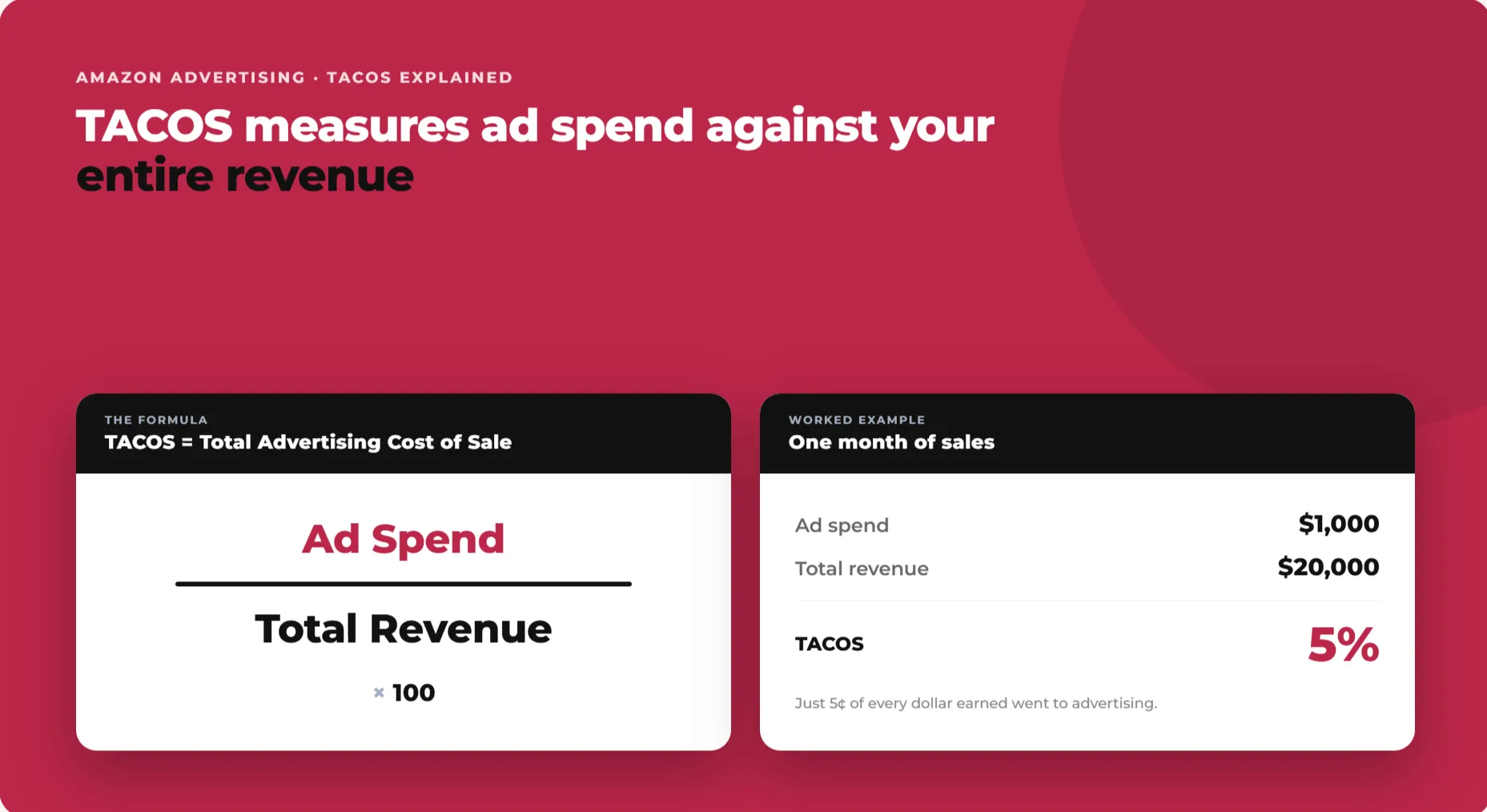
TACOS stands for Total Advertising Cost of Sale. It tells you what share of your entire revenue, not just your ad-driven revenue, is being spent on advertising. In other words, for every dollar your store earns from any source, how much did you spend on ads to support it? That is the simple TACOS meaning Amazon sellers need to understand before judging account health.
The Amazon TACOS formula is straightforward:
TACOS = (Ad Spend ÷ Total Revenue) × 100
Imagine you spend $1,000 on advertising in a month, and your store generates $20,000 in total sales across both paid and organic orders. Your TACOS is ($1,000 ÷ $20,000) × 100, which works out to 5%. That means just 5 cents of every dollar your brand earned went to advertising. The rest of that revenue arrived without a fresh ad cost attached, which is exactly the position a healthy, established product wants to be in. This is the basic Amazon TACOS calculation and the simplest way to calculate TACOS on Amazon.
The reason this matters is the word "total." Because the denominator is your whole revenue, TACOS captures something campaign-level metrics can't: the relationship between the money you put into ads and the size of the entire business those ads help create.
The Story TACOS Tells About Your Business
A single TACOS figure is useful, but its real power is as a narrative about how your brand is growing. It answers a question that keeps experienced sellers up at night: how much of my revenue would survive if I turned the ads off?
When your TACOS is low and stable, it signals that a large share of your sales is coming organically. Customers are finding you through search rankings, repeat purchases, and word of mouth rather than only through paid placements. That's a brand with its own gravity. When your TACOS is high, it tells you the opposite, that your revenue leans heavily on continued ad spend and would contract quickly if you reduced it.
This is why TACOS is best understood as the metric you manage strategy with. It won't tell you which keyword to bid on or which campaign to pause, but it will tell you whether your advertising is building a self-sustaining business or simply propping up this month's numbers. Used well, it keeps you honest about whether you're investing in demand or just buying it.
Amazon TACOS Benchmarks: What's Healthy at Each Stage
There is no Amazon-published TACOS benchmark, and any source that hands you one fixed number is oversimplifying. The right level depends almost entirely on where your product is in its life on the marketplace. A new launch should run a high TACOS on purpose, because you're spending aggressively to win rank and reviews before organic sales exist. An established product with real demand should settle far lower, because much of its revenue now arrives on its own.
Here's how the healthy ranges break down by stage in 2026:
Stage | Healthy TACOS Range | What It Reflects |
|---|---|---|
Launch | 30% – 40% | Heavy investment to build rank, reviews, and velocity |
Growth | 15% – 25% | Scaling sales while organic visibility builds |
Mature / Established | 5% – 10% | Strong organic demand carrying most of the revenue |
Warning zone | Above 30% (for a non-launch product) | Advertising is eating too much of total revenue |
As a general rule, a TACOS in the 10% to 15% band is considered healthy for a growing brand, anything below 10% is excellent, and a figure climbing above 20% on a product that isn't actively launching is a sign that ads are carrying too much of the load. Treat these as guide rails, then judge yourself against your own stage and goals rather than a blanket target when asking what is a good TACOS on Amazon.
Reading the TACOS Trend
The most valuable thing about Amazon TACOS isn't a single month's number. It's the direction it moves over a quarter, because the trend reveals whether your advertising is genuinely building the business or just sustaining it.
Falling TACOS: Organic Demand is Compounding
When your TACOS drifts down while total sales hold steady or climb, that's the signal every seller wants to see. It means your organic visibility is improving and a growing share of revenue is arriving without paid support. A downward-trending TACOS alongside rising revenue is the clearest proof that your ad investment is lifting your organic rank and reducing your dependency on paid media over time.
Rising TACOS: Paid Dependency is Creeping Up
A rising TACOS is a warning, even when individual campaigns look efficient. It means advertising is funding a larger and larger portion of your sales. If TACOS is climbing while total revenue stays flat, your growth has stalled and you're paying more to stand still. If TACOS is rising while total revenue falls, that's an emergency that needs attention immediately.
TACOS versus Revenue Direction
The cleanest way to read your TACOS is to look at it next to the direction of total revenue. TACOS falling while revenue rises is healthy, the flywheel turning as it should. TACOS rising while revenue is flat is a watch signal that your organic engine has stalled. TACOS rising while revenue drops is a red alert. Reading the two together tells you far more than either number alone.
The Amazon Advertising Flywheel: How Paid Spend Builds Free Organic Sales
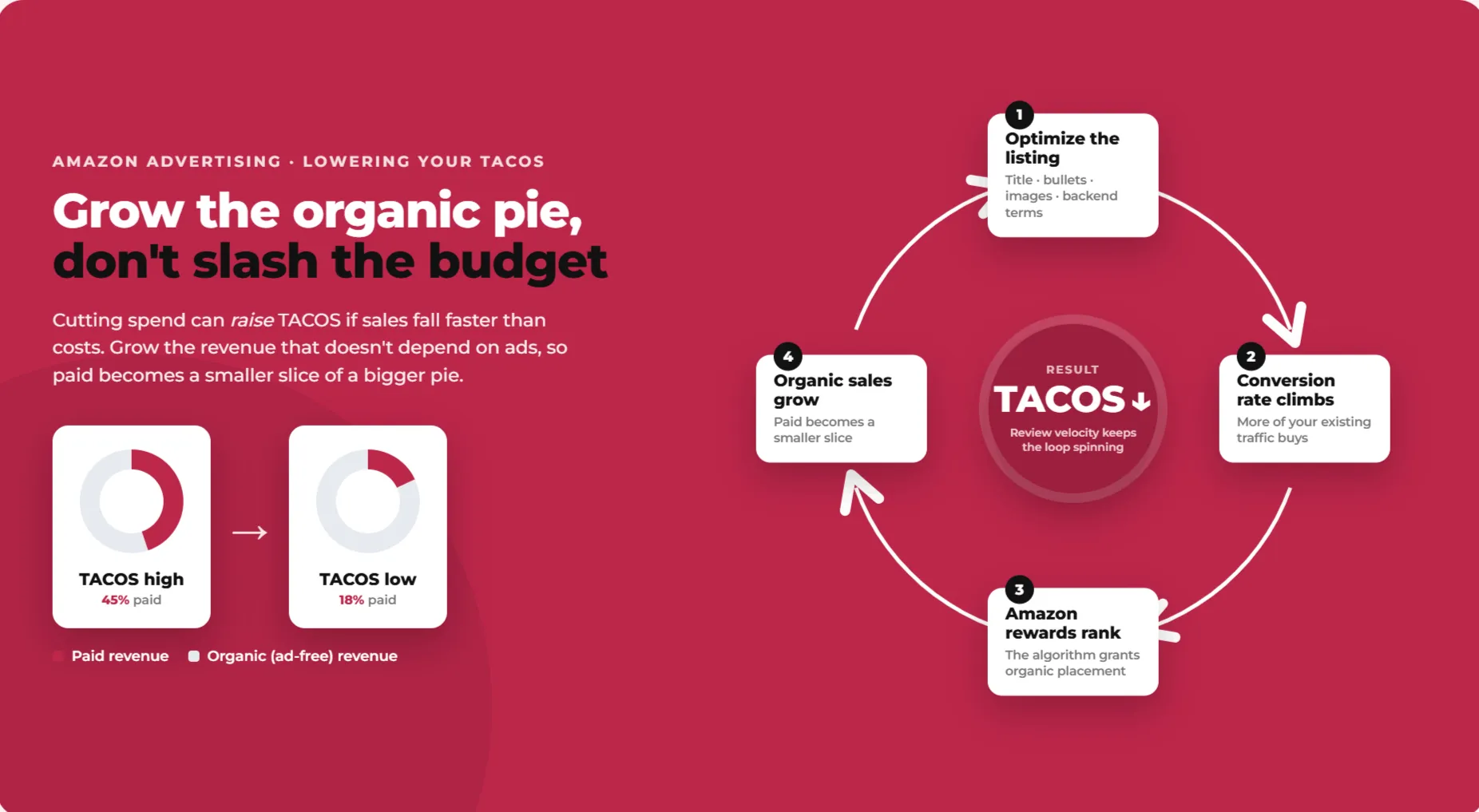
To understand why a falling TACOS is so powerful, it helps to see the Amazon advertising flywheel behind it. Advertising does more than generate a single sale. Each paid order adds to your product's sales velocity, and velocity is one of the strongest signals Amazon's algorithm uses to decide organic ranking. As your rank climbs, your product surfaces more often in organic search results, which generates sales you didn't pay a click for. Those organic sales add more velocity, which lifts rank further, and the cycle compounds.
This is the halo effect, and TACOS is the metric that proves it's happening. When the flywheel is turning, you spend roughly the same on ads but earn an ever-larger pool of organic revenue on top, so your TACOS naturally drifts downward. The goal for any maturing product is exactly this: total sales holding or growing while TACOS quietly falls quarter over quarter. That pattern, more than any single figure, is what confirms your advertising is building a durable business rather than renting you temporary sales.
How to Bring Your TACOS Down
Lowering TACOS is not about slashing your ad budget. Cutting spend can actually raise it if your sales fall faster than your costs. The real path is to grow the revenue that doesn't depend on ads, so paid spend becomes a smaller slice of a bigger pie.
The single fastest lever is growing organic sales, and that starts with your product listing. A listing with a keyword-optimised title, persuasive bullet points, strong images, and well-structured backend search terms ranks more easily and converts more of the traffic you already have. Every percentage point of conversion-rate improvement teaches Amazon's algorithm that your product deserves organic placement, which brings in sales you no longer have to pay for.
Review velocity reinforces this. A steady flow of genuine reviews builds the trust that lifts both conversion and rank, feeding the same flywheel. Beyond the listing, track TACOS at the individual product level rather than only across the whole account, because a blended figure hides which products are pulling their weight organically and which are leaning entirely on ads. That visibility lets you reallocate budget toward the products and stages where it builds the most lasting demand, and gradually wean your mature, well-ranked products off the heavy paid support they no longer need.
When a High TACOS Is Actually Good News
It's worth resisting the instinct to treat every high TACOS as a problem, because context decides whether it's a warning or a wise investment. During a product launch, a high TACOS is not just acceptable, it's the correct strategy. You have no organic rank or reviews yet, so you spend heavily to manufacture the early velocity that earns them. In that phase a TACOS of 30% or more reflects deliberate investment in a position you'll profit from later, not inefficiency.
The same number on a mature product tells a very different story. A product that has been selling for a year should have built enough organic demand to carry most of its revenue, so a high or rising TACOS there signals that the organic engine never developed, or has started to slip. The figure itself is neutral. What makes it good or bad is whether it's buying you a future rank you don't yet have, or merely covering for demand that should already exist.
When the Market Moves Your TACOS
Not every shift in your TACOS comes from something you did. A large part of the number is set by forces outside your account, and reading those forces correctly is what separates a calm, strategic response from a panicked one.
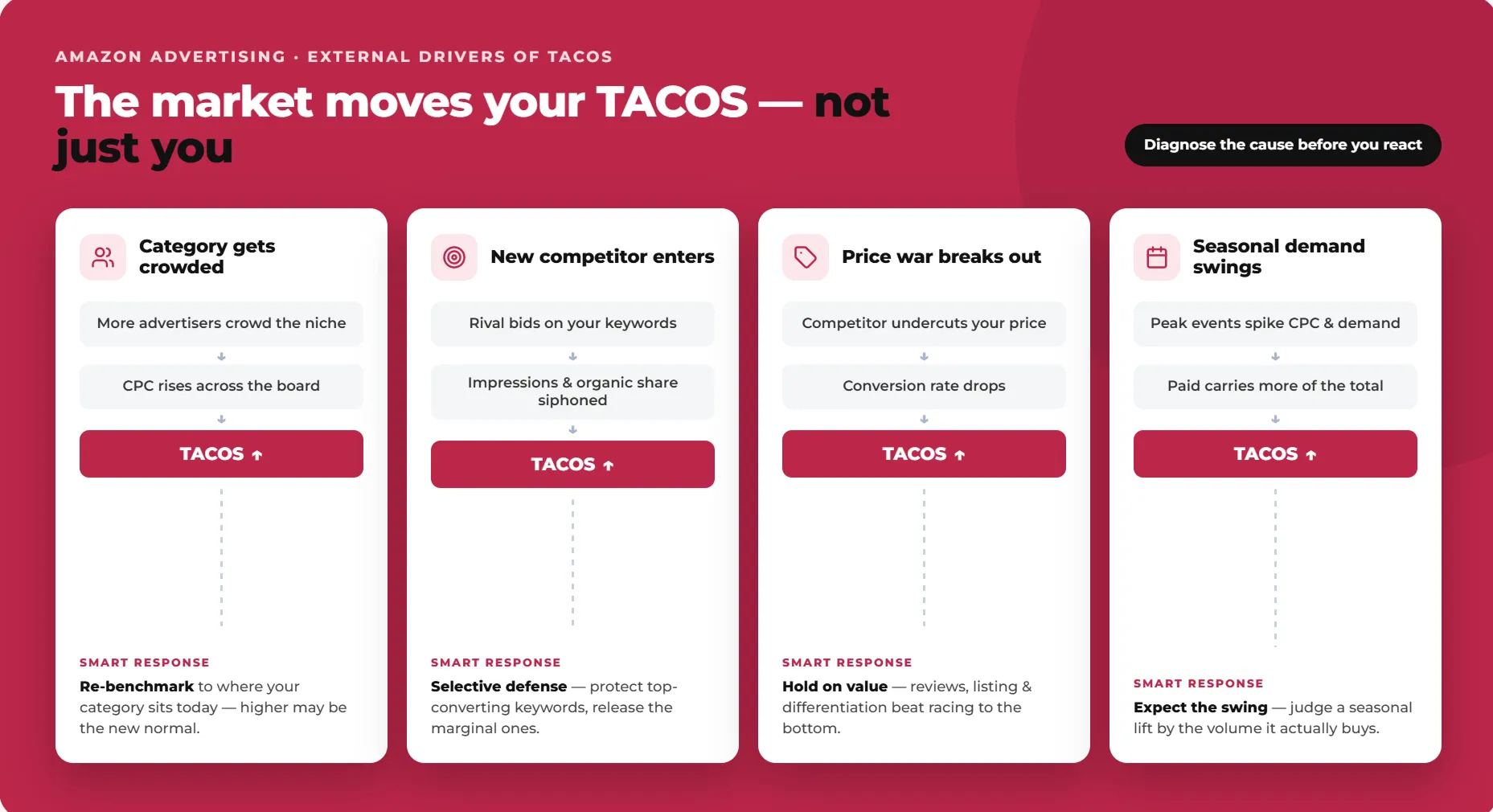
The competitiveness of your category is the biggest external driver. As more advertisers crowd into a niche, the cost per click rises across the board, which means the same volume of sales now consumes more ad spend and pushes your TACOS up even if your own performance hasn't slipped at all. With Amazon's average CPC climbing year over year, this upward pressure is something most categories now feel by default. When it happens, the right move isn't to assume your campaigns broke. It's to re-benchmark against where your whole category sits today, because a higher TACOS may simply be the new normal for that space.
A new competitor entering your niche creates a sharper, more targeted shift. When a rival starts bidding on your keywords and competing for your placements, they siphon off impressions and organic share, forcing you to spend more to defend the rank you already held. The instinct is to outbid them everywhere, but that's how margins evaporate. The smarter response is selective defense: protect your highest-converting, most profitable keywords aggressively, and let go of the marginal terms where the fight isn't worth the spend. Defending everything equally usually just funds a bidding war you can't win.
Price wars hit TACOS from a different angle. When a competitor undercuts you on price, your conversion rate tends to drop as shoppers compare options, so you need more ad spend to win the same number of sales, and TACOS climbs. Matching their price protects conversion but squeezes your margin, which can leave you worse off than the higher TACOS would have. This is where non-price strengths earn their keep. A brand with strong reviews, a superior listing, and genuine differentiation can often hold its price and accept a temporarily elevated TACOS rather than race to the bottom, because its product still converts on value instead of cost alone. The durable defense against a price war is built long before it starts.
💡 Pro Tip: Protect Discoverability
Rewrite Titles and Item Highlights Together
A shorter title does not have to mean weaker keyword coverage. Flairox Listings helps you prioritize title keywords, move secondary terms into Item Highlights, and keep the full listing compliant without keyword stuffing.
Claim Your 2 Free Listing Optimizations →
Seasonality and broader demand swings round out the picture. During peak periods such as Q4 and major sales events, competition and CPCs spike while everyone fights for the same shoppers, so a seasonal lift in TACOS is expected and usually worth it for the volume. In the quiet months, organic demand softens and paid spend carries a larger share of a smaller total, which can nudge TACOS up for reasons that have nothing to do with your strategy. The throughline across all of these is the same: diagnose what is actually moving your TACOS before you react, then respond to that specific cause rather than reaching for a blanket budget cut.
The Takeaway
Amazon TACOS is best thought of as a vital sign for your business. It measures whether your advertising is doing the job that actually builds enterprise value, turning paid spend into organic rank, repeat customers, and demand that keeps producing sales long after the campaign budget is gone. The sellers who win on Amazon don't chase the lowest possible TACOS. They watch it move in the right direction, falling steadily while total revenue grows, as confirmation that the brand is getting stronger underneath the numbers.
Getting that flywheel turning takes coordinated work across advertising, listing quality, and organic strategy, and it's rarely the result of managing campaigns in isolation. If you'd like a team that builds Amazon advertising around long-term brand health rather than this month's report card, Flairox offers full Amazon PPC management designed to drive total revenue and bring TACOS down over time. Book an Amazon advertising review with Flairox and we'll show you where your TACOS should be heading.
Frequently asked questions
A good TACOS depends on your product's stage. Launches commonly run 15% to 25%, growing brands sit around 10% to 15%, and mature, established products settle at 5% to 10%. Below 10% is excellent for an established product, while anything above 20% on a non-launch product usually signals over-reliance on ads.