 Bilal Siddiqui
A video starts picking up views. Within a day, three things happen at once. Some viewers tap the shopping link and buy the product inside the TikTok Shop. A few others click through to the Amazon listing and check out there. And a larger group watches, keeps scrolling, and then two or three days later opens Amazon, searches the brand by name, and buys.
The seller looks at their dashboards and sees movement everywhere. TikTok Shop shows orders. Amazon shows a bump in sessions and sales. The ad platform shows clicks. What none of the dashboards shows is a clean line connecting the video to every sale it helped create. Some of that impact is measured precisely. Some of it can only be inferred. And some of it cannot be proven at all.
That gap is what this guide is about. TikTok can generate real demand for a product that ultimately sells on Amazon, but the relationship between the two is easy to overstate and hard to measure. The goal here is to map how TikTok demand actually reaches Amazon, help you decide where to send it, and be honest about what you can and cannot know when you try to measure the result.
The TikTok-to-Amazon demand loop
TikTok and Amazon do different jobs in a purchase. TikTok is a discovery and demand engine. Its feed puts products in front of people who were not searching for them, and short video is good at creating want, curiosity, and social proof. Amazon is a high-intent conversion destination. People arrive already close to buying, trust the checkout, and expect fast delivery.
Put those together and you get a loop rather than a straight line. Demand created on TikTok can convert immediately inside TikTok Shop, it can flow to Amazon through a link, or it can sit dormant and resurface later as an Amazon search. The same piece of content can feed all three at once. Understanding the loop matters because each path has different economics, a different checkout, a different owner of the customer relationship, and very different measurability. Treating them as one thing is where most cross-channel plans go wrong.
Three ways TikTok activity can reach Amazon
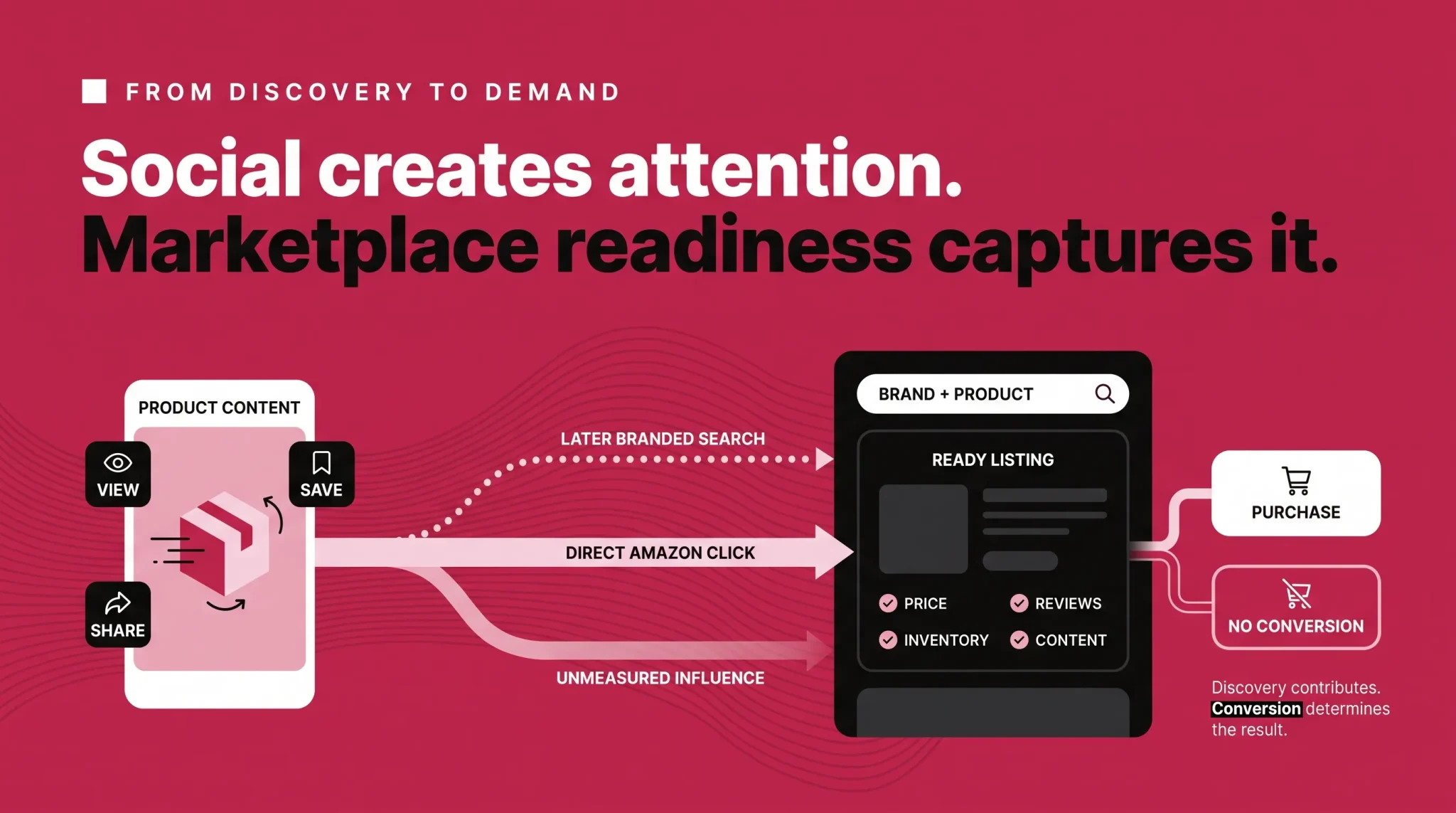
There are three distinct journeys hiding inside "TikTok drove my sales." Keeping them separate is the single most useful thing a seller can do here.
Path one: TikTok content leads to a TikTok Shop purchase. The shopper discovers the product and completes checkout without leaving TikTok. The purchase is completed within TikTok Shop, so TikTok Shop records the transaction and reports the order through its commerce analytics. Fulfillment may still be handled through Seller Shipping, TikTok Shipping, Fulfilled by TikTok, Amazon Multi-Channel Fulfillment, or another currently supported setup. Note that this is not an Amazon sale at all. It is a TikTok Shop sale that happens to be part of the same demand strategy.
Path two: a tagged or external TikTok click leads to Amazon. The viewer taps a link that sends them to your Amazon product detail page or Brand Store, and they buy on Amazon. Amazon holds the transaction and the customer relationship, and this is the one path where the connection between TikTok and the Amazon sale can be measured directly, because the click passed through a link you can tag.
Path three: TikTok-created demand later appears as Amazon activity. A viewer sees the content, does not click anything, and days later searches your brand or product on Amazon and buys through an organic result. No dashboard attributes this cleanly. The sale is credited to Amazon organic or to a last ad click, and the TikTok content that planted the intent gets no visible credit. This path is often the largest and always the hardest to prove.
Everything else in this guide follows from these three journeys. They create different attribution signals, different fees, different fulfillment responsibilities, and different reporting limits, so a strategy that ignores the differences will misread its own results.
Choosing the purchase destination
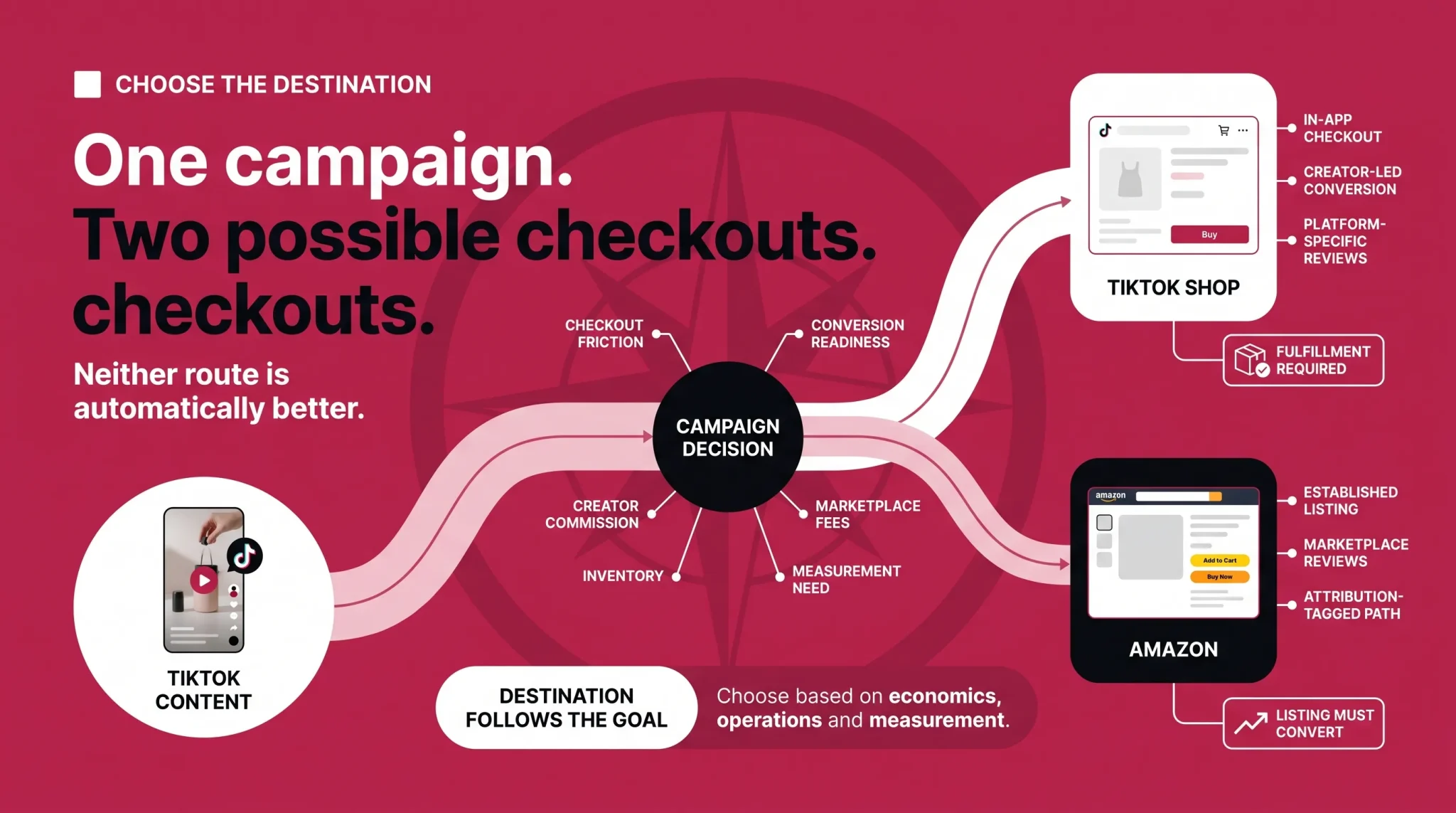
Every campaign should have a deliberate destination rather than a default one. The realistic options are a TikTok Shop product page, an Amazon product detail page, or an Amazon Brand Store where it fits the campaign. The right one depends on the situation, not on a rule.
Weigh where checkout friction is lower for that audience, how ready the product is to convert in each place given its reviews and content, what a creator commission will cost you versus Amazon referral and advertising costs, your current fees and any promotions on each platform, where your inventory sits and whether the product is eligible on each channel, what you actually need to measure, how much customer trust each destination carries, and the campaign objective itself. A launch built to seed reviews and gather first-party signal may point to TikTok Shop, while a product with a deep review base and strong Amazon conversion may do better sending traffic to Amazon. Neither is universally the better discovery channel or the better conversion channel.
Cost is part of this decision, and it is worth being precise instead of repeating the idea that TikTok Shop is simply cheaper than Amazon. On the TikTok Shop side, most US product categories currently use a 6% referral fee, selected jewelry subcategories and several pre-owned categories currently use 5%, and some qualifying high-value portions can fall into a different tier, so sellers should confirm the current rate for their exact category in TikTok Shop Seller Center. On top of the referral fee, creator affiliate commissions are set by the seller and can vary by product, margin, collaboration type, creator, campaign, and commercial agreement. TikTok supports different structures for this, including open collaboration where any eligible creator can promote at a public rate, targeted collaboration that you negotiate directly, and selling yourself without paying an affiliate commission at all.
The honest comparison is the full cost structure, not the headline percentage. On either channel you are paying some mix of platform or referral fees, creator commissions, advertising, product samples, discounts and platform promotions, fulfillment, returns, content production, inventory coordination, and operational overhead. Once those stack up, the platform with the lower headline fee is not automatically the cheaper or more profitable place to sell. The destination should be chosen on total economics and conversion readiness, not on a single fee line.
Preparing Amazon for social traffic
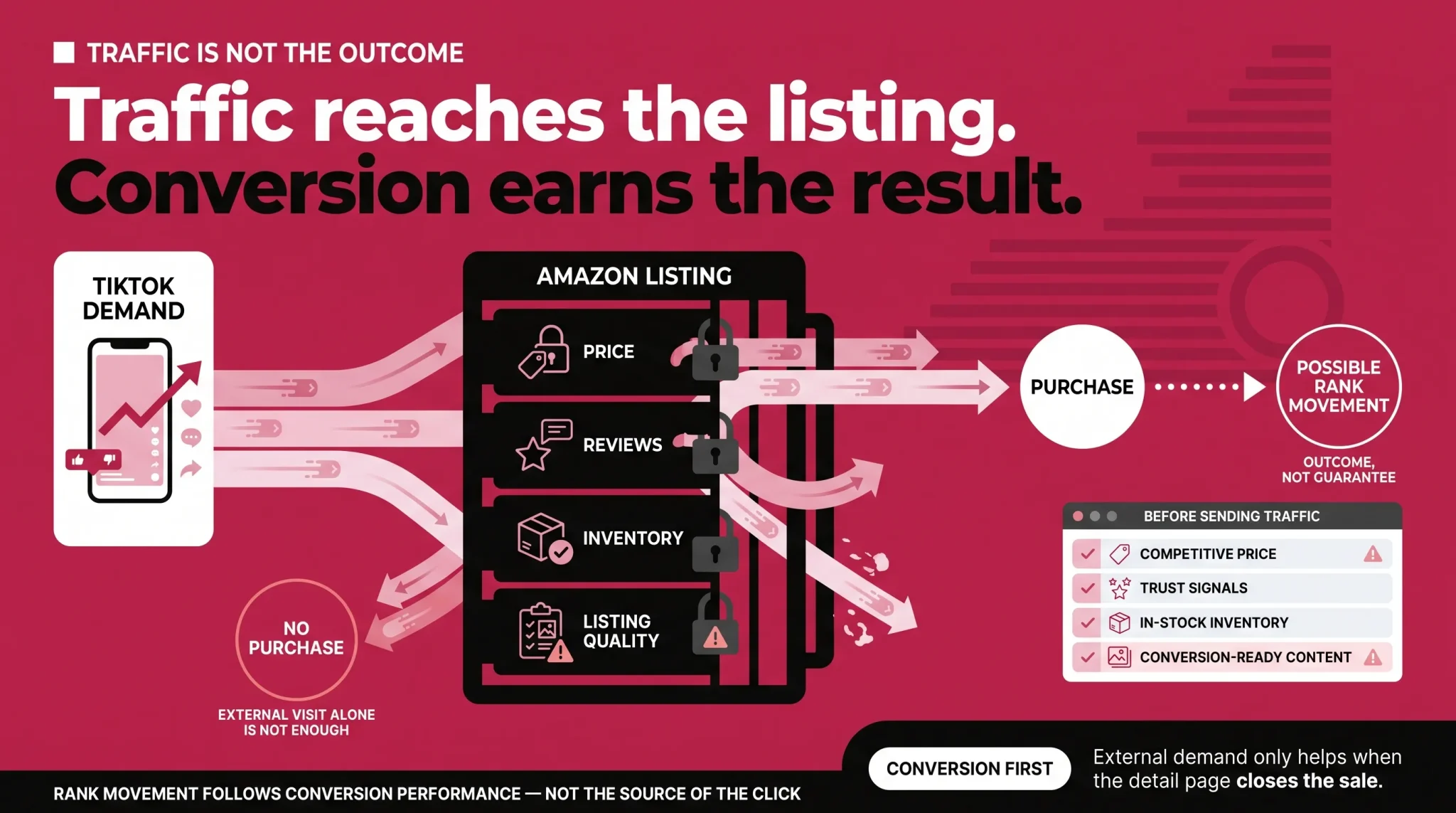
When Amazon is the destination, the listing has to be ready to convert a cold, curious visitor who just came from a video. Social traffic is less patient and more skeptical than search traffic, so a weak listing wastes the demand for the content created.
Before pointing TikTok traffic at Amazon, confirm the basics are right: the link goes to the correct ASIN and variation, the price is current and consistent with what the content implied, the item is in stock with a credible delivery promise, the main image and listing content hold up to a first impression, the reviews and rating give a new shopper enough confidence, the Featured Offer is available where that is relevant, and the whole thing presents well on mobile since that is where the click is coming from. Promotions should match across channels so the shopper does not feel misled, and any claim a creator repeats about the product needs to be accurate and supported on the listing itself. This is retail readiness, not a full listing optimization project, but skipping it turns paid attention into bounced sessions. One caution to hold onto: sending external traffic to a listing does not automatically improve organic rank, Best Sellers Rank, conversion rate, or advertising efficiency. Those outcomes depend on whether the traffic converts, and that depends on the readiness above.
What can and cannot be measured
This is the part most cross-channel content skips, and it is the part that keeps you honest. Measurement here falls into three levels, and mixing them is how sellers fool themselves.
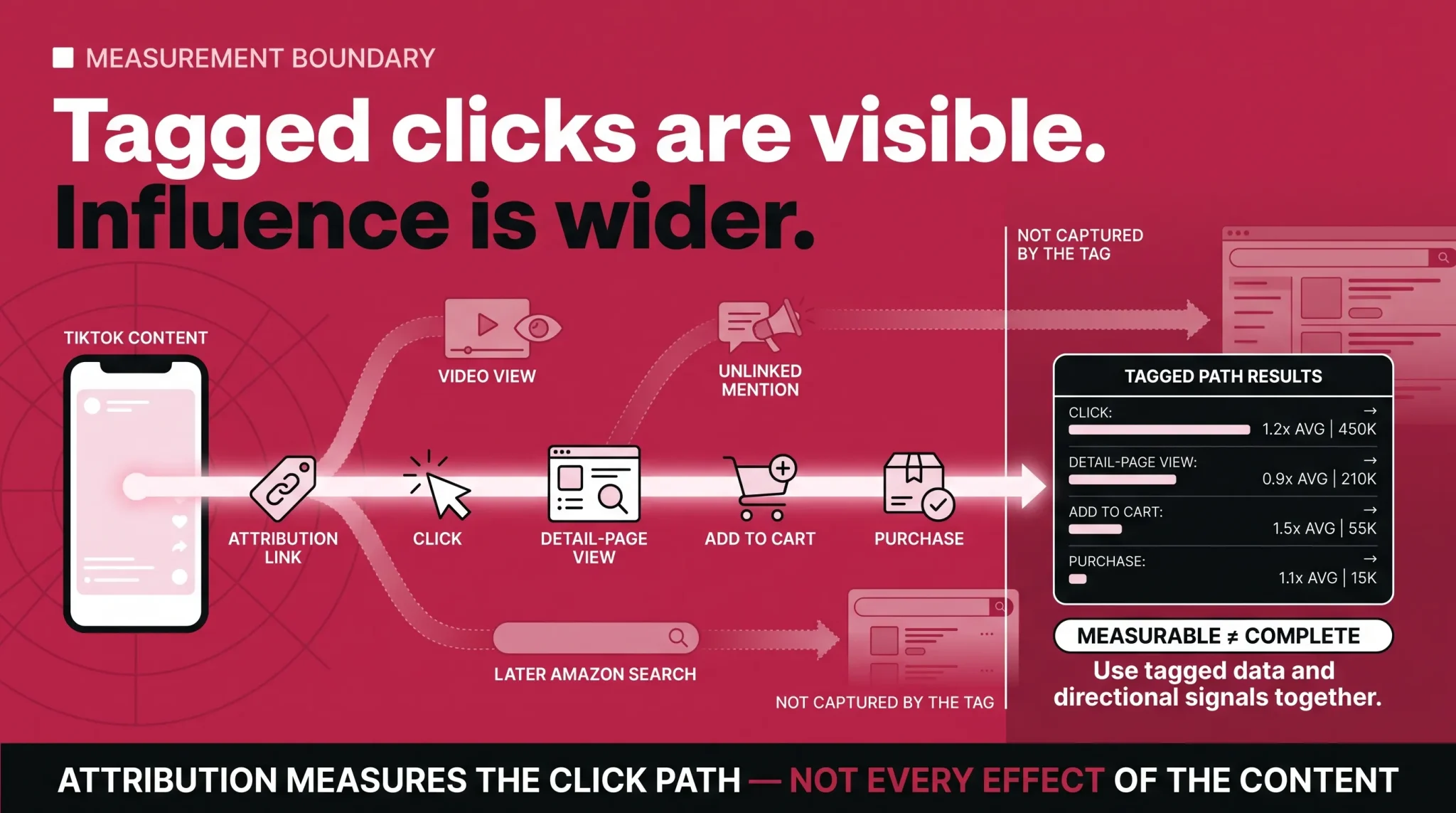
Two things are directly measured. TikTok Shop transactions are recorded inside TikTok Shop, so orders and gross merchandise value that happen in the app are visible in its commerce analytics. And tagged TikTok-to-Amazon clicks can be measured with Amazon Attribution. Attribution is available to specific advertiser types, generally professional sellers enrolled in Brand Registry with the Brand Representative role, vendors, and eligible agencies representing sellers, among other currently supported types. It works by placing a unique attribution tag in an external destination link, can be used for eligible paid or organic social campaigns, measures the tagged click path using a 14-day last-touch model, and can report metrics such as detail-page views, add-to-carts, purchases, and sales where available.
The limits matter as much as the capability. Amazon Attribution does not measure TikTok video views without a click, unlinked organic mentions, later Amazon searches that did not pass through a tagged click, every purchase a creator influenced, or TikTok Shop orders. There is also a mobile reality to plan for.
TikTok may open Amazon links inside an in-app browser. Amazon Attribution can underreport downstream conversions when the shopper is not logged in or does not transition into the Amazon app during the initial session.
When that happens, you may still see detail-page views, add-to-carts, tagged purchases, branded-search movement, total Amazon sessions, and conversion changes, but a conversion that Attribution missed should not automatically be assigned to TikTok. The absence of a tagged conversion is not proof of a TikTok sale, and it is not proof of no sale either.
TikTok's own advertising reporting needs the same care. Product GMV Max is TikTok Shop's automated advertising solution that can optimize across available shoppable placements and creative assets. Its dashboard can attribute orders for promoted products across paid, organic, and affiliate activity inside TikTok Shop, which is useful, but that reporting model should not be read as proof that the paid campaign incrementally caused every order shown. It helps to keep four different things separate in your head: TikTok Shop platform attribution, paid media incrementality, Amazon Attribution, and cross-channel directional analysis. In particular, do not compare a Product GMV Max revenue figure directly against an Amazon Attribution revenue figure as if the two systems measured the same thing the same way. They do not.
Then there are the directional signals on Amazon. Branded-search movement is visible through Search Query Performance, which requires eligible Brand Analytics access and is generally available to Brand Representative accounts. It focuses on shopper behavior in Amazon search results and shows query volume, impressions, clicks, cart adds, and purchases for relevant brand or ASIN queries. It does not identify TikTok as the traffic source, so a rise in branded queries during a campaign is a directional clue, not a source report. The same is true of session data: Business Reports show sessions but do not identify the original source of every visit. Organic-sales movement, conversion changes, and new-to-brand activity where available all point in a direction without proving a cause.
That leaves the honest bottom line for the whole section. You can measure what you tag and what happens inside each platform, you can read the rest as directional evidence, and you should resist the temptation to convert coincidence into causation. A sale that happened during a campaign is not automatically a sale caused by it.
The measurement map
Here is the same idea in one view. Read the final column as the discipline that keeps the others honest.
Signal | Where it appears | What it can tell you | What it cannot prove |
|---|---|---|---|
TikTok Shop orders and GMV | TikTok Shop commerce analytics | Sales completed inside TikTok Shop | That the same buyers would not have bought on Amazon instead |
TikTok affiliate and ad activity | TikTok Shop and TikTok Ads reporting | Creator and campaign performance inside TikTok | Incremental lift on Amazon |
Product GMV Max reporting | TikTok Shop ads dashboard | Orders attributed across paid, organic, and affiliate in TikTok Shop | That the paid campaign incrementally caused every attributed order |
Amazon Attribution tagged clicks | Amazon Attribution | Detail-page views, add-to-carts, purchases from the tagged click path | Views, unlinked mentions, or later untagged searches |
Amazon detail-page views and sessions | Business Reports | Traffic and conversion movement on the listing | The original source of each visit |
Amazon branded-search movement | Search Query Performance | Shifts in brand and ASIN query behavior | That TikTok was the source |
Amazon conversion and total-sales movement | Business Reports and sales data | Whether performance changed during the campaign | That TikTok caused the change |
New-to-brand metrics where available | Amazon reporting | First-time brand purchase activity | Which channel created the first touch |
Directly measured means the TikTok Shop transactions and the tagged TikTok-to-Amazon clicks. Directional means branded-search movement, session lift, organic-sales movement, conversion changes, and new-to-brand changes. Not proven means view-through influence without a tagged click, incremental sales caused by TikTok, organic-ranking lift caused by TikTok, and every sale during the campaign window. Resist building a single blended attribution number that erases those lines.
Coordinating inventory, pricing, promotions, and fulfillment
Running demand across two channels creates operational risk that has nothing to do with content. The most common failure is a stockout: a video takes off, demand spikes, and the product runs out on Amazon at exactly the wrong moment. If the same FBA inventory is serving both Amazon orders and Multi-Channel Fulfillment orders, one channel's demand can quietly consume stock the other channel was counting on. Shared inventory can simplify operations, but it can also let a TikTok surge drain the pool that Amazon needs.
The list of things to keep aligned is longer than it looks. TikTok Shop and Amazon can show different prices or promotions, a creator can feature a variant that is out of stock or not listed, bundles can differ by channel, and SKU, GTIN, title, image, and variation details can drift apart until the same product looks like two different products. Returns flow through separate workflows, reviews stay separate between the platforms, and inventory sync delays can lead to overselling and different shipping promises. None of this is glamorous, and all of it can undo a good campaign.
On fulfillment, TikTok Shop in the US currently supports several paths at a strategy level: Seller Shipping where it is available to the seller, TikTok Shipping, Fulfilled by TikTok, and Amazon Multi-Channel Fulfillment through supported TikTok Shop workflows and integrations. Access can vary by seller account, and each option carries its own dispatch requirements, tracking requirements, delivery standards, return workflow, cost structure, and inventory implications. The point is to choose deliberately, not to treat fulfillment as an afterthought once the content is live.
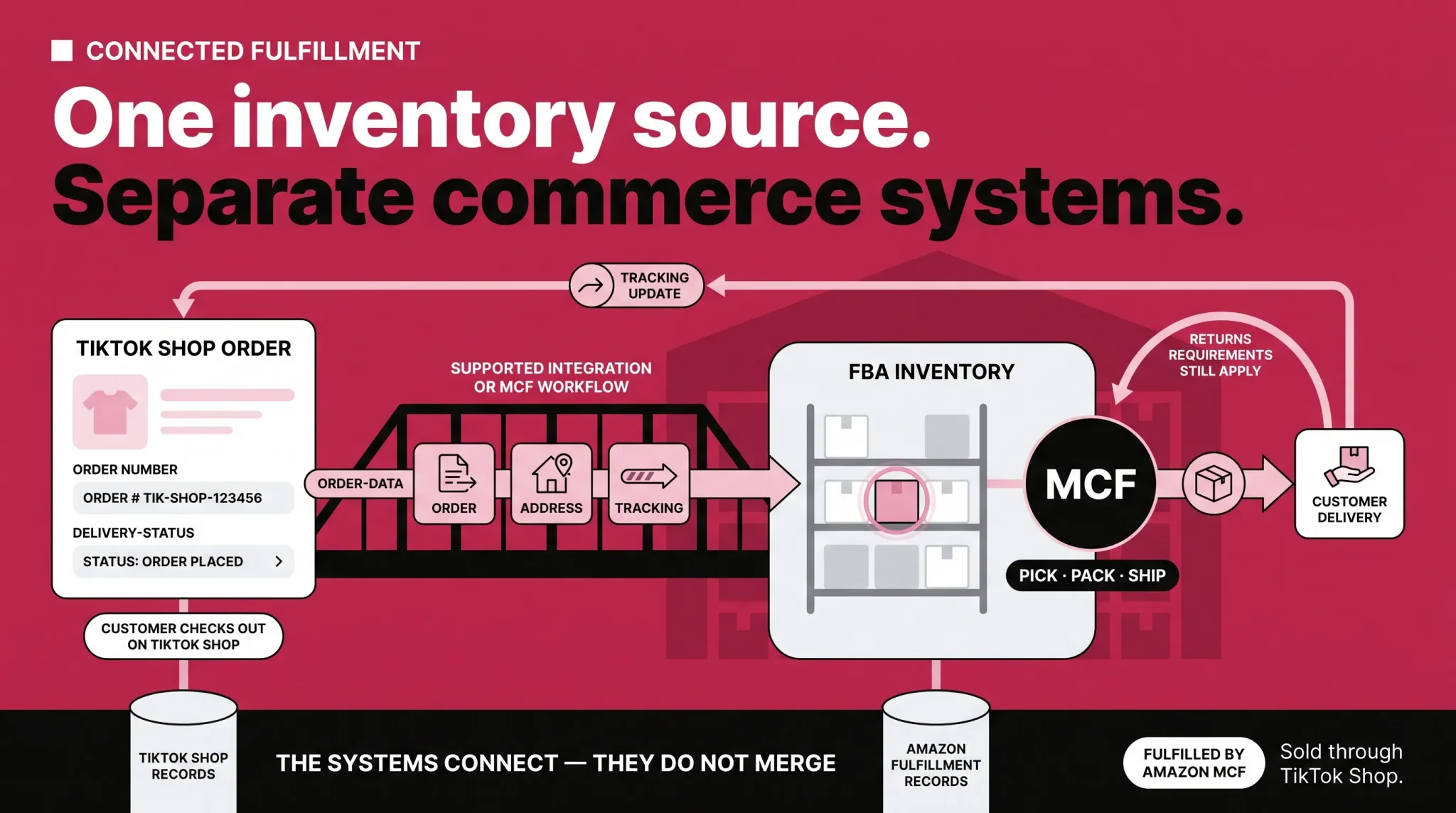
The Amazon Multi-Channel Fulfillment path deserves a clear answer because sellers ask about it constantly. Amazon Multi-Channel Fulfillment can fulfill TikTok Shop orders using inventory held in Amazon's fulfillment network. Sellers need an eligible Amazon account with FBA inventory and must configure TikTok Shop through a supported integration or the current Amazon MCF warehouse workflow. A few strategic qualifications keep this from going wrong: TikTok Shop tracking requirements still apply, and incorrect MCF tracking configuration can create fulfillment violations. Inventory and order data must be synchronized between the two systems. The seller must provide a seller-controlled returns address, and Amazon's dynamic fulfillment centers should not be entered as the TikTok Shop returns warehouse. MCF fulfillment and TikTok Shop order management remain separate systems connected through an integration, not a single merged operation, so treat them accordingly.
Working with creators without creating compliance problems
Creator content is the engine of most TikTok-to-Amazon demand, and it comes with disclosure and claim responsibilities that a brand cannot ignore. TikTok currently requires its commercial content disclosure setting when content promotes the creator's own brand or business, a third-party brand, or a product received through a paid or incentivized relationship. Applying that setting through TikTok for Business is a starting point, not the finish line.
For US audiences, FTC disclosure expectations apply whenever a creator has a material connection to the brand, including payment, commission, free or discounted products, employment, or a personal or family relationship where relevant. Disclosures should be clear, difficult to miss, and placed with the endorsement itself, not buried. A platform label does not automatically satisfy every legal requirement in every country, so treat it as one layer among several.
Two more boundaries protect the brand. Creators must not make unsupported product claims, and the brand should review high-risk claims before content goes live, because a creator's exaggeration becomes the brand's problem. And the review economies of the two platforms do not connect. TikTok comments and TikTok Shop reviews do not transfer to Amazon, sellers cannot incentivize positive Amazon reviews, and creators should not direct only satisfied customers to leave Amazon reviews. Social proof on TikTok can warm up a shopper, but it does not become Amazon review equity, and trying to force that crossover is where sellers get into trouble.
A test-and-learn workflow
Because attribution is imperfect, the sane approach is a disciplined test rather than a hunt for a guaranteed formula. A workable sequence looks like this:
Define one campaign objective.
Select one primary purchase destination.
Establish an Amazon and TikTok baseline before launch.
Use separate tagged links by campaign or creator where practical.
Confirm inventory, pricing, fulfillment, and offer readiness.
Record TikTok Shop, Amazon Attribution, Amazon search, session, and sales signals separately.
Compare campaign periods with appropriate prior periods while noting other changes.
Document stockouts, Amazon ad changes, promotions, price changes, and creator activity.
Decide whether to scale, change destination, or stop the test.
A simple before-and-after comparison will not give you statistical certainty, and it should not pretend to. There is no single correct campaign length or budget, because both depend on your margins, your category, and how much noise is in your data. The value of the workflow is that it forces you to record signals separately and account for the other things moving at the same time, which is the only way to learn something real from a channel you cannot fully attribute.
When TikTok Shop makes sense for an Amazon seller
TikTok Shop is not a fit for every Amazon seller, and framing it as a required move does more harm than good. It tends to make sense when the product demonstrates well in short video, when the margin has room for creator commissions, content production, and ads on top of platform fees, and when the business has the operational capacity to run a content engine and meet TikTok Shop's fulfillment and service expectations. It tends not to make sense when margins are already thin, when there is no capability or budget to produce a steady stream of content, or when the product is hard to show convincingly in a few seconds.
It also helps to be clear about the relationship. TikTok Shop and Amazon can operate as separate sales channels, as complementary discovery and conversion channels, as competing destinations for the same product, or as parts of one coordinated demand strategy. The right framing is a decision, not a default, and it should follow from the destination logic and economics above rather than from the assumption that more channels are always better.
Cross-channel readiness checklist
Before you put real budget behind TikTok content aimed at Amazon, run through these readiness signals:
The Amazon listing is ready to convert social traffic, with correct ASIN, price, stock, images, content, and reviews.
Inventory is synchronized well enough to survive a demand spike without a stockout on either channel.
Pricing and promotions are consistent across TikTok Shop and Amazon.
There is a tagging and measurement plan in place before any spend, so results can be read honestly.
Each campaign has one clear purchase destination rather than a vague "buy it anywhere."
Creator relationships are disclosed and compliant, and high-risk product claims are reviewed before publishing.
Turning TikTok demand into measured Amazon growth
The brands that get real value from this do not chase virality and hope it shows up on Amazon. They pick a destination on purpose, get the Amazon listing ready to convert, tag what they can, and read the rest as directional evidence. If you want help designing a TikTok-to-Amazon test that measures what it can and prepares your listing to convert social traffic, Flairox works across Amazon growth and Amazon advertising. Book a call and we will help you build a test worth running.
Frequently asked questions
It can contribute. TikTok content can create discovery and demand that shows up as Amazon clicks or later branded searches. The effect varies by product, content, and listing readiness, and only part of it can be measured directly.