 Bilal Siddiqui
Choosing between an amazon seo agency and a freelancer is usually framed as a talent question.
In practice, it is more often a constraints question.
The real variables are speed, scale, risk, ownership, and how much internal structure your brand already has.
A small catalog with one decision-maker often needs something very different from a brand managing multiple marketplaces, regulated claims, or ongoing ranking defense.
So this guide is not about who sounds smarter on a sales call. It is about fit.
By the end, you should have a clearer choice and a simple way to evaluate SEO help before you commit.
Start With Your Situation
The label matters less than the operating reality.
1) You have 1-5 SKUs and no real process yet
This usually needs focused execution, not a large service layer. You are often still figuring out positioning, keyword priorities, listing quality, and who owns decisions internally. In that setup, an amazon seo freelancer or a consultant can fit well if the scope is narrow and the founder can review work quickly.
2) You have 20-100 SKUs and rankings are inconsistent
This usually needs process, not just talent. Once a catalog gets bigger, the challenge is not only keyword decisions. It becomes change logs, QA, rollout order, reporting, and consistency across listings. If the work spans many ASINs, categories, or marketplaces, the provider needs operating discipline, not just copy skill.
3) You are defending mature listings, not just fixing weak ones
Mature listings often need controlled edits, better reporting discipline, and stronger change tracking. Amazon's Manage Your Experiments tool exists precisely because content changes should be tested rather than guessed, and Amazon offers Brand Analytics dashboards to track query, click, and purchase behavior over time. That makes mature-listing work more about iteration quality than one-off rewrites.
4) You are expanding into multiple marketplaces
Multi-marketplace SEO is not just translation. Amazon's Global Selling resources and Build International Listings tooling show that cross-listing and international offer management add operational complexity. Once a brand is managing multiple stores, workflow and ownership usually matter more.
5) You sell in a heavy-compliance category
Supplements, baby, beauty, food, and topical products usually need stronger QA. Amazon has category-specific rules for dietary supplements, broad restricted-products policies, and additional requirements for consumable, ingestible, and topical products. In these categories, one careless listing change can create policy risk, so the evaluation standard should be higher.
That is why "agency vs freelancer" is the wrong first question.
The better first question is: what kind of operating problem do you actually have?
What You Actually Buy When You Hire SEO Help
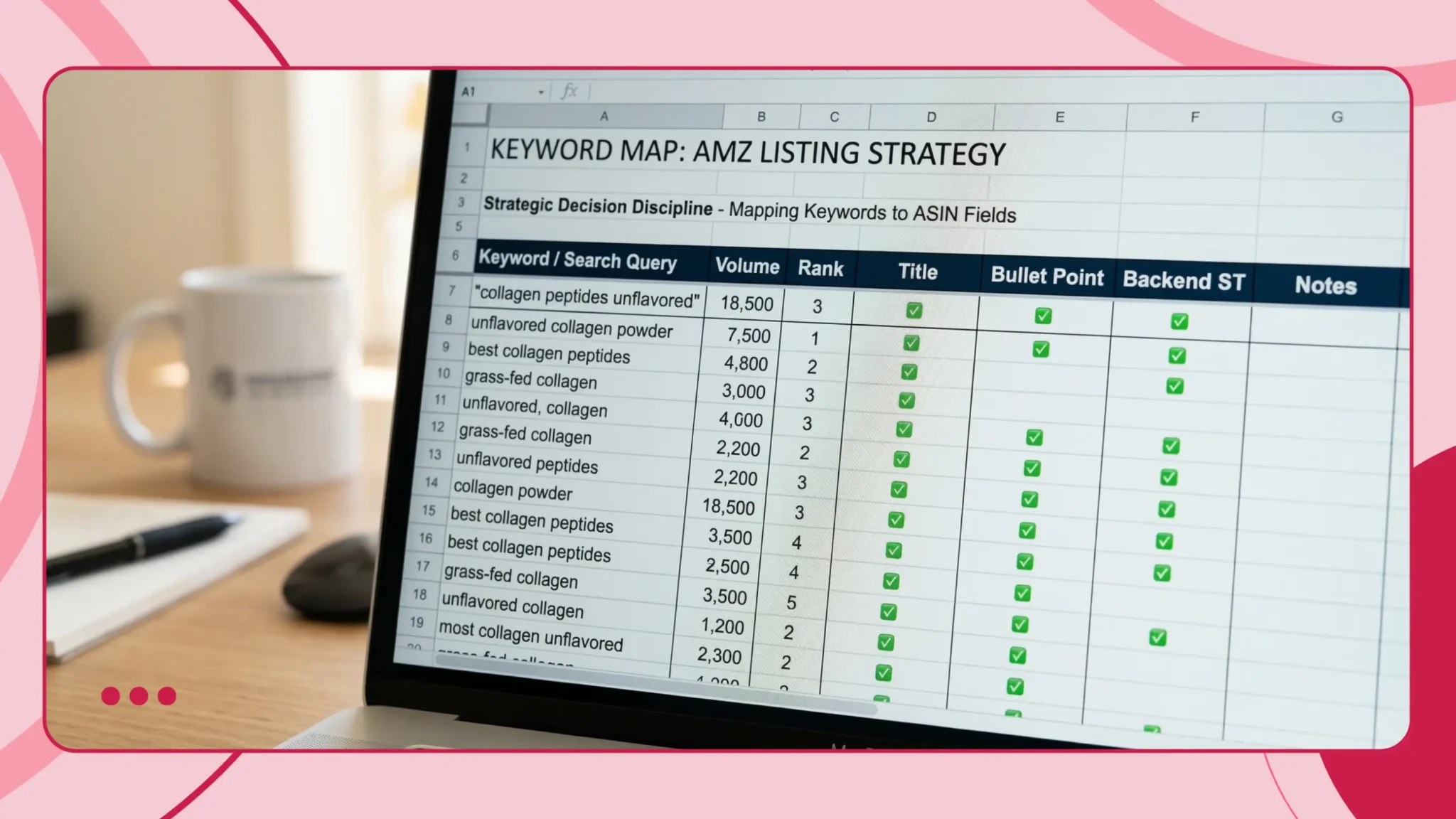
Good amazon seo services are not just "keyword research" or "listing optimization."
At a high level, you are usually buying five things:
1) Keyword map decisions
Someone needs to decide which queries matter, which ones belong in visible copy, which ones belong in backend search terms, and which ones should be left alone. Amazon's own SEO guidance and Brand Analytics tools make this clear: SEO work is tied to search terms, query performance, and product discoverability, not random copy edits.
2) Change log discipline
If rankings move after edits, you need to know what changed and when. This matters even more on mature listings, where careless edits can break what already works. Amazon's testing tools reinforce the same point: optimization should be measurable.
3) Iteration cadence
You are not only buying one deliverable. You are buying a rhythm: diagnose, change, measure, learn. If the provider cannot explain how they decide what gets changed next, that is a real weakness.
4) QA and compliance awareness
This is especially important in regulated or restricted categories. Amazon explicitly prohibits misleading claims, restricted products, and unsupported detail-page claims, and it maintains category-specific compliance standards for products like dietary supplements.
5) Reporting
Not vanity reporting. Useful reporting. Query trends, what changed, what moved, what did not move, and what the next hypothesis is. If you have access to Brand Analytics, that reporting can be stronger because Amazon provides dashboards for search queries, clicks, and purchases.
In other words, when you hire amazon seo help, you are buying accountability around decisions.
When A Freelancer Fits Better
A freelancer usually fits better when the scope is tight.
Best-fit conditions:
One brand, one decision-maker
Small catalog or narrow subset of ASINs
Quick execution matters more than process depth
You already know the problem area
You do not need cross-functional support every week
This is where an amazon seo freelancer or amazon seo consultant can be a strong choice. You often get direct communication, less overhead, and faster edits.
That said, there are clear risks.
Main freelancer risks
Single point of failure if they disappear or get overloaded
Limited breadth if the work expands into design, catalog troubleshooting, compliance review, or multi-marketplace operations
Less formal documentation unless you ask for it
More dependence on the person's own working style
What to request to reduce freelancer risk
Ask for portable artifacts, not just finished copy:
keyword map by ASIN
change log
edit rationale
final files in your systems
QA notes
access clarity for any seller tools used
This matters because if the relationship ends, you should still own the work. If your provider used Brand Analytics, Brand Registry tools, or testing workflows, the learnings should be documented in a way your team can continue using. Amazon makes clear that Brand Registry unlocks tools like Brand Analytics, A+ Content, and Manage Your Experiments, so those insights should not stay trapped inside one person's head.
A freelancer is often best when you need sharp execution without a lot of machinery.
When An Agency Fits Better
An agency usually fits better when the work is broader than one person can manage cleanly.
Best-fit conditions:
Larger catalog or many active ASINs
Multi-marketplace expansion
Cross-functional workflow across copy, design, catalog, and reporting
Need for QA gates before changes go live
Need for continuity even if one team member changes
Higher compliance exposure
This does not mean an agency is automatically better. It means the operating model may fit better.
Main agency risks
More process than you need
Communication layers that slow decisions
Generic reporting if the team is weak
You may not know who is actually doing the work
What to request to reduce agency risk
Ask for:
named owners by function
SOP for change approval and rollout
clear escalation path
reporting format before you sign
ownership rules for copy, keyword maps, and research
SLAs or response expectations for review cycles
Agencies tend to make more sense when your SEO work interacts with more Amazon systems and workflows. Brand Registry, Brand Analytics, experiments, cross-listing, and category compliance all create operational load that can justify a more structured partner.
An agency is not just buying more people. Ideally, it is buying better process control.
The Evaluation Questions That Decide Quality

These questions matter more than polished pitch decks.
Process and artifacts
How do you decide which ASINs get worked on first?
What artifacts do you produce besides final copy?
Will I receive a keyword map and change log, or only edited listings?
How do you document why a change was made?
How do you avoid making too many variables change at once?
Measurement and reporting
What metrics will you use to judge whether your work is helping?
How often will reporting happen, and what will be included?
Do you use Amazon Brand Analytics or only third-party data when Brand Analytics is available?
How do you distinguish between a visibility problem and a conversion problem?
How do you handle cases where a listing is indexed but not gaining meaningful visibility?
Amazon provides Search Query Performance, Top Search Terms, and related Brand Analytics dashboards to help brands understand search and purchase behavior, so serious providers should be able to explain whether and how they use them.
Compliance and risk handling
How do you review copy in categories with stricter rules?
What is your process if a claim or detail page element may violate Amazon policy?
How do you handle supplements, topical products, or restricted categories differently?
Who signs off on risky edits before they go live?
Amazon explicitly prohibits misleading claims and has category-specific policies for dietary supplements and other regulated product types. A provider does not need to be a lawyer, but they should have a real review process.
Ownership and portability
Who owns the keyword research, copy drafts, and reporting files?
If we stop working together, what exactly do we keep?
Where will the work live: your systems or ours?
Will you document experiments and learnings in a way our team can reuse?
Communication and iteration cadence
Who is my day-to-day contact?
How quickly do you turn feedback into the next round of work?
What does a normal weekly or biweekly cycle look like?
How do you handle blocked decisions from our side?
A good answer is usually concrete. A weak answer is usually vague and smooth.
A Simple Decision Framework
Use this as a practical rubric.
Factor | Freelancer usually fits better | Agency usually fits better |
|---|---|---|
Speed on narrow scope | Yes | Sometimes |
Scale across many ASINs | Limited | Stronger |
Risk control and QA layers | Limited unless very senior | Usually stronger |
Ownership clarity | Easier if documented well | Needs to be requested clearly |
Cross-functional support | Limited | Stronger |
Specialized single-brand focus | Strong | Can be strong, but varies |
Multi-marketplace coordination | Harder alone | Usually better |
Regulated-category review discipline | Depends heavily on individual | Usually stronger if process is real |
A simpler version:
Choose a freelancer when the scope is tight and the decision path is short.
Choose an agency when the work needs coordination, documentation, and continuity.

Pricing And Engagement Models
In practice, most amazon seo services show up in three shapes.
Hourly
Best when:
you need expert review
the problem is narrow
you want second-opinion strategy
your team can execute internally
Risk:
You may get advice without enough implementation support.
Fixed scope
Best when:
you have a defined project
a set of ASINs needs a known deliverable
you want clarity on outputs before starting
Risk:
Scope can become outdated fast if the catalog or priorities change.
Retainer
Best when:
the work is ongoing
rankings and content need monitoring
you want iteration, reporting, and accountability over time
Risk:
A bad retainer becomes vague maintenance with no real decision discipline.
Warning signs of misaligned scope:
no named outputs
no reporting format
no artifact ownership language
"we will optimize everything" with no priority logic
flat promises without any measurement plan
Those are not pricing problems. They are clarity problems.
💡 Pro Tip: Automate the Execution
Optimize Your Listing Against Your Real Competitors in Seconds
Before you build an SEO team, automate the critical mapping and compliance work. Flairox Listings is the SaaS tool that identifies your top 5 direct competitors, extracts their high-volume keywords, and analyzes them against your organic rank. It generates Amazon-compliant titles, bullets, and descriptions, so you don’t need to manage freelancers or agencies just to get structured listing updates.
Get Your First 2 Listings Optimized Free →
How To Run A 14-Day Trial Without Wasting Money
You do not need a huge pilot.
A short, focused trial is usually enough to test quality.
What to give them
3-5 ASINs max
current titles, bullets, backend terms, and images
target marketplace
main competitors
current known issues
access to available data, especially Brand Analytics if you have it
category risk notes if relevant
Brand Registry can unlock Brand Analytics, A+ Content, and Manage Your Experiments, so if you have those tools, make access and role boundaries clear before the trial starts.
What outputs you should expect
prioritization logic for the chosen ASINs
keyword map or query notes
proposed edits with rationale
change log template
QA notes, especially for risky categories
a simple review plan for what to measure next
What signals show competence
they ask smart questions about constraints, not just keywords
they separate visibility issues from conversion issues
they document decisions clearly
they avoid over-editing
they flag compliance risk without being asked
they explain what they would measure after changes
If the trial produces only prettier copy with no decision trail, that is not strong enough.
Frequently asked questions
No. A strong freelancer can be a better fit for a narrow scope, small catalog, or one-brand setup. An agency usually makes more sense when scale, QA, cross-functional work, or marketplace complexity increase.