 Bilal Siddiqui
Building an Amazon listing with AI can save you hours of writing, but it introduces a critical business risk: compliance failure. AI models are trained to be persuasive and engaging, not to memorize Amazon's strict seller policies.
Because of this, AI frequently hallucinates product features, exaggerates guarantees, and accidentally includes restricted medical or environmental terminology. If you publish raw, unchecked AI copy, you risk policy violations, suppressed ASINs, or complete account suspension. Amazon listing compliance requires rigorous human oversight.
To use AI safely, you must build strict quality assurance (QA) gates into your operational workflow. You cannot rely on the AI to act as its own legal reviewer. Every claim, specification, and keyword must be verified against your physical product and Amazon's terms of service.
This guide focuses entirely on post-generation risk control. It does not cover how to prompt or generate the copy. Instead, it provides the exact compliance frameworks you need to protect your account.
Below, you will find a complete claims risk map, a detailed Amazon listing QA checklist, and a step-by-step human review SOP to ensure every AI-generated listing is policy-safe before you publish.
The 3 Failure Modes Of AI Copy That Trigger Policy Risk
When AI writes Amazon product listings, it typically fails in three specific ways that trigger policy bots.
1. Hallucinated Facts
AI hates empty space. If your prompt does not specify a product's material, weight, or dimensions, the AI will simply invent them. It might label a standard polyester shirt as "100% organic cotton" because it sounds appealing. This triggers "Inaccurate information on product detail page" violations and leads to severe customer return rates.
2. Overstated Performance and Guarantees
AI leans heavily into aggressive sales language. It defaults to phrases like "guaranteed results," "failsafe," or "lifetime warranty." Amazon strictly prohibits warranty and guarantee information in A+ content, and promotional guarantees in standard product descriptions can flag your listing for review.
3. Implied Medical and Regulated Claims
This is the most dangerous failure mode. AI often tries to highlight benefits by crossing into medical territory. It will turn a "comfortable knee sleeve" into a device that "cures arthritis and joint pain." This immediately triggers Amazon's FDA and restricted medical device bots, instantly suppressing your ASIN until you can provide a 510(k) clearance you do not possess.
🛡️ Policy-Safe AI Generation
Write Compliant Copy & Beat Your Top 5 Competitors
Don't risk account suspension with raw AI. Flairox Listings is the AI software that analyzes your top 5 direct competitors, integrates your website's exact brand tone, and generates fully optimized, Amazon-compliant content—zero prohibited claims, zero keyword stuffing.
Optimize Your First 2 Listings For Free →
Claims Risk Map
To review AI copy efficiently, you must categorize claims by risk level. Use this map to determine when to remove, soften, or prove a statement.
Low Risk (Green): Factual Descriptors
These are objective facts about your product, such as color, dimensions, item count, and standard materials (e.g., "blue," "8 inches," "stainless steel").
Rule: Verify against the physical product. No special documentation is needed.
Medium Risk (Yellow): Comparative and Environmental Claims
These include mild performance statements and general eco-friendly language (e.g., "durable," "energy-efficient"). Amazon requires that environmental claims follow the FTC Green Guides.
Rule: Soften the claim or add specific proof. You cannot use broad terms like "eco-friendly" without explicitly stating the environmental benefit (e.g., "made from 20% recycled plastic").
High Risk (Red): Medical, Safety, and Absolute Superlatives
These include disease treatment claims, strict safety promises, and absolute rankings (e.g., "cures insomnia," "100% safe for babies," "FDA approved," "the #1 best seller"). Amazon's Medical Devices and Accessories policy prohibits unapproved medical marketing.
Rule: Remove the claim entirely unless you hold official, verified documentation, such as an EPA registration for antimicrobials or an official ASTM certificate for compostability.
Claims Checklist With Safe Rewrite Patterns

Use this table to translate risky AI output into policy-safe Amazon listing copy.
Claim Type | Risk Level | Why It Is Risky | Safe Rewrite Pattern | Proof You Need | Example (Bad -> Better) |
|---|---|---|---|---|---|
Guarantees/Refunds | High | Violates A+ policy on promotional/refund text | Focus on build quality | None | "100% Money Back Guarantee" -> "Premium quality materials" |
Superlatives | High | Deceptive if unproven; triggers review | Describe objective features | Market share data | "The #1 Best Spatula" -> "Highly rated spatula design" |
Medical Treatment | High | Triggers FDA and medical device bots | Focus on general comfort | FDA 510(k) clearance | "Cures joint pain" -> "Provides daily knee support" |
Time-bound Results | High | Unsubstantiated medical/cosmetic claim | State general benefits | Clinical trial data | "Erases wrinkles in 7 days" -> "Hydrates skin for a smoother look" |
Competitor Comparison | High | A+ guidelines forbid mentioning competitors | Focus strictly on your brand | None | "Better than [Brand Name]" -> "Advanced ergonomic design" |
Baby Safety | High | Strict CPSIA liability and safety policies | State factual material stats | Lab testing reports | "100% safe for newborns" -> "Made with BPA-free silicone" |
Eco-Friendly | Medium | Violates FTC Green Guides if too broad | State specific material % | Material supply certs | "100% Eco-Friendly" -> "Made from 20% recycled plastic" |
Biodegradable | High | Banned in CA without specific ASTM certs | Use accurate technical terms | ASTM / Vincotte cert | "Biodegradable plastic" -> "Compostable (ASTM D6400)" |
Lifetime Durability | Medium | Hard to prove; often flagged as a warranty | Highlight material strength | Stress testing data | "Lasts a lifetime" -> "Built for heavy daily use" |
Clinically Proven | High | Misleading without actual clinical trials | Use "tested" or "formulated" | Clinical trial data | "Clinically proven to work" -> "Dermatologist tested" |
FDA Cleared/Approved | High | Prohibited to claim casually; no FDA logos | Remove or state facility | FDA registration | "FDA Approved Device" -> "Made in an FDA registered facility" |
Promotional | High | Banned in A+ content and PDP titles | State exactly what is inside | None | "Includes a FREE brush" -> "Cleaning brush included" |
Non-toxic | Medium | Requires FTC substantiation | Name the missing chemicals | Lab testing report | "100% Non-toxic" -> "Lead and Phthalate free" |
Hypoallergenic | Medium | Medical-adjacent; needs clinical backing | Focus on sensitive skin | HRIPT testing | "Hypoallergenic" -> "Gentle on sensitive skin" |
Shipping Claims | High | Strictly banned on PDP and A+ content | Remove entirely | None | "Fast Free Shipping" -> [Remove completely] |
Review Quotes | High | Private quotes banned in A+ content | Paraphrase the core benefit | None | "Customers say it's the best" -> "Designed for maximum comfort" |
AI QA Checklist Before Publish
Before loading AI-generated text into Seller Central, run it through this strict QA scan.
Check | What To Scan For | Pass/Fail Rule | How To Fix |
|---|---|---|---|
1. Fabric/Material | AI invented materials | Must match manufacturer specs exactly | Manually edit the material list |
2. Size/Dimensions | AI hallucinated measurements | Must match the actual physical product | Correct the numbers |
3. Weight/Capacity | AI guessed weight limits | Must match real engineering/testing | Insert correct limits |
4. Feature Accuracy | AI added features not present | 100% accuracy to the real product | Delete false features |
5. Medical Keywords | "Cure, treat, prevent, heal" | ZERO medical claims unless FDA cleared | Replace with comfort/support terms |
6. Pesticide Keywords | "Anti-bacterial, antimicrobial" | Fails unless FIFRA registered | Remove terms entirely |
7. Environmental | "Eco-friendly, green" | Fails without specific qualifications | Specify recycled % or remove |
8. Promotional Phrasing | "Buy now, limited time, cheap" | Fails (A+ and PDP violation) | Delete promotional words |
9. Warranty/Guarantee | "Money-back, lifetime" | Fails (not allowed in PDP copy) | Remove guarantee language |
10. Competitor Names | Mention of other specific brands | Fails (trademark and A+ violation) | Remove brand comparisons |
11. Shipping Details | "Free shipping, ships fast" | Fails (PDP guideline violation) | Delete shipping text |
12. Keyword Stuffing | Unnatural repetition of keywords | Must read naturally to a human | Rewrite for smooth flow |
13. AI Formatting | Weird symbols, markdown asterisks | Must be clean, readable text | Remove AI formatting artifacts |
14. Variation Accuracy | Wrong colors/counts in variations | Must match the specific child ASIN | Update variation details |
15. Brand Voice | Overly robotic or aggressive tone | Must match your brand guidelines | Edit for a professional tone |
16. Certifications | "CE, UL, FDA" mentioned | Fails if you lack physical proof | Remove or upload actual certs |
17. Included Items | AI lists accessories not in box | Must exactly match actual packaging | Delete unincluded items |
18. Character Limits | Bullets > 255 chars, Title > 200 | Must fit Amazon backend limits | Trim text to fit character limits |
Human Review SOP
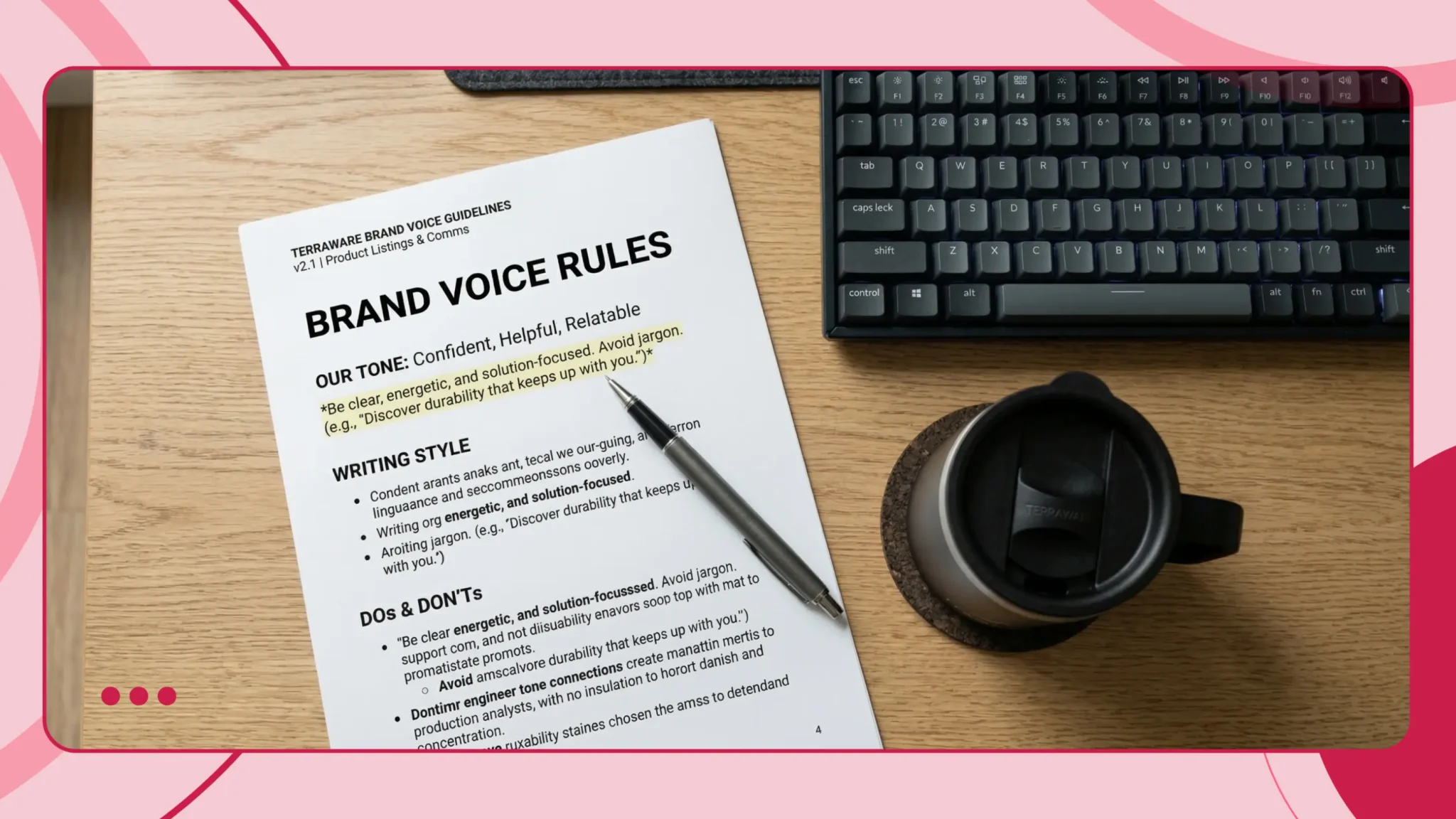
To prevent compliance failures at scale, implement a structured Standard Operating Procedure (SOP) with distinct approval gates. Whether you use basic prompts or a dedicated listing software like the Flairox Listing tool, your initial draft is only the starting point; human review remains mandatory.
Roles:
Drafter: Generates the AI copy and does the initial cleanup.
Compliance Reviewer: Scans for policy violations, medical claims, and restricted keywords.
Brand Approver: Final sign-off on brand voice, factual accuracy, and readiness.
Gate 1: Truth Check (Drafter)
Action: Compare the AI draft against the manufacturer specification sheet and physical product photos.
Pass Criteria: All dimensions, materials, included components, and features are 100% physically accurate.
Failure Protocol: If AI hallucinated a feature, the Drafter must rewrite that specific bullet point before passing it to Gate 2.
Gate 2: Policy and Claims Check (Compliance Reviewer)
Action: Scan the copy using the Claims Risk Map and the QA Checklist.
Pass Criteria: Zero unproven environmental claims, zero medical keywords (cure/treat/prevent), zero promotional language, and zero unauthorized guarantees.
Failure Protocol: If a restricted claim is found, the Reviewer must rewrite it using a safe pattern or reject the draft back to the Drafter.
Gate 3: Publish Readiness (Brand Approver)
Action: Final review for brand voice, formatting, and variation consistency.
Pass Criteria: The text flows naturally, respects Amazon character limits, contains no AI markdown formatting, and accurately represents the specific child ASIN.
Failure Protocol: Make minor editorial tweaks directly; major tone issues go back to the Drafter.
Evidence Log Template
For any medium or high-risk claims that you decide to keep (because you actually have the proof), maintain a simple internal log.
Claim Made: (e.g., "Compostable")
Evidence Source: (e.g., Vincotte OK Compost HOME Certificate)
Where Stored: (e.g., Google Drive -> Compliance Folder)
Approved By: (e.g., Jane Doe)
Date: (e.g., 2026-03-06)
Handling Edge Cases

Certain product categories require extreme caution when using AI to generate listings.
Supplements and Health-Adjacent Products
AI will naturally write disease-treatment claims for vitamins or fitness gear. You must strictly adhere to the FDA's dietary supplement guidelines. Never allow the AI to use words like "heals," "cures," or "prevents." Frame everything as "supports" or "promotes" (e.g., "supports joint health").
Baby Products and Safety Claims
AI loves to invent safety certifications to make baby products sound better. Never let AI claim a product is "hypoallergenic," "SIDS-safe," or "100% non-toxic" unless you have the specific Children's Product Certificate (CPC) and lab testing to back up that exact phrase.
Eco-Friendly and Green Claims
Amazon enforces the FTC Green Guides and strict California state laws. If AI writes "biodegradable" for a plastic product, Amazon will restrict your sales in California unless you provide specific ASTM standard certifications. Always force the AI to state the exact percentage of recycled materials rather than using broad "green" language.
Common Mistakes
When integrating AI into your Amazon listing workflow, avoid these specific QA mistakes:
Trusting AI character counts: AI models are notoriously bad at counting characters. Always verify your title is under 200 characters and bullets are under 255 characters using a traditional character counter.
Ignoring variation differences: AI often writes one great description, and sellers copy-paste it across variations, forgetting to change the color or size details.
Leaving placeholder text: AI frequently outputs brackets like "[Insert Brand Name Here]". Failing to scan for these makes your listing look unprofessional.
Blindly accepting AI translations: If you use AI to translate listings for international marketplaces, it may inadvertently use restricted slang or medical terms in the target language. Always have a native speaker review it.
Forgetting packaging contents: AI will describe what a product should come with (like batteries or a carrying case), not what actually comes in your specific box.
Over-optimizing for search over readability: AI can stuff keywords so densely that the text becomes unreadable to humans, which hurts your conversion rate.
Assuming AI knows current policies: Amazon updates its restricted product and A+ content guidelines frequently. Your AI model's training data might be a year out of date.
Skipping the mobile preview: AI often writes massive, dense paragraphs. You must manually break these up so they are readable on the Amazon mobile app.
Frequently asked questions
Your AI likely used restricted keywords such as "cure," "treat," "prevent," or "heal." Amazon's bots automatically flag these words as unapproved medical marketing, regardless of the actual product type.