 Raahim Sheikh
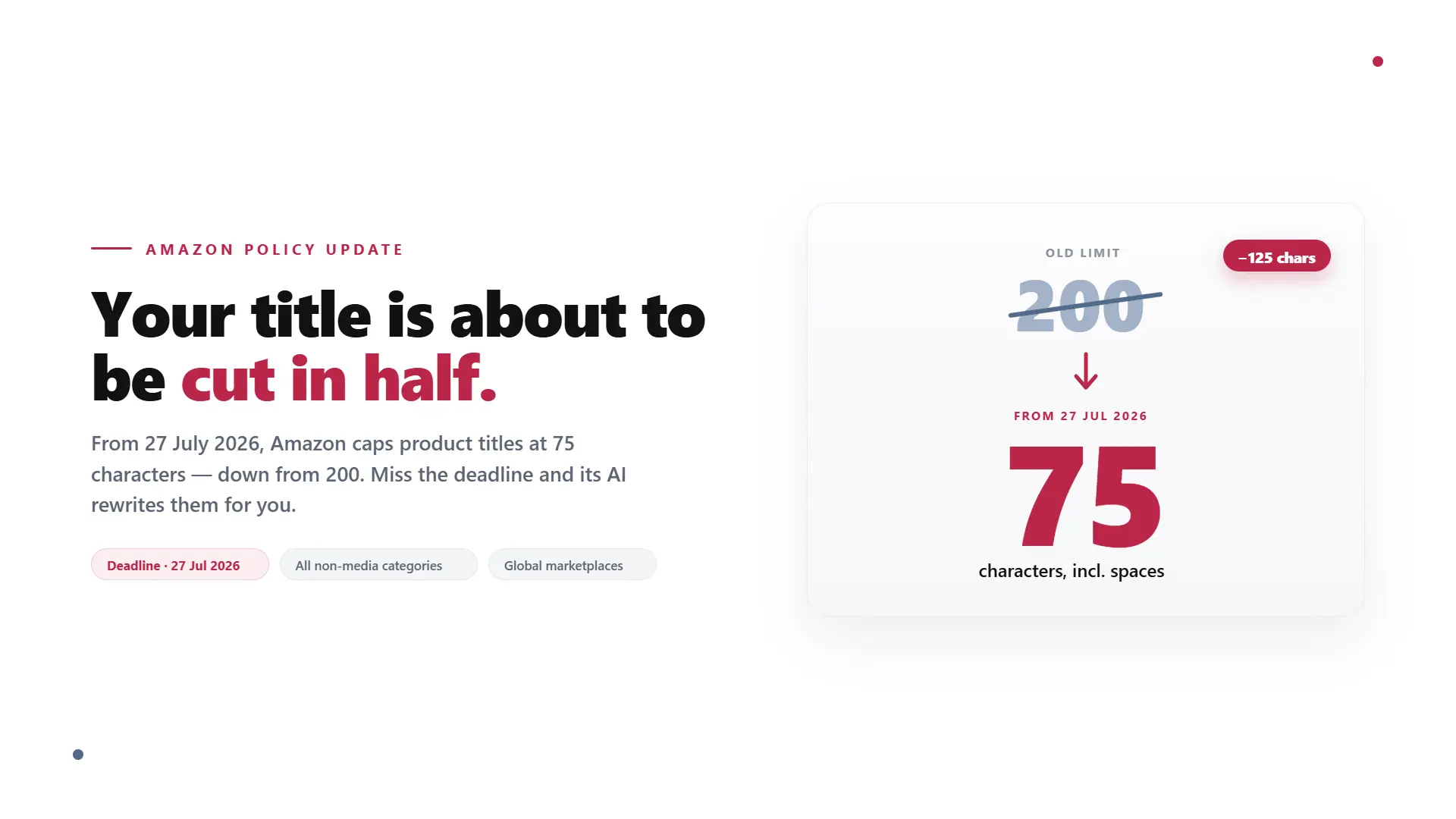
If you sell on Amazon, the title you have spent years optimising is about to get a lot shorter, whether you like it or not. From 27 July 2026, Amazon is capping product titles at 75 characters, including spaces, across every category except media. Any title still over the limit after that date gets handed to Amazon's AI to rewrite for you, and if you are not enrolled in Brand Registry, you will not get a say in what it produces.
For more than a decade, the title field has been the single most valuable piece of keyword real estate on a listing: the place Amazon's algorithm weighted most heavily for organic ranking, and where sellers loaded every term they wanted to be found for. Cutting it by more than half overnight, with the remainder potentially rewritten by an algorithm, is one of the most consequential Amazon product detail page changes in years.
Here is exactly what the Amazon 75 character title limit involves, why it is happening, how the enforcement works, and who it affects most.
What's Changing on 27 July 2026
Amazon confirmed the change in a Seller Forums announcement, posted by its News_Amazon account and updated on 10 June 2026. Two things happen.
First, the title field shrinks to a maximum of 75 characters, down from the 200-character cap Amazon introduced in January 2025. This applies to all non-media categories, with books, music, and video as the notable exclusions. It also applies across Amazon's global marketplaces, from the US and UK to the EU, Canada, Australia, Japan and beyond. It is not a regional test or a category pilot; it is a platform-wide standard.
Second, the rule is enforced automatically. After 27 July, any title over 75 characters will not be switched off, and your listing stays live and shoppable, but Amazon will gradually apply an AI-generated title to bring it into compliance. You can continue editing your own titles and Item Highlights at any time, before or after the deadline.
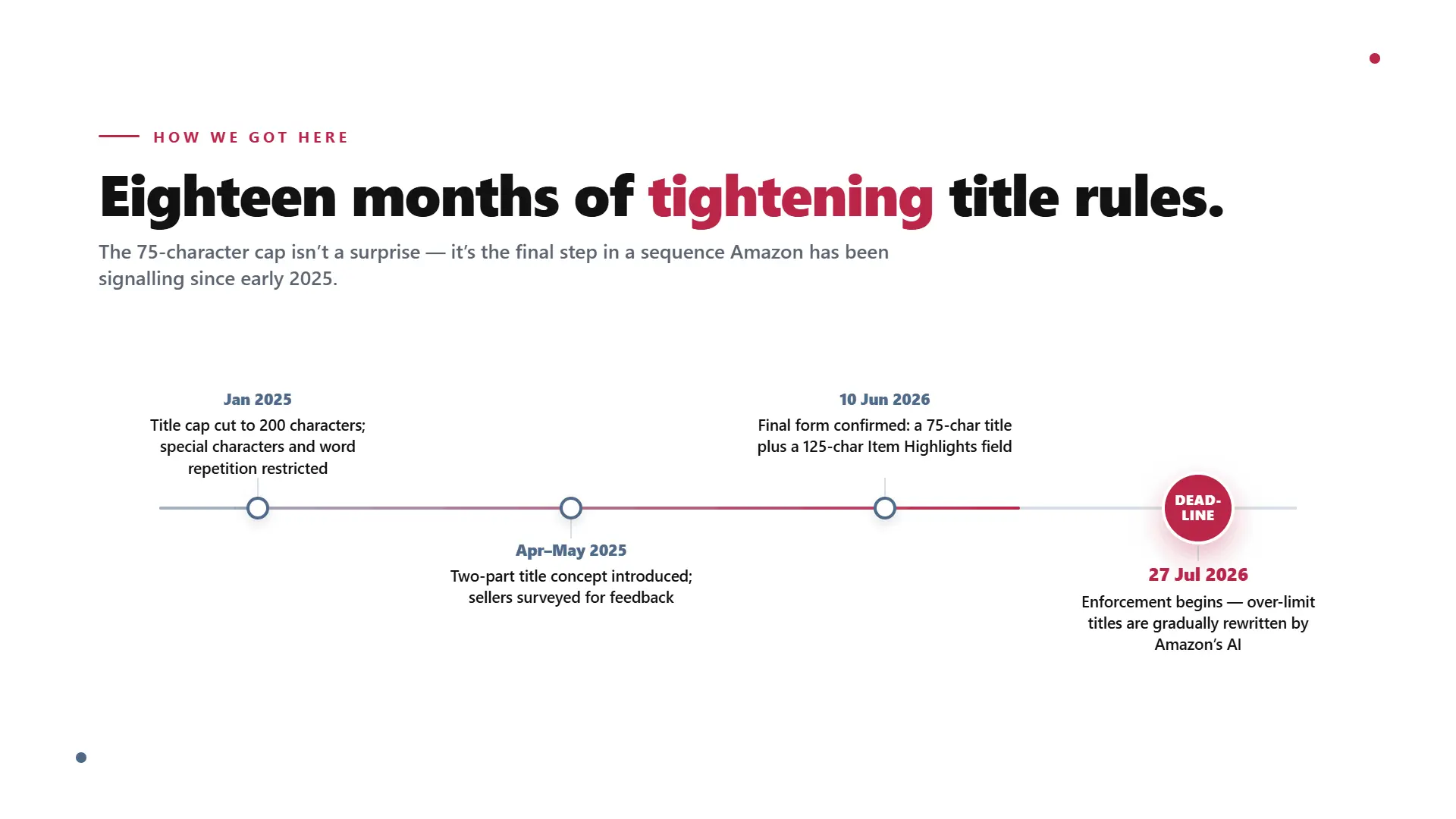
This is not a standalone decision. It is the final step in a sequence that has been tightening title rules for 18 months:
January 2025: Amazon cuts the title cap to 200 characters in most categories, restricts special characters, and limits word repetition.
April to May 2025: Amazon emails sellers introducing a two-part title concept (a short core title plus a separate highlights field) and gathers survey feedback, signalling a rollout later that year.
10 June 2026: Amazon confirms the final form, a 75-character title supported by a 125-character Item Highlights field.
27 July 2026: Enforcement begins, and over-limit titles are gradually rewritten by AI.
In other words, sellers who treated the 200-character limit as the new normal in 2025 are now facing a second, far steeper cut.
The New Item Highlights Field
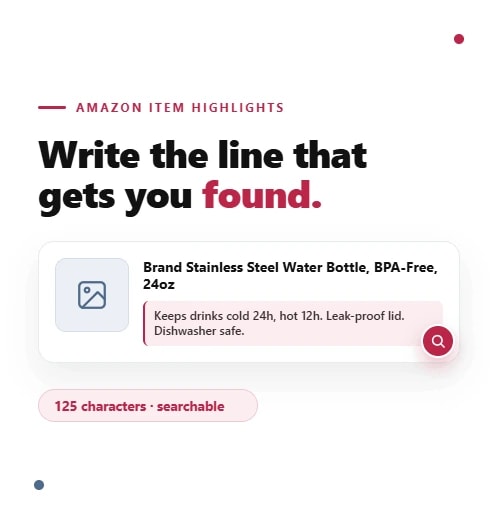
To offset the shorter title, Amazon is introducing a new field called Item Highlights, which gives you up to 125 characters for the detail that used to sit at the back of a long title: materials, recommended use cases, pack sizes, size and fit information, and comparison terms.
Two things make Item Highlights important rather than cosmetic. It is searchable, and it displays directly beneath the title in search results and on the product detail page. So the supplementary information is not disappearing. It is moving into a separate, structured container that customers and the search engine can both see.
A simple example shows how the split is meant to work. A title like "Premium Stainless Steel Insulated Water Bottle, BPA-Free" pairs with an Item Highlights entry such as "Keeps drinks cold 24 hours, hot 12 hours. Ideal for gym, office, and outdoor adventures." The title states what the product is; the highlights handle the benefits, use cases and secondary terms.
The open question, and it is a big one, is how heavily Amazon weights Item Highlights for ranking compared with the title. Amazon has not documented this. Industry practitioners who have engaged with Amazon on the change believe the field is weighted more heavily than generic back-end search terms, which would mean keyword content moved there stays meaningfully discoverable. But until the field has been live for some time, anyone claiming the 125 characters fully replace what the title loses is making an educated guess, not stating a fact.
Why Amazon Is Making This Change
Amazon's stated reason is mobile. The majority of shopping now happens on phones, where search results truncate long titles at roughly 70 to 80 characters regardless of how much you have written. In Amazon's words, "for customers shopping on mobile, every character counts." Long, cluttered, keyword-stuffed titles were hard to scan and, past the truncation point, simply were not being read.
A shorter, cleaner title is easier to read and brings Amazon in line with how the rest of online retail presents products. It also supports a more mobile-first Amazon listing optimization approach, where clarity, click-through rate, and conversion matter as much as keyword coverage.
There is a broader strategic pattern, too. The 75-character limit sits alongside the 200-character cap, restrictions on special characters and repetition, the rollout of agentic AI tools across Seller Central, and tighter rules on discounts and listing presentation. The consistent direction is more platform control over how products appear to shoppers, with AI as the enforcement mechanism.
Sellers are getting less freedom to present listings on their own terms, and more of the catalogue is being shaped by Amazon's systems.
How the AI Rewrite Works
This is the detail that matters most, so it is worth being precise about the mechanics.
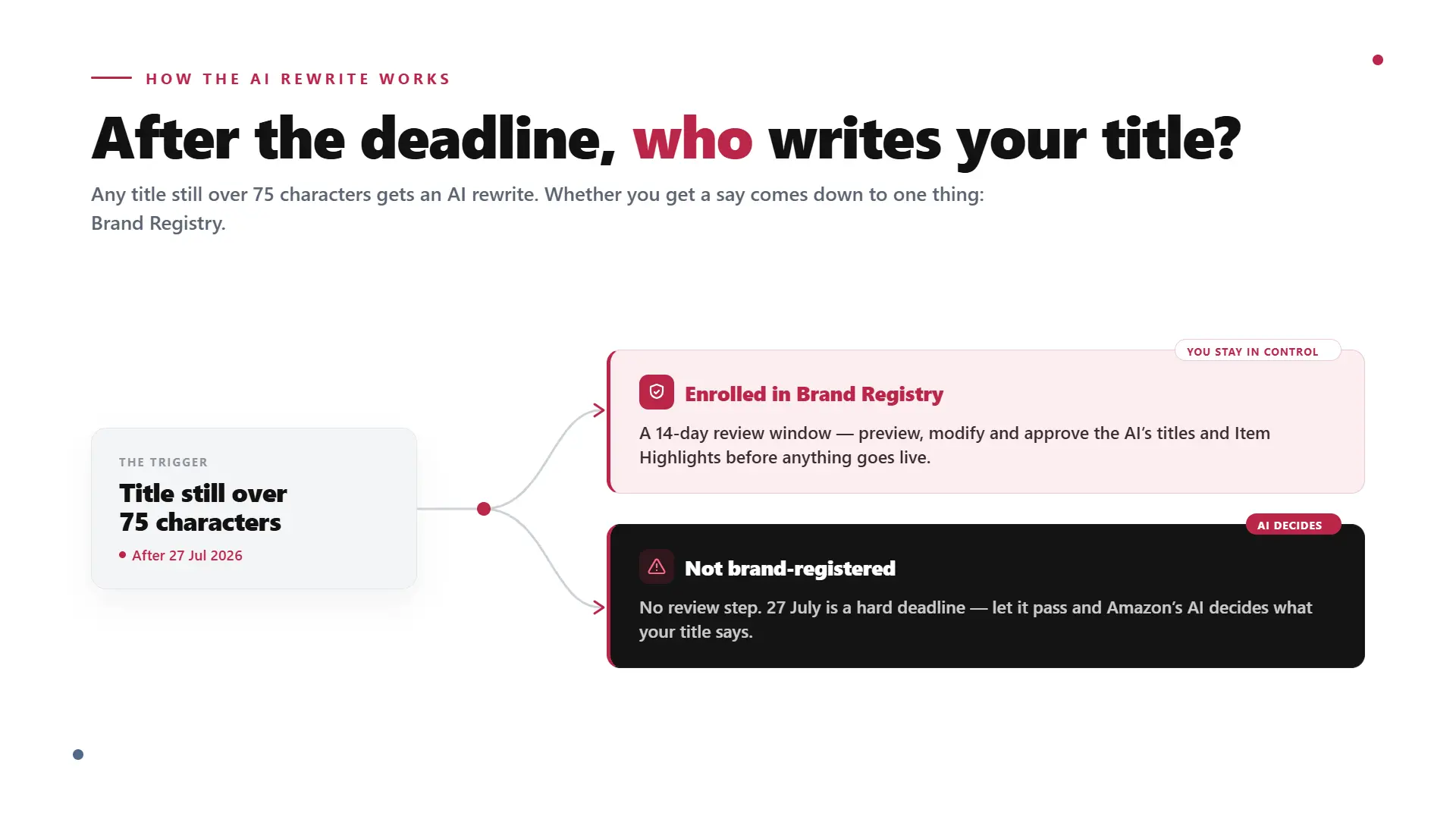
After 27 July, titles over the limit are rewritten gradually, not all at once, and listings stay active throughout the process. What happens next depends on whether you are brand-registered.
If you're enrolled in Brand Registry, you get a safety net. Amazon gives brand owners a 14-day window to review, modify, and approve its AI-generated recommendations for both titles and Item Highlights, inside a panel called Review Listings Changes. Nothing goes live until you act on it within that window.
If you're not brand-registered, that pre-approval window does not appear to apply. For unregistered sellers, 27 July is effectively a hard deadline: let it pass without acting and Amazon's AI decides what your title says, with no review step.
Amazon is also making the AI tools available now, ahead of the deadline. You can preview recommended titles and Item Highlights by going to Manage All Inventory, selecting Edit on a listing, and clicking View enhancements. The system is designed to keep core product information in the title and push secondary detail into Item Highlights, automatically respecting the new limits.
Early seller testing, however, has been bumpy. Users on Amazon's announcement thread reported error code 100476, where the attribute "Item Highlight" was currently unsupported, even after trimming titles below 75 characters. At least one seller also had AI-generated content flagged by Amazon's own content moderation for promotional claims, creating a circular problem caused by the platform's tools.
The functionality is new, and it is not yet fully reliable. That alone is a strong argument for handling your important listings manually rather than trusting an automated rewrite.
What It Means for Your Rankings and Advertising
The central risk is keyword loss. Cutting a title from roughly 200 characters to 75 inevitably drops terms, and some of those terms may be holding organic positions you cannot afford to lose. Because an AI rewrite carries an unknown keyword configuration, a listing left to the algorithm could quietly lose relevance for searches it currently ranks well on.
The impact extends to paid search. Sponsored Products performance depends in part on listing relevance and the keywords embedded in your product data. If your campaigns target long-tail terms that previously lived in the title, and the AI removes or reorganises them, the relevance signal behind those keywords can weaken, pushing up cost-per-click or reducing impressions on terms you are actively bidding on.
Whether Item Highlights fully preserves that signal is not yet documented at a granular level, which is exactly why you want your listings in a final, seller-controlled state before the deadline rather than after.
If you are changing titles at scale, track your main keyword positions before and after edits. A simple Amazon keyword rank tracker can help you see whether visibility holds steady, dips temporarily, or needs a follow-up adjustment.
Who's Affected Most
Not every seller feels this equally. If your titles already sit in the 70 to 80 character range, which Amazon's style guides have recommended for years, this is a light touch-up rather than a rebuild.
The pain concentrates in two groups.
Keyword-heavy categories such as supplements, home, beauty, and electronics will shed the most indexed keywords because their titles have often been packed with variant terms and use cases.
Industrial, hardware, and components sellers face a structural problem. Their titles carry defining details such as sizes, material grades, fitting types and dimensions that are essential, not supplementary. Compressing that into 75 characters can push critical information off the search results page and force buyers to click through to find what they previously saw at a glance, which can hurt click-through in precisely the categories where specification drives the purchase.
For variation-heavy listings, the challenge is even sharper. You need a consistent title pattern across child ASINs while still preserving the attributes shoppers actually search by. If that is your situation, review your Amazon variation keyword split strategy before changing every title.
The Prime Day Timing Trap
There is an awkward calendar collision to plan around. Prime Day 2026 runs 23 to 26 June across 26 countries, barely five weeks before the title deadline.
Editing a title can disturb ranking and indexing, and you do not want to do that going into the biggest traffic event of the year. The sensible approach is to lock your proven titles through Prime Day, then make your changes in the window between the event ending on 26 June and the 27 July cut-off, a tight stretch of roughly a month.
For brands managing hundreds or thousands of SKUs, that means planning the work now, executing it after Prime Day, and not leaving the edit to the algorithm.
What You Should Do Now
In short: audit your catalogue, flag every title over 75 characters, and rewrite the important ones yourself before 27 July rather than leaving them to Amazon's AI. Start with your best-sellers and most heavily advertised SKUs, since that's where a poor rewrite costs the most, and confirm which keywords are actually driving your rankings before you cut anything. For a full walkthrough of how to structure a compliant, high-converting title and use the Item Highlights field effectively, see our guide on writing a 75-character Amazon title that still ranks.
If auditing thousands of SKUs and protecting your ranking keywords before the deadline sounds like a heavy lift, especially with Prime Day in the middle of it, that's exactly what we do. At Flairox, we manage and optimize Amazon listings for growing brands, and we're already preparing client catalogues for 27 July. Book an Amazon listing audit with Flairox
and we'll make sure your titles are ready before Amazon's AI gets there first.
Frequently asked questions
Enforcement begins on 27 July 2026. Amazon confirmed the change in a Seller Forums announcement updated on 10 June 2026. After 27 July, titles still over the limit are gradually rewritten by Amazon's AI.