 Raahim Sheikh
Key takeaways
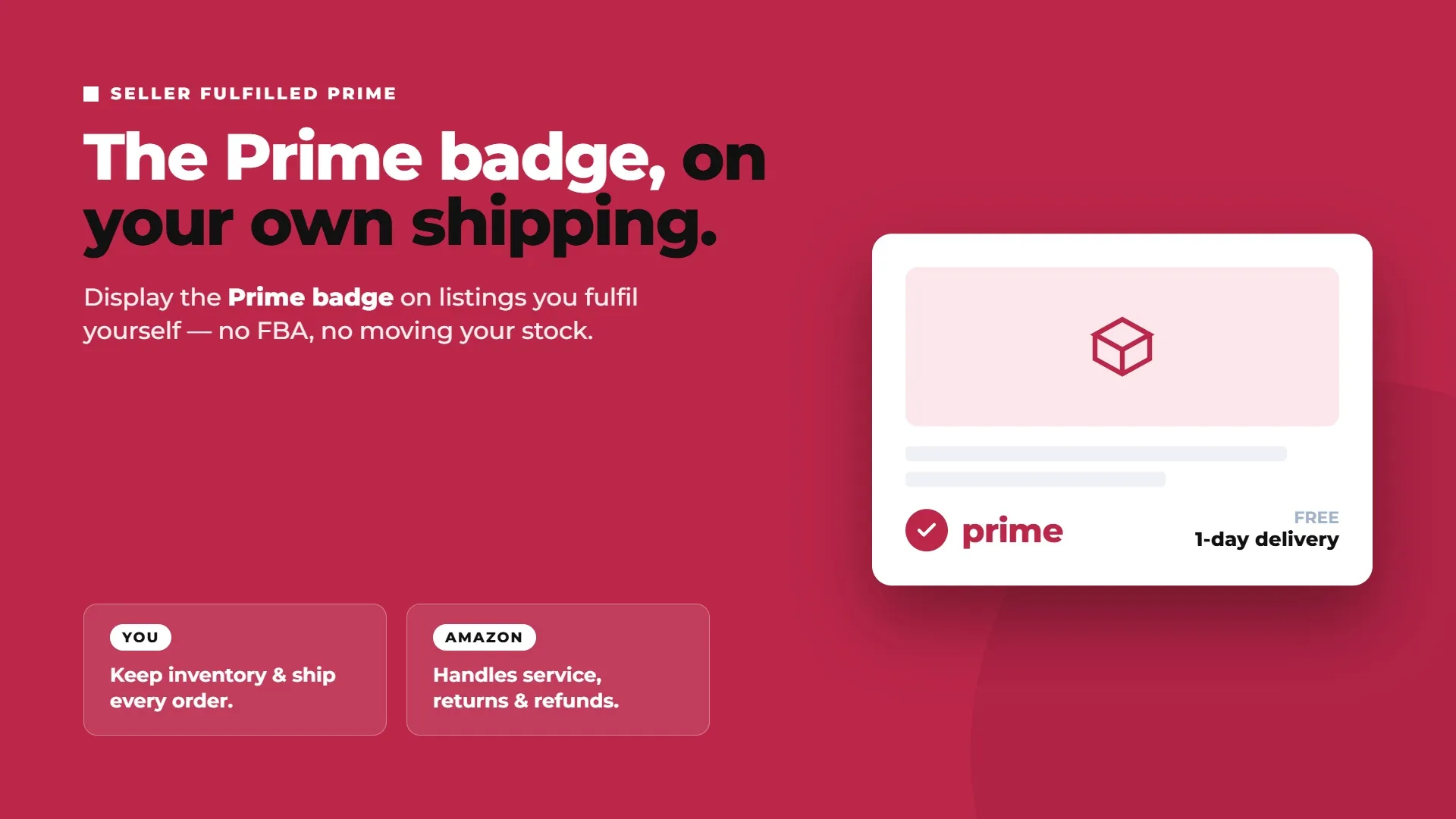
SFP lets you display the Prime badge while shipping from your own warehouse or 3PL, instead of using FBA.
Amazon tightened delivery-speed requirements effective 6 July 2026, raising the share of Prime shoppers who must be offered one- and two-day delivery.
The bar is high: a 93.5% on-time delivery rate, 99% valid tracking, and under 0.5% cancellation, plus weekend operations and same-day shipping.
You must pass a 30-day trial, shipping at least 100 Prime orders, before the badge is granted.
Amazon handles post-order customer service, returns, and refunds for SFP items, even though you fulfill them.
SFP suits sellers with fast, reliable, nationwide shipping and punishes anyone whose logistics can't consistently hit the metrics.
Every serious Amazon seller runs into the same tension. The Prime badge drives conversion, Prime shoppers filter for it and trust it, but earning it through FBA means handing over your inventory, your margins, and a big chunk of your fulfilment control. Seller Fulfilled Prime is the third path: keep shipping from your own warehouse and still show the Prime badge. The catch is that it has always been a demanding programme, and as of July 2026 the bar to qualify just went up again.
This guide covers what Seller Fulfilled Prime is, how it works, the new 2026 delivery-speed rules, the full requirements and trial, what it costs, how returns are handled, and how it stacks up against FBA. By the end, you'll know whether your operation can realistically clear the bar, and whether the badge is worth the effort.
What Is Seller Fulfilled Prime (SFP)?
Seller Fulfilled Prime is a programme that lets third-party sellers display the Amazon Prime badge on listings they fulfil themselves, from their own warehouse or a third-party logistics provider, rather than through Amazon fulfilment centres. You keep your inventory, you ship the orders, and your listings still carry the Prime badge that Prime members look for.
That badge is the entire point. Prime shoppers filter search results by it, expect fast free delivery from it, and convert on it at meaningfully higher rates than on non-Prime listings. A huge share of Amazon's US customer base are Prime members, and many of them habitually skip past listings that don't carry the badge, so a non-Prime listing in a competitive category is often invisible to the buyers most likely to purchase. SFP is the only way to earn that badge without moving your stock into Amazon's fulfilment centres, which is why sellers who want to keep their own logistics but can't afford to be filtered out of Prime search keep coming back to it despite the demands.
From the customer's side, an SFP order looks and feels exactly like an FBA Prime order: the same fast, free delivery promise, and the same post-purchase support, because Amazon still handles customer service, returns, and refunds on SFP items. The shopper never needs to know you shipped it yourself.
It's worth knowing the programme's trajectory, because it explains why the requirements feel so strict. SFP was closed to new enrolment for several years, reopened in 2023 under tighter rules, and has been tightened further since, most recently with the July 2026 delivery-speed changes covered below. The clear direction of travel is that SFP has been getting harder to qualify for and harder to hold, not easier. Going in with that expectation is the right frame.
How Does Seller Fulfilled Prime Work?
The end-to-end flow looks like this. You enrol and pass a trial period (more on that below). Once approved, your eligible listings display the Prime badge. When a Prime customer places an order, you ship it from your own warehouse the same day, using Amazon Buy Shipping and an approved carrier, with valid tracking attached. After delivery, Amazon takes over any customer service, returns, or refunds.
Three operational pillars make that possible, and all three are non-negotiable:
If you run FBA alongside SFP, keep the inbound side compliant as well by reviewing the Amazon FBA packaging requirements before sending inventory into Amazon’s network.
Same-day shipping. Prime orders carry a 0-day handling time, meaning an order that comes in has to go out the same day.
Weekend coverage. You need to ship at least one weekend day and have carrier pickup available, because Prime delivery promises don't pause for Saturdays and Sundays.
Amazon Buy Shipping. Buying your shipping labels through Amazon's own service is required, and outside the trial it also unlocks on-time-delivery-rate protection, so a carrier delay on a Buy Shipping label doesn't count against you.
The New 2026 Seller Fulfilled Prime Delivery-Speed Rules
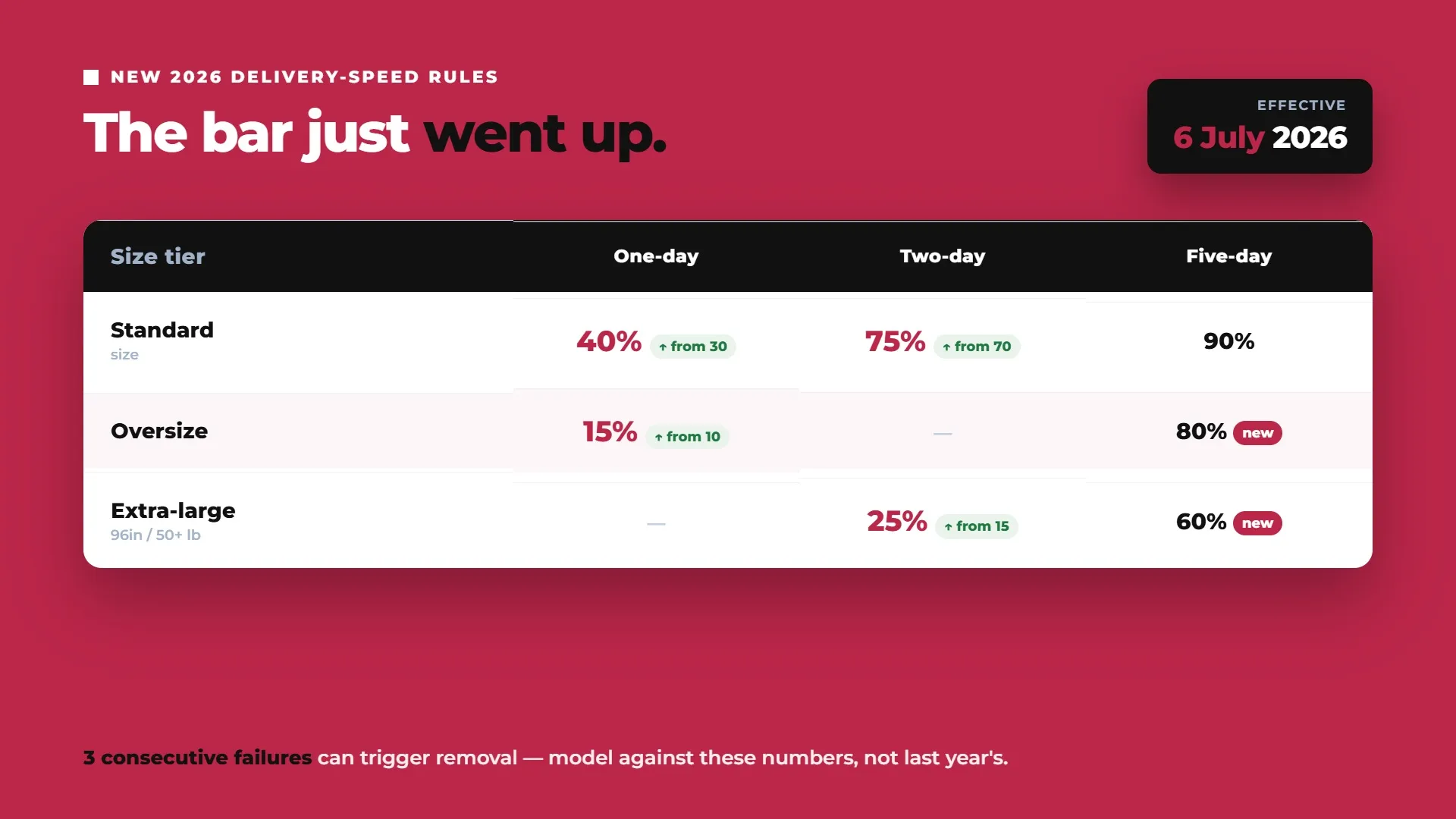
The most important recent change: Amazon raised SFP delivery-speed requirements effective 6 July 2026 (ShipSage). If you're already on SFP or considering it, these are the numbers that matter now, not last year's.
The requirement is expressed as the share of Prime page views for which you must be able to offer a given delivery speed:
Size tier | One-day delivery | Two-day delivery | Five-day delivery |
|---|---|---|---|
Standard-size | 40% (up from 30%) | 75% (up from 70%) | 90% (unchanged) |
Oversize | 15% (up from 10%) | Not specified | 80% (new) |
Extra-large (96 in longest side or 50+ lb) | Not specified | 25% (up from 15%) | 60% (new) |
A few transition details soften the landing, but only temporarily. Weekends are excluded from speed evaluations until 17 October 2026, giving sellers a grace period to adjust their carrier setup. Amazon is also launching a zip-code-level delivery-promise tool in September 2026, so sellers can see exactly which speeds they need to offer in which areas rather than guessing.
Enforcement is real: three consecutive failures against the requirements can trigger removal from the programme (ShipSage). The practical takeaway is that sellers already on SFP should check whether their current carrier mix still clears the raised thresholds, and anyone considering the programme should model against these new numbers, not the older, easier ones still floating around in older guides.
What's driving these changes is worth understanding, because it tells you where the programme is heading. Amazon has been steadily raising the delivery-speed expectations across all of Prime, its own FBA network included, as one-day and same-day delivery become the customer default rather than a premium. SFP sellers are being held to the same rising standard, which means the requirements are unlikely to loosen. If anything, planning on the assumption that the bar will keep climbing is more prudent than treating the July 2026 numbers as a permanent ceiling. Building carrier relationships and warehouse locations that can comfortably beat today's thresholds, rather than just scrape past them, is how sellers stay ahead of the next tightening.
Full Seller Fulfilled Prime Requirements (2026)
The requirements come in three layers: what you need to qualify to apply, what you need to hold during the trial, and what you need to maintain ongoing. The jump between the first two layers is the part that surprises sellers.
Prequalification: eligibility to apply
Before you can even start, your seller-fulfilled performance needs to clear these thresholds (AMZ Prep):
Cancellation rate below 2.5%
Valid tracking rate above 95%
Late-shipment rate under 4%
At least 100 seller-fulfilled packages shipped in the past 90 days
A Professional selling account
Trial and ongoing performance bar
Once you're in the trial, the metrics get considerably stricter, and these are the standards you have to hold to stay in the programme:
Metric | Prequalification | Trial / ongoing |
|---|---|---|
On-time delivery rate | (not the gate) | 93.5% or higher |
Valid tracking rate | Above 95% | 99% or higher |
Cancellation rate | Below 2.5% | Below 0.5% |
That leap is the heart of SFP's difficulty. Qualifying to apply is achievable for many established sellers, but holding a 93.5% on-time delivery rate and a sub-0.5% cancellation rate week after week is a genuinely high operational bar that separates sellers who can sustain SFP from those who wash out.
Ongoing operational requirements
Alongside the metrics, you have to run the operation to Prime standards: same-day shipping with 0-day handling on Prime orders, weekend operations with carrier pickup available, nationwide delivery coverage at the required speeds above, and Amazon Buy Shipping for your labels. Performance is reviewed weekly, Sunday through Saturday, so there's nowhere to hide a bad stretch.
The Seller Fulfilled Prime Trial Explained
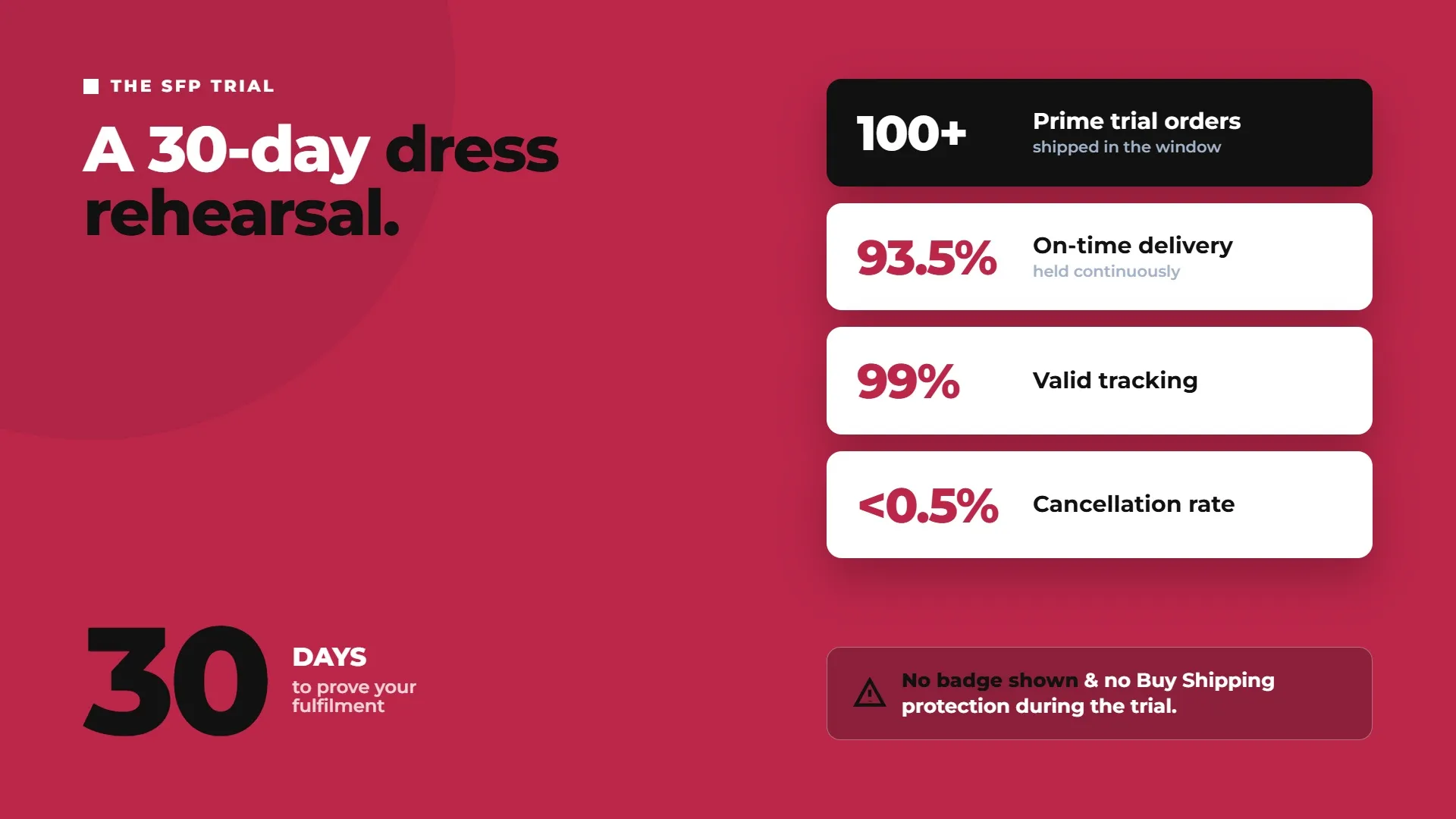
The trial is a 30-day proving period that starts once Amazon approves you to begin. During it, you must ship at least 100 Prime trial orders while continuously holding the strict trial metrics: 93.5% on-time delivery, 99% valid tracking, and under 0.5% cancellation (AMZ Prep).
Two things make the trial the hardest part of SFP. First, the Prime badge is not displayed during the trial, so you're fulfilling to demanding Prime standards without yet getting the conversion benefit that makes SFP worthwhile. Second, on-time-delivery-rate protection through Buy Shipping doesn't apply during the trial, which means a carrier's delay counts fully against you even when it wasn't your fault.
Treat the trial as a dress rehearsal you've already stress-tested, not something to improvise. Sellers who succeed have usually run their fulfilment at Prime speed for weeks before starting, so the trial is confirming a system that already works rather than hoping one comes together under pressure.
How to Apply for Seller Fulfilled Prime
The path to the badge runs roughly like this:
Confirm you meet the prequalification metrics (cancellation, tracking, late-shipment, and the 100-package history).
Enrol via the Seller Fulfilled Prime programme page in Seller Central (Amazon).
Set up a Prime shipping template with the required one- and two-day delivery options.
Get Buy Shipping and a weekend-capable, approved carrier in place before you start shipping trial orders.
Complete the 30-day trial by shipping at least 100 Prime orders while holding the trial metrics.
Get approved, at which point the Prime badge activates on your eligible listings.
This is not an instant switch. Realistically it's a multi-week process gated on your logistics actually performing, not just a form you submit. The application is the easy part; the trial is what decides it.
How to Protect Your SFP Metrics (and Avoid Removal)
Because SFP performance is reviewed weekly and three consecutive failures can end your enrolment, staying in the programme is an ongoing discipline, not a one-time approval. A few practices separate sellers who hold the badge for years from those who lose it in a bad quarter.
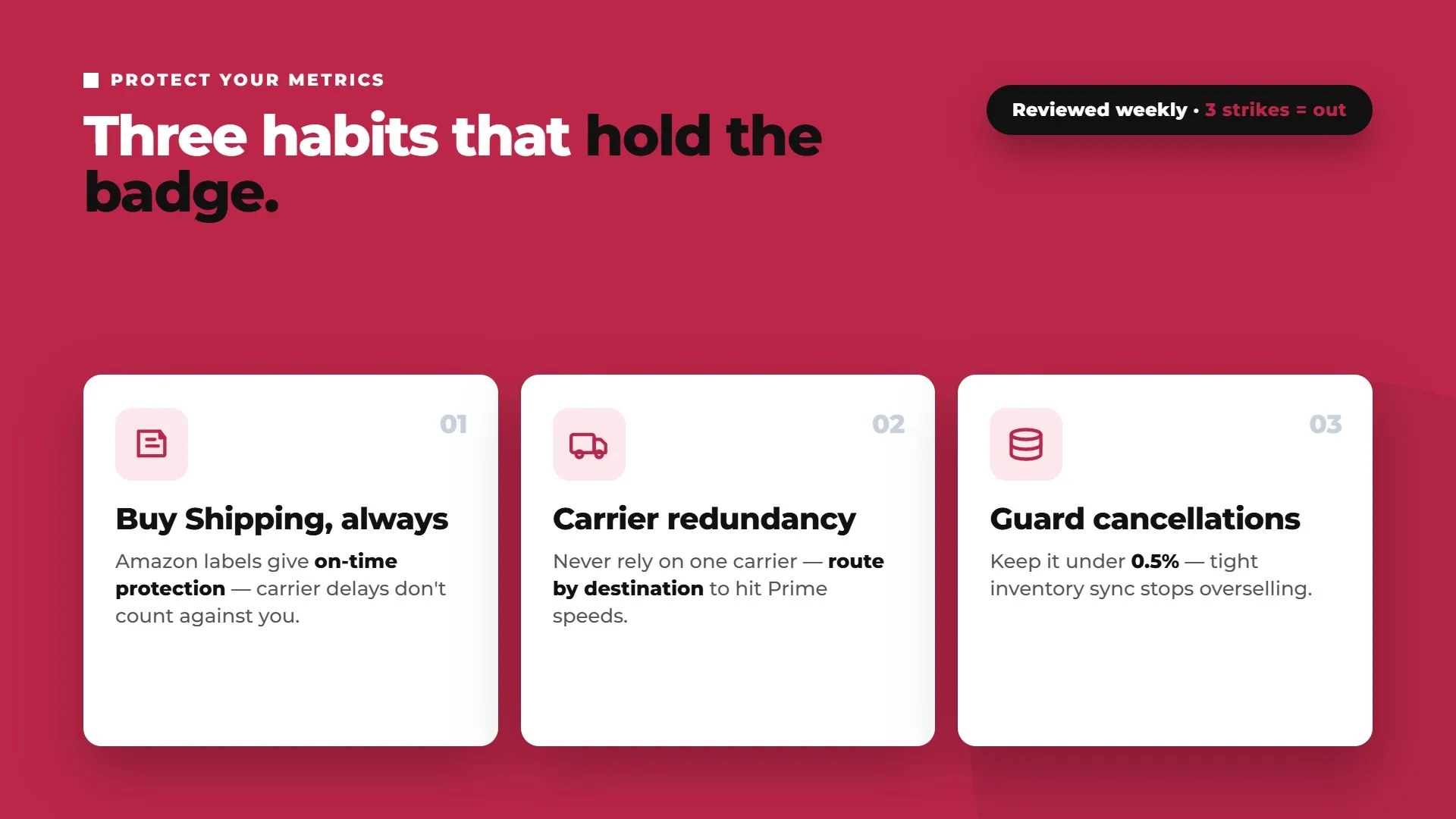
Buy your labels through Amazon Buy Shipping without exception. Outside the trial, this gives you on-time-delivery-rate protection: if a carrier delays a package shipped on a Buy Shipping label, that delay doesn't count against your on-time metric. Sellers who ship off-platform to save a few cents on postage give up that protection and expose themselves to carrier failures they can't control.
Build genuine redundancy into your carrier setup. Relying on a single carrier for nationwide Prime speeds is fragile, one regional service disruption during a peak week can tip you below the threshold. Sellers who consistently clear the bar usually have more than one carrier option and route by destination to hit the required speeds reliably.
Watch your cancellation rate above all. The sub-0.5% cancellation requirement is unforgiving, which means your inventory accuracy has to be near-perfect. Overselling a SKU you can't ship is the fastest way to rack up cancellations, so conservative stock management and tight inventory sync matter more under SFP than under almost any other Amazon programme. Treat weekly performance review as a standing operational checkpoint, not a report you glance at after something has already gone wrong.
Seller Fulfilled Prime vs FBA
For many sellers the real question isn't "SFP or nothing," it's "SFP or FBA." Here's how they compare:
FBA | Seller Fulfilled Prime | |
|---|---|---|
Who holds inventory | Amazon | You (own warehouse or 3PL) |
Who ships | Amazon | You |
Customer service / returns | Amazon | Amazon (you fulfil outbound only) |
Storage fees | Yes, plus peak surcharges | None to Amazon; your own storage |
Fulfilment cost control | Low (Amazon's fees) | High (your own carriers) |
Prime badge | Yes | Yes |
Performance risk | Amazon absorbs it | You carry it |
Best-fit seller | Fast-moving, standard-size stock | Strong logistics; bulky, heavy, or slow-moving stock |
For the wider self-fulfilment model without the Prime programme requirements, see our Amazon FBM (Fulfilment by Merchant) guide.
The core trade-off: FBA gives up control and margin in exchange for convenience and Amazon absorbing the performance risk, while SFP keeps control and often better unit economics but puts the performance risk squarely on you. SFP is the natural route for sellers with large, heavy, high-value, or slow-moving inventory that's expensive to store in FBA, or for sellers who already run strong fulfilment operations and would rather not pay FBA's fees.
It's also why SFP shows up when people search for an "alternative to Amazon FBA." It's the most credible one that still keeps the Prime badge, everything else means giving the badge up.
Many established sellers don't treat it as a strict either-or. It's common to run FBA for fast-moving, standard-size products where Amazon's fulfilment is cheap and efficient, while using SFP for the bulky, heavy, or slow-moving lines where FBA storage fees and size surcharges eat the margin. Splitting your catalogue that way lets each product sit in the fulfilment model that suits its economics, rather than forcing everything through one channel. The main constraint on that split is operational: you still have to hold the SFP performance bar across every SFP order, so the SFP portion of your catalogue has to be one your logistics can genuinely support at Prime speed.
Seller Fulfilled Prime Costs and Returns
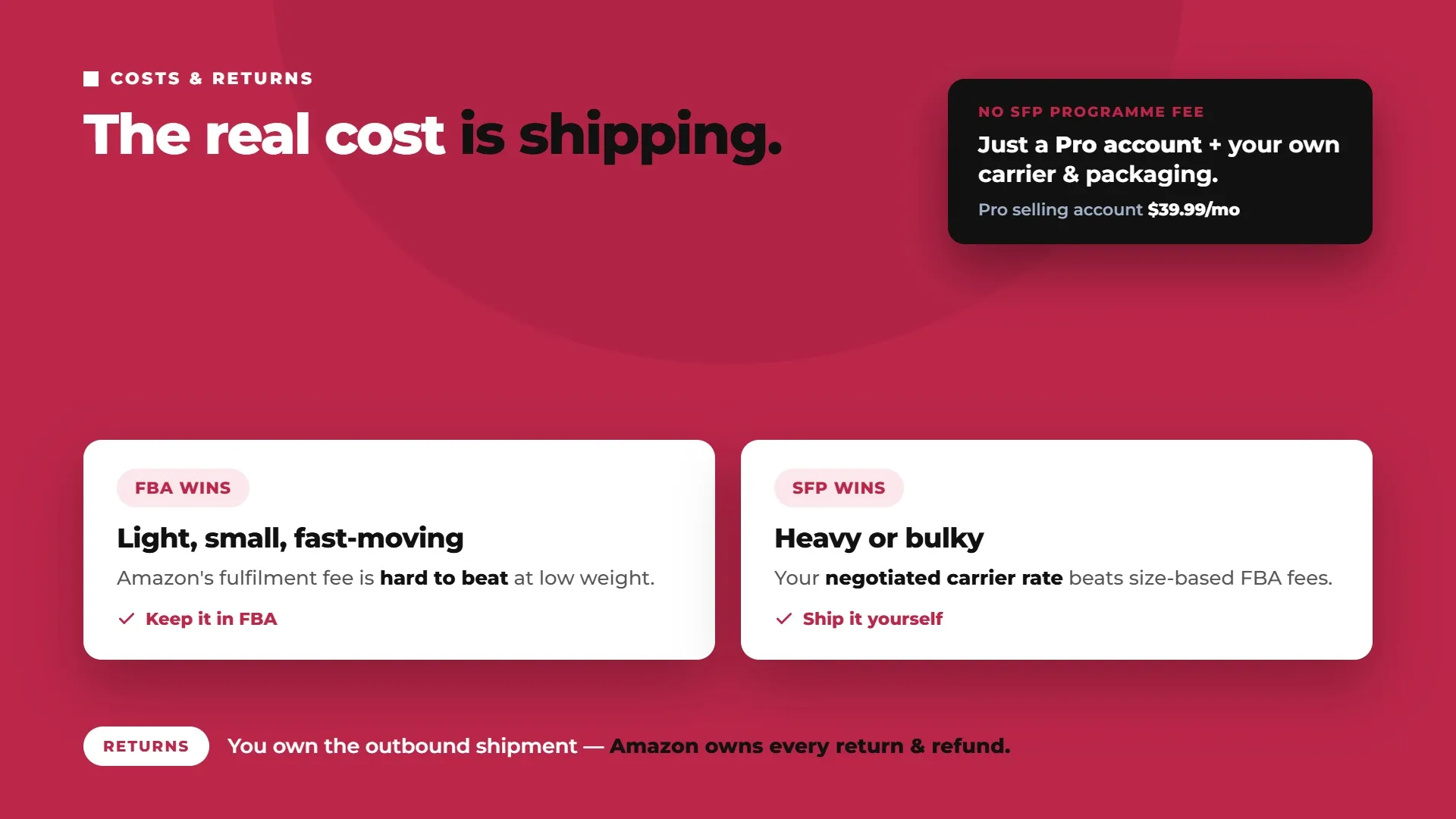
On cost, the thing to understand is that SFP's real expense isn't a programme fee, it's shipping. You'll pay for a Professional selling account ($39.99/month in the US, with an equivalent monthly subscription in the UK and other marketplaces) plus your own fulfilment, packaging, and carrier costs. Because Amazon requires competitive Prime delivery speeds nationwide, the shipping cost per order can be substantial, and that, rather than any Amazon programme charge, is the true cost of SFP. Amazon's current Seller Fulfilled Prime programme page does not list a separate SFP-specific fee (Amazon); if you're budgeting, model your carrier and packaging costs carefully and confirm the latest fee position against Amazon's own SFP pages before you commit, since Amazon has revisited SFP economics before.
The honest way to think about SFP cost is per-order, not per-month. Under FBA you hand Amazon a fulfilment fee and a storage fee and stop thinking about it. Under SFP you're absorbing the pick, pack, packaging materials, and, above all, the shipping to hit Prime speed, and that shipping cost is where SFP either wins or loses against FBA for a given SKU. For a light, small, fast-moving product, FBA's fulfilment fee is often hard to beat. For a heavy or bulky product where FBA's size-based fees and storage surcharges pile up, absorbing your own negotiated carrier rate can come out well ahead, which is exactly the kind of SKU SFP tends to suit.
On returns, Amazon handles all post-order customer service, returns, refunds, and adjustments for SFP items under the standard Amazon returns policy (Amazon). The customer gets the same returns experience they would on an FBA Prime order. You own the outbound shipment; Amazon owns the returns relationship. That's part of what keeps the SFP experience indistinguishable from FBA on the buyer's side.
Is Seller Fulfilled Prime Worth It?
The benefits are real. You get the Prime badge and its conversion lift without surrendering your inventory to FBA, you keep control over your branding, packaging, and fulfilment, and for the right products, bulky, heavy, high-value, or slow-moving SKUs that are expensive in FBA, the economics can be significantly better.
The costs are just as real. It's a demanding, freshly-tightened performance bar; the operational burden of same-day and weekend shipping is constant; hitting Prime delivery speeds nationwide costs money in carrier fees; and slipping on the metrics carries genuine removal risk.
So the honest answer depends entirely on your logistics. If you already run fast, reliable, nationwide fulfilment, or have a 3PL that does, and you sell products where FBA is costly, SFP can be one of the best moves available to you. If your fulfilment can't consistently clear 93.5% on-time delivery at same-day, seven-days-a-week speed, SFP is a trap that will cost you money and eventually your enrolment. It's a programme that rewards operational strength and punishes everything short of it.
The Bottom Line
Seller Fulfilled Prime remains the only way to keep the Prime badge while shipping from your own warehouse, and that badge is genuinely valuable. But the July 2026 changes made an already-demanding programme harder, and the direction of travel is clear: Amazon keeps raising the bar. SFP rewards sellers with strong, fast, nationwide logistics and punishes everyone else.
The decision comes down to an honest audit of your fulfilment: can it hold 93.5% on-time delivery, same-day, seven days a week, at the new speed thresholds? If you're not sure, that uncertainty is worth resolving before you enrol, not during the trial. Talk to Flairox about whether Seller Fulfilled Prime is right for your Amazon business, and about building the fulfilment operation that can actually hold the badge.
Frequently asked questions
Seller Fulfilled Prime is an Amazon programme that lets third-party sellers show the Prime badge on listings they fulfil from their own warehouse or 3PL, rather than through FBA, while Amazon still handles post-order customer service and returns.