 Bilal Siddiqui
Key takeaways
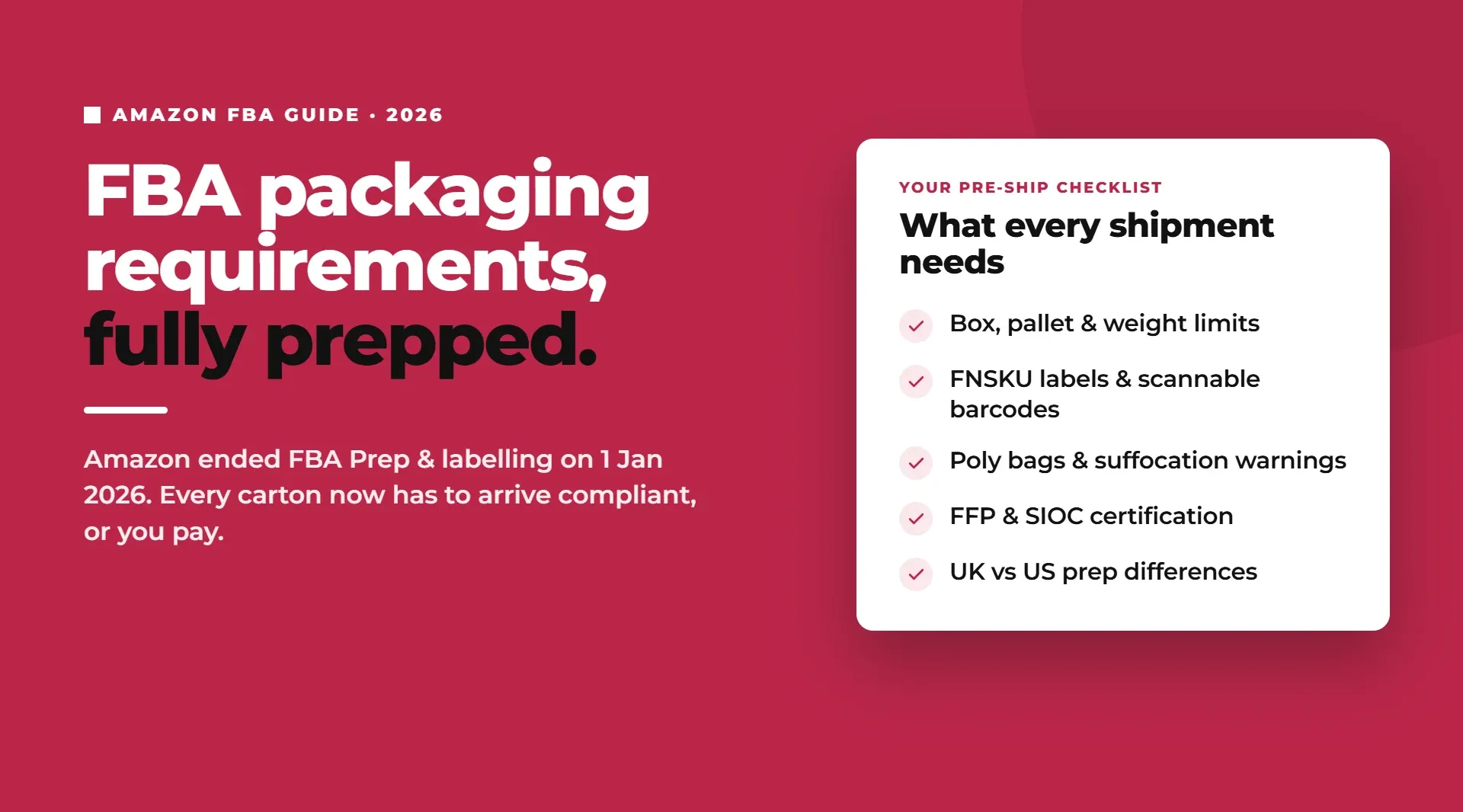
Prep is now entirely on the seller. Amazon discontinued FBA Prep Service and item labelling in the US from 1 January 2026, so self-prep, supplier-prep, or a third-party prep provider are your only options.
Non-compliance fees jumped sharply in 2026, from a few cents per defective unit to as much as several dollars per unit.
Boxes have hard limits: roughly 25 inches (63.5 cm) on any side and 50 lbs (22.6 kg) in the US, with different figures for the UK.
Poly bags need a minimum thickness and, above a 5-inch opening, a suffocation warning label.
FNSKU and barcode labels must scan cleanly first time, or the whole carton can be held at receiving.
Frustration-Free Packaging (FFP) and SIOC certification remove prep-related chargebacks on qualifying products, at the cost of an upfront certification process.
Your shipment lands at an Amazon fulfilment centre. A fraction of the units fail a labelling check, a poly bag opening is a fraction of an inch too wide, or a carton arrives without a scannable FNSKU. A year ago, that mistake cost you a few cents a unit. In 2026, it can cost you several dollars a unit, and Amazon is no longer the one fixing it for you.
From 1 January 2026, Amazon stopped offering FBA Prep Service and item labelling for US shipments. Every carton that reaches a fulfilment centre now has to arrive fully prepped and compliant, whether you did it yourself, your supplier did it, or a third-party prep provider did it. Amazon confirmed the change applies to all shipments created from that date onward, and that shipments prepped in violation of the requirements lose eligibility for damage reimbursement (Supply Chain Dive).
This guide walks through every Amazon FBA packaging requirement that matters in 2026: box and pallet limits, labelling and barcodes, poly bags and suffocation warnings, Frustration-Free Packaging (FFP) and SIOC certification, what non-compliance actually costs, and how the rules differ if you're shipping into the UK. By the end, you'll have a checklist you can run against your next shipment before it leaves the warehouse.
Why Amazon Packaging Requirements Matter More in 2026
For years, a seller who got packaging slightly wrong could lean on Amazon's own prep service as a backstop, at a fee. That backstop is gone. As Amazon told sellers, "the vast majority of Amazon sellers now handle their own packaging, including prep and item labelling" already, and the company is using that as justification to withdraw the service entirely and focus fulfilment centre operations on receiving and shipping (Supply Chain Dive). Shipments created before 1 January 2026 still qualify under the old rules; anything created after has to arrive compliant or the seller forfeits damage reimbursement eligibility on top of any defect fee.
The bigger change is financial. Amazon's inbound non-compliance defect fee, charged per unit that fails to meet packaging or labelling requirements, rose sharply between 2025 and 2026, an increase reported at close to 1,600% (AMZ Prep):
2025 fee per unit | 2026 fee per unit | |
|---|---|---|
Non-compliance defect fee | $0.02 to $0.07 | $0.32 to $5.72 |
Cost of a 2% defect rate on 10,000 units | $4 to $14 | $64 to $1,144 |
Multiply that across a year of restocks and packaging compliance stops being an ops checklist item and becomes a line item that shows up in your margin.
That's the frame for everything below. None of these requirements are new in spirit, Amazon has always cared about box strength, label placement and safe poly bags, but the cost of ignoring them changed enough in 2026 that "we'll fix it later" is no longer a viable strategy.
Amazon FBA Box and Carton Requirements
Weight and dimension limits
In the US, the standard limit for an individual FBA carton is roughly 25 inches (63.5 cm) on any side and 50 lbs (22.6 kg) in weight. Boxes between about 33 lbs (15 kg) and 50 lbs need a "Team Lift" label on five sides so warehouse staff know to handle them with two people, and boxes that push past 100 lbs risk outright rejection or a requirement for mechanical lift labelling. Oversized cartons that exceed the standard dimensions can trigger additional handling fees, delays at receiving, or a manual review that slows the whole shipment down.
Box weight | What's required |
|---|---|
Up to 33 lbs (15 kg) | Standard carton, no special label |
33 to 50 lbs (15 to 22.6 kg) | "Team Lift" label required on five sides |
Over 50 lbs | Risk of additional handling fees or delay |
Over 100 lbs (45 kg) | Risk of outright rejection or mechanical lift labelling |
Standard dimension limit: 25 inches (63.5 cm) on any side.
Box construction standards
Amazon expects strong, new corrugated boxes, not reused cartons that have already absorbed one trip's worth of compression damage. Every carton should be a proper six-sided construction, sealed with adequate tape (not just a strip across the top), and packed so the weight inside is evenly distributed rather than concentrated in one corner. Accurate, honestly stated dimensions matter too: a box that's marked smaller than it actually is creates a carrier label mismatch that can delay the whole shipment.
Pallet requirements
If you're shipping on pallets, the limits are specific. Total pallet height, including the pallet itself, must not exceed 72 inches (182 cm), and total pallet weight is capped at 1,500 lbs (680 kg). Pallets need to be a standard 40 by 48 inches (102 by 122 cm), built from ISPM-15 certified wood (no plastic or PECO pallets), loaded with zero overhang so boxes stay within the pallet edges, and wrapped in clear stretch wrap with a minimum of three full rotations. Amazon also requires 4-way forklift entry and four pallet labels, one per side, in PDF417 barcode format.
Pallet spec | Requirement |
|---|---|
Max height (including pallet) | 72 in (182 cm) |
Max weight | 1,500 lbs (680 kg) |
Footprint | 40 x 48 in (102 x 122 cm) |
Material | ISPM-15 certified wood only |
Forklift entry | 4-way |
Overhang | None, boxes must stay within pallet edges |
Stretch wrap | Clear, minimum 3 full rotations |
Labels | 4 required, one per side, PDF417 barcode |
The 3-foot drop test
Seller guidance around FBA packaging commonly references a durability expectation known informally as the 3-foot drop test: your packaging should be able to survive being dropped from around 3 feet without the contents being damaged or the box failing. It isn't framed as a formal pass/fail test Amazon runs on every carton, but as a practical benchmark for how robust your case pack needs to be to survive normal warehouse handling. If you're shipping anything fragile, don't assume your retail packaging is tough enough. Test it, or add protective packaging inside the shipping carton.
Amazon FBA Labelling Requirements
FNSKU labels
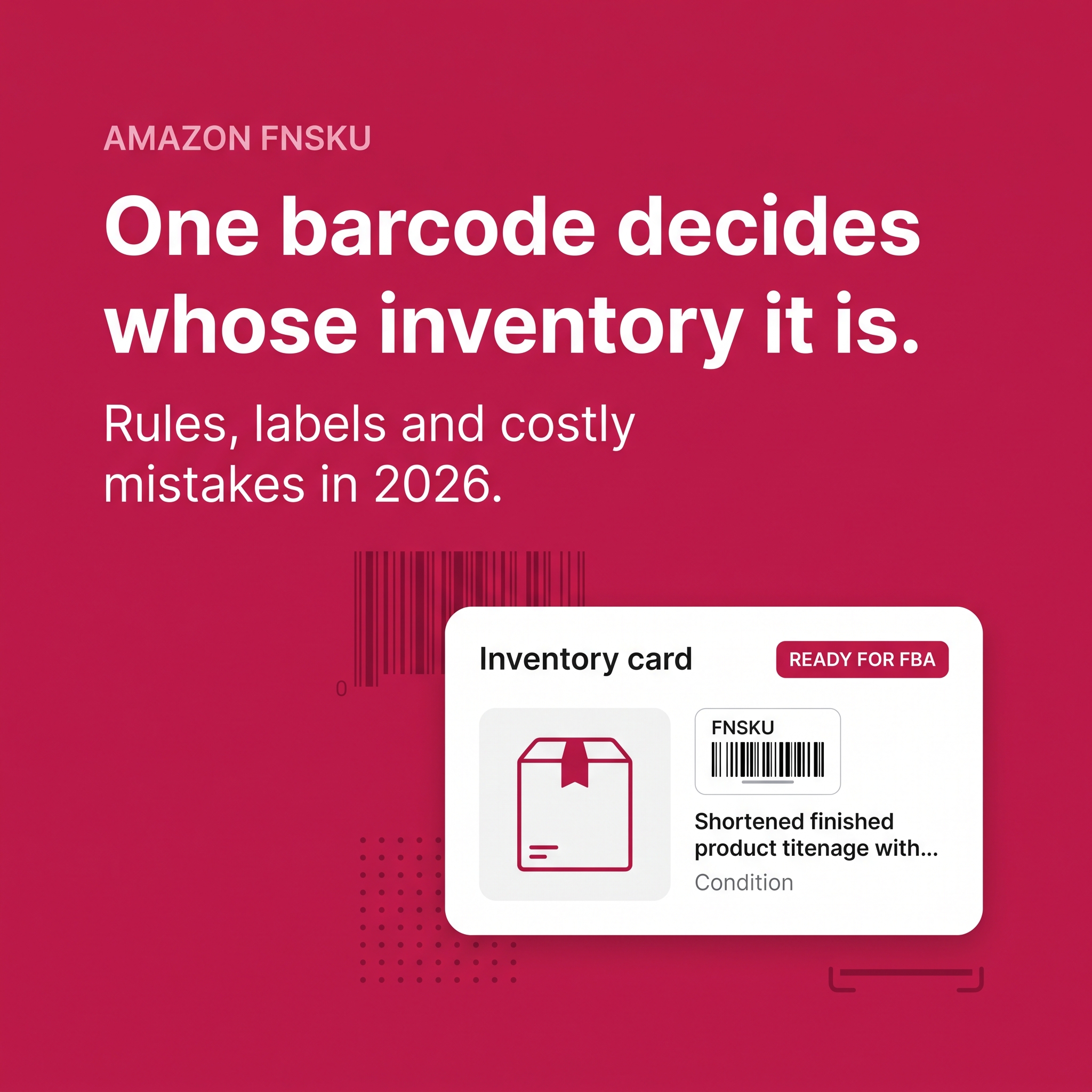
An FNSKU (Fulfilment Network Stock Keeping Unit) is Amazon's own barcode for tracking inventory inside its fulfilment network. If you're using commingled inventory, where your units are pooled with other sellers' identical stock, Amazon can use the manufacturer barcode instead. But the moment you want stickerless, commingled inventory turned off, or you're selling a product where provenance matters (used, refurbished, or category-restricted items), an FNSKU label is required on every unit. Placement matters as much as presence: a label stuck over a seam, a fold, or an existing barcode causes a failed scan, and a failed scan at receiving is exactly the kind of defect that now carries a real fee.
Barcode requirements
Every unit needs exactly one scannable barcode, either the FNSKU or, where eligible, the manufacturer's UPC/EAN. Don't cover the manufacturer barcode with your FNSKU label unless the listing setup specifically calls for it, and never ship a unit with two competing scannable codes visible, since that's a common cause of misreads at receiving.
Label print quality
Print quality is an easy thing to get wrong at scale. Labels should be printed at a minimum of 300 DPI using a thermal or laser printer, never inkjet, which smudges under warehouse handling and humidity. As a benchmark, UK fulfilment centre specifications require labels to stay readable and scannable for 24 months after printing (Amazon official UK shipping guidance). If your labels fade, blur, or peel before that, you're building a defect fee into every restock cycle.
Amazon Poly Bag and Suffocation Warning Rules
When a poly bag is required
Amazon requires poly bagging for a specific set of product types: clothing and fabrics, plush toys, small items with loose or detachable parts, sharp or fragile items, liquids and powders not already packaged in glass, any open or unsealed product, multi-item bundles, and products with exposed parts that could separate in transit (Unicargo). If your product falls into one of these categories and you skip the poly bag, expect a defect flag at receiving.
Poly bag specifications
The bag itself has to meet a minimum thickness, generally cited at around 1.5 mil, thick enough to resist punctures, tears, and moisture during transit. For standard products, the bag needs to be transparent so a scanner can read the barcode through the plastic without unbagging the unit; adult products are the exception, and must ship in black, non-transparent poly bags. Size matters too: a poly bag shouldn't extend more than around 3 inches beyond the product's own dimensions on any side, since an oversized bag creates handling and safety issues of its own.
Spec | Requirement |
|---|---|
Minimum thickness | ~1.5 mil |
Transparency | See-through for standard items; black/opaque for adult products |
Maximum overhang | No more than ~3 in beyond the product on any side |
The suffocation warning threshold
This is one of the most commonly missed requirements. A poly bag with an opening of roughly 5 inches or wider, measured flat, requires a printed suffocation warning. The required print size scales with the width of the bag itself:
Bag width | Minimum warning print size |
|---|---|
Under 29 in | 10-point |
30 to 39 in | 14-point |
40 to 59 in | 18-point |
60 in and over | 24-point |
The warning needs to sit on a flat, clearly visible part of the bag, never across a seam, fold, or closure edge, where it could crumple and become unreadable. Because exact wording requirements can shift, confirm the current mandated text in Seller Central's bagging guidance before you finalise packaging for a new SKU rather than relying on last year's template.
Frustration-Free Packaging (FFP) and SIOC Explained
Frustration-Free Packaging is Amazon's own packaging certification programme, and it's worth understanding properly rather than treating it as an optional extra, because it directly removes some of the fees discussed above.
What FFP is and why Amazon created it
Amazon launched FFP to fix the retail packaging problem shoppers complain about most: excess plastic, wire ties, and clamshell casing that takes ten minutes and a box cutter to open. FFP certification is built around four principles: packaging has to be protective enough to survive transit and delivery undamaged, cost-effective in that products ship in their own container without extra void fill or over-boxing, easy to open (Amazon's own benchmark is that a shopper should be able to access the contents within about 120 seconds, with no plastic clamshells or packing peanuts), and low-waste, using recyclable materials with correct recycling markings.
FFP vs SIOC vs PFP
Certification isn't a single tier. Broadly:
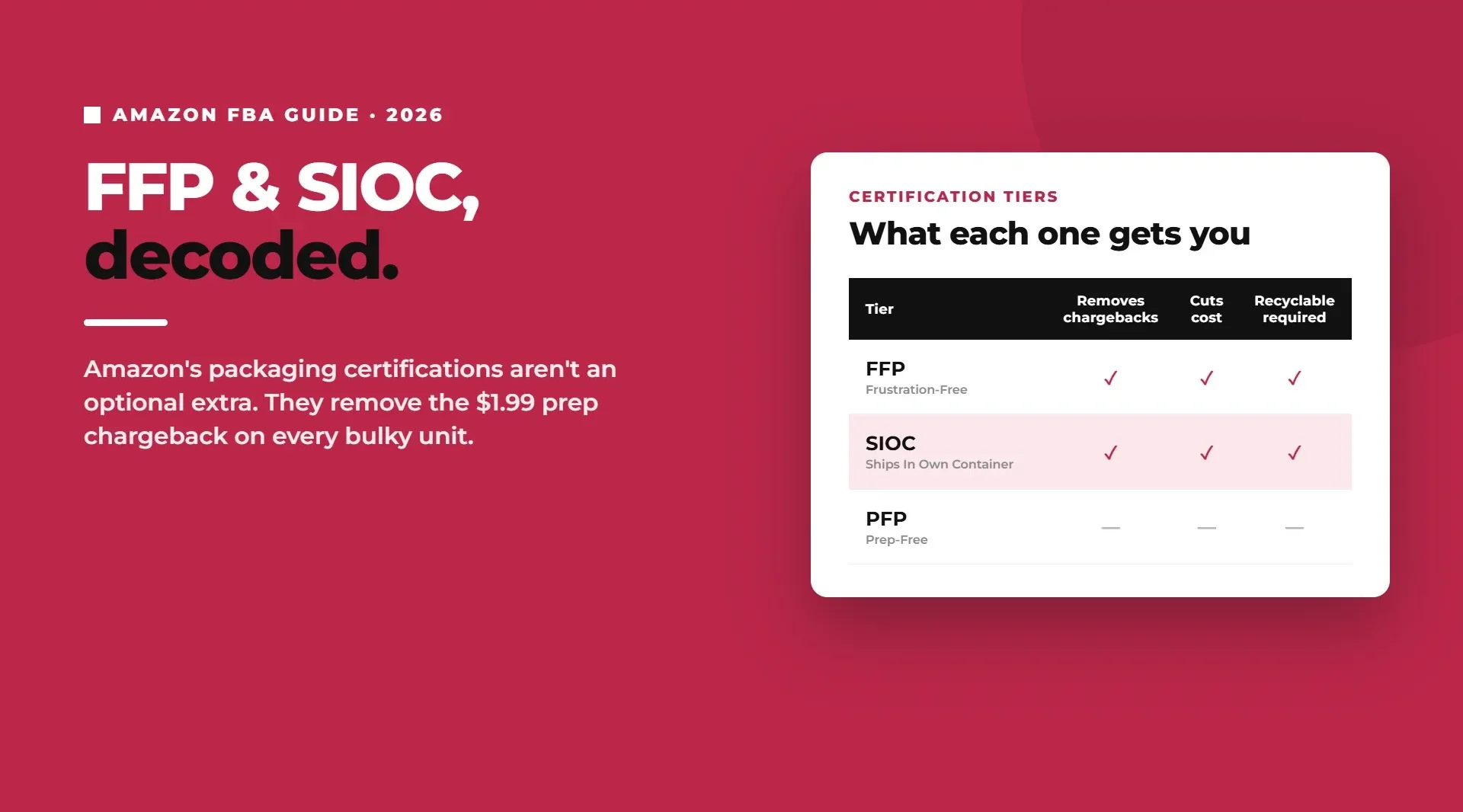
Certification | Removes prep chargebacks | Reduces packaging cost | Recyclable materials required |
|---|---|---|---|
FFP | Yes | Yes | Yes |
SIOC (Ships in Own Container) | Yes | Yes | Yes |
PFP (Prep-Free Packaging) | No | No | No |
SIOC is effectively the practical evolution of FFP for many sellers: the product ships to the end customer in the same container it arrives at Amazon in, with no additional Amazon-applied packaging at all.
How to get certified
Certification runs through Seller Central or Vendor Central. You enrol the ASIN, submit packaging samples and images to Amazon's packaging lab for review, and the packaging then goes through transit testing at an ISTA-certified facility to confirm it survives real shipping conditions. Certification is granted per ASIN, not blanket across your catalogue, so a redesign or new product line means going through the process again.
What it costs you if you skip it
Amazon applies a chargeback, commonly cited at around $1.99 per unit, to non-certified products above a size and weight threshold, roughly 20 lbs or 18 x 14 x 8 inches, that aren't already certified ready-to-ship (SellerApp). A handful of categories are exempt, including Amazon Fresh, Prime Pantry, media products, and hazmat items. If you sell anything bulky, heavy, or awkwardly shaped, FFP or SIOC certification usually pays for itself quickly once you weigh it against paying that chargeback on every unit indefinitely.
Amazon FBA Packaging Requirements in the UK (vs US)
If you're shipping into UK fulfilment centres, don't assume the US rules transfer directly. Amazon's own UK shipping and packaging guidance sets out several concrete differences:
Requirement | US | UK |
|---|---|---|
Max carton dimension | ~25 in (63.5 cm) per side | 63.5 cm per side |
Max carton weight | 50 lbs (22.6 kg) | 15 kg unless a single unit exceeds it |
Carton construction | Strong corrugated, six-sided | Regular Slotted Carton (RSC), B flute, ECT-32 |
Label standard | FNSKU + barcode, 300 DPI | UCC128 barcode, 300 DPI minimum, thermal/laser only |
Label longevity | Must remain scannable | Must stay readable and scannable for 24 months |
UK dunnage (the packing material used to protect items inside the box) rules are also specific. Foam, air pillows, and full paper sheets are accepted. Styrofoam peanuts, biodegradable or cornstarch peanuts, shredded paper, and crinkle wrap are all prohibited, a stricter standard than many sellers assume based on general packaging practice.
UK fulfilment centres also enforce category-specific restrictions that don't have a direct US equivalent, most notably around sharp items: knives, knife blades, razor blades, boxed knife sets, carving sets, swords, daggers and axes are restricted, with narrow exceptions for safety razors, folding blades under 3 inches, and ordinary cutlery sets. If you're selling homeware, kitchenware, or outdoor products into the UK market, check this list before your first shipment rather than after a rejected carton.
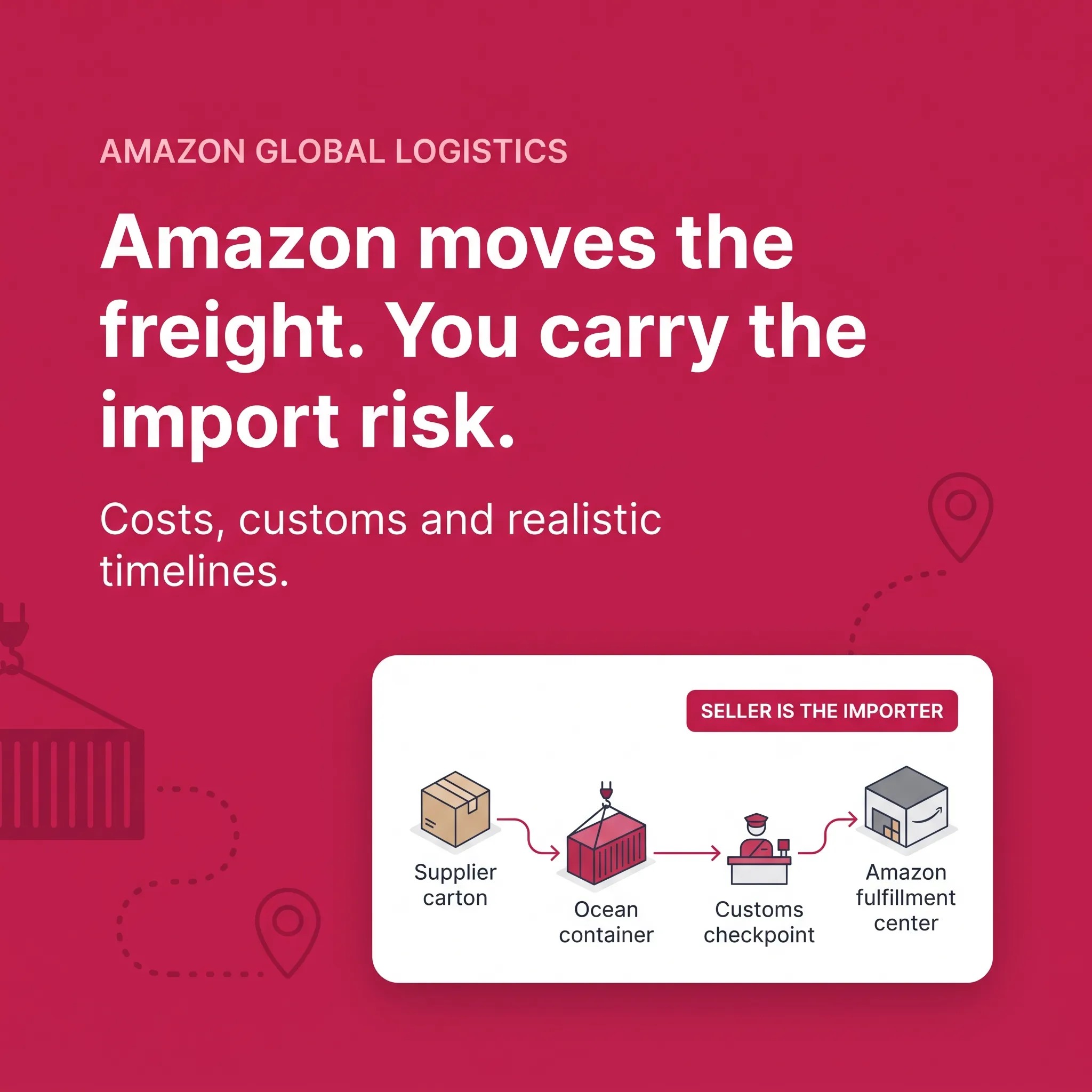
Sellers shipping internationally into UK fulfilment centres should also plan for DDP (Delivered Duty Paid) terms, since Amazon will not act as Importer of Record for inbound stock.
What Happens If Your Packaging Doesn't Comply
Non-compliant packaging triggers a few overlapping consequences, and they compound if you're shipping frequently.
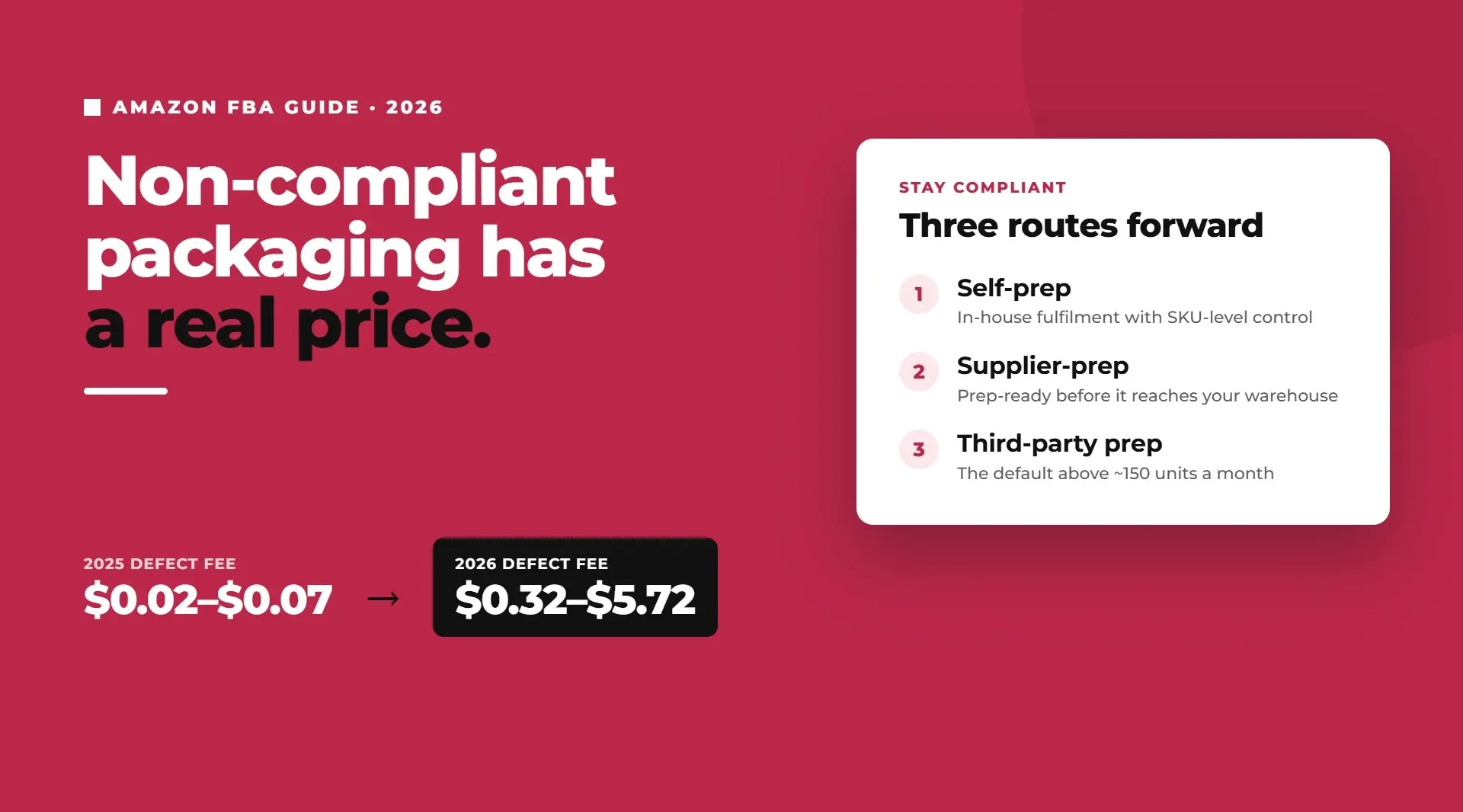
The direct cost is the inbound non-compliance defect fee covered earlier: roughly $0.02 to $0.07 per unit in 2025, now $0.32 to $5.72 per unit in 2026. Separately, if you're shipping a bulky or heavy item without FFP or SIOC certification, you're paying the roughly $1.99 per-unit prep chargeback on top of that. Beyond the direct fees, non-compliant units can be held at receiving rather than checked in, which delays your inventory reaching sellable status and increases your exposure to Amazon's inbound placement fees if the shipment has to be re-routed or reprocessed. In a worse case, an entire pallet or carton can be flagged for manual review, slowing down every unit inside it, compliant or not.
With Amazon's own prep service gone in the US, sellers essentially have three routes to staying compliant:
Self-prep. Practical for sellers with in-house fulfilment capability and enough SKU-level control to keep packaging specs current.
Supplier-prep. Build compliant labelling and packaging into your manufacturing or private-label agreement, so units arrive prep-ready before they ever reach your warehouse.
Third-party US prep provider. Increasingly the default for sellers moving meaningful volume. As a rule of thumb, once you're shipping upwards of around 150 units a month, a professional prep partner typically costs less than the defect-fee risk of getting it wrong at scale.
A Pre-Shipment Packaging Checklist
Run this against every shipment before it leaves the building, not after Amazon flags it:
Boxes are new, six-sided, properly sealed, and within the weight/dimension limit for your marketplace (US: ~25 in / 50 lbs; UK: 63.5 cm / 15 kg).
Weight is evenly distributed; boxes over the Team Lift threshold are labelled correctly.
Every unit has one clean, scannable barcode (FNSKU or approved manufacturer barcode), placed away from seams and folds.
Labels are printed at 300 DPI minimum on a thermal or laser printer, not inkjet.
Poly bags meet the minimum thickness, correct transparency, and size limits for the product category.
Any poly bag with a 5-inch or wider opening carries a correctly sized suffocation warning, placed flat and unobstructed.
Dunnage matches your marketplace's accepted materials (no prohibited peanuts or crinkle wrap for UK shipments).
Pallets, where used, meet height (72 in / 182 cm), weight (1,500 lbs / 680 kg), and construction standards, with four correctly placed labels.
Bulky or heavy items are checked against the FFP/SIOC size threshold, and certified where it makes financial sense.
Packaging has actually been tested against realistic handling and drop conditions, not just assumed to be strong enough.
The Bottom Line
Amazon's packaging rules haven't changed in principle, boxes still need to be strong, labels still need to scan, and poly bags still need to be safe. What changed in 2026 is the safety net. With Amazon's own prep service gone in the US and non-compliance fees multiplied several times over, packaging compliance has moved from an operational nice-to-have to a genuine margin protection issue.
Getting this right at the SKU level, and staying on top of it as Amazon's requirements evolve across marketplaces, is exactly the kind of operational detail that's easy to under-resource until it starts costing real money. Talk to Flairox about FBA prep and packaging compliance to make sure every shipment reaches Amazon's fulfilment centres compliant the first time.
Frequently asked questions
Amazon FBA packaging requirements cover box strength and size, weight limits, FNSKU and barcode labelling, poly bag specifications (including suffocation warnings above a 5-inch opening), and, for bulky or heavy items, Frustration-Free Packaging or SIOC certification. Requirements vary slightly by marketplace, with the UK enforcing different box, label and dunnage standards than the US.