 Raahim Sheikh

Key takeaways
The forwarder now sits inside your compliance surface. They handle carton data, labels, ASNs, and appointments, and Amazon fines you when those go wrong.
An Incoterm allocates costs between commercial parties. It does not determine your importer of record under US customs law.
Neither Amazon nor your forwarder is your IOR by default. Filing an entry is not the same as accepting liability for it.
A DDP quote far below market is usually cheaper because of what is being declared, not because of freight efficiency.
Amazon stopped prepping and labeling US FBA shipments on January 1, 2026, and inbound defect fees rose sharply during the same period.
Compare quotes line by line. Two forwarders can quote the same route with entirely different scopes.
Vet for Amazon inbound experience specifically. A competent general forwarder can still fail at appointments, ASNs, and carton specifications.
Choose based on total risk, not the rate per cubic meter.
Before you take anyone's advice on this subject, including the advice you find at the top of Google, check who wrote it.
Search for guidance on choosing a freight forwarder for Amazon FBA and nearly every result is published by a freight forwarder. That includes the "best freight forwarder" rankings, one of which places its own parent company at number one while stating that forwarders cannot pay to influence the list.
The bias shows up in the recommendations. On the single biggest decision in freight, whether to ship DDP or DAP, the sources contradict each other directly. One says DDP is almost always the better choice for FBA inbound from China. Another says DAP is surging among scaling sellers and saves 10 to 25%. A third says DAP is the recommended replacement for DDP. Each position happens to match what that company sells.
Flairox does not sell freight. What follows is the buyer's side of this decision: what a forwarder actually does, what they cannot take off your hands, how to read a quote, what to ask before you sign, and which risks remain yours no matter who you hire.
What an Amazon FBA freight forwarder actually does
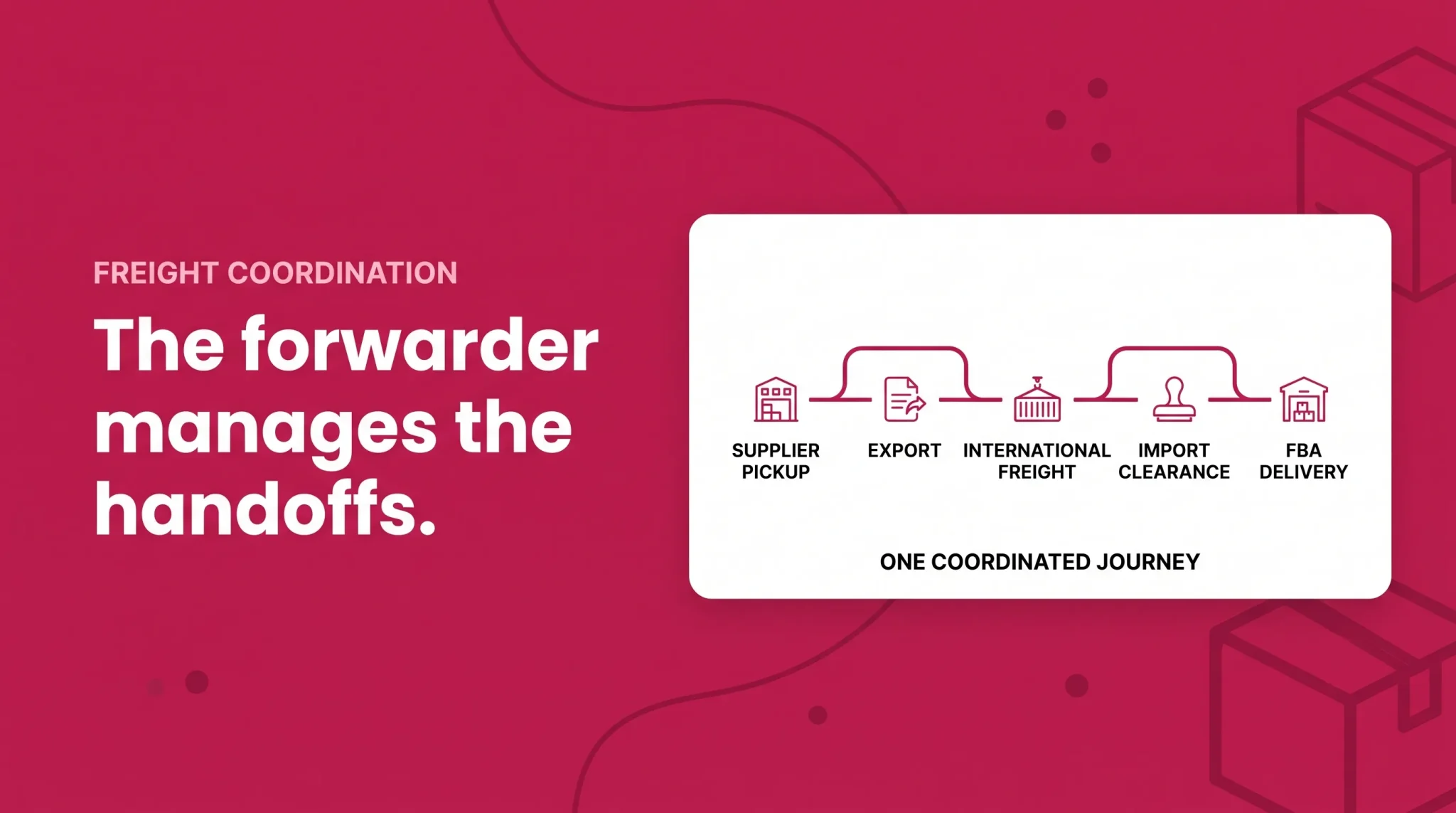
A freight forwarder coordinates the movement of your inventory from your supplier's facility to an Amazon fulfillment center. They are an organizer of services rather than the owner of most of them. Very few forwarders own ships, planes, trucks or warehouses.
In a typical China to US FBA shipment, the forwarder books space with an ocean or air carrier, arranges collection from your supplier, consolidates cargo if you are shipping LCL, handles the export declaration at origin, manages the ocean or air leg, coordinates import clearance at destination through a licensed customs broker, arranges drayage from the port, and books the delivery appointment at the fulfillment center.
That is a genuinely valuable bundle, particularly because the handoffs between those steps are where shipments fail.
What a forwarder is not
Three distinctions matter, because assuming the forwarder covers these is how tasks end up owned by nobody.
A forwarder is not automatically a customs broker. Customs entries must be filed by a CBP-licensed broker or by the importer of record directly. Many forwarders have brokerage in-house or a partner who does it. Some do not. Ask.
A forwarder is not a prep center. Since Amazon stopped prepping and labeling US FBA shipments on 1 January 2026, every unit must arrive fully compliant. Some forwarders offer origin prep, which is often cheaper than doing it in the US. Many explicitly do not, and will refer you to a partner facility. Our guide to Amazon FBA prep requirements covers what has to happen before cargo loads.
A forwarder is not your importer of record. This is the one that costs sellers real money, and it gets its own section below.
Forwarder, broker, carrier and 3PL: who does what
Party | Role | Licensed by | Takes customs liability? |
|---|---|---|---|
Freight forwarder | Arranges and coordinates transport end to end | FMC (as OTI/NVOCC) for ocean | No |
Customs broker | Files the customs entry on your behalf | CBP | No, acts under power of attorney |
Carrier | Physically moves the cargo | Varies by mode | No |
Importer of record | Legally accountable party for the import | Registered with CBP | Yes |
Prep center / 3PL | Labels, bags, bundles, stores, consolidates | Not federally licensed | No |
The row that matters is the fourth one. Everyone else in the chain performs a service. Only the importer of record carries the liability.
Do you need a freight forwarder?
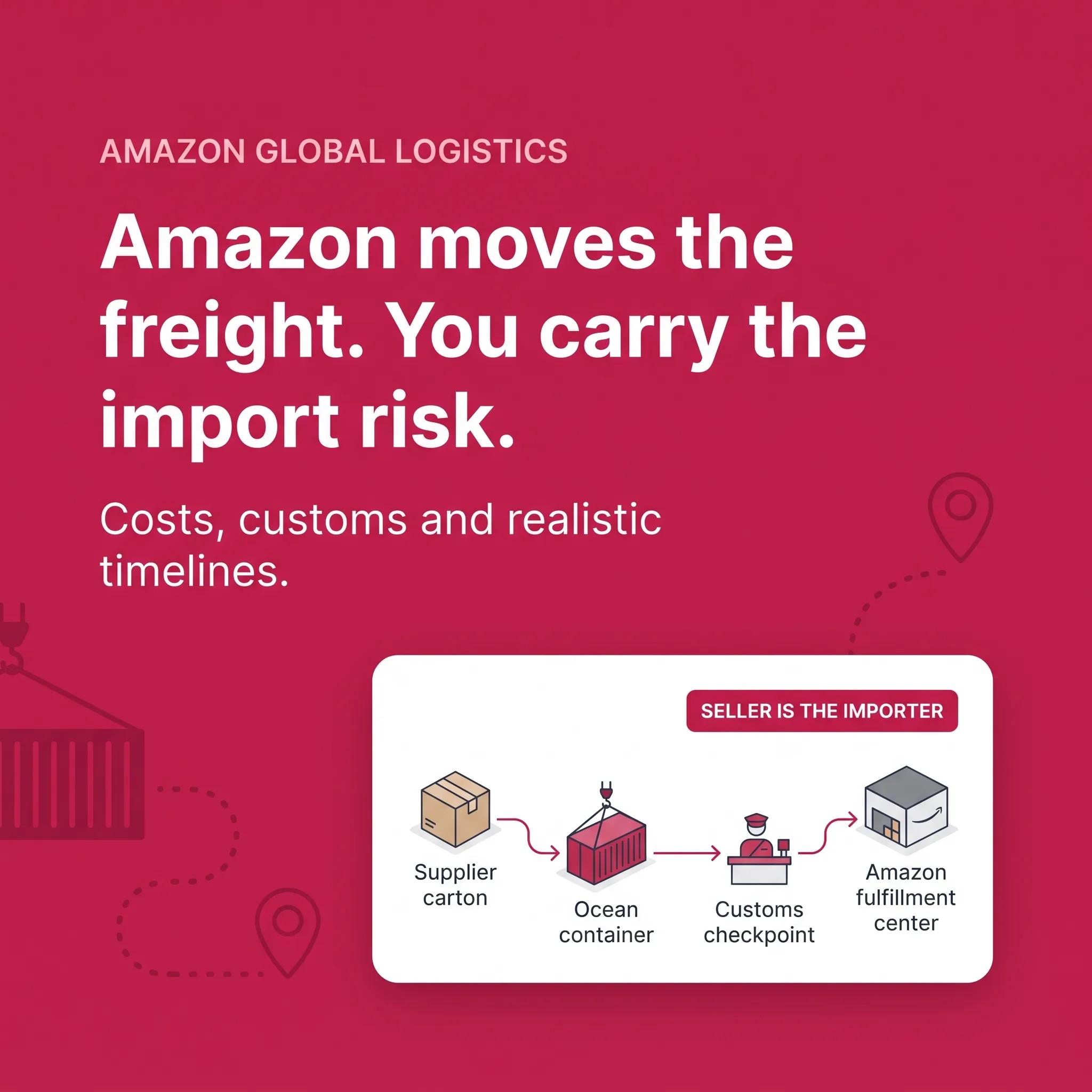
If you are importing commercial quantities from overseas into FBA, yes, in some form. The realistic alternatives are running the import yourself with a broker and carrier relationships, using Amazon Global Logistics on covered lanes, or letting your supplier arrange everything.
That third option deserves a caution. Supplier-arranged freight is convenient, and for a first small shipment it can be reasonable. But your supplier's recommended forwarder works for a relationship that predates yours, is usually paid by the supplier, and has little incentive to represent your interests when something goes wrong. It is also the most common route into the gray clearance arrangements described later in this guide.
If you use a supplier's forwarder, treat them as your vendor. Get your own quote, your own contract, and your own visibility into what is being declared at the border.
Incoterms for Amazon FBA, and why the advice conflicts
Incoterms define where the seller's responsibility ends and the buyer's begins. Five come up regularly in FBA importing.
EXW (Ex Works) means the supplier makes goods available at their facility and nothing more. You own everything from the factory door, including export clearance, which is difficult to arrange as a foreign buyer. Rarely the right choice.
FOB (Free On Board) means the supplier delivers the goods loaded onto the vessel at the origin port and handles export clearance. You take over from there. This is the traditional default for FBA importing and remains a sound, transparent starting point.
CIF (Cost, Insurance and Freight) means the supplier covers freight and insurance to the destination port. It sounds generous. In practice it hands control of the ocean leg to the supplier's forwarder, who then often recovers margin through destination charges you have no ability to negotiate.
DAP (Delivered at Place) means the supplier or forwarder delivers to a named place, frequently your forwarder's US warehouse or the fulfillment center, but you handle import clearance and duties. You see the actual duty figure and pay it directly.
DDP (Delivered Duty Paid) means everything including duties is covered to the destination, arriving as one all-in price.
Why an Incoterm does not decide your importer of record
This is the most consequential misunderstanding in FBA importing, and it is worth stating precisely.
An Incoterm allocates cost and risk between commercial parties. It does not establish which party qualifies as the importer of record under US customs law. Paying the duties does not make a party the IOR. Filing the customs entry does not make the broker or forwarder the IOR either. The named party must qualify as the owner or purchaser of the goods, or on another basis CBP recognizes, and must have expressly accepted the customs liability.
A DDP arrangement that does not identify an eligible, willing importer of record is not a compliant import, regardless of what the quote promises.
DDP or DAP
Both can be right. Which is right for you depends on your volume, whether you have a US entity, and how much visibility you want into duty.
DDP suits sellers who want a single predictable number, who lack a US entity or compliance capability, and who are shipping modest volumes where the administrative overhead of running your own clearance outweighs the savings. Legitimate DDP through a reputable forwarder with a licensed broker partner is a real product.
DAP suits sellers who want to see exactly what duty was assessed, who have or can establish a broker relationship and a bond, and who are at enough volume that supplier or forwarder duty padding becomes material. Sellers who make the switch commonly report savings, largely because bundled duty estimates tend to be built with a margin for the quoting party's risk.
The important part is not which you choose. It is understanding that when someone tells you the answer is obvious, check whether the obvious answer is also the one they sell.
Gray DDP and the risks that stay with you
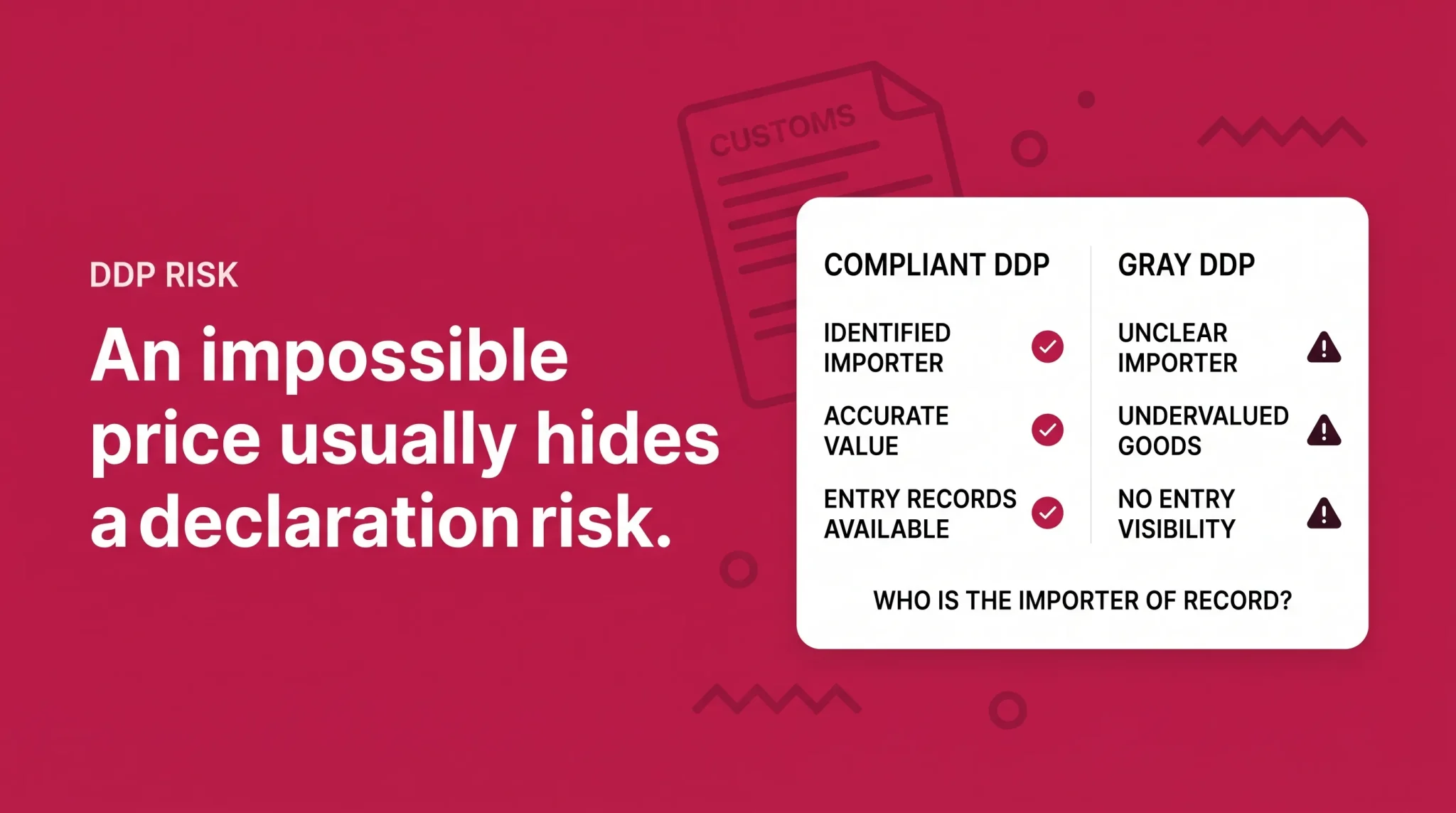
Not all DDP is the same, and the difference is not visible in the quote.
Legitimate DDP means a licensed customs broker or a properly registered party acts as importer of record, the shipment is declared at accurate value with correct HS codes, and all duties are actually paid. It costs more than the alternative.
Gray DDP is the version quoted by some origin-side forwarders at prices that look impossible. There are three common mechanisms and all three leave exposure with you.
Bundled bond clearance. The forwarder consolidates many clients into one container and clears everything under a single shell company's bond. If any consignment in that container turns out to be counterfeit or prohibited, CBP can seize the container. Your legitimate goods sit in it.
Undervaluation. You pay the forwarder based on real cargo value. A fraction of that value is declared to customs and the difference is retained. When CBP audits the entry, the agency pursues the ultimate consignee, and the ultimate consignee is you. Penalty exposure on customs fraud runs to multiples of the duty value.
Aggressive classification and origin manipulation. HS codes chosen for the duty rate rather than the product, or country of origin declared as somewhere other than where substantial transformation occurred. Entries remain reassessable for years, and the reassessment lands on the importer.
The practical tell
You do not need to audit anyone's paperwork to spot the risk. A DDP quote meaningfully cheaper than a clean, fully declared import is usually cheaper because of what is being declared, not because of freight efficiency.
Freight is a competitive market with thin margins and broadly similar carrier costs. Nobody has a 30% structural advantage on the ocean leg. If a quote is 30% below the field, the saving is coming from somewhere, and duty is the only line large enough to produce it.
Ask directly: who is the importer of record on my entries, what value is declared, and can I see the entry summary? A compliant provider will answer all three without hesitation. Reluctance is your answer.
Customs, documentation and importer of record
Amazon is not your IOR, and your forwarder is not either by default
Amazon does not act as importer of record for FBA inventory of any value. Naming Amazon as IOR gets the shipment rejected.
Your forwarder generally does not either. Forwarders and their brokers file paperwork on behalf of the importer of record. Filing is a service performed under power of attorney, not an assumption of liability. Some providers do offer a third-party IOR service where they genuinely accept that liability, which is a distinct and separately priced product. If you believe you have that, confirm it in writing.
Setting up as a non-resident importer
Sellers without a US entity can still act as importer of record through the non-resident importer framework. It involves registering with CBP using Form 5106 to establish an importer identity, granting power of attorney to a licensed US customs broker who files entries on your behalf, and posting a customs bond covering your duty obligations.
A standard continuous bond costs roughly $500 to $1,000 a year for typical seller volumes and takes around one to three weeks from application to active, assuming documentation is complete. Executive Order 14411, signed in June 2026, is expected to increase minimum bond requirements for foreign importers of record as implementation proceeds, so budget for higher figures later in the year.
The alternative is appointing a third-party importer of record established in the destination country to carry that liability under power of attorney. For non-resident sellers without a compliance function, this is frequently the lower-risk route.
The documents that travel with every shipment
Your forwarder will assemble most of these, but errors in them become your problem, so understand what each one does.
The commercial invoice states what the goods are, who bought them and what was paid. It drives the customs valuation, which makes it the single most audited document in the set. The packing list details cartons, contents, weights and dimensions, and must match physical reality. The bill of lading is the contract of carriage and the document against which cargo is released. The Importer Security Filing must be submitted for ocean shipments ahead of vessel loading, and late or inaccurate filings carry penalties in the thousands per violation. A certificate of origin may be required depending on product and origin, and matters more than usual in the current tariff environment because origin drives the rate.
HS classification is the importer's responsibility. A broker will file the code you provide or derive one from your description, but the legal duty to classify correctly sits with the IOR. Getting a binding ruling on an ambiguous product is inexpensive relative to a reclassification assessment years later.
A note on scope: this article explains how the system works. It is not customs, legal or tax advice, and Flairox is not a licensed customs broker. Work with a licensed broker or trade attorney on classification, valuation, bonds and entity structure.
How to read an Amazon FBA freight quote
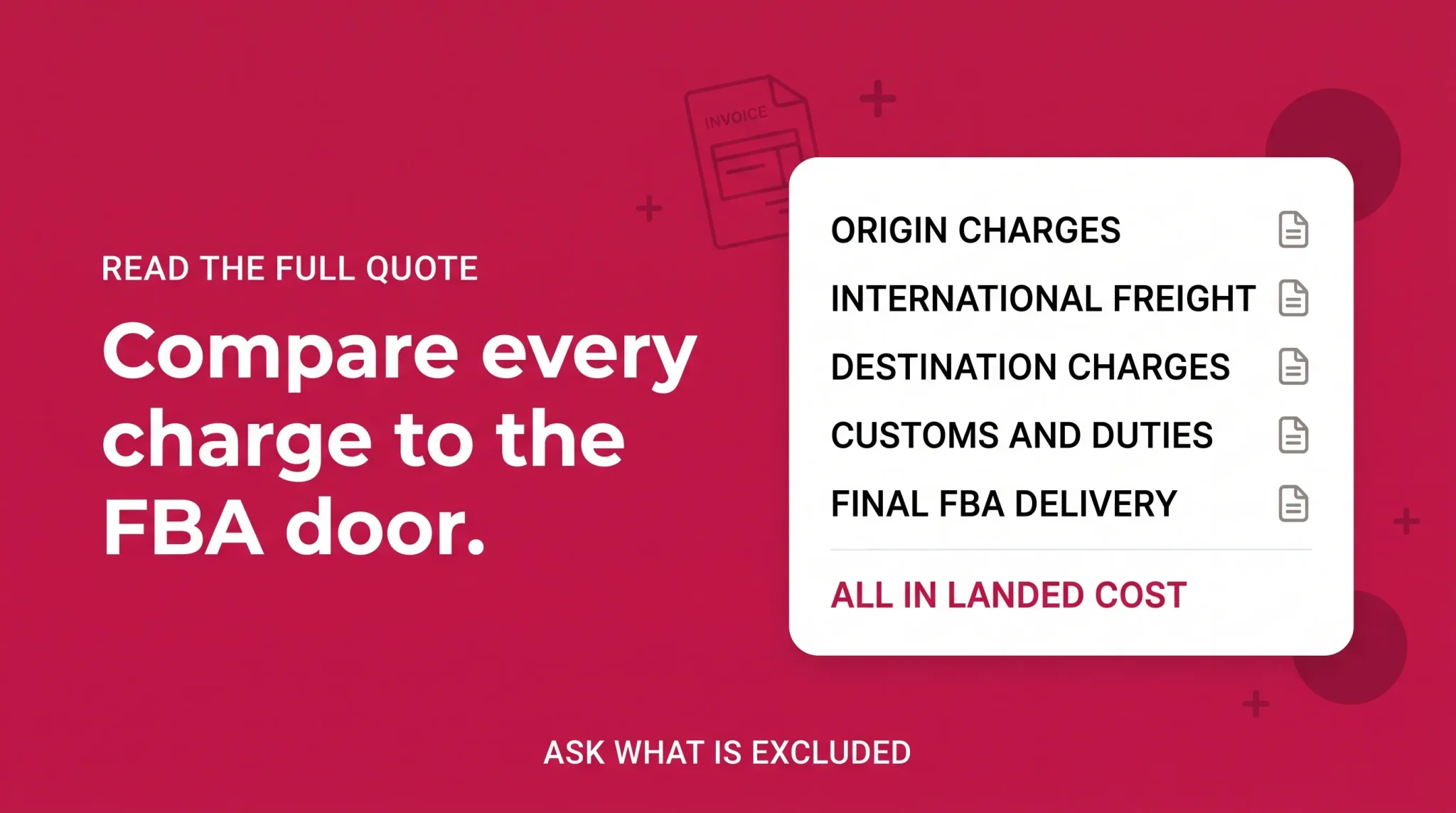
Quote comparison is where most sellers think the decision happens, and where most of them compare two documents that are not describing the same thing.
A complete quote should let you see, separately, the origin charges covering pickup, export clearance, documentation and terminal handling at origin, the freight itself for the ocean or air leg, the destination charges including terminal handling, customs clearance fees, any bond fees and drayage from port, and the final delivery into the fulfillment center. Duties and taxes should be shown as their own line or explicitly excluded, never folded silently into a headline rate.
Rates move constantly with lane, season, container type and capacity, so any specific figure published in an article is stale within weeks. What does not go stale is the structure.
Where quotes hide cost
The usual pattern is an attractive freight rate with thin origin and destination detail, followed by charges that appear once cargo is moving and leverage has shifted. Terminal handling, documentation fees, chassis and drayage charges, demurrage and detention, customs examination fees and delivery appointment charges are all legitimate costs, and all easy to leave out of an initial quote.
Two questions solve most of this. Ask for a quote that is explicitly all-inclusive to the fulfillment center door with every line itemized. Then ask what circumstances would generate a charge not shown on it. The second answer is more revealing than the first.
Compare landed cost, not freight rate
Duties frequently exceed the freight bill on Chinese-origin goods in the current tariff environment. A quote that is 10% better on freight while being vague about duty handling is not the cheaper quote. Build the comparison as goods, freight, duties, bonds, prep, insurance and inbound placement, then decide.
Vetting a freight forwarder: the questions to ask
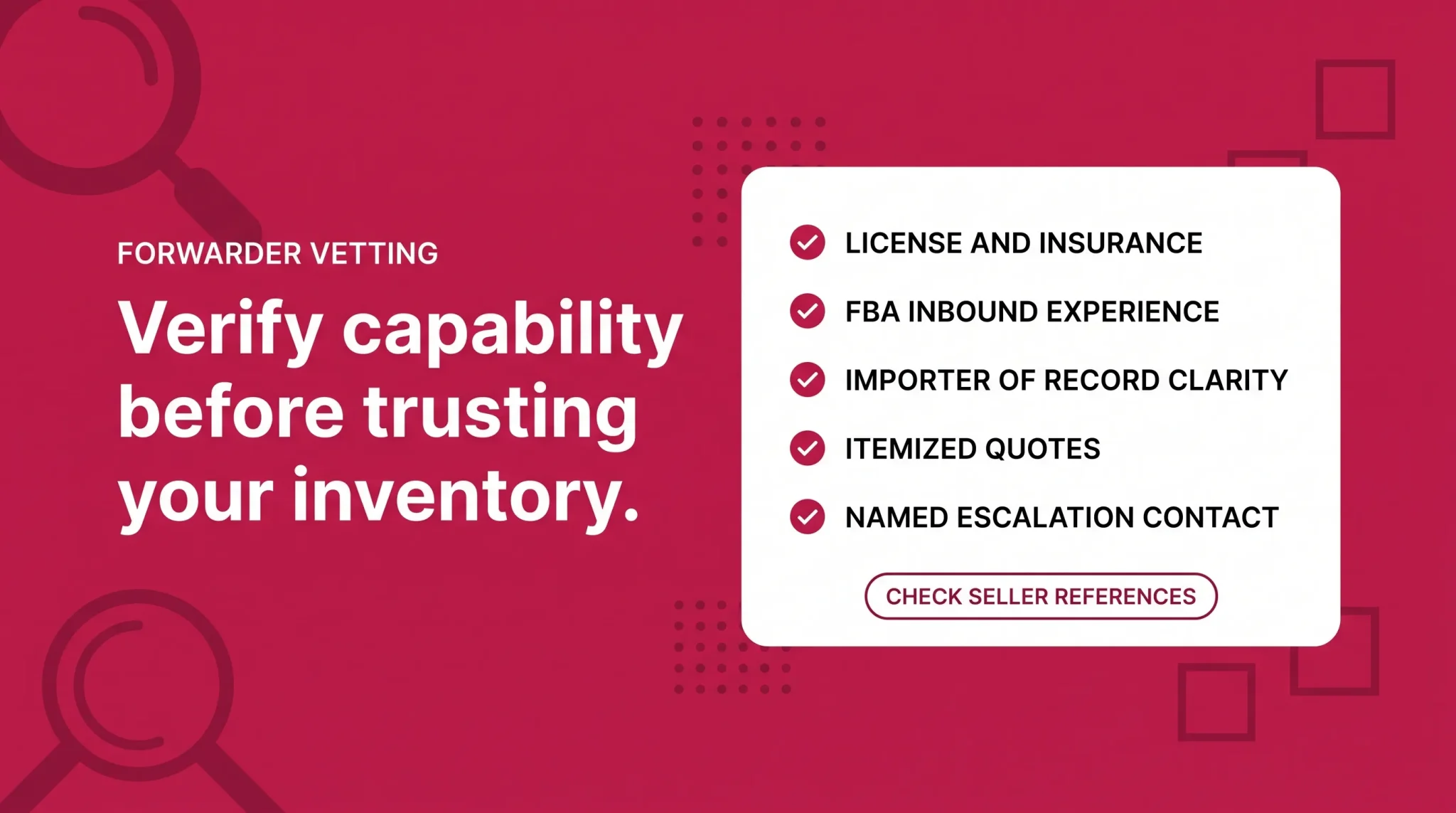
Use these as a structured conversation rather than a checklist to email. How a provider answers tells you as much as what they answer.
On credentials. Are you licensed with the Federal Maritime Commission, and as an NVOCC or ocean transportation intermediary? Do you have in-house customs brokerage or a partner, and who is the licensed broker of record? Can you provide your FMC license number and proof of insurance?
On Amazon specifically. How many FBA inbound shipments do you handle monthly? Who books the delivery appointment and through which system? How do you handle ASNs and box content files? Have you had shipments refused at an Amazon dock, and what happened next?
On customs. Who will be named as importer of record on my entries? What value will be declared? Can I receive a copy of the entry summary for each shipment? Do you offer a third-party IOR service, and if so is that priced separately?
On the quote. Can you provide an itemized all-in quote to the FC door? What charges could arise that are not on it? How do you handle demurrage and detention, and who absorbs it when a delay is on your side?
On communication. Who is my named contact? What are your hours relative to my time zone? What is the escalation path when a container is held? How quickly do you commit to responding to an exception?
On insurance and references. What cargo insurance do you offer and what is the claims process? Can you provide two references from Amazon sellers at similar volume on similar lanes?
Red flags
A quote far below the field, particularly on DDP. Refusal or reluctance to itemize. Vagueness about who the importer of record is. No named human contact. No demonstrable Amazon inbound experience, as distinct from general freight experience. Pressure to decide quickly. An unwillingness to put scope in writing.
Amazon-specific requirements your forwarder must handle
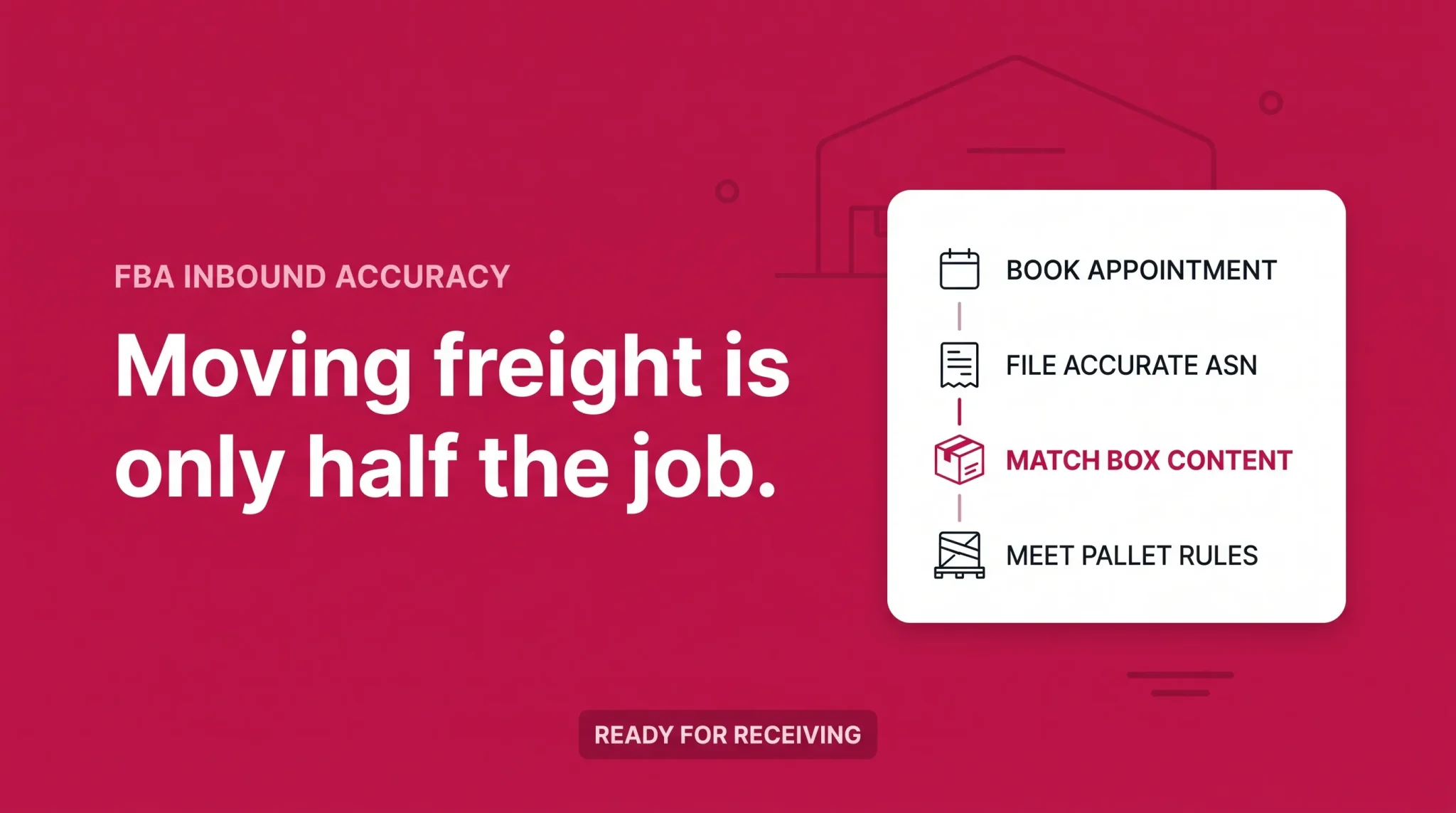
This is where a competent general forwarder fails and an FBA-experienced one earns the fee. None of this is about moving cargo. All of it is about Amazon's receiving process.
Delivery appointments. Amazon will turn a truck away at the gate if the carrier has not booked a slot in advance and tied it to a valid bill of lading or shipment ID. No appointment means no delivery, and a missed appointment means rescheduling into whatever capacity exists days later.
Advance shipping notices. The ASN must be accurate and tied to the bill of lading. Most inbound chargebacks trace back to ASN mismatches, and the fix is procedural: generate the ASN after final quality control, once cartons are labeled, counted and sealed, rather than from a plan written before the cargo was built.
Box content files. What Seller Central says is in each carton must match what is physically in each carton. Amazon prefers one ASIN per carton. Mixed cartons are permitted but must match the box content file and ASN exactly.
Carton and pallet specification. Pallets are expected to be standard 40 by 48 inch GMA style, built with uniform tops, no overhang, securely wrapped, with labels on two adjacent sides at eye level and barcodes unobstructed. Carton labels go on a flat surface rather than a corner. Non-standard pallets risk rejection on arrival.
The 2026 fee exposure. Amazon consolidated its inbound charges into a single inbound defect fee, described in its 2026 fee summary as averaging around $0.60 per unit for shipments that fail to arrive, arrive late as abandoned, or are delivered to the wrong location. Reported ranges run from roughly $0.32 to $1.74 per unit on standard size and higher on bulky items. Units arriving without required prep also attract unplanned prep fees. Separately, shipments created after 1 January 2026 that arrive without proper prep and labeling are not eligible for reimbursement if damaged or untraceable.
Read those two paragraphs together and the conclusion is straightforward. Your forwarder's accuracy on carton data, labels and appointments is now a direct line item in your P&L. When you evaluate providers, you are buying error prevention as much as transport.
Cargo insurance
Carrier liability and cargo insurance are not the same thing, and the gap between them is wide.
Carrier liability is limited by international convention and contract, often to a figure per package or per kilogram that bears no relationship to what your goods are worth. It also generally requires proving carrier fault. A container lost overboard in heavy weather may produce no recovery at all.
Cargo insurance is a separate policy covering the value of the goods, usually on an all-risk basis, without needing to establish fault. It typically costs a fraction of a percent of insured value.
For a container of inventory representing a meaningful share of your working capital, that is not a close call. Ask what your forwarder offers, what it excludes, what the deductible is and how claims are handled. If the answer is thin, buy cover independently.
Common freight problems and how to prevent them
Customs holds usually trace to documentation inconsistency, valuation questions or classification disputes. Prevention is accuracy up front and a broker who flags problems before filing rather than after.
Missed delivery appointments cascade, because rescheduling depends on available capacity rather than your urgency. Build buffer and confirm the appointment is booked rather than assuming.
Damage is prevented at the packing stage far more than in transit. Adequate cartons, proper palletization and shrink wrapping matter more than anything that happens at sea.
Delays are structural in ocean freight. Plan against cargo ready to sellable, which includes booking lead time, consolidation, transit, clearance, drayage, appointment and check-in, rather than port to port transit.
Non-compliant arrivals became materially more expensive in 2026. The prep has to happen before cargo loads, whether at the factory, an origin warehouse or a US prep center.
Managing the relationship
Get scope in writing. Who books appointments, who files the ASN, who is IOR, what insurance applies, how demurrage is allocated and what the escalation path is. Most disputes with forwarders are scope disputes.
Benchmark annually. Rates move enough that a relationship priced two years ago is rarely priced correctly today. Requoting is not disloyalty, and a good provider expects it.
Consider running two providers once volume justifies it. It gives you a live rate comparison in both directions, and removes single-provider dependency at the moment dependency is most expensive.
Keep your own records. Entry summaries, commercial invoices, bills of lading and ASNs. If CBP asks questions in two years, the forwarder relationship may be over and the liability will still be yours.
Choose on total risk, not rate per cubic meter
The freight rate is the most visible number in this decision and rarely the one that determines the outcome. Duties usually exceed it. Inbound defect fees and unplanned prep charges can exceed it on a bad shipment. A customs reassessment two years after the fact can exceed all of it combined.
What you are actually buying from a freight forwarder is accuracy: correct documents, correct declared values, correct carton data, appointments that exist, and someone who picks up the phone when a container is held. Providers who deliver that are not the cheapest ones, and the gap between them and the cheapest quote is usually smaller than a single avoidable problem.
Ask who the importer of record is. Ask for the quote itemized. Ask about Amazon inbound experience specifically. Then compare on landed cost.
Flairox helps brands run the Amazon side of this properly. Our Amazon marketplace management service covers inbound compliance, inventory planning and the operational detail that decides whether stock arrives sellable or sits in problem solve.
If you are reviewing your freight setup, we will look at your landed cost, your inbound defect exposure and your prep workflow, and tell you where the money is actually going. Talk to the Flairox team.
Customs rules, bond requirements and Amazon fee structures referenced here were accurate as of September 2026 and have changed repeatedly over the preceding year. Confirm current requirements with a licensed customs broker before committing to a shipment. This article is informational and is not customs, legal or tax advice. Flairox does not sell freight services and has no commercial relationship with any freight provider.
Frequently asked questions
Entries must be filed by a CBP-licensed broker or by the importer of record. Many forwarders provide brokerage in-house or through a partner. Confirm which applies rather than assuming.