 Bilal Siddiqui
Key takeaways
The fee only applies when you choose to ship to fewer fulfilment centres than Amazon recommends. Full Amazon-optimized splits cost $0.
Amazon's 2026 rate update took effect 15 January 2026, and the gap between optimized and minimal splits has widened.
Rates scale with both size tier and how consolidated the shipment is. Partial splits (3 to 4 fulfilment centres) cost less per unit than minimal splits (1 to 2 fulfilment centres).
The fee isn't automatically a bad deal. For some SKUs, the freight savings from consolidating a shipment outweigh the placement fee.
There are legitimate ways to reduce exposure: letting Amazon auto-split by default, using middle-mile consolidation, and deciding per SKU rather than applying one rule across your whole catalogue.
You check a recent settlement statement and there it is: "FBA inbound placement service fee," a line item that wasn't there last time, or one that's suddenly bigger than you remember. The confusing part is that it doesn't appear on every shipment. That's because this fee isn't a fixed cost of using FBA, it's the price of a choice you made when you created the shipment, and Amazon's 2026 rate update made that choice more expensive to get wrong.
This guide explains what the Amazon inbound placement service fee actually is, how Amazon decides your default shipment split, what the 2026 rates look like, and how to work out, per SKU, whether paying it is actually worth the freight savings you're trying to capture.
What Is the Amazon Inbound Placement Service Fee?
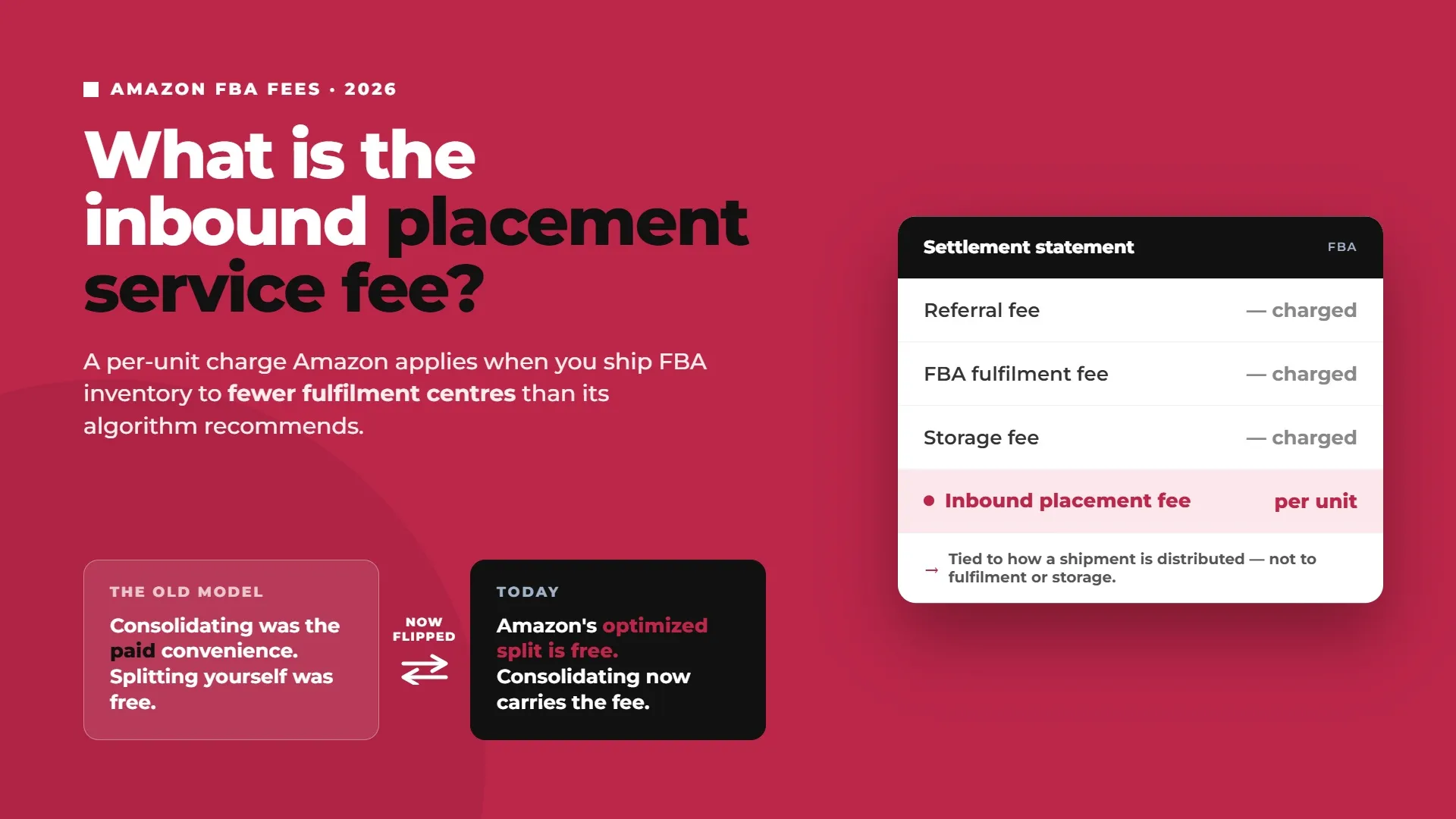
The Amazon inbound placement service fee is a per-unit charge Amazon applies when a seller chooses to ship FBA inventory to fewer fulfilment centres than Amazon's own algorithm recommends for that shipment. It sits alongside referral fees, FBA fulfilment fees, and storage fees on your settlement statement, but it's a distinct charge tied specifically to how a shipment gets distributed inbound, not to fulfilling or storing the inventory itself.
It's worth knowing this fee is the reverse of an older Amazon programme. Amazon used to run an opt-in "Inventory Placement Service" that let sellers pay a flat fee to consolidate an entire shipment into a single fulfilment centre, the default back then was to split inventory yourself at no charge, and consolidation was the paid convenience. Today, that logic has flipped. Amazon's own optimized split, spreading inventory across the fulfilment centres it judges best for demand, is now the free default, and consolidating to fewer destinations is what carries a cost.
For the wider fulfilment decision beyond inbound distribution, see our FBA vs FBM guide.
How Amazon Decides Your Shipment Split
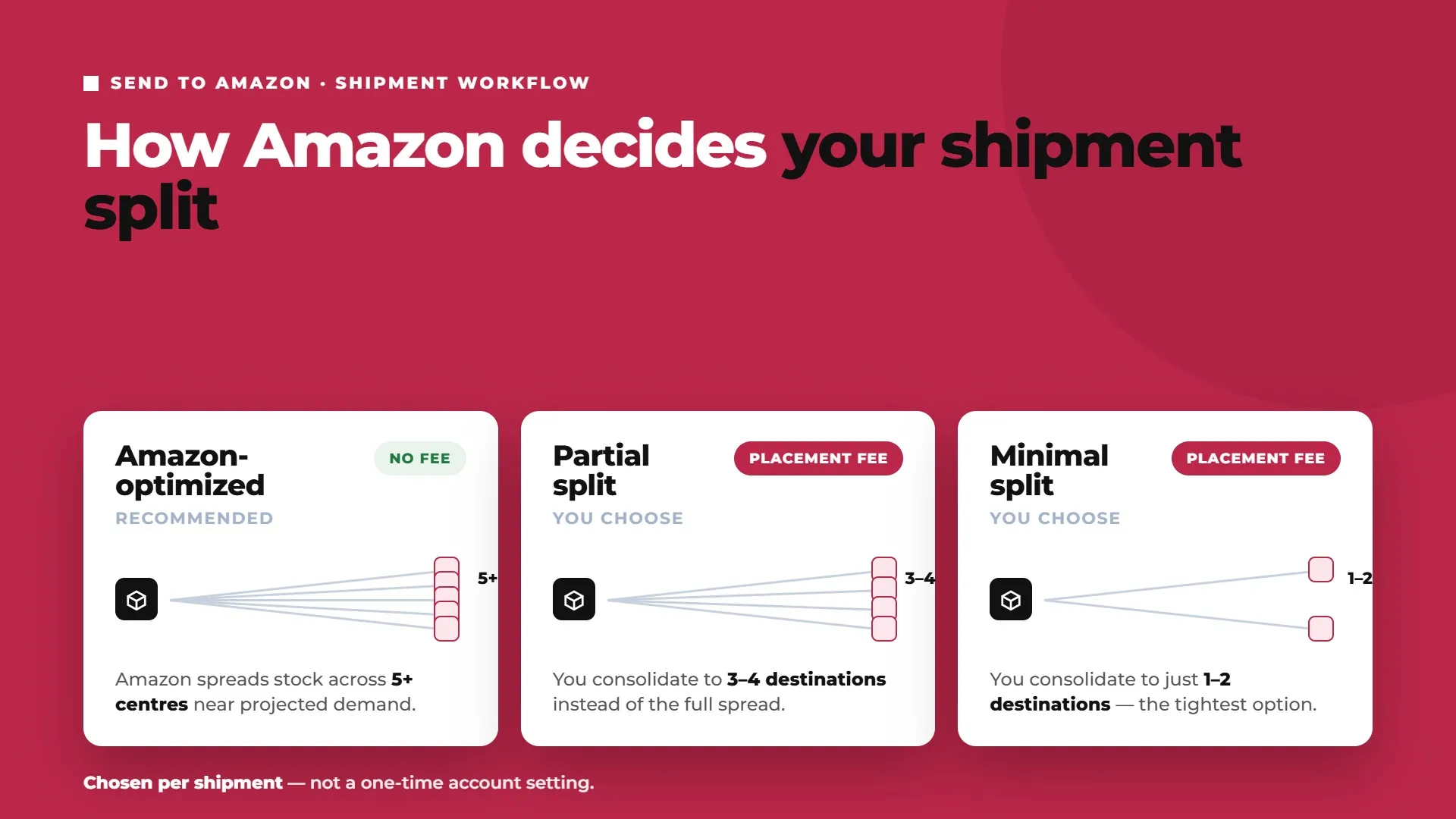
When you create an FBA shipment, Amazon's algorithm looks at projected demand geography and recommends splitting your inventory across multiple fulfilment centres, often five or more, so stock sits close to where orders are actually likely to come from. This is called an Amazon-optimized split, and it carries no placement fee.
Sellers aren't required to accept that recommendation. At shipment creation, inside the "Send to Amazon" workflow, you can instead choose to consolidate the shipment yourself:
Partial split, consolidating to 3 to 4 destinations instead of Amazon's full recommendation.
Minimal split, consolidating to just 1 or 2 destinations.
Both options carry the inbound placement fee. This choice is made per shipment, not as a one-time account setting, so it's entirely possible to run some shipments Amazon-optimized and others consolidated, depending on what makes sense for the SKU and the freight arrangement behind it.
Amazon Inbound Placement Fee Rates in 2026
Amazon's inbound placement fee rates increased under a 2026 update that took effect 15 January 2026 (Nova Analytics). Amazon's own current rate schedule is published inside the Seller Central help page for this fee, which requires an account login to view, so the table below reflects figures reported across seller-tooling breakdowns of that rate card (SKU Compass; AMZ Prep), useful as a directional guide, but worth confirming against the FBA Revenue Calculator for your exact ASIN before budgeting against it.
Size tier | Partial split (3 to 4 FCs) | Minimal split (1 to 2 FCs) |
|---|---|---|
Small standard | ~$0.21 to $0.35/unit | ~$0.30 to $0.40/unit |
Large standard | ~$0.27/unit | ~$0.36/unit |
Small/medium oversize | ~$0.94/unit | ~$1.20/unit |
Large oversize | ~$1.32/unit | ~$1.58 to $3.12/unit |
Special oversize | ~$2.16/unit | ~$3.95/unit |
Reported figures vary somewhat between sources, particularly at the small standard and large oversize tiers, which is why the ranges above are wider than a single hard number. What's consistent across every source: Amazon-optimized splits remain $0 regardless of size tier, and the fee climbs sharply as both the item gets bigger and the shipment gets more consolidated.
A Worked Example: Is Consolidating Worth the Fee?
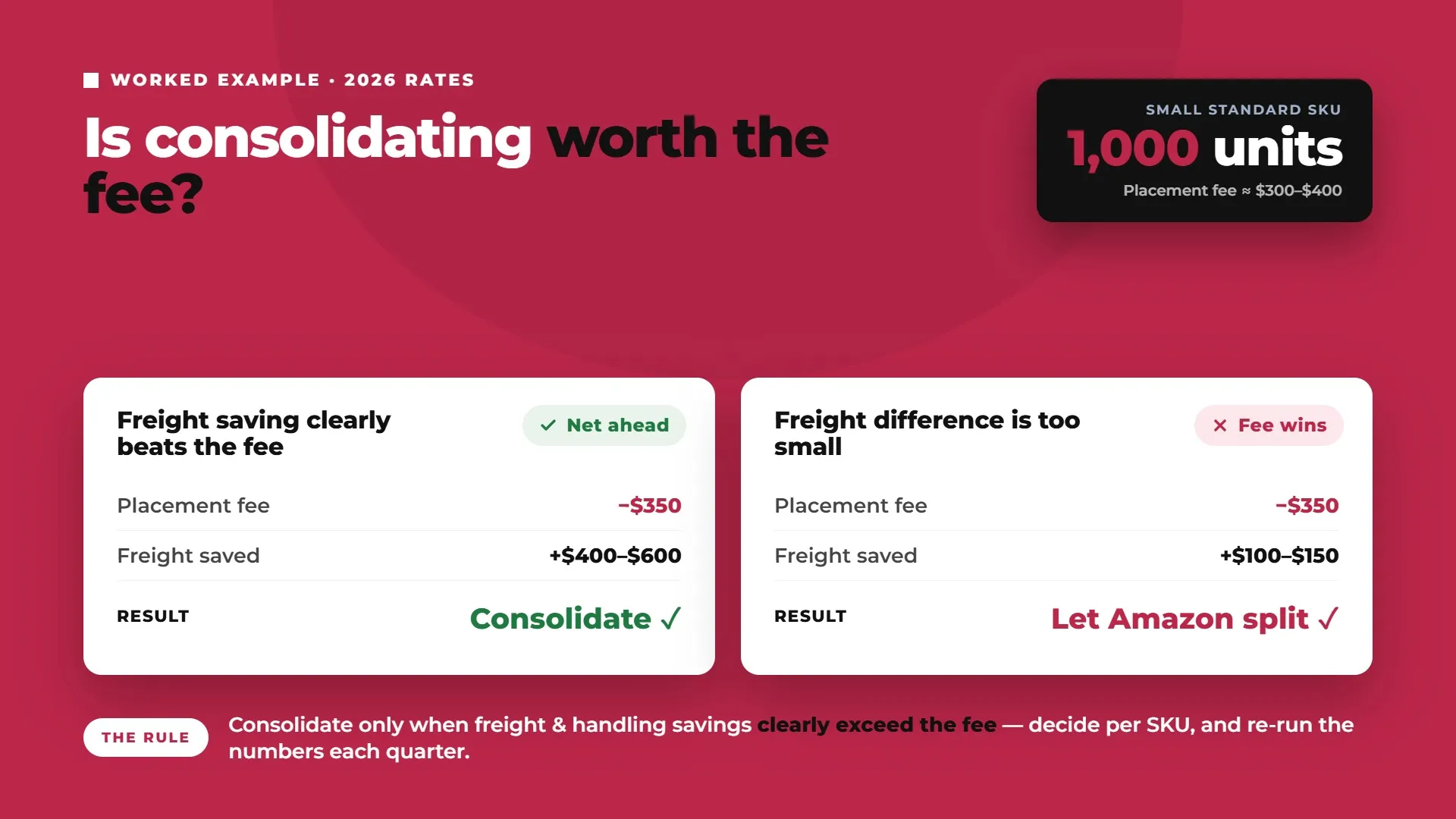
Take a seller shipping 1,000 units of a small standard SKU. Letting Amazon optimize the split costs nothing in placement fees, but spreads inventory across five or more fulfilment centres, which can mean higher total freight cost if you're paying per-destination trucking or working with a 3PL that charges per drop-off.
Choosing a minimal split instead, consolidating to one or two fulfilment centres, might cost roughly $300 to $400 in placement fees across those 1,000 units at 2026 rates. If consolidating to fewer destinations saves $400 to $600 in freight compared to splitting the shipment five ways, the placement fee is a reasonable trade, you're net ahead. If the freight difference is only $100 or $150, the placement fee erases most or all of that saving, and Amazon-optimized splitting would have been cheaper overall.
The rule worth keeping: consolidate only when the freight and handling savings clearly exceed the placement fee for that specific SKU, and evaluate it per SKU rather than as a blanket policy across your catalogue. Large or oversize SKUs are where this trade-off breaks down fastest, the per-unit placement fee at those tiers is high enough that consolidating rarely pays for itself, whereas small standard items are where the decision is genuinely close and worth running the numbers on.
It's also worth re-running this calculation periodically rather than setting it once. Freight rates move, your 3PL's per-destination charges change, and Amazon's own placement fee rates can shift with future updates the way they did in January 2026. A split decision that made sense last quarter isn't guaranteed to still be the cheaper option this quarter.
How to Reduce or Avoid Amazon Inbound Placement Fees
A few practical, legitimate approaches, rather than one silver bullet:
Whichever shipment split you choose, every unit and carton still needs to meet Amazon FBA packaging requirements before it enters the network.
Default to Amazon-optimized splits wherever your shipment timing and freight setup allow it. This is the only guaranteed $0 option, and for many standard-size, fast-moving SKUs it's also operationally simpler, since you're not managing multiple consolidation legs yourself.
Use middle-mile consolidation for shipments you do want to keep tight. A freight consolidator receives one truckload from your warehouse or manufacturer, sorts it by Amazon fulfilment centre destination, and delivers it across Amazon's recommended network on your behalf. Because you're technically handling the distribution yourself rather than asking Amazon to do it, this route can avoid the placement fee entirely while still getting inventory into multiple fulfilment centres quickly, typically a 2 to 6 day total transit time (AMZ Prep). It tends to make the most sense once you're shipping enough volume, roughly 5 to 10 pallets a month, to justify the consolidator relationship.
Evaluate per SKU, not per shipment or per account. A single shipment can legitimately mix SKUs where consolidating makes sense with SKUs where it doesn't. Treat the split decision as a per-SKU freight-versus-fee calculation rather than a single toggle you set once and forget.
Check the FBA Revenue Calculator before committing to a split choice. Exact fees depend on precise weight and dimensions within a tier, so the number you'll actually be charged can differ from a generic size-tier estimate.
Conclusion
The inbound placement fee isn't a punitive charge, it's the price of choosing consolidation over Amazon's own distribution logic. For most standard-size, fast-moving SKUs, letting Amazon optimize the split is the simplest way to avoid it entirely. For the SKUs where consolidating genuinely saves more in freight than it costs in fees, it's a legitimate trade worth making deliberately, backed by real numbers, rather than by default.
Working out which SKUs are worth consolidating and which are better left on Amazon's optimized split is exactly the kind of detail that's easy to get wrong at scale. Talk to Flairox about optimising your Amazon inbound shipping strategy to make sure every shipment split is a deliberate cost decision, not a default click.
Frequently asked questions
"Inbound" refers to the process of a seller's inventory arriving at Amazon's fulfilment network, from the point a shipment is created in Seller Central through to the inventory being received and stocked at one or more fulfillment centres. The inbound placement fee applies specifically to the distribution choice made at this stage.