 Raahim Sheikh
Key takeaways
Direct Fulfillment is a Vendor Central (1P) program (formerly called Dropship Central) where the vendor ships directly to the customer when Amazon places an order.
Amazon provides a prepaid shipping label and pays the freight, and handles all customer service and returns.
It sidesteps the chargebacks that plague bulk 1P, with no advance shipping notice, carton-content, or shortage-claim penalties on Direct Fulfillment orders.
The service level agreement is strict: acknowledge the purchase order within roughly 24 hours and ship within the required window, or risk performance penalties and, ultimately, suspension.
Cash flow is the hidden catch: you front per-order fulfilment costs against Amazon's standard vendor payment terms, often 60 to 75 days.
It's invite-only and best suited to long-tail, oversized, seasonal, or new-launch SKUs rather than your fastest-moving core lines.
As a 1P vendor, bulk purchase orders into Amazon's warehouses come with a familiar tax: freight allowances, advance shipping notice requirements, carton-content rules, and a steady drip of compliance chargebacks that quietly eat into your margin every month. Amazon Direct Fulfillment offers a different model, Amazon sends you an order only when a customer actually buys the item, and you ship it straight to their door using a shipping label Amazon pays for.
Before going further, one clarification that most articles on this topic get wrong: Amazon Direct Fulfillment is a Vendor Central (1P) program. It is not FBA, not FBM, and not seller-side dropshipping. If you run a third-party seller account, this specific program isn't for you. This guide is written for vendors, and brands invited into Vendor Central, who want to understand how Direct Fulfillment works, what it saves, what it costs, and how to run it without getting suspended.
What Is Amazon Direct Fulfillment?
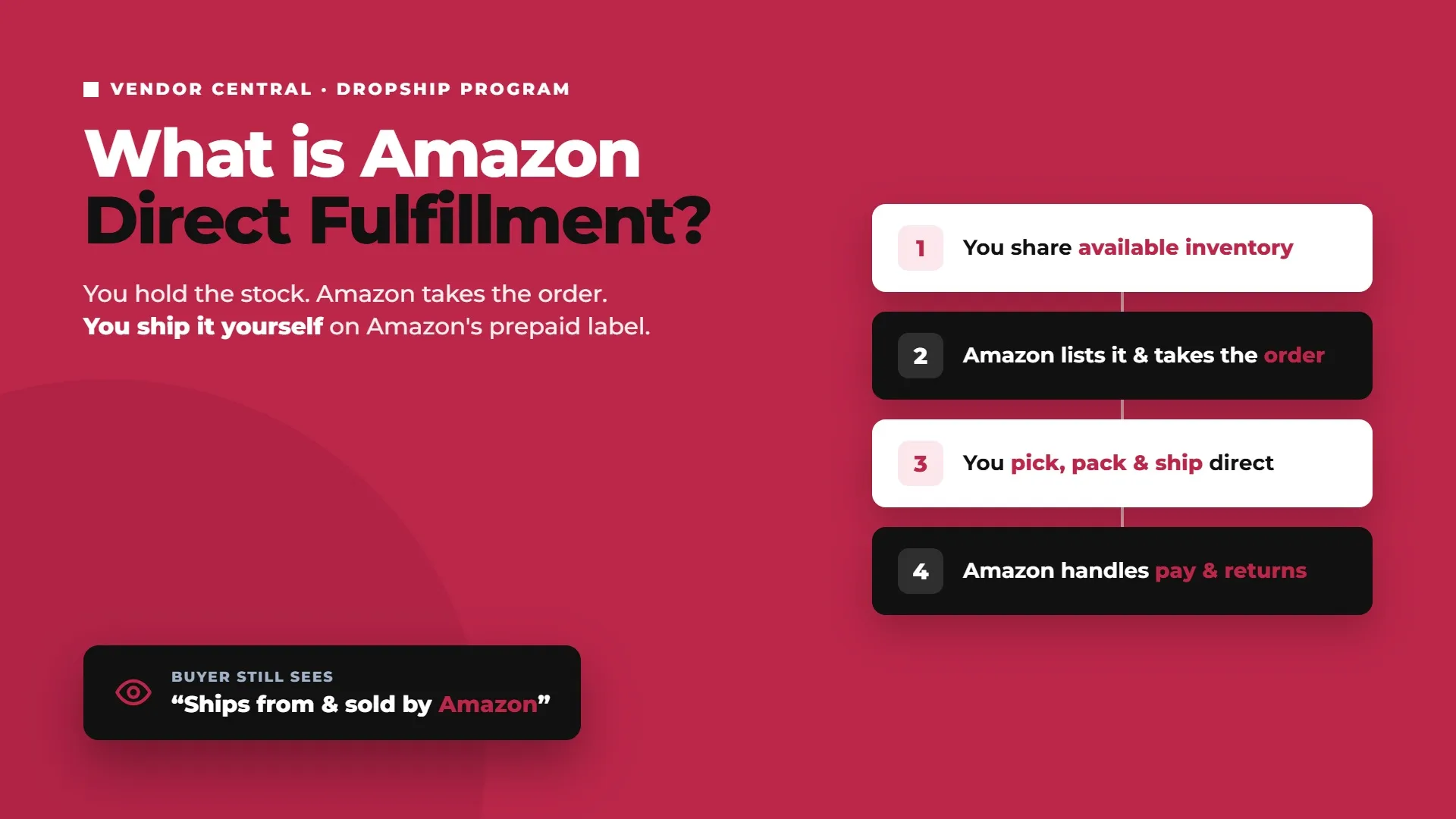
Amazon Direct Fulfillment is a Vendor Central dropship program. You share your available inventory with Amazon, Amazon lists those quantities on the relevant product pages, and when a customer places an order, Amazon issues you a dropship purchase order. You then pick, pack, and ship that single order directly to the customer using a prepaid label Amazon provides. Amazon handles the payment, the customer service, and any returns.
The program was previously known as Dropship Central, so older documentation and some vendor managers may still use that name. Functionally it's the same thing. Amazon documents the full order lifecycle in its Selling Partner API vendor documentation (Amazon Selling Partner API), which is the authoritative reference if your team is building an integration.
The detail that makes it attractive to vendors: from the customer's perspective, nothing changes. The order still displays as "Ships from and sold by Amazon," so the buyer never knows the item came from your warehouse rather than an Amazon fulfilment centres. You get to keep that premium "sold by Amazon" perception while holding the inventory yourself until the moment it sells.
Flairox Listings
Fulfillment Changes. Your Product Page Still Has to Convert.
Create stronger titles, bullet points, descriptions, product images and A+ Content with AI, then monitor listing performance and unexpected content changes from one workspace.
Optimize Your Listing Free → Product Detail Page LIVE ✓ Ships from Amazon Sold by Amazon ✓
That last point matters more than it first appears. In standard Vendor Central, you commit inventory to Amazon's warehouses on the strength of Amazon's demand forecast, and if that forecast is wrong, you're left with stock stranded in the network or a chargeback for failing to fulfil a PO. Direct Fulfillment inverts that risk: you only part with a unit once a real customer has already paid for it. For any SKU where demand is uncertain, that shift from forecast-based to demand-based fulfilment is the whole appeal.
Because "Amazon fulfilment" is a crowded term, it's worth drawing the lines clearly:
Model | Who it's for | Who holds inventory | Who ships to the customer |
|---|---|---|---|
Standard Vendor Central (1P) | Vendors | Amazon (bulk POs) | Amazon |
Direct Fulfillment (1P) | Vendors | The vendor | The vendor (Amazon-paid label) |
FBA (3P) | Sellers | Amazon | Amazon |
FBM / seller dropship (3P) | Sellers | The seller | The seller |
For the seller-side fulfilment models shown in the comparison, see our FBA vs FBM guide.
Direct Fulfillment is the only model where you hold your own stock but Amazon still owns the transaction and the customer relationship.
How Amazon Direct Fulfillment Works (Step by Step)
The order lifecycle runs like this:
Share your inventory. You send Amazon your available quantities via EDI, the Selling Partner API, or a manual spreadsheet upload in Vendor Central.
Amazon lists your stock. Your available quantities become buyable on the product detail page.
A customer orders. Amazon generates a dropship purchase order in Vendor Central for that specific order.
You acknowledge the PO. This needs to happen within roughly 24 hours, confirming you can fulfil the order.
You pick, pack, and label. You print Amazon's prepaid shipping label and prepare the parcel to Amazon FBA packaging requirements.
You confirm the shipment. Once the carrier collects the package, you send Amazon a ship confirmation.
The order reaches the customer, typically within a few business days.
Amazon handles everything after that, including customer service and returns.
Two points inside that flow deserve extra attention, because they feed directly into your performance metrics: the roughly 24-hour purchase order acknowledgement, and the ship window. Miss either consistently and your standing in the program suffers, which we'll come back to.
Direct Fulfillment vs Standard Vendor Central (1P)
If you're already a 1P vendor, the useful comparison isn't Direct Fulfillment against FBA, it's Direct Fulfillment against the standard bulk-PO Vendor Central model you already run.
Standard Vendor Central | Direct Fulfillment | |
|---|---|---|
Order trigger | Bulk PO based on Amazon's forecast | Individual customer purchase |
Who holds inventory | Amazon's warehouses | Your warehouse |
Freight | Vendor freight allowance | Amazon-paid prepaid label |
Chargeback exposure | High (ASN, carton content, shortages) | Minimal on the inbound side |
Inventory risk | Committed bulk stock | Ship only after a confirmed sale |
Best-fit SKUs | High-velocity core lines | Long-tail, oversized, seasonal, new |
The core framing: standard 1P is built for high-velocity core products you can forecast confidently and ship in bulk. Direct Fulfillment is built for the long tail, oversized items, seasonal inventory, and unproven SKUs where committing bulk stock to Amazon's warehouses is too risky or too expensive. Most vendors who use Direct Fulfillment well run it alongside standard Vendor Central, not instead of it, routing the right SKUs to each model.
The Chargeback Advantage (and What Direct Fulfillment Doesn't Save You From)
For many vendors, chargebacks are the single most frustrating part of the 1P relationship. Bulk purchase orders come with a long list of operational compliance requirements, and every miss (a late advance shipping notice, an inaccurate carton-content declaration, a shortage claim) triggers a deduction. Across a large catalogue these add up to a meaningful percentage of wholesale revenue.
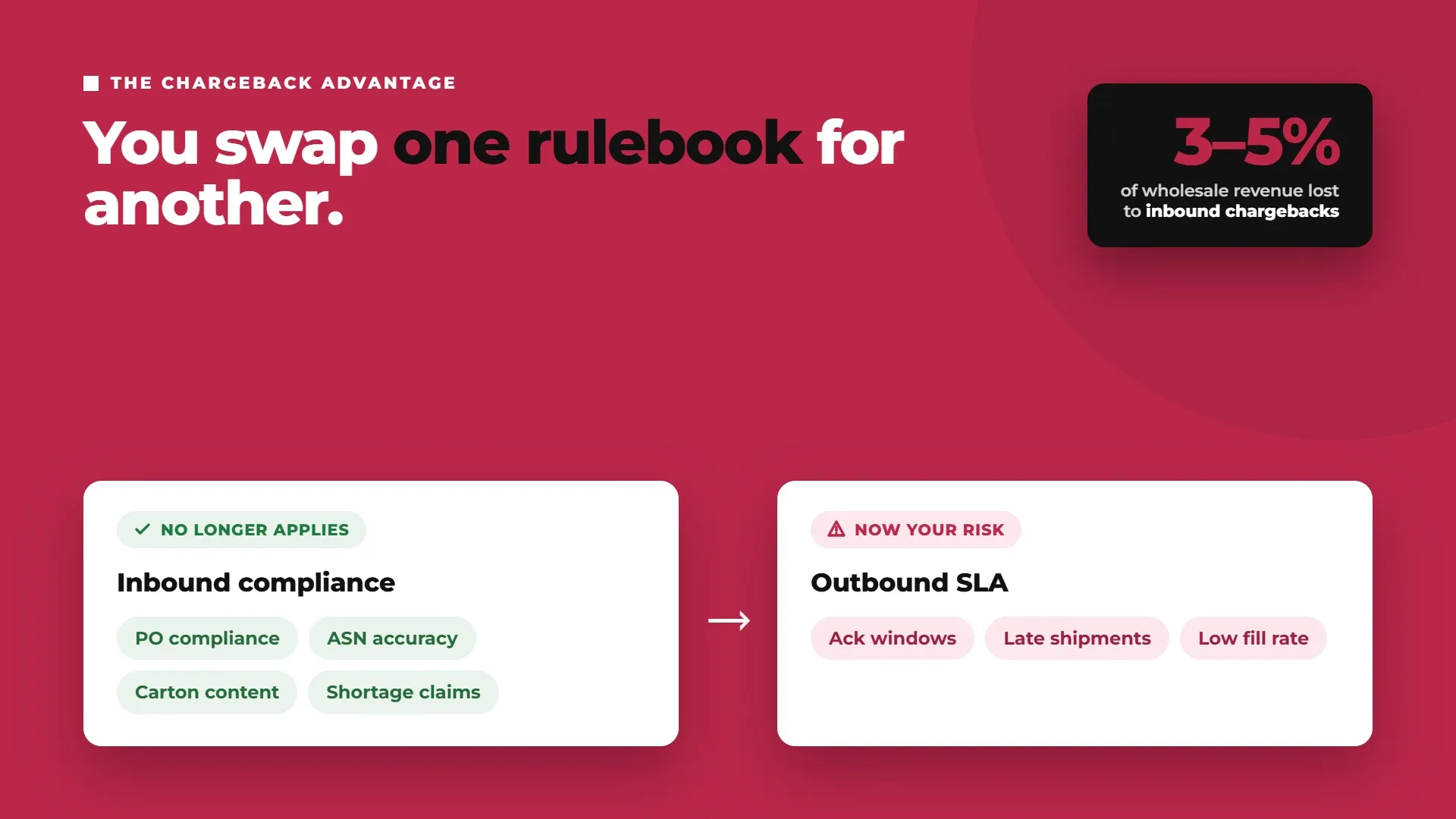
Direct Fulfillment sidesteps most of that. Because there's no bulk inbound shipment to get wrong, the classic inbound-compliance chargebacks (PO compliance, advance shipping notice accuracy, carton content, shortage claims) simply don't apply to Direct Fulfillment orders. For a vendor losing 3 to 5% of wholesale revenue to these deductions, that's the headline saving (Feedvisor). As an illustration, a vendor doing roughly $2M in annual wholesale revenue at a typical chargeback rate could recover a five-figure sum a year by shifting the right volume to Direct Fulfillment (treat this as illustrative rather than a guaranteed figure, your actual chargeback rate is what matters).
Here's the honest counterweight, though: Direct Fulfillment isn't penalty-free, it swaps one compliance regime for another. Instead of inbound-compliance chargebacks, you now carry outbound-SLA performance risk, missed acknowledgement windows, late shipments, and low fill rate. If your operation isn't set up to hit those service levels consistently, you can trade a chargeback problem for a suspension problem. The saving is real, but it comes with a different set of obligations, not zero obligations.
Amazon Direct Fulfillment Setup: EDI, API & the Portal
There are three ways to connect your operation to Direct Fulfillment, and the right one depends on your order volume and technical capability:
Manual portal. You update inventory and process purchase orders directly in the Vendor Central interface. This works at low volume, but becomes unmanageable quickly, manually acknowledging every PO within 24 hours doesn't scale.
EDI. Automated electronic document exchange handles inventory feeds, purchase order acknowledgements, and ship confirmations without manual intervention. This is the established path for vendors with the technical setup or a partner to manage it.
API. Amazon's Selling Partner API includes Vendor Direct Fulfillment endpoints for vendors building a custom or scaled integration, giving the most control over the order lifecycle.
Whichever path you choose, one inventory tactic is worth understanding early: buffered inventory. Because Direct Fulfillment penalises you for accepting an order you then can't ship, vendors deliberately publish a conservative fraction of their true on-hand stock rather than the full number. A common approach is to feed a buffered figure, for example, publishing roughly half your real quantity and holding back a safety margin, so a burst of orders never outruns what you can actually fulfil. Under-publishing costs you a little visibility, but it protects your fill rate, which is far more valuable.
Finally, use the reports. Vendor Central provides Direct Fulfillment-specific reporting on order performance, fill rate, and lead time. These are your early-warning system, watch them weekly, and slipping metrics show up before they turn into a suspension warning.
Payment Terms and the Cash-Flow Reality
This is the section most promotional write-ups skip, and it's the one that most often catches vendors out. As a 1P vendor, Amazon pays you on vendor terms, commonly net 60 to 75 days depending on your specific agreement. But you incur the pick, pack, and handling cost of every Direct Fulfillment order upfront, at the moment you ship it.
Put those two facts together and the working-capital implication is clear: at high Direct Fulfillment order volume, you're carrying weeks of accumulated fulfilment cost before Amazon's payment clears. The larger your Direct Fulfillment business grows, the more cash you have tied up in that gap at any given moment.
The rule of thumb from vendors who've run this at scale: thin wholesale margins make the gap genuinely painful. If your wholesale margin on a line is below roughly 15%, the combination of upfront fulfilment cost and a 60-to-75-day wait can turn a program that looks profitable on a per-order basis into a cash-flow strain (Feedvisor). Model this honestly before you scale Direct Fulfillment volume, the chargeback savings are real, but they don't help you if you can't fund the float.
The precise numbers here, your exact acknowledgement window, your specific ship-window days, and your negotiated payment terms, live inside your Vendor Central agreement and can vary from one vendor to the next. The ranges in this guide reflect what's typical across the vendor community, but confirm your own figures against your agreement before you build a cash-flow model on them.
Performance Requirements and Avoiding Suspension
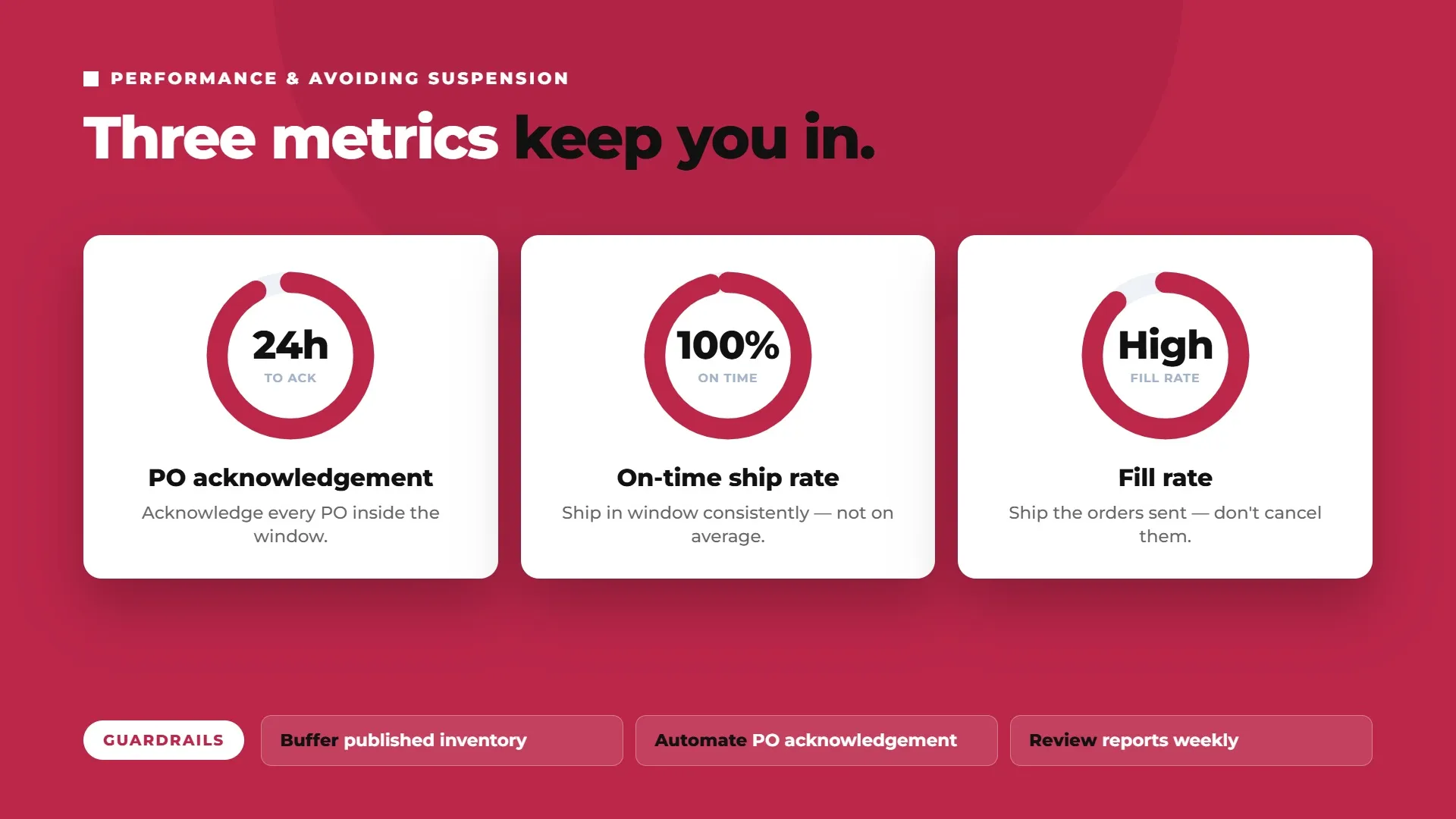
Direct Fulfillment access is a privilege Amazon can and does revoke. Three metrics govern your standing:
Purchase order acknowledgement timeliness. Acknowledge each PO within roughly the 24-hour window.
On-time ship rate. Ship within the required window consistently, not just on average.
Fill rate. Actually accept and ship the orders Amazon sends you, rather than cancelling or failing to fulfil them.
Suspension rarely comes from a single mistake. It's the accumulation of small misses, a pattern of late acknowledgements, a creeping cancellation rate, repeated missed ship windows, that eventually pushes your metrics below Amazon's threshold. That's actually good news, because it means the failure mode is visible in your reports well before it becomes terminal, if you're watching.
Your compliance backbone is Amazon's vendor routing guide and shipping requirements: use the specified carriers, follow the label placement rules, and meet the packaging standards (SalesDuo). Getting the mechanical details right keeps you clean on the parts of the process you fully control.
Three practical guardrails keep most vendors safe: publish conservative buffered inventory so you never accept more than you can ship, automate purchase order acknowledgement so the 24-hour window is never missed to human delay, and review the Direct Fulfillment performance reports weekly so slippage gets caught early.
Is Amazon Direct Fulfillment Worth It? When It Fits (and When It Doesn't)
Direct Fulfillment isn't an all-or-nothing decision. It's a targeted tool, and the honest answer to "is it worth it" is "for the right SKUs, yes, and for the wrong ones, no."
It genuinely fits for:
Long-tail SKUs that don't sell fast enough to justify committing bulk stock to Amazon's warehouses.
Oversized items that are expensive to ship inbound in bulk.
Seasonal inventory where you don't want stock stranded in Amazon's network out of season.
New product testing, where you want to gauge demand before committing to a bulk PO.
It breaks down for:
Warehouses optimised for pallet-out, not parcel-out. If your operation is built for bulk shipping and can't efficiently pick and pack individual orders, Direct Fulfillment fights your infrastructure.
Thin wholesale margins, which can't absorb the upfront-cost-versus-slow-payment cash-flow gap.
Very small catalogues, where standard 1P is simply simpler to manage.
Core high-velocity SKUs, which are almost always cheaper to ship in bulk than to fulfil one order at a time.
The decision frame to give yourself: don't ask whether to use Direct Fulfillment for your whole catalogue, ask which specific SKUs fit its profile. Run those through Direct Fulfillment, keep your forecastable core lines on standard Vendor Central, and you get the upside of both.
Conclusion
Amazon Direct Fulfillment is a genuinely useful tool for the right vendor and the right SKUs. It escapes the bulk-1P chargebacks and freight costs that erode vendor margins, keeps the "sold by Amazon" halo, and lets you hold inventory in your own warehouse until it actually sells. But it trades inbound-compliance risk for outbound-SLA risk, and it demands real working capital to bridge the gap between when you ship and when Amazon pays.
Vendors who match Direct Fulfillment to the right SKU profile, and run it with disciplined purchase order acknowledgement, buffered inventory, and weekly performance monitoring, capture the upside without the suspension risk. The operational and compliance side is exactly where a lot of the value, and a lot of the risk, actually lives. Talk to Flairox about managing your Amazon Vendor Central and Direct Fulfillment operations so the program works as a margin lever, not a compliance liability.
Frequently asked questions
Amazon Direct Fulfillment is a Vendor Central (1P) dropship program in which a vendor ships an item directly to the customer when Amazon places an order, using a prepaid shipping label Amazon provides. Amazon handles payment, customer service, and returns, and the order still shows as "sold by Amazon."