 Bilal Siddiqui

Key takeaways
Models vs. Platforms: 1P and 3P define your commercial relationship with Amazon (selling to Amazon vs. selling through Amazon as a channel), whereas Vendor Central and Seller Central are simply the operational portals used to manage those relationships.
The Trade-off Between Control and Convenience: The 3P model gives brands critical control over retail pricing, listing content, and performance data, but requires a substantially heavier operational workload compared to the more hands-off 1P wholesale model.
Margin Economics Are Highly Variable: 3P does not automatically guarantee better margins. Brands must calculate per-unit economics by factoring in referral fees, fulfillment charges, and advertising costs to compare them accurately against Amazon's 1P wholesale price.
Accessibility Dictates the Starting Point: Because 1P access is strictly invitation-only, the 3P model is the default reality for most brands. While hybrid structures exist, they are complex and usually only suitable for larger brands with proven internal capabilities.
Every brand that reaches meaningful scale on Amazon eventually faces the same fork. You can sell your products to Amazon and let Amazon retail them, or you can sell them yourself on Amazon's marketplace and keep the customer transaction. Those two routes are what the industry means by Amazon 1P and Amazon 3P, and the choice between them decides who sets your price, who carries your inventory, who owns your data, and how much of the retail margin you keep.
The decision gets muddled because four terms get used interchangeably when they should not be. 1P and 3P are commercial models. Vendor Central and Seller Central are the platforms most commonly associated with each. They line up in practice, but they are not the same thing, and treating them as synonyms is where a lot of confused strategy starts.
This article compares the two models on the dimensions that actually affect a brand's economics and operations, sets out the honest trade-offs on both sides, and gives you a framework for deciding which fits your business today.
What Amazon 1P Means
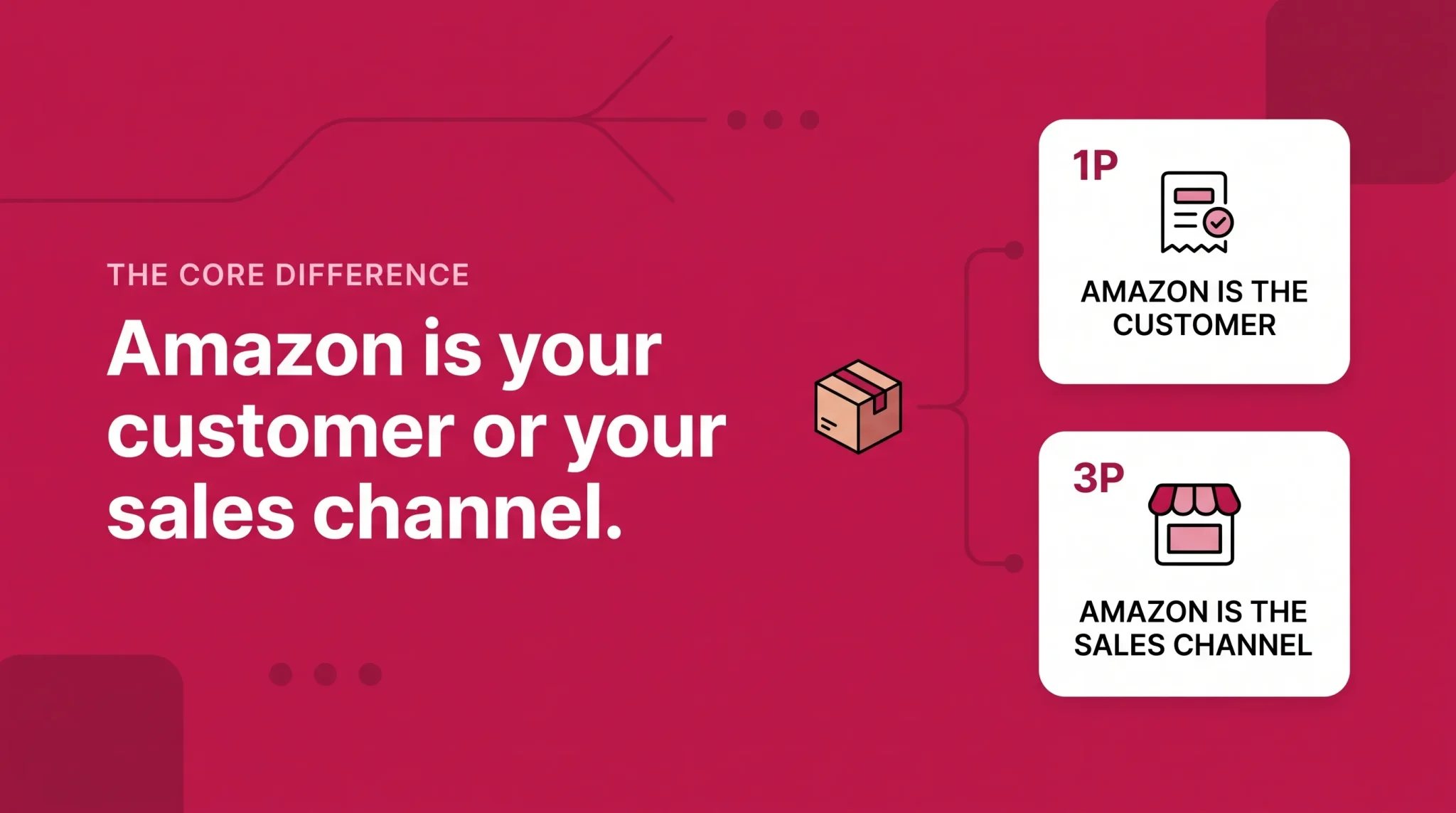
In a first-party relationship, Amazon is your customer. You supply Amazon at an agreed wholesale cost, Amazon takes ownership of the units, and Amazon retails them to shoppers under its own account. Those listings carry the "Ships from and sold by Amazon.com" designation, because that is literally what is happening.
Once Amazon owns the inventory, Amazon makes the retail decisions. It sets the shopper-facing price, handles fulfillment and returns, manages the customer service relationship, and merchandises the product as it sees fit. Your commercial relationship is business to business: you negotiate cost, you receive purchase orders, and you ship against them.
Two structural facts about 1P matter more than any feature comparison. First, access is not open. Vendor Central is invitation-based, which means 1P is not a model most brands can simply choose. Second, the relationship is Amazon's to continue or end. Purchase order volumes are Amazon's decision, and industry reporting in recent years has described Amazon narrowing which vendors it maintains direct relationships with. Amazon has not published criteria for this, so treat it as a risk factor rather than a rule, but the underlying point stands: a 1P relationship is a commercial arrangement that can change on the other party's terms.
What Amazon 3P Means
In a third-party relationship, Amazon is your sales channel rather than your customer. You list your own products, you set the retail price, you own the inventory until a shopper buys it, and the transaction is between you and that shopper. Amazon provides the storefront, the traffic, the payment processing, and optionally the fulfillment, and charges you for it.
That is the plain answer to what 3P means on Amazon. A 3P seller is any independent business selling on Amazon's marketplace rather than to Amazon. This covers a wide range: brand owners selling their own products, resellers of other brands, private label operators, and large distributors, all under the same commercial model.
The scale here is not marginal. Amazon states that more than 60 percent of sales in its store come from independent sellers, almost all of which are small and medium-sized businesses. The marketplace is where most of the commerce happens, which is why 3P is the default assumption for most brands rather than a fallback.
In exchange for that control, you carry the work. Listing quality, pricing, advertising, inventory forecasting, and customer experience are all yours to manage. Amazon takes a referral fee on each sale, plus fulfillment fees if you use its logistics network.
How 1P, 3P, Vendor Central, and Seller Central Fit Together
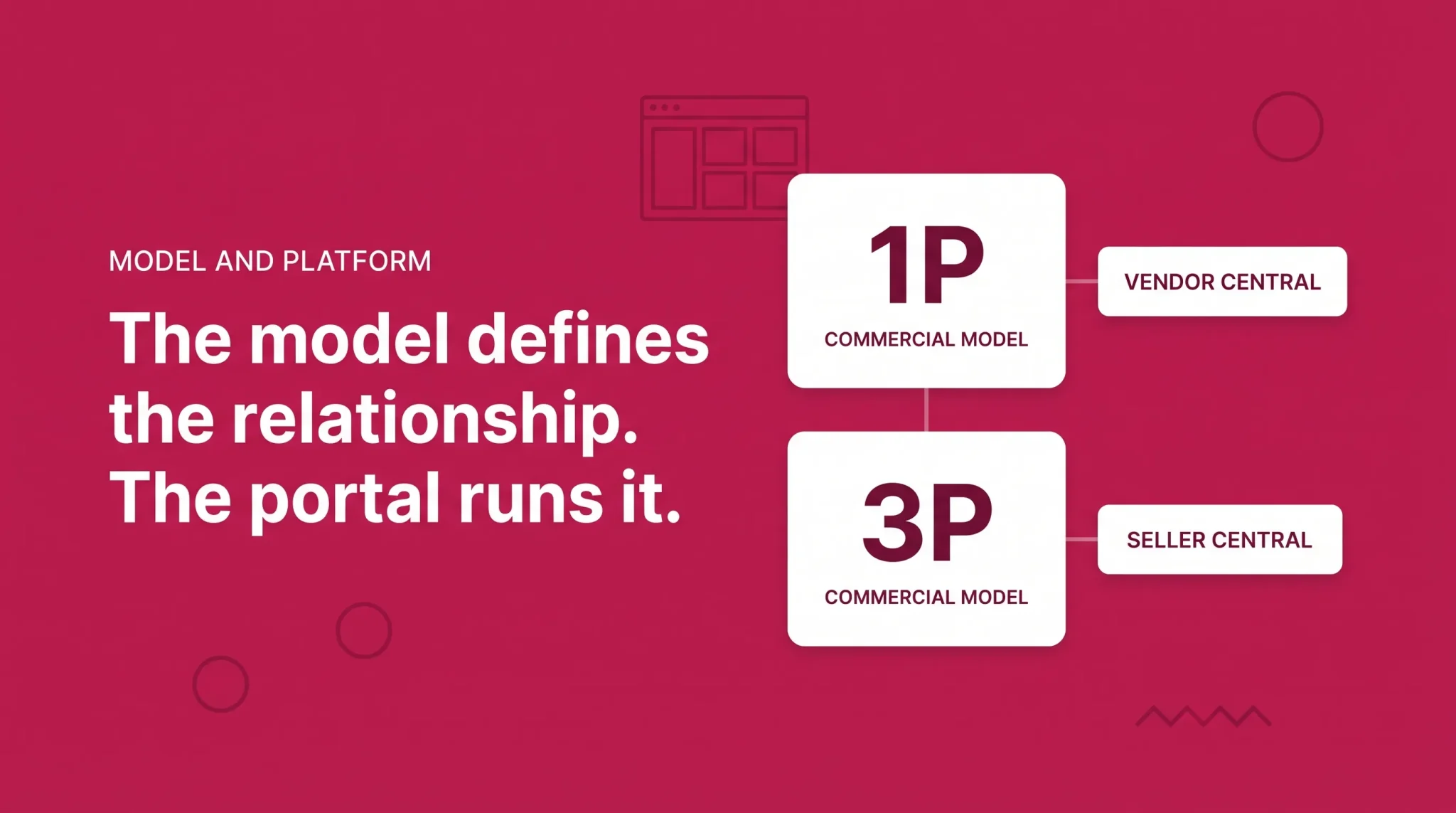
The cleanest way to hold these four terms is this: 1P and 3P describe the commercial relationship, while Vendor Central and Seller Central are the operational platforms attached to them.
Vendor Central is the portal a 1P vendor uses to receive and fulfill purchase orders and access vendor reporting. Seller Central is the portal a 3P seller uses to manage listings, inventory, pricing, orders, and advertising. So a brand asking "is Seller Central 1P or 3P" is asking a question with a clear answer: Seller Central is the 3P platform.
The reason to keep the model and the platform conceptually separate is that the mapping is a strong default rather than an absolute law. Amazon operates a range of programs and supplier arrangements beyond the standard vendor relationship, some brands work with Amazon through structures that do not fit either label neatly, and a single brand can hold both a Vendor Central and a Seller Central account at the same time. If you assume model and platform are identical, hybrid structures become impossible to reason about.
A brief note on a term that causes confusion: Supplier Central is a separate Amazon-facing supply arrangement and is not the same thing as Vendor Central. It sits outside the scope of this comparison, and the platform-level detail on Vendor Central operations belongs in a dedicated Vendor Central guide rather than here.
Amazon 1P vs FBA: Not the Same Comparison
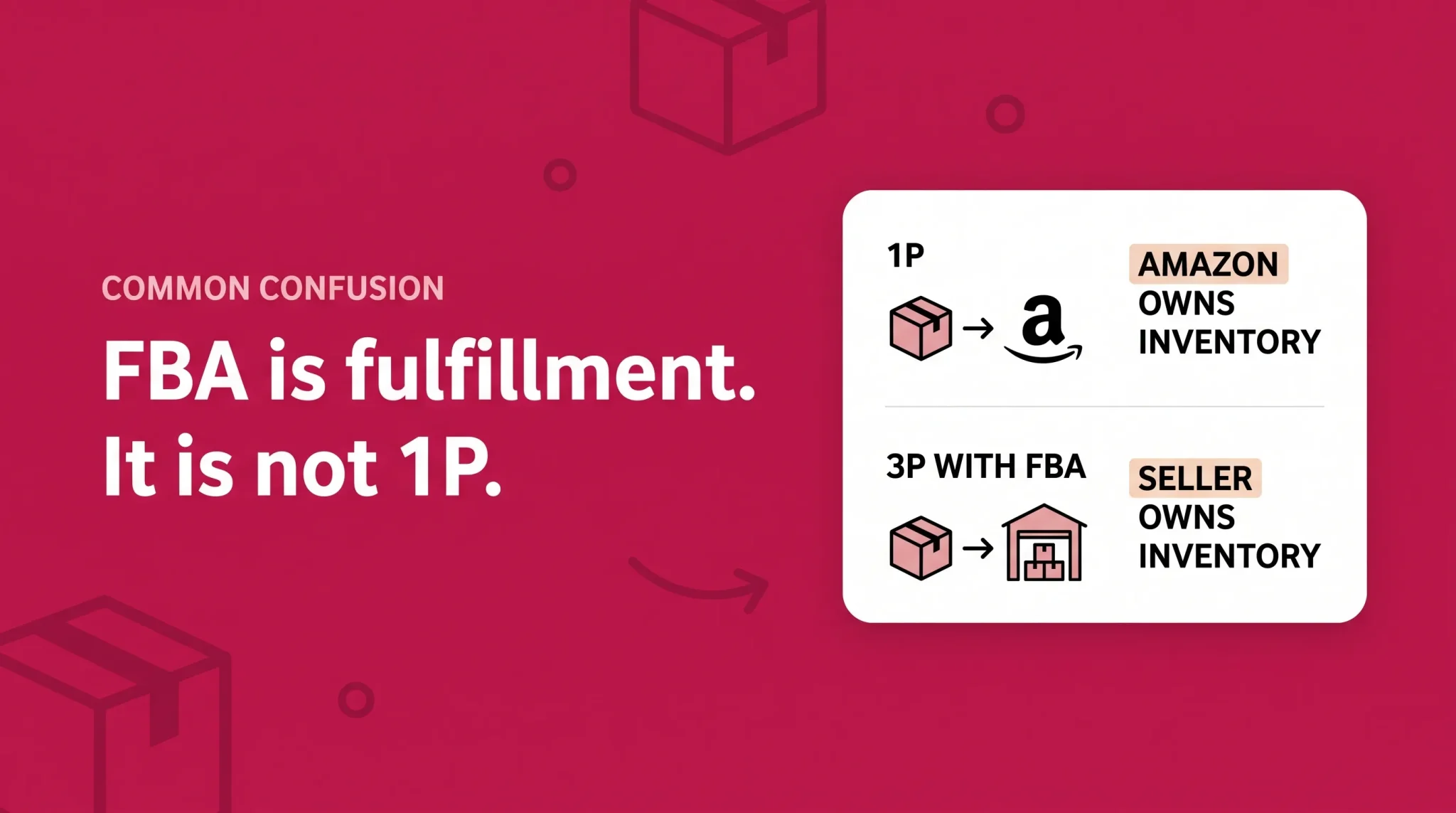
This one comes up constantly and is worth clearing up directly, because it is a category error rather than a close call.
FBA is not a business model. It is a fulfillment option available to 3P sellers. A seller using Fulfillment by Amazon is still a 3P seller: they still own the inventory, still set the price, still own the listing, and still own the customer transaction. They have simply outsourced storage, picking, packing, and shipping to Amazon.
The confusion is understandable, because from the shopper's side a 1P listing and an FBA listing can look similar. Both carry Prime delivery. Both ship in Amazon boxes. The difference is invisible on the product page and total in the back end. With 1P, Amazon bought your inventory and is reselling it. With FBA, Amazon is storing and shipping inventory you still own, and taking a fee to do so.
So the real comparison is not 1P versus FBA. It is 1P versus 3P, with FBA, Fulfilled by Merchant, and Seller Fulfilled Prime as the fulfillment choices available inside the 3P model.
The Practical Differences
Amazon 1P | Amazon 3P | |
|---|---|---|
Who Amazon is to you | Your customer | Your sales channel |
Access | Invitation only | Open registration |
Retail pricing | Amazon sets it | You set it |
Inventory ownership | Transfers to Amazon on delivery | Stays with you until sale |
Fulfillment | Amazon, by default | Your choice of FBA, FBM, or SFP |
Revenue recognition | Wholesale price per unit on purchase orders | Retail price minus fees per sale |
Customer service and returns | Amazon handles | Yours, or Amazon's under FBA |
Data access | Vendor reporting on Amazon's terms | Direct access to your own sales and traffic data |
Operational workload | Lower day to day, heavier on supply chain compliance | Substantially higher across listings, pricing, ads, and inventory |
Brand control | Limited over pricing and merchandising | High over content, pricing, and positioning |
Cash flow | Payment terms set by Amazon after PO fulfillment | Amazon disbursements on its settlement cycle |
Scalability lever | Amazon's ordering volume | Your inventory, advertising, and catalog decisions |
Three rows in that table carry most of the strategic weight.
Pricing control is the one brands underestimate. Under 1P, Amazon can move the retail price to compete with other channels, clear stock, or match an external retailer. If you have distribution agreements or pricing expectations elsewhere, a price move you did not authorize can create real friction across your whole channel. It is worth noting that pricing control on 3P is also conditional rather than absolute: you set your price, but your listing needs to be the featured offer for that price to convert, which on shared listings means competing for it.
Data access compounds over time. A 3P seller sees their own sales, traffic, conversion, and advertising performance directly and can act on it weekly. A 1P vendor sees what vendor reporting provides, on the terms Amazon provides it. Over a few years that difference shapes how well a brand actually understands its own demand.
Operational workload is the honest cost of 3P. The control is real, and so is the headcount required to use it. A brand without anyone owning listings, pricing, inventory planning, and advertising will not get 3P's upside; it will just get 3P's responsibilities.
How the Margin Structure Actually Differs
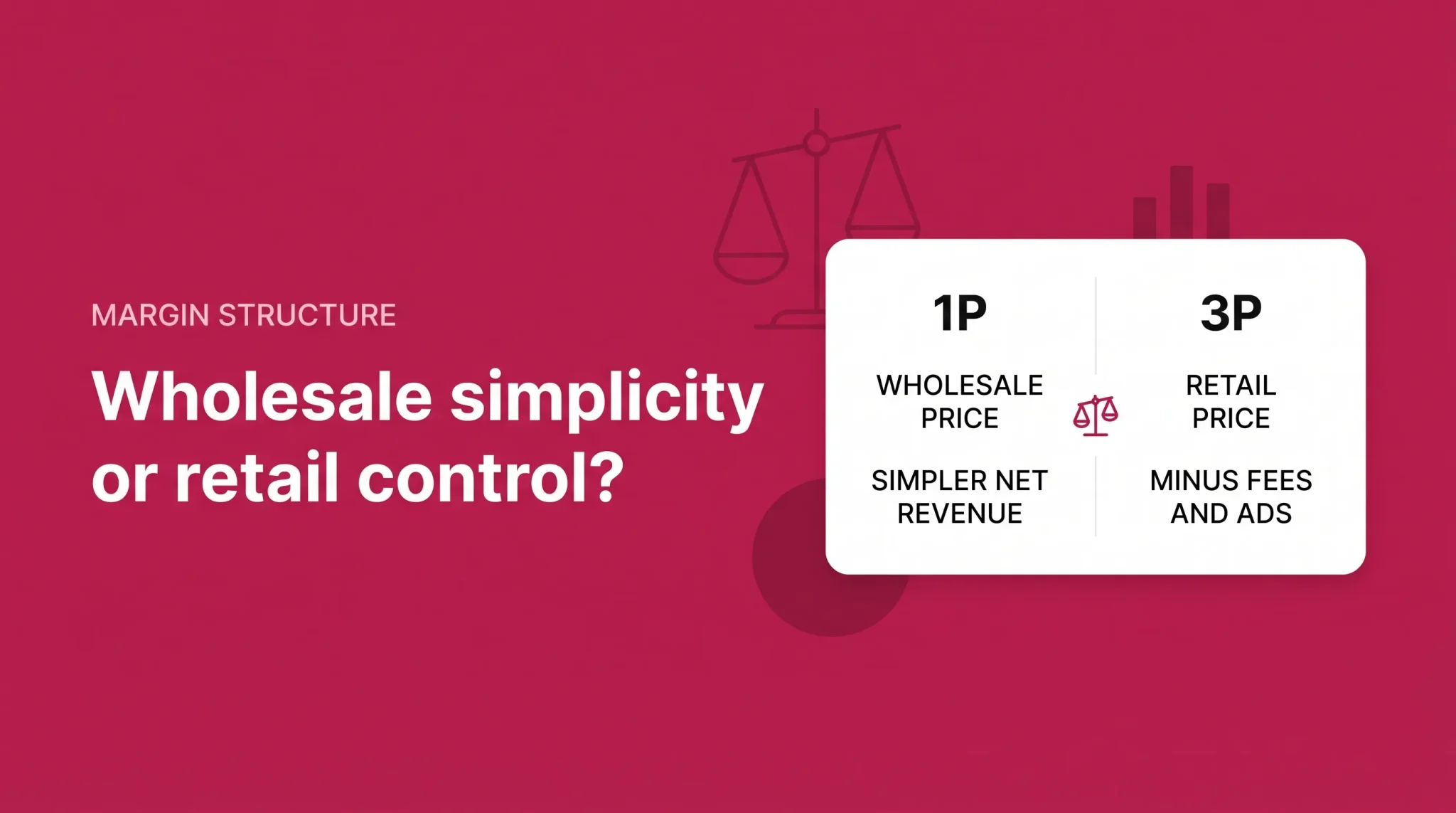
The two models do not just split revenue differently. They recognize it at different points and against different cost bases.
Per-unit net revenue, 1P = agreed wholesale price. Per-unit net revenue, 3P = retail price minus referral fee minus fulfillment cost minus advertising cost attributable to that unit.
The 1P side looks simpler because it is. You know your number when the purchase order is issued, and your remaining costs are cost of goods plus whatever supply chain and compliance obligations the vendor agreement carries.
The 3P side has more moving parts, and that is exactly why the comparison is not a single number. A 3P seller's net per unit depends on referral fee percentage in their category, fulfillment cost for their size and weight tier, and how much advertising is required to win the sale. A product that converts organically at a healthy rate and sits in a low fee category can net meaningfully more on 3P than the wholesale price Amazon would pay. A product that needs heavy advertising to move, in a high fulfillment cost tier, can net less than a clean wholesale arrangement would.
This is why "3P has better margins" is only true as a generalization. The correct exercise is to model your specific product both ways: what would Amazon plausibly pay per unit at wholesale, versus what you actually net per unit at your realistic retail price, fee structure, and advertising cost. Do that on your three or four highest volume SKUs before forming a view.
There is also a volume dimension. 1P can move more units on a given SKU when Amazon commits to it, because Amazon's own merchandising and deal placements go behind products it owns. Lower margin on higher volume is not automatically worse than higher margin on lower volume. It is a different shape of business, and the right answer depends on your fixed cost base and what you need the channel to do.
Pros and Cons of Each Model
Amazon 1P | Amazon 3P | |
|---|---|---|
Main advantages | Reduced day to day operational burden; Amazon handles retail execution, fulfillment, and customer service; Prime eligibility without managing it; potential for higher volume on SKUs Amazon backs; simpler cross-border and B2B mechanics in some cases; the "sold by Amazon" signal on the listing | Pricing control; you keep the retail margin rather than the wholesale one; direct access to your own performance data; control over listing content, imagery, and positioning; freedom to launch, test, and retire products on your own timeline; open access with no invitation needed |
Main disadvantages | No retail pricing control, which can disrupt pricing across other channels; lower per-unit revenue; limited visibility into customer and performance data; ordering volume is Amazon's decision; chargebacks and compliance obligations attached to the vendor agreement; the relationship can be reduced or ended by Amazon | Substantially higher operational workload; you carry inventory risk and the working capital tied up in it; you fund your own advertising; you compete for the featured offer on shared listings; customer service and returns are your obligation under some fulfillment choices; results depend heavily on execution quality |
Neither column is a verdict. A brand with a lean team and a commodity product may find 1P's disadvantages entirely acceptable. A brand whose differentiation lives in its content, pricing, and customer experience will find them intolerable. That is the actual decision.
Three Brand Situations
A mid-sized consumer goods brand with strong DTC pricing discipline. This brand sells the same products through its own site and specialty retail. A 1P arrangement puts retail pricing in Amazon's hands, and a price drop on Amazon will be visible to every other channel partner within a day. For this brand, the pricing control question outranks the operational convenience question, and 3P is usually the better structural fit even though it costs more to run.
A manufacturer with high volume, low differentiation products and no ecommerce team. Think consumables or components where the buying decision is driven by availability and price rather than brand story. Content and positioning move the needle very little, and the brand has nobody internally to run listings and advertising. Here 1P's trade is a reasonable one: give up control you were not going to exercise well anyway, in exchange for volume and a much lighter operational load.
A brand already running 3P that receives a Vendor Central invitation. This is the most common live version of the question, and the reflex to accept is worth resisting for a week. The right analysis is per SKU rather than per brand: which products would genuinely benefit from Amazon's ordering volume, and which are worth keeping under your own pricing and content control. That analysis often leads to a split rather than a switch.
Hybrid Operating Structures
Some brands run both models at once, holding a Vendor Central relationship for part of the catalog and selling the rest through Seller Central. The usual logic is to put stable, high volume, low differentiation SKUs on 1P where Amazon's ordering does the work, and keep new launches, premium lines, and anything requiring active content and pricing management on 3P.
This can work, and for larger brands it is common. It also introduces problems that a single-model setup does not have: pricing consistency across two channels that Amazon controls differently, potential competition between your own offers, more complex forecasting, and two sets of operational requirements to staff.
Hybrid is best understood as an option that becomes available once a brand has the internal capability to run 3P properly. It is rarely a good starting point, because it multiplies the operational demands before the brand has proven it can meet them once.
Which Model Fits Your Brand
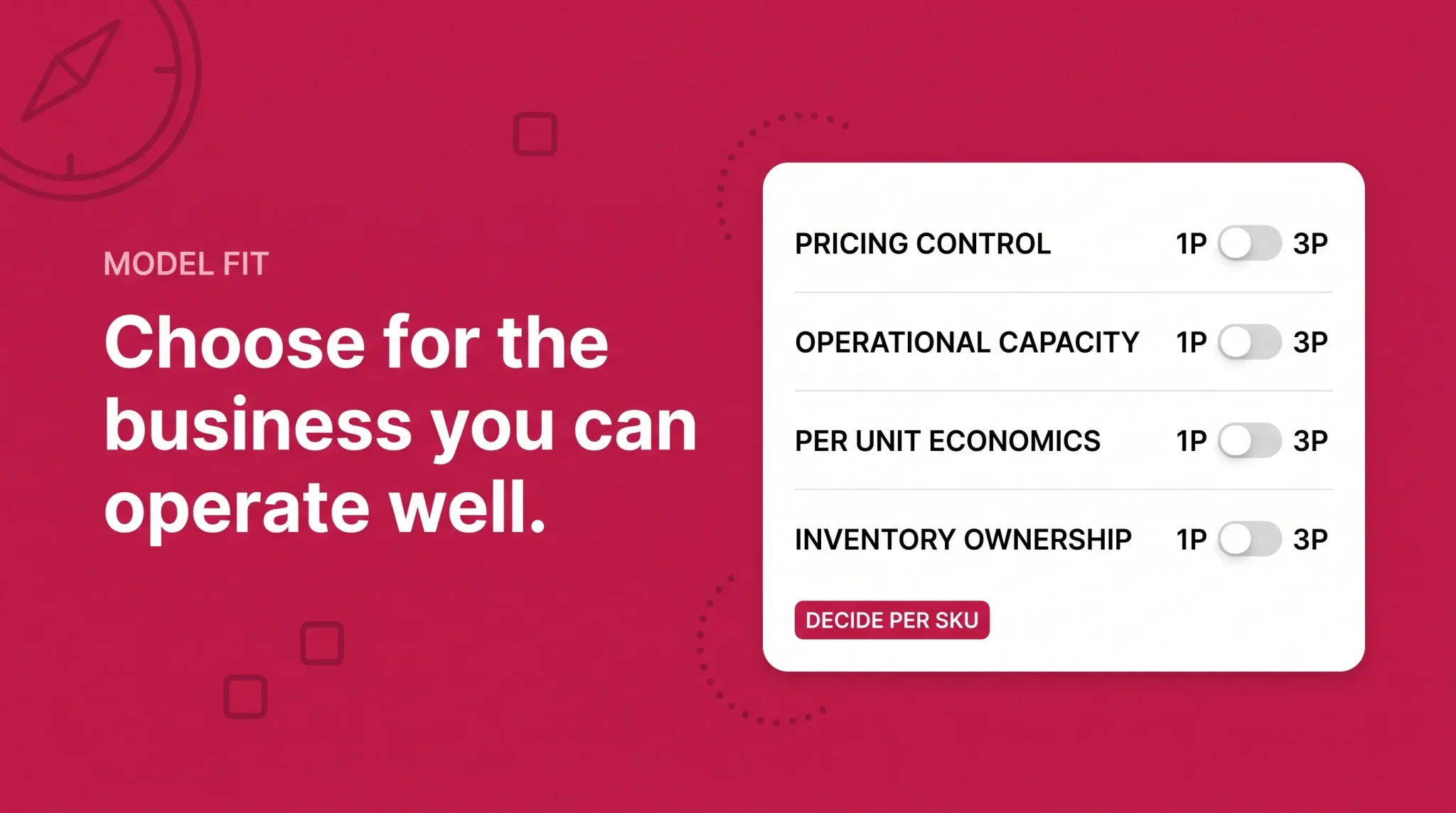
Work through these before deciding. Each one that points toward control and away from convenience strengthens the case for 3P.
Is pricing consistency across your other channels a commercial requirement or a preference
Do you have, or can you fund, someone who owns listings, pricing, advertising, and inventory planning
Does your product's differentiation depend on content and positioning, or on availability and price
Can your balance sheet carry inventory and the working capital gap that comes with owning it
How much does direct access to your own sales and traffic data matter to your wider business
Would Amazon's ordering volume on a given SKU realistically exceed what you can drive yourself
What does the per-unit math say on your top SKUs when you model both routes honestly
How comfortable are you with the volume decision on a SKU sitting with the other party
Do you actually have the choice, given that 1P requires an invitation you may not receive
For most brands the practical answer resolves quickly, because the invitation question settles it. 3P is available now. 1P is not something you can elect. That asymmetry means the useful version of this decision for the majority of brands is not "which should I choose" but "how well am I going to run 3P," with 1P as a scenario to evaluate if and when an invitation arrives.
For brands that do hold both options, the answer usually depends less on which model is theoretically better and more on which one your organization is actually built to operate.
The 1P versus 3P question is rarely decided on definitions. It gets decided on your per-SKU economics, your pricing obligations to other channels, and whether your team is resourced to run a marketplace business properly. If you want a second set of eyes on which of your products would hold up better under each model, book a free strategy call.
Frequently asked questions
Amazon 1P is a first-party relationship where you sell your products wholesale to Amazon. Amazon buys the inventory, sets the retail price, fulfills orders, and sells to shoppers under its own account through the Vendor Central platform.