 Bilal Siddiqui
Most brands don’t go looking for Amazon Vendor Central. It usually finds them. One day an email arrives from someone on Amazon’s vendor recruitment team suggesting that Amazon would like to buy your products wholesale and sell them itself. For a lot of founders and brand leaders, that email feels like validation, a sign the business has arrived.
Then the questions start. Do you have to accept? What actually changes if you do? Will your margins hold up? And is this the same thing as the “Supplier Central” link someone on your team mentioned?
This guide is built to answer the question underneath all of those: should your brand operate as an Amazon vendor, and what are you really signing up for if you do? We’ll cover what Vendor Central is, how the first-party model works, how it differs from Seller Central and from Supplier Central, how invitations actually happen, and the commercial realities that decide whether 1P is a good deal for a particular brand. Where a topic has its own dedicated home, we’ll point you to it rather than repeat it here.
What Amazon Vendor Central actually is
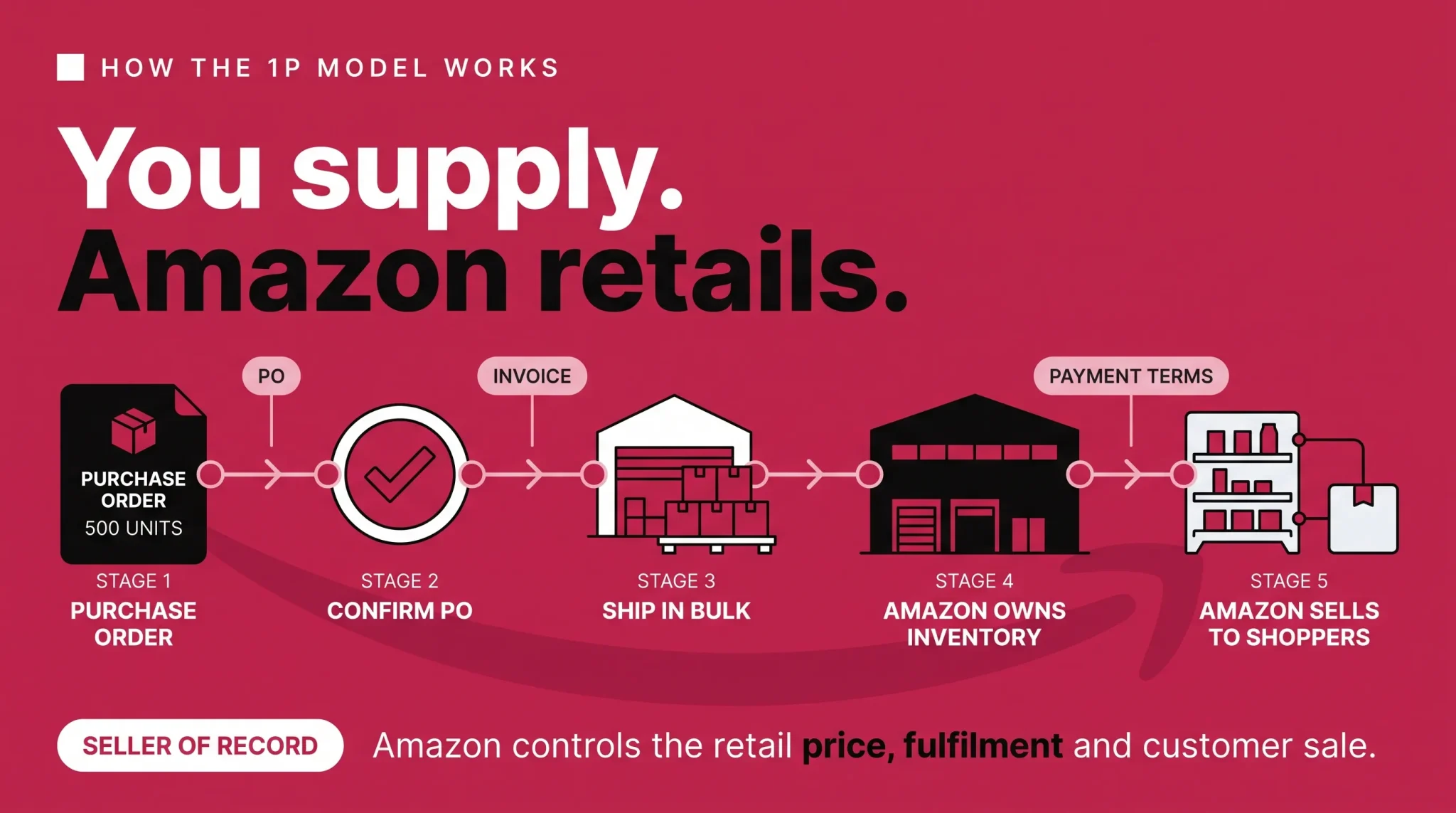
Amazon Vendor Central is the platform brands and manufacturers use when they sell their products to Amazon as a wholesale supplier, rather than selling directly to shoppers. Amazon’s retail team buys your inventory in bulk, takes ownership of it, sets the retail price, and handles the sale, fulfillment, customer service, and returns. To a shopper, the product simply shows the “Ships from and sold by Amazon” label, and Amazon is the seller of record.
This is what people mean by the first-party, or 1P, relationship. You become a supplier to a very large retailer, and that retailer happens to be Amazon.
Mechanically, the relationship runs on purchase orders. Instead of receiving individual customer orders, you receive a purchase order (PO) from Amazon for a quantity of units, you confirm and ship that order, usually in bulk to Amazon’s fulfillment centers, though some items can be handled through a direct-fulfillment arrangement, and you invoice Amazon for it. Amazon then owns and sells that inventory. Your customer, in a commercial sense, is Amazon itself.
That single fact shapes almost everything else. Because Amazon buys the goods, Amazon controls what happens to them: the shelf price, the promotions, the merchandising, and the relationship with the end shopper. You supply; Amazon retails. For established brands that value simplicity and scale, that can be attractive. For brands that want to control their own pricing, margins, and customer experience, it can feel like handing over the steering wheel.
First-party and third-party, in plain terms
It helps to be precise about two labels that get thrown around constantly.
A first-party (1P) seller sells to Amazon. Amazon buys the inventory wholesale and resells it. That’s Vendor Central.
A third-party (3P) seller sells through Amazon, directly to shoppers. You keep ownership of your inventory, you set your own prices, and Amazon acts as the marketplace (and, if you use Fulfilled by Amazon, as your logistics provider). That’s Seller Central.
That’s the distinction you need to understand Vendor Central, and it’s as far as we’ll take it here. The wider landscape, dropshipping, retail and online arbitrage, private label, Kindle Direct Publishing, Amazon Business and B2B, and how 1P and 3P sit among all of them, is a topic in its own right. If you’re weighing the full range of ways to sell on or through Amazon, our Amazon Selling Models Guide covers that comparison properly.
Vendor Central vs Seller Central
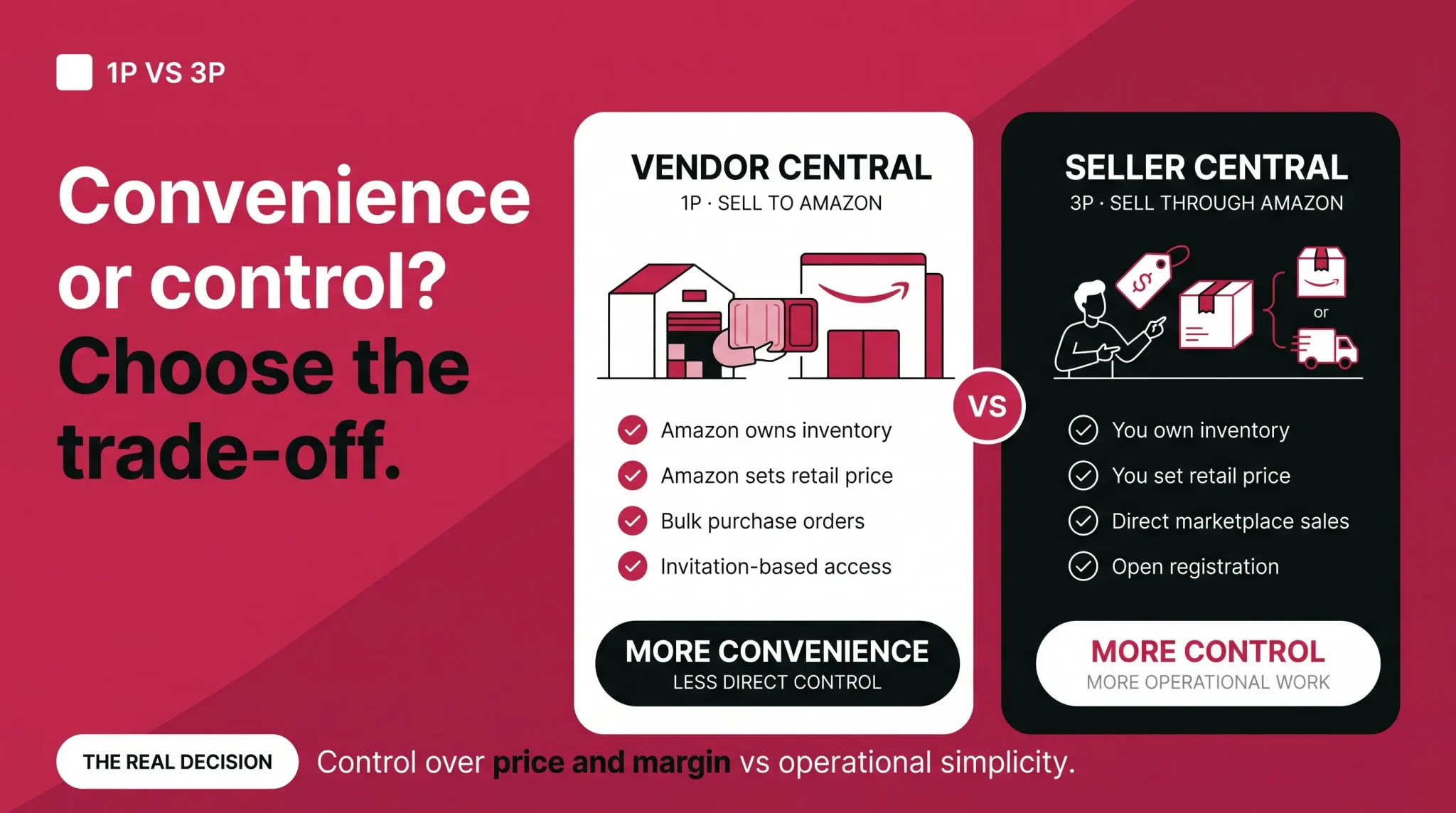
This is the comparison most brands are really trying to make, so it’s worth doing carefully. The two platforms aren’t different versions of the same thing; they’re two different business models, and the trade-offs run in opposite directions.
The cleanest way to think about it is control versus convenience. Seller Central gives you control and hands you the operational work. Vendor Central takes the operational work off your plate and hands the control to Amazon.
Vendor Central (1P) | Seller Central (3P) | |
|---|---|---|
Who sells to the shopper | Amazon | You |
Who owns the inventory | Amazon, once it buys it | You |
Who sets the retail price | Amazon | You |
How you get paid | Wholesale invoices under agreed payment terms | Marketplace disbursements, net of fees |
Fulfillment | Ship in bulk against POs | You choose (FBA or self-fulfillment) |
Customer relationship and data | Amazon manages the retail customer relationship; reporting comes through the vendor environment | More direct operational visibility and limited buyer communication, but Amazon still controls the marketplace customer relationship and restricts customer-data use |
Access | Generally invitation-based | Open registration |
A few of these deserve a closer look.
Pricing. On Seller Central you set your retail price and decide when to discount. On Vendor Central you negotiate a wholesale cost with Amazon, and Amazon decides the shelf price. Amazon’s systems can and do lower that price when the algorithm judges it will help conversion, and because other retailers often benchmark against Amazon’s price, a discount there can ripple across your other sales channels. For brands that care about price consistency or maintain a minimum advertised price, this is one of the most consequential differences in the whole comparison.
Content, advertising, and brand tools. For years, the assumption was that vendors got the better toolkit. That’s no longer a clean story. Brand-registered sellers on Seller Central, those enrolled in Amazon Brand Registry, now have access to many of the merchandising, brand-building, review, analytics, and advertising tools that were once seen as major Vendor Central differentiators, A+ Content, a Brand Store, Amazon Vine for early reviews, Brand Analytics, and the full set of Sponsored ad formats, with availability of some features depending on region and program. On the advertising side specifically, it’s worth being accurate: Amazon DSP, the programmatic platform, is open to brands, agencies, and even advertisers that don’t sell on Amazon at all, so it isn’t a vendor-only advantage. The practical differences between the two models today have less to do with a checklist of content features and more to do with the commercial relationship, the data environment, retail operations, account support, and the specific programs written into an agreement.
Reporting. The two platforms are organized around different jobs, so their data is too. Vendor Central reporting is built around the wholesale relationship, sales, inventory, forecasting, traffic, and margin views through Amazon Retail Analytics, plus shopper-behavior data through Brand Analytics for enrolled brands. Seller Central reporting is built around your direct marketplace operation. Which specific reports you get, how granular they are, how quickly they update, and whether any expanded analytics are available all vary by account, Brand Registry status, and program. Reporting cadence and granularity differ between the two environments, and some vendor reports may update on different schedules than Seller Central dashboards.
Account support. It’s a common misconception that becoming a vendor means Amazon assigns you a dedicated person who looks after your business. Amazon does not staff every vendor account the same way. Larger or strategically important accounts may have a category contact or an assigned vendor manager; many accounts interact mainly through Vendor Central’s tools and standard support channels. Some vendor accounts may receive additional account support or participate in paid or agreement-specific support programs, but the structure, availability, and program names vary by account, category, region, and agreement. No contact, internal or external, can guarantee an invitation or a particular set of commercial terms.
Vendor Central vs Supplier Central
This pair causes a surprising amount of confusion, partly because some older articles treat the two names as interchangeable. They aren’t.
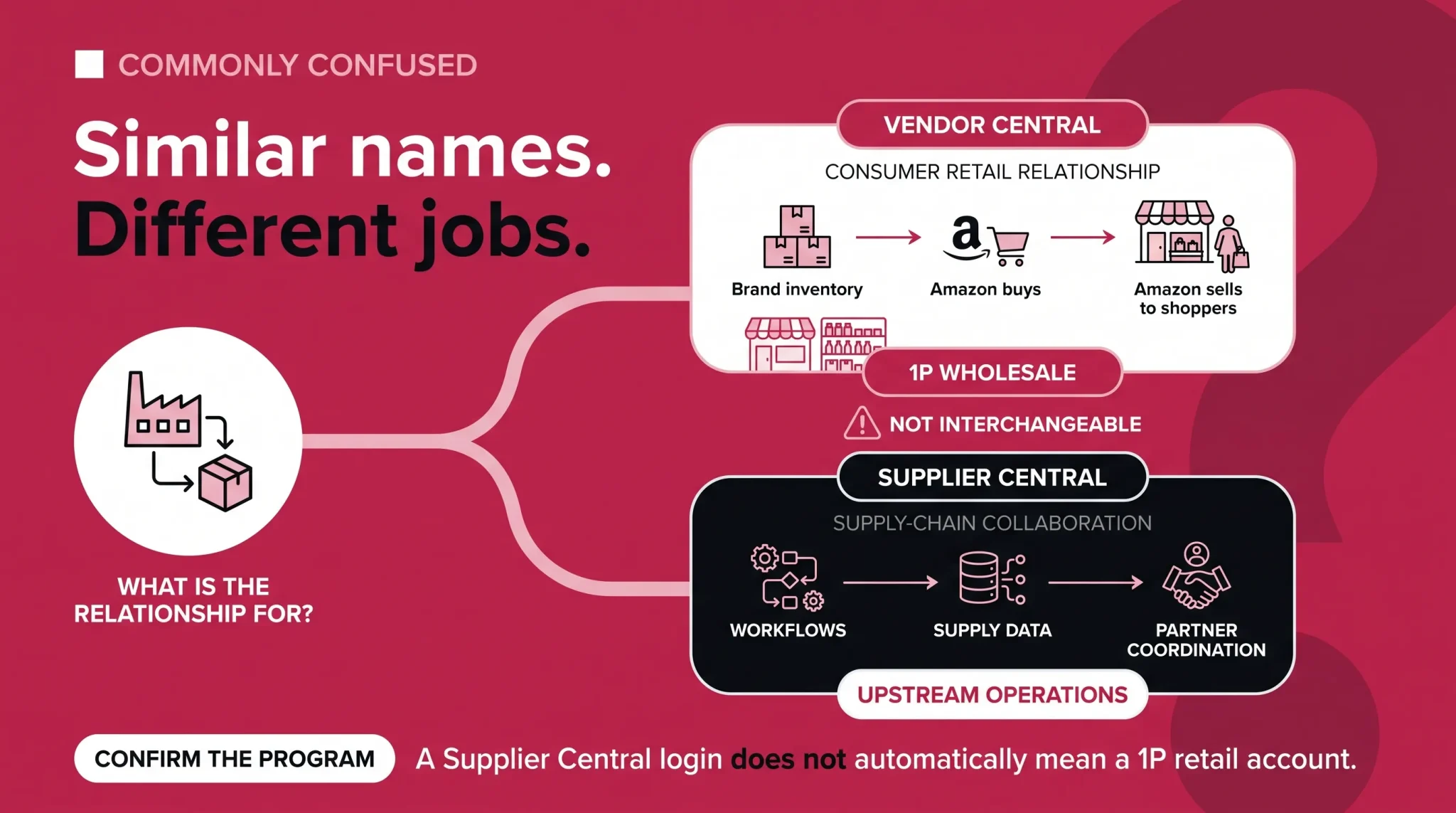
Amazon’s current public description presents Supplier Central as an upstream supply-chain collaboration environment, a place for standardized workflows, centralized information, supply-chain data visibility, and coordination with supply chain partners, with access provided by invitation through an Amazon partner. In other words, it is oriented toward the supply side of Amazon’s operation, not toward selling products to shoppers.
Vendor Central, by contrast, is a consumer-facing retail relationship: Amazon buys your product and sells it to customers on the marketplace.
The simplest way to hold the difference in your head: Vendor Central is about Amazon retailing your product to shoppers, while Amazon’s current public framing of Supplier Central is about supply-chain collaboration, not a marketplace selling account. If you’ve received an invitation to sell your products to Amazon for resale, that’s the Vendor Central conversation. If someone points you to a “Supplier Central” login, it’s worth confirming exactly which program and purpose is involved before assuming it’s the same 1P retail relationship, because it very likely isn’t.
How the Vendor Central invitation actually works
Vendor Central access is generally invitation-based, and Amazon does not offer a normal public self-service application comparable to Seller Central registration. You typically can’t simply sign up and open a vendor account on your own. When brands do become vendors, it’s usually because Amazon’s recruitment team reached out.
Because there’s no open application form, a small industry has grown up around promising to “get you into” Vendor Central. Treat those promises with caution. No agency or consultant can guarantee an invitation, and legitimate invitations come from Amazon directly. Paying for a guaranteed vendor invite is, at best, paying for something no third party actually controls.
None of this means a brand has zero influence over whether it gets noticed. It simply means the levers are indirect: build the kind of demand, reliability, and category relevance that make Amazon want to buy from you, and let the invitation follow if it’s going to.
What Amazon tends to look for
Amazon does not publish a universal Vendor Central invitation checklist, so anyone presenting one is describing patterns, not confirmed criteria. That said, industry experience points fairly consistently in the same direction. Amazon is more likely to approach brands that show established demand for their products, reliable supply and operational consistency, strong relevance to a category Amazon wants to grow, and enough scale to make a wholesale relationship worthwhile. A track record of selling well on Amazon already, as a third-party seller, is a commonly reported path to a vendor invitation, though it isn’t the only route and isn’t an officially confirmed requirement.
The honest summary is that becoming a vendor is largely at Amazon’s discretion, informed by data about your products and your category. You can make yourself a more attractive candidate; you can’t manufacture an invitation.
The commercial reality: how the money actually works
This is the part that most deserves your attention before you say yes, because it’s where the appeal of “Amazon just buys everything” quietly meets the details.
It starts simply enough. Amazon issues a purchase order, you ship against it, you invoice, and Amazon pays under the payment terms in your agreement. Those terms are negotiated, not fixed, you’ll often see arrangements described in the form of net-30, net-60, or net-90, but treat any specific number as an example rather than a standard, because the actual terms depend on the agreement. The gap between shipping product and getting paid is a real cash-flow consideration for a wholesale supplier, and it’s worth modeling honestly.
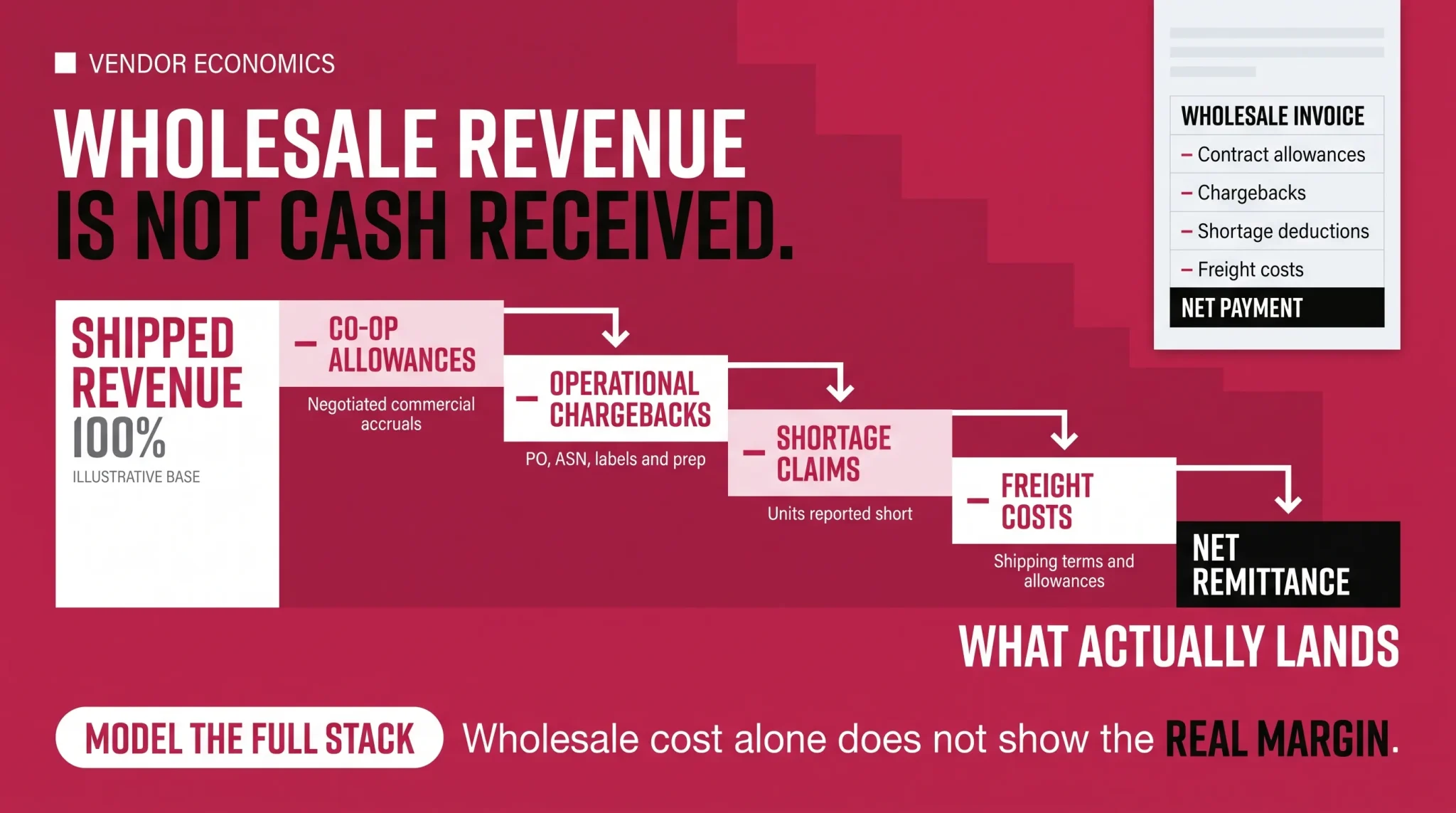
The larger point is that the wholesale cost you negotiate is not the whole picture. Several distinct kinds of commercial charges sit on top of it, and lumping them together as “Vendor Central fees” hides how they work. It’s worth separating them:
Contractual and co-op allowances are the negotiated accruals baked into your vendor terms, things like marketing development funds, damage allowances, and freight allowances. These are structural: they come out of your remittances as a matter of agreement, not because anything went wrong. They’re typically revisited during Amazon’s annual vendor negotiations. The exact allowances and how they are applied depend on the vendor agreement, which is why brands should review every commercial term rather than focusing only on the headline wholesale cost.
Operational chargebacks are penalties for compliance failures on the inbound side: shipments that miss their PO window, advance-ship-notice inaccuracies, carton-labeling errors, packaging or prep violations, routing-guide noncompliance, and similar issues. Individually they can look small; across a lot of POs they add up, and they’re issue-specific and evidence-based, which means many are disputable if you have the records.
Invoice deductions and shortage claims happen when Amazon reports receiving fewer units than you invoiced and pays the difference short. Disputing a shortage claim usually means matching purchase orders, invoices, shipping records, and receiving data to show the correct quantity shipped, and doing it within tight filing windows.
Freight-related costs cover how goods move to Amazon and who bears that cost, which may be handled through a freight allowance or specific shipping terms in your agreement.
Taken together, these deductions and allowances can represent a meaningful share of shipped revenue. Exactly how large that share is varies widely by brand, category, region, and the specifics of the agreement, so it’s not a number to assume, it’s a number to model for your own products. What tends to surprise new vendors is not any single line but the cumulative effect: a wholesale margin that looked workable on paper can compress once allowances, chargebacks, and short-paid invoices are netted out. That’s the margin pressure experienced 1P operators talk about, and it’s the single biggest reason to run the full unit economics before accepting an invitation rather than after.
Which model fits which brand
There’s no universal answer, but there are clear tendencies.
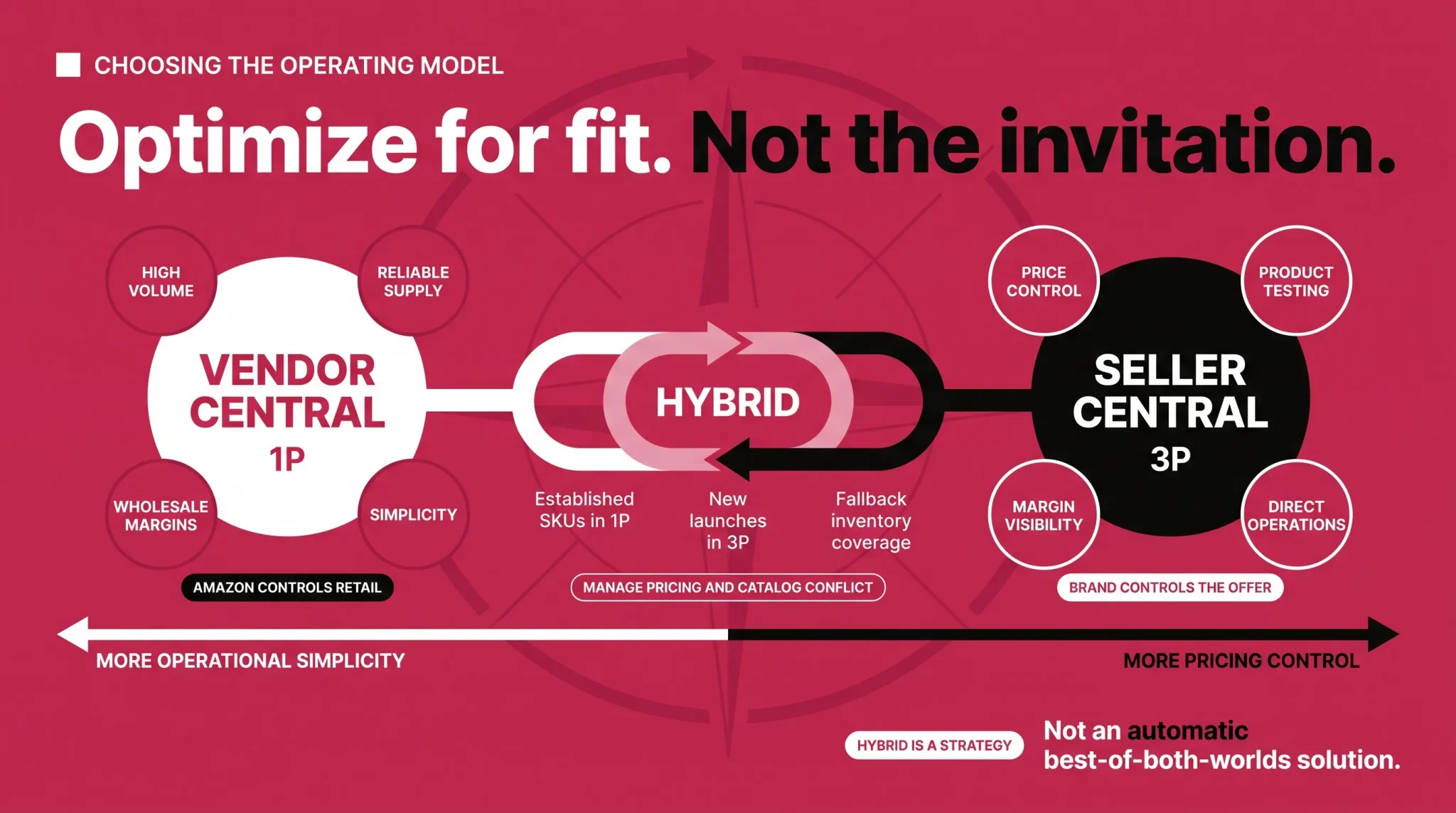
Vendor Central tends to suit established, higher-volume brands that value simplicity and scale over control, brands with reliable supply, efficient logistics, and enough margin headroom to absorb wholesale pricing and the deduction stack. If your priority is moving large volumes with Amazon handling the retail mechanics, and you’re comfortable letting Amazon control pricing and the customer relationship, 1P can be a reasonable fit. Legacy and household brands that already think in wholesale terms often find the model familiar.
Seller Central tends to suit growing brands and anyone who wants control over pricing, margins, listings, and marketplace performance data. If you’re still building the brand and setting up as a third-party seller, launching and testing products, defending a minimum advertised price, or simply unwilling to let Amazon set your shelf price, the control that 3P gives you usually outweighs the operational work it demands. Seller Central is often the stronger fit for brands that prioritize pricing control, product testing, margin visibility, and direct marketplace operations.
The decision isn’t only about size, though. It’s about what you’re optimizing for: hands-off scale and predictable bulk orders on one side, control over price, margin, and data on the other. A brand that would lose its pricing discipline or its margin under 1P should think hard before accepting an invitation, however flattering it feels.
Can a brand use Vendor Central and Seller Central together?
Yes, running both is possible, and for some brands it’s practical. In a hybrid setup, a brand keeps some products in the 1P vendor relationship while selling others as a 3P seller. A common pattern is to let Amazon handle high-volume, established items through purchase orders while using Seller Central to launch new products, test variations, defend pricing on premium items, and keep control over pricing, listings, and marketplace performance data. Keeping a Seller Central presence can also act as a fallback if Amazon’s purchase orders slow down, so a product doesn’t simply go out of stock.
But hybrid isn’t automatically the best of both worlds, and it shouldn’t be treated as a default. Running two models at once introduces its own friction: pricing can conflict between your 1P and 3P offers, the two can compete for the same Buy Box or listing, catalog ownership and inventory allocation get more complicated, and your agreement may include restrictions or create commercial tension around selling the same items both ways. Hybrid is best understood as possible and sometimes genuinely useful, a deliberate strategy for specific reasons, not a shortcut you adopt to avoid choosing.
You’ve been invited, what to evaluate before saying yes
If an invitation is on the table, the worst move is to sign the standard agreement quickly because the invite felt like an achievement. The invitation is the start of the work, not the end of it.
Before accepting, model your real unit economics under the proposed wholesale cost, across the products in scope, not just as a blended average. Layer in the allowances, likely chargebacks, and payment terms so you’re looking at what actually lands in your account, not the headline wholesale price. Think through what losing retail pricing control means for your other sales channels and for any minimum advertised price you maintain. Consider how much operational visibility and buyer-communication access you’re comfortable giving up. And decide in advance whether you want everything in 1P or whether a hybrid approach protects your priorities better.
If, after that work, the numbers and the trade-offs make sense for your brand, Vendor Central can be a strong channel. If they don’t, an invitation is not an obligation, plenty of successful brands stay on Seller Central by choice. Either way, the goal is to make the decision on the economics and the fit, not on the flattery of being asked.
Frequently asked questions
Generally, no. Vendor Central access is invitation-based, and there's no normal public self-service application like Seller Central's open registration. Invitations come from Amazon directly, and no agency or consultant can guarantee one.