 Bilal Siddiqui
Key takeaways
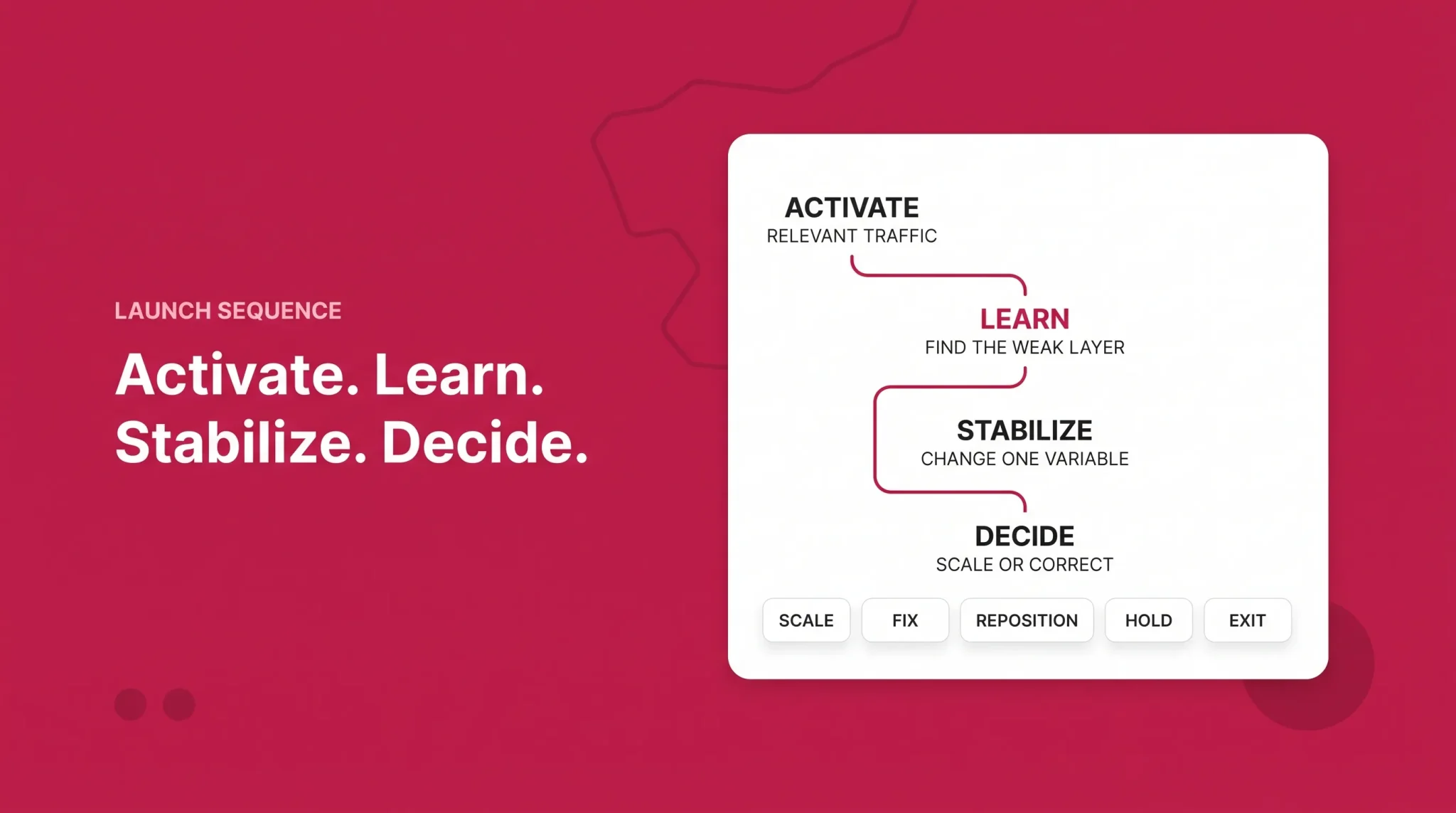
An Amazon product launch is a process of validating demand, conversion, and profitability. Use evidence to decide whether to scale, fix, reposition, hold, or exit rather than following a fixed launch calendar.
Confirm retail readiness before driving traffic. Your listing should be complete, compliant, active, and buyable, with sellable inventory, a competitive offer, and a funded replenishment plan.
Model contribution margin after product costs, Amazon fees, fulfillment, advertising, promotions, and returns. Sales growth alone does not prove that a launch is financially viable.
Use Amazon Vine where eligible and approved review request methods to build trust. Check incentive eligibility early, and avoid incentivized reviews, review manipulation, or fixed review-count targets.
Use advertising to test clear hypotheses, diagnose weak performance by its underlying cause, and change one meaningful variable at a time. Scale only when conversion, inventory, product feedback, and economics support higher demand.
Most Amazon launches do not fail because the seller picked the wrong keyword in week one. They fail because traffic arrives at a product that is not ready to receive it.
The listing goes live before the images are finished. Inventory is still in receiving when ads start spending. The margin looks fine until the coupon, the advertising, and the returns land in the same month. By the time anyone diagnoses the problem, three weeks of budget are gone and the reorder decision is overdue.
A launch is better understood as a sequence of readiness gates than as a thirty day campaign. The question is not how fast you can generate sales. It is whether the product is ready to receive traffic, convert it, fulfill the demand, collect compliant customer feedback, and fund the next purchase order before you start scaling.
A Launch Starts Before the Product Is Buyable
Creating a listing is not launching a product. Sellers treat the moment the ASIN appears in the catalog as day one, then discover the offer was not buyable, the variation family was wrong, or the first units were still in transit.
The operational launch begins when the product can genuinely receive customers: a buyable offer, available inventory, a complete detail page, an intentional price, advertising ready if it is part of the plan, a compliant review plan, a saved measurement baseline, and a replenishment plan that does not depend on optimism.
That distinction matters because the highest leverage decisions come before the product is live. Vine can be scheduled ahead of launch. Program eligibility windows start counting from listing and inbound dates. A team that treats launch day as the starting line has already given away the part of the sequence where the leverage sits.
One framing note. Seller community concepts such as a honeymoon period should not be treated as documented Amazon policy. Plan around what you control: readiness, evidence, and how quickly you act on what the data shows.
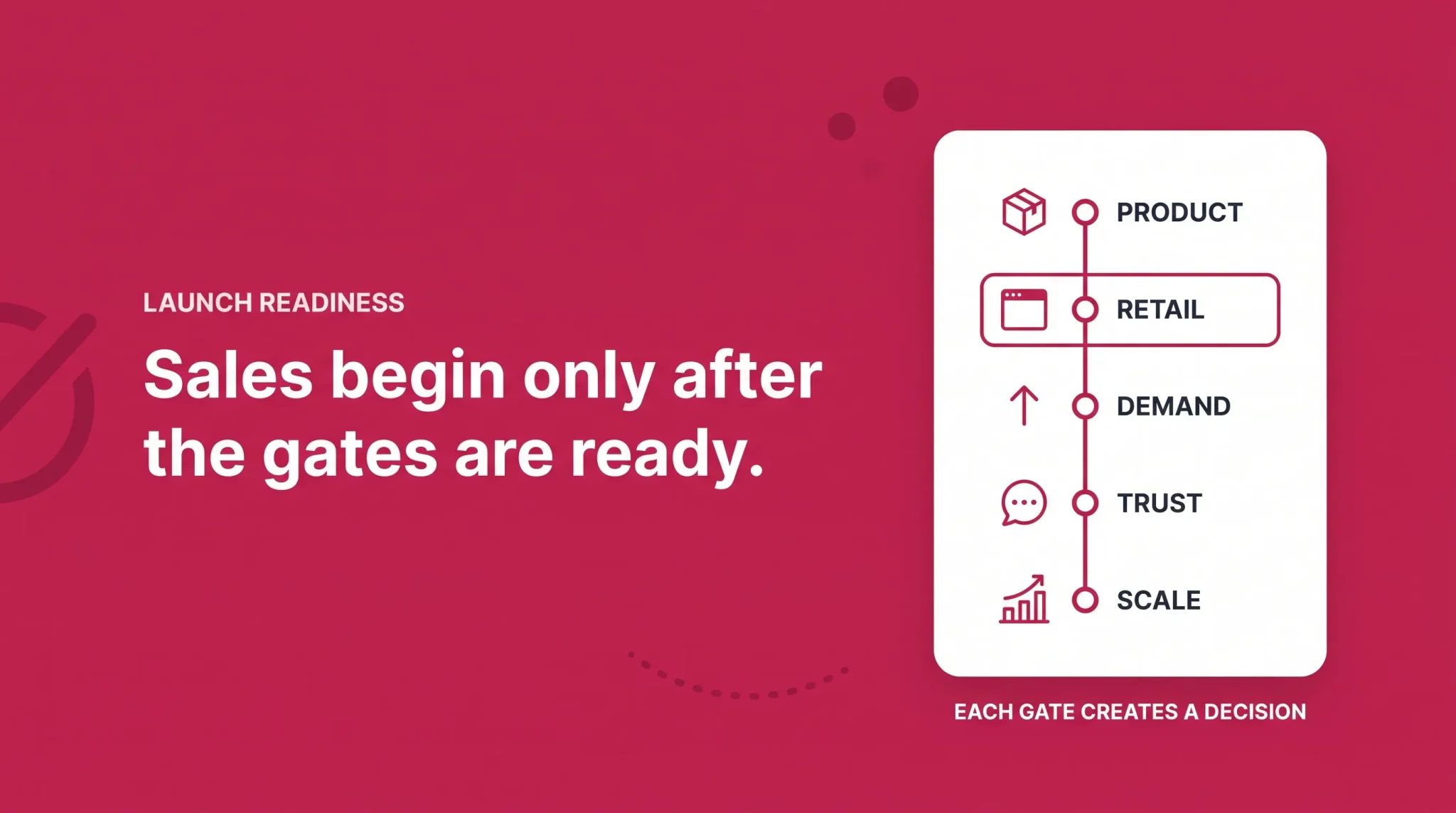
The Five Launch Readiness Gates
Product readiness asks whether the physical product, its packaging, and its landed cost are ready for commercial scale. Retail readiness asks whether the detail page and offer can convert a shopper who arrives. Demand activation asks whether you can generate relevant traffic on purpose. Trust and learning asks whether you have a compliant way to gather early feedback and read it honestly. Scale readiness asks whether the evidence justifies committing more money.
Each gate produces a decision, not a checkbox. The last one is the gate most launches skip. Sales beginning is not the same as a launch succeeding, because a product can generate units and lose money on every one of them.
Launch gate | What must be true | What happens if it is not |
|---|---|---|
Product | Differentiation clear, quality stable, packaging production ready, landed cost supports a viable margin | Returns, negative reviews, and compliance issues surface after spend has started |
Catalog and compliance | Correct parent and child structure, correct product type and brand, required attributes complete, eligibility and certifications confirmed | Suppression, stranded inventory, or a listing that cannot be advertised |
Retail readiness | Listing active and buyable, content and creative complete, price intentional, delivery promise credible | Traffic converts poorly and the data teaches you nothing |
Inventory | Sellable units available, replenishment lead time modeled, next order timed and funded | Demand is created and then wasted on a stockout |
Demand activation | Campaign structure and budget approved, target queries identified, a clear learning hypothesis | Spend produces traffic without producing answers |
Reviews and trust | Vine eligibility checked early, review process fully policy compliant | Slow trust building, or an account level policy problem |
Economics and measurement | Contribution margin modeled including ads and promotions, baseline saved, scale or stop criteria agreed | The launch cannot be judged, so it never formally ends |
Product Validation Is a Handoff
This guide assumes the product already exists as a commercial decision. Before going further, confirm six things: demand has been validated rather than assumed, the competitive set is understood, the differentiation is defensible to a shopper reading a detail page for eleven seconds, a realistic margin survives fees and advertising and returns, compliance requirements have been considered, and supply can scale if the product works.
If any of those are unresolved, resolve them in product research first. A launch plan applied to an unvalidated product simply spends money faster.
Product Development Failures That Become Launch Failures
A surprising share of launch problems are product problems wearing a marketing costume.
Weak differentiation is the most common, and no launch sequence compensates for a product functionally identical to established competitors. Unstable quality across production runs turns into inconsistent reviews. Wrong dimensions cause both returns and fulfillment surprises. Fragile packaging arrives damaged and produces reviews about something other than the product.
Then the documentation problems. Unsupported claims create compliance exposure and expectation gaps. Missing certifications surface after inventory has landed. Supplier lead time variability makes replenishment planning fictional. An MOQ far larger than realistic launch demand turns a modest test into a large cash commitment.
Three more that quietly ruin launches: a contribution margin too thin to support any advertising, a product or packaging change made after creative assets were approved so the images no longer match what arrives in the box, and warranty or return economics that were never modeled.
Retail Readiness Before You Turn On Traffic
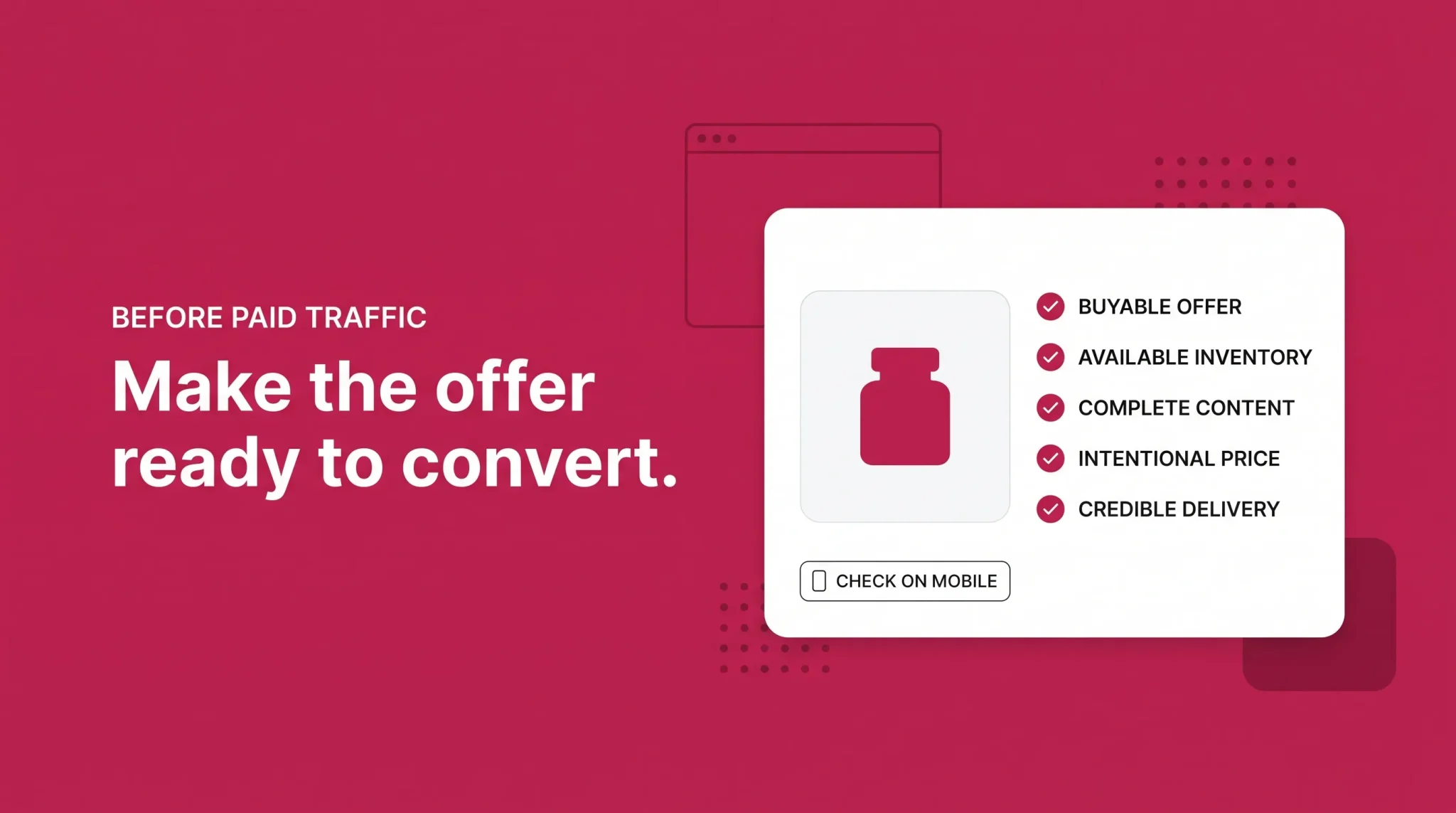
Traffic is only worth generating once the page can convert it.
On the catalog side: correct ASIN and variation structure, required attributes complete, listing active and not suppressed, and the offer genuinely buyable rather than merely created. On the offer side: inventory actually available, price set deliberately, Featured Offer status where relevant, and a delivery promise a shopper would find credible.
On the content side: title, bullets, and description complete, main image compliant and strong, secondary images covering the questions shoppers actually ask, video where the product benefits from demonstration, A+ Content live where you are eligible, claims compliant, relevant search coverage in place, and the page reviewed on a phone. Most shoppers never see the version you designed on a laptop.
For execution depth use the listing optimization guide, and for search coverage the Amazon SEO framework. The gate is what matters here: complete before traffic, not during it.
Inventory and Replenishment Readiness
Launch inventory planning is where optimism does the most damage, because the common approach is to forecast a first month and order that quantity.
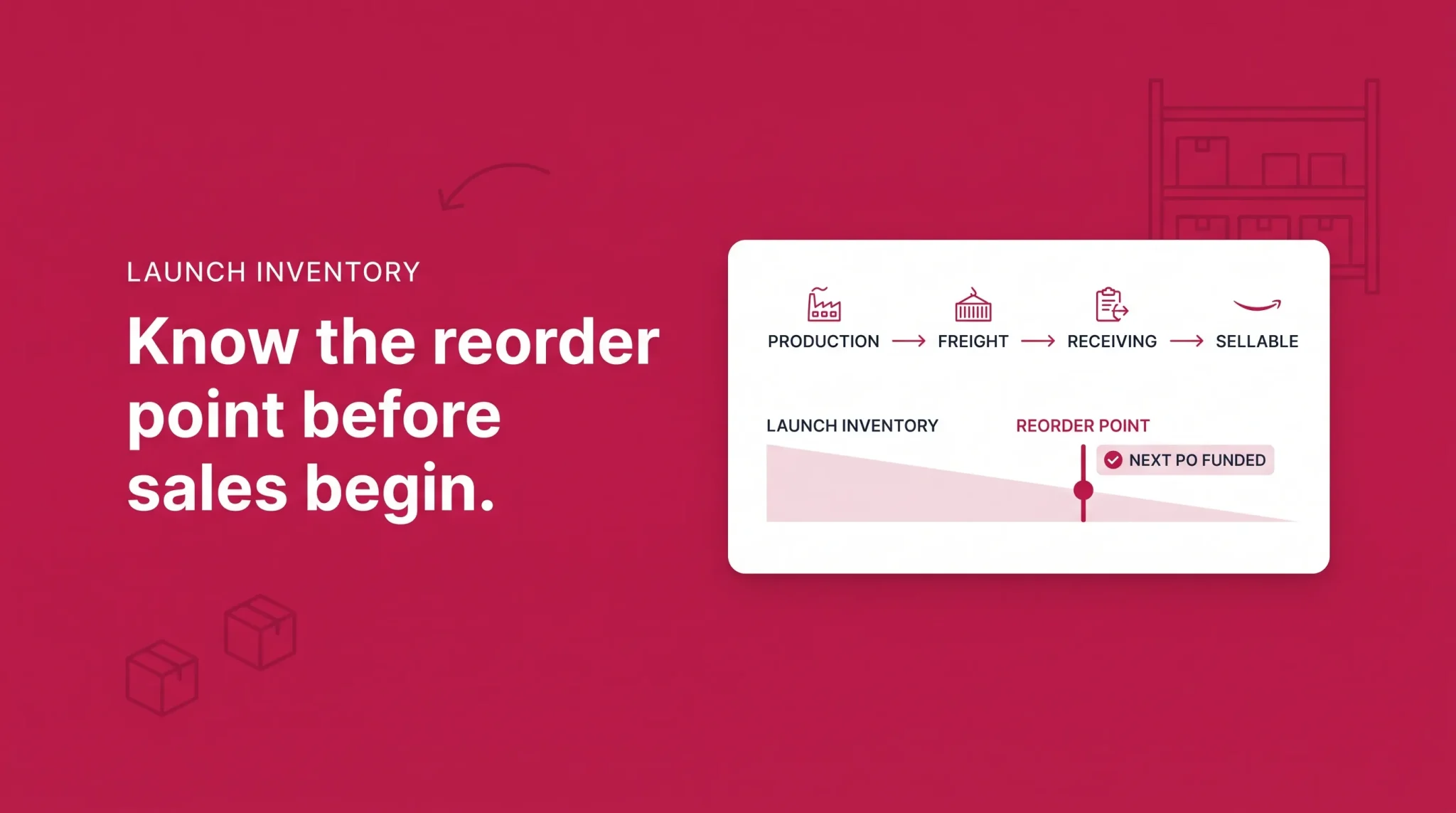
The real chain is longer. Production lead time, freight, customs, Amazon receiving, and movement within the fulfillment network all sit between a purchase order and a sellable unit. Launch demand is uncertain by definition, promotions and advertising pull demand forward unevenly, and units committed to Vine come out of the same pool.
Then the parts sellers forget: safety stock for receiving delays that will happen, a reorder MOQ that may exceed the demand you have proven, and cash for the next purchase order, which usually falls due before the first order's revenue has been disbursed.
Any guide offering a fixed thirty, sixty, or ninety day inventory target is guessing at your lead times. The discipline that matters is knowing your reorder point before launch and knowing whether you can fund it. For deeper planning, use the FBA inventory management guide.
Vine and Compliant Early Review Planning
Early feedback matters, and Amazon Vine is the most legitimate mechanism available for a new product. It also has the most underused feature in launch planning: it can start before your product is live.
Current U.S. eligibility, as of August 2026, requires a Professional selling plan and an eligible FBA offer, plus either a Brand Representative or Reseller role for a brand enrolled in Amazon Brand Registry or an eligible generic product in your catalog. Brand Registry is the usual path but not a universal requirement, since Amazon currently allows qualifying generic products to participate. The product needs fewer than thirty reviews on the detail page, an image and description, and it must fall within eligible product types.
The sequencing point changes launch plans. Amazon currently states that a new product can be enrolled in Vine as soon as you have a customer ready FBA listing and set a launch date in the future, before inventory has been received and before the listing goes live. Amazon recommends enrolling and having inventory available in the fulfillment network at least three weeks before the planned launch date, so Vine Voices have time to receive, use, and write about the product.
Read that as sequencing guidance, not a promise. Vine does not guarantee reviews on launch day, a review count, positive sentiment, sales, or ranking. Vine Voices write honest opinions, including critical ones, and sellers cannot influence them.
On cost, current U.S. enrollment is charged per parent product with no additional cost for child products. As of August 2026 the tiers are no cost for up to two units, $75 for three to ten units, and $200 for eleven to thirty. Amazon currently states billing occurs only after your first Vine review is published and according to its enrollment timing rules, and that no enrollment charge applies if no review is received within ninety days of enrollment. Confirm current pricing in Amazon's Vine documentation.
Outside approved Amazon programs, most tactics that circulate in launch content violate Amazon's Customer Product Reviews policy. That includes product tester sites tied to Amazon reviews, review clubs, rebates tied to reviews, free or discounted product in exchange for a review, and refunds or compensation in exchange for writing, changing, or removing one. It includes asking specifically for positive reviews, asking a customer to remove a negative one, reviews from friends, family, employees, or business partners, selectively soliciting only happy customers, diverting unhappy customers away from Amazon's review mechanisms, and incentivized packaging inserts. Aggregating unrelated products under one variation family to pool reviews is a catalog manipulation problem on top of a review problem, as is any compensated search or ranking activity.
These are not gray areas. Amazon enforces with review removal, blocked future reviews, listing and account action, withheld payments, and legal action.
Which is why a fixed review target is the wrong goal. A count by launch day, before starting ads, or before scaling: none of these are Amazon rules, and treating them as targets is what pushes sellers toward the tactics above. Use Vine where eligible, use Amazon's approved review request mechanisms, monitor rating and review themes as they develop, and treat qualitative feedback as launch learning. Review count is context, not a gate.
New Seller Versus New Product
A genuinely new Amazon seller may qualify for New Seller Incentives, which are tied to account level and first product events such as listing your first buyable product, enrolling a brand within a set window, or sending your first FBA inventory. An established seller launching another ASIN does not reset those windows. Listing your tenth product does not make you a new seller again.
What an established seller can still access are per ASIN programs. The New Selection Program (2026) and Vine are evaluated against the product rather than the account, so a new ASIN can qualify even when the account is years old. These are separate programs with separate eligibility, and where they overlap they do not simply stack.
New Seller Incentives
For a genuinely new seller, Amazon currently runs incentives across brand, fulfillment, and advertising activity in the U.S. store. Current qualifying categories include a Brand Registry sales bonus, a Vine credit, a Partner Carrier credit, an Amazon Global Logistics credit, FBA and New Selection benefits, an inbound placement credit, exemptions from low inventory level fees and storage utilization surcharges, Multi-Channel Fulfillment benefits, tiered Sponsored Products credits, and a Coupon credit.
Amazon markets a combined headline value of over $50,000. Treat that as the potential combined value of every benefit rather than an amount any seller receives. Each has its own qualifying action and deadline, most measured from the date you list your first product or first send inventory, and sellers only receive what they qualify for and complete inside those windows.
The practical implication is scheduling, not accounting. If several benefits expire ninety days after listing, the order of listing, inbound, Brand Registry enrollment, Vine enrollment, and first campaign matters more than the individual amounts. Verify current benefits and windows on Amazon's New Seller Incentives page.
New Selection Program (2026)
The previous FBA New Selection Program ended on July 30, 2026, replaced by the New Selection Program (2026). Because it is current, it belongs in your launch sequencing rather than in a post mortem.
ASIN eligibility. The program applies to qualifying branded new to FBA parent ASINs. Amazon's current definition is that the ASIN has not had an FBA shipment during the applicable previous twelve month period by any seller, which is a marketplace wide check rather than a check against your own history. Used items and a defined set of excluded categories do not qualify.
Seller eligibility. A Professional selling plan and FBA enabled for eligible ASINs. Where a seller has an assigned Inventory Performance Index score, current guidance uses a trailing six month IPI of 300 or higher. Sellers without an assigned score fall under different current handling, and this condition should not be generalized to other programs.
Automatic enrollment for new FBA sellers. The current condition ties to a qualifying first FBA shipment being received at an Amazon fulfillment center within the applicable ninety day window after the offer is listed. Created is not the same as received, and receiving time is exactly what teams underestimate.
Current transition. Sellers enrolled in the previous program were automatically moved into the new one for an introductory period covering July 30 through October 31, 2026. Current guidance indicates sellers need to accept the updated terms to keep receiving benefits after October 31.
Benefits. Qualifying products can currently receive early sales fee credits, a Vine enrollment credit, a Coupon variable fee credit, storage relief, customer return relief, liquidation benefits, storage utilization surcharge relief, and low inventory level fee relief. In practice that currently means referral fee equivalent credits across the first 200 qualifying units under the current tier structure, a $75 middle tier Vine enrollment credit, a $50 Coupon variable fee credit, and first 200 unit inventory benefits across the current 120 day period. Amazon also currently describes a 45 day extension of these windows when Vine Pre-launch is used, which is a direct argument for scheduling Vine before launch rather than after.
Where a product qualifies for both this program and New Seller Incentives, the benefits do not stack, and Amazon applies New Seller Incentives first on overlapping types. None of this is guaranteed to every seller and the windows are time sensitive, so confirm the current position on Amazon's New Selection program page. The lesson holds regardless of the numbers: check eligibility before the listing and inbound sequence consumes the qualification window.
Pricing and Promotions
The launch offer is an economics decision, not a psychology trick. Two patterns should not survive into a modern launch plan: a staged discount ladder that walks a product down through arbitrary percentages, and an artificially inflated list price used to manufacture the appearance of a bargain.
Build from the sustainable price first. That is the price the product must hold once any promotion ends, set against contribution margin and competitive context rather than against a target discount. From there, decide whether a promotion is justified at all.
If you use one, model the full cost: promotional and coupon fees, margin given up per unit, expected volume, and the customer expectation you create for the period after it ends. Check current Amazon coupon, promotion, and reference pricing rules before building the offer around them, and consider Featured Offer implications, since price and offer competitiveness interact. A launch discount is optional, and one applied to a weak detail page simply loses money faster.
Turning On Amazon Ads
Advertising belongs in a launch, but the timing question is not calendar based. Turn on meaningful paid traffic when the offer is retail ready and the team knows what it wants to learn.
Sponsored Products can be a direct initial discovery mechanism for eligible products, since a new ASIN has no organic history to draw on. Amazon's own advertiser guidance makes the dependency explicit: products need to be in stock and presenting the Featured Offer, or ads will not serve at all.
Start with a hypothesis rather than a template. Useful launch questions include whether relevant traffic can be generated at a workable cost, which shopper queries actually convert, which targets produce usable demand rather than clicks, and whether the retail offer is strong enough to convert paid traffic. As data accumulates, separate proven targets from ongoing discovery so each keeps its own budget and purpose.
This guide will not prescribe one structure. Exact match first, automatic and manual simultaneously, a mandatory day one launch, a fixed budget percentage, or tolerance for unlimited inefficiency because ranking will supposedly follow later: none of these are universal rules, and paid clicks do not purchase organic ranking. Campaign construction, targeting, bidding, budgets, and optimization cadence belong in the Amazon PPC guide.
Optional External Traffic
External traffic is a legitimate option and never a requirement. Sources worth considering include a brand email audience, an existing social community, creator content, paid social, Google, and PR.
It earns its place only when the traffic is genuinely relevant, the listing is retail ready, the economics work once acquisition cost is counted against contribution margin, and measurement is configured using Amazon Attribution where relevant and available.
Be clear about what it does not do. External traffic does not directly boost Amazon organic rank, Amazon does not automatically reward it, influencer traffic does not guarantee sales, and external giveaways must never be used to generate Amazon reviews.
Phase 1: Activate
The first phase has a narrow objective: generate relevant traffic and produce enough early orders to tell you something.
Resist changing five variables at once. If price, images, campaign structure, and promotion all move in the same week, the resulting data cannot be attributed to anything.
Consider a hypothetical seller who launches ads the day the listing goes live, on a page whose secondary images were never finished. Traffic arrives and unit session percentage is weak. The instinct is to raise bids. The correct move is to check traffic relevance, price, listing content, review presence, offer status, and delivery promise before increasing spend, because more traffic to a page that does not convert produces a bigger loss rather than a bigger dataset.
Phase 2: Learn
The second phase is diagnostic, and the layers are distinguishable if you look at them separately.
A visibility problem means few shoppers reach the page. A click problem means the product appears but the main image, price, or rating does not earn the click. A conversion problem means shoppers arrive and leave. A trust problem means the offer is credible but the product lacks proof for a first time buyer. An offer problem means price, availability, or Featured Offer status undermines otherwise healthy demand. An economics problem means units sell and the money is not there. An inventory problem means everything works and you are about to run out.
Metric definitions belong in the Seller Reports and metrics guide. The signals worth watching are sessions, unit session percentage, units ordered, Featured Offer percentage, ad traffic and attributed outcomes, review count and rating, return themes, fulfillable and inbound inventory, days of supply, contribution margin, and search visibility.
Launch signal | Likely layer to investigate | What to check before changing strategy |
|---|---|---|
Low sessions with reasonable conversion | Visibility | Search coverage, ad reach and budget, eligibility, seasonality |
Traffic present with weak conversion | Retail offer | Price, images, review presence, delivery promise, traffic relevance |
Ad clicks with few orders | Offer or targeting | Query relevance, retail readiness, price position, listing claims |
Unit growth with negative contribution | Economics | Ad cost per unit, promotion cost, fulfillment and return costs, landed cost |
Strong conversion with low inventory | Supply | Days of supply, inbound timing, reorder point, next order funding |
Rising return rate | Product or expectation | Return reasons, specification accuracy, packaging, listing claims |
Repeated negative review theme | Product | Whether the same defect or expectation gap appears across independent reviews |
Sales present but scaling economics weak | Business case | Contribution margin at higher volume, price elasticity, category cost structure |
Every row is a prompt, not a verdict. One signal narrows the field. It does not prove the cause.
Phase 3: Stabilize
Fix the weak layer without rewriting everything around it. If conversion is the problem, work the offer and the detail page and hold campaign structure steady so you can read the result. If visibility is the problem, work coverage and reach and leave the page alone. If economics are the problem, the fix is price, cost, or spend efficiency, not more traffic.
A hypothetical inventory case makes the discipline concrete. A product starts converting well, and the obvious response is to increase budget. But the replenishment order will not arrive until after current stock sells through. The right move is to slow scaling and fix replenishment timing rather than create demand that ends in an avoidable stockout. Change one meaningful variable at a time, because a launch that cannot attribute its own improvements has learned nothing repeatable.
Phase 4: Scale, Fix, Reposition, Hold, or Exit
A launch ends when you have enough evidence to decide, and only one of the five outcomes is scale.
Scale when the offer is reliably buyable, inventory supports higher demand, conversion is stable enough to be predictive, review sentiment reveals no product failure, advertising can produce viable economics or useful learning, contribution margin is understood, returns are acceptable for the category, and the next replenishment will arrive before a stockout. Scaling then means expanding query coverage, increasing budget, testing additional formats and promotions, extending demand off Amazon, raising reorder quantity, or adding an adjacent variation.
Fix when one identified layer is weak and correctable. Reposition when the product works but the audience, price band, or positioning is wrong. Hold when the data is genuinely ambiguous. Exit when the evidence says the commercial case is not there.
A third hypothetical is worth sitting with. Traffic and retail setup look healthy, conversion is acceptable, and yet returns and independent reviews keep identifying the same defect or expectation gap. That is not a marketing problem, and scaling multiplies the damage across a larger customer base and a permanent review record. Stop scaling and fix the underlying issue.
Once an ASIN has stable traffic, conversion, inventory, and economics, launch strategy gives way to growth strategy.
Why Amazon Launches Fail After They Go Live
The failure modes are distinguishable, and treating all of them as search problems is why so many launches get the wrong fix.
A product problem means demand or differentiation was misread. A retail readiness problem means traffic reached a weak offer. A traffic problem means the page is ready and too few relevant shoppers see it. A trust problem means the product lacks proof, or early feedback surfaced a real concern. An economics problem means sales happen while advertising, discounting, or fulfillment costs destroy contribution margin. An inventory problem means the seller earned demand and could not serve it. A product quality problem means returns or reviews exposed a flaw no listing edit will hide. An operational problem means compliance, suppression, catalog structure, receiving, or fulfillment blocked availability.
A measurement problem means the seller changed several variables at once and can no longer explain what happened. That last one is the most preventable and the least discussed.
The First 90 Days: A Measurement Rhythm
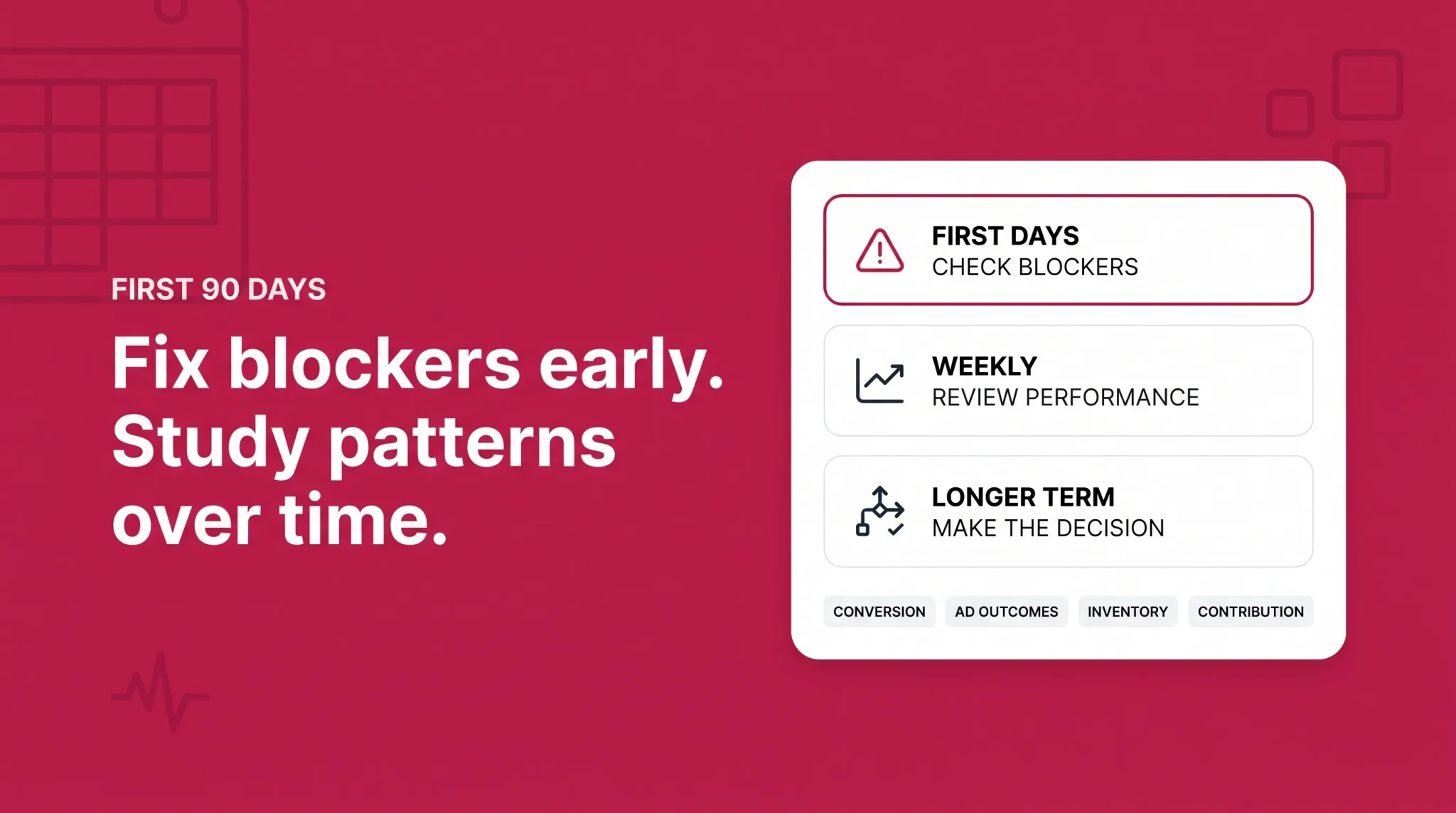
Daily optimization is not a strategy, and frantic bid and content changes in week one usually destroy the signal you need in week four.
In the first days after traffic begins, watch for blockers rather than optimizing: a suppressed listing, a missing Featured Offer, inventory that is not actually available, campaigns that are not delivering, a broken variation, the wrong price, or an unexpected compliance flag. These are binary problems and they need same day attention.
Weekly through the launch, review the substance: sessions, unit session percentage, units ordered, Featured Offer percentage, spend against attributed outcomes, review and return themes, inventory coverage, search term learning, and contribution margin. Treat the first week, first month, and first ninety days as approximate observation windows rather than deadlines, because the right cadence depends on your sales volume, category, and how much data your traffic generates.
The Launch Readiness Checklist
Run this before you turn on traffic, not after.
Demand validation completed rather than assumed
Differentiation clear and defensible on a detail page
Contribution margin modeled including fees, fulfillment, ads, promotions, and returns
Product and category eligibility confirmed
Compliance and certification evidence ready
Catalog structure and variation relationships correct
Listing complete, active, buyable, and not suppressed
Images, video, and A+ Content ready and checked on mobile
Price intentional and sustainable after any promotion ends
Inventory sellable and confirmed available
Replenishment lead time, reorder point, and next order funding modeled
Campaign structure, budget, and learning hypothesis agreed before spend
Vine eligibility checked early enough to enroll ahead of launch
Review process confirmed compliant, with zero manipulation tactics
New Seller Incentives and New Selection Program (2026) eligibility checked before listing and inbound
Baseline metrics saved so later changes can be measured
Scale or stop criteria agreed, with a named owner
Launch execution is mostly sequencing, and sequencing is easy to get wrong when one team is handling sourcing, catalog, creative, ads, and cash flow at once. If you want a second set of eyes before you commit inventory and budget, Flairox can run a launch readiness review with you: catalog and listing readiness, a compliant early review plan, launch campaign coordination, inventory and contribution margin modeling, and a first ninety days diagnosis that ends in a clear decision about whether the ASIN should scale, be fixed, repositioned, held, or retired. Schedule a call if that would be useful.
Frequently asked questions
Work through readiness gates rather than a calendar. Confirm product, catalog, retail, and inventory readiness, plan compliant early reviews, activate demand deliberately, then diagnose results before deciding whether to scale, fix, reposition, hold, or exit.