 Bilal Siddiqui

Key takeaways
Unpredictable Supply Limits Compounding: Unlike wholesale or private label models, arbitrage businesses do not compound over time because inventory cannot simply be reordered. Every single unit sold requires a fresh, manual sourcing decision to replace it.
The Sourcing Trade-Off: Retail arbitrage allows you to find hidden, local deals with low competition, but it is severely bottlenecked by travel time and shallow stock. Online arbitrage offers better inventory depth and systematized research, but highly visible deals attract immediate competition that can quickly tank the selling price.
Permission and Paperwork Realities: Being legally allowed to resell a product does not guarantee Amazon will grant you permission to list it, as restrictions exist at the category, brand, and ASIN levels. Furthermore, Amazon routinely rejects standard retail receipts when verifying inventory sources, creating a persistent structural risk for arbitrage sellers.
A Price Gap is Not a Margin: A visible difference between a retail clearance price and an Amazon listing price does not equal profit. True profitability requires calculating the net return only after subtracting referral fees, fulfillment costs, inbound shipping, prep center fees, and allowances for returns.
Amazon arbitrage is the most accessible way to start selling on Amazon and one of the easiest to lose money on. The mechanics look simple: find a product selling for less at a retailer than it sells for on Amazon, buy it, list it, keep the difference. What that description leaves out is that the difference is not your profit, that a large share of attractive-looking products cannot legally be listed by you at all, and that the price you based your purchase on can move before your stock arrives.
This guide covers what arbitrage actually involves: how retail and online sourcing differ, how to evaluate a product properly before committing money, which restrictions and documentation requirements apply, how FBA and FBM change the workload, what the tools do, and how to start without buying a garage full of inventory you cannot sell.
What Amazon Arbitrage Is
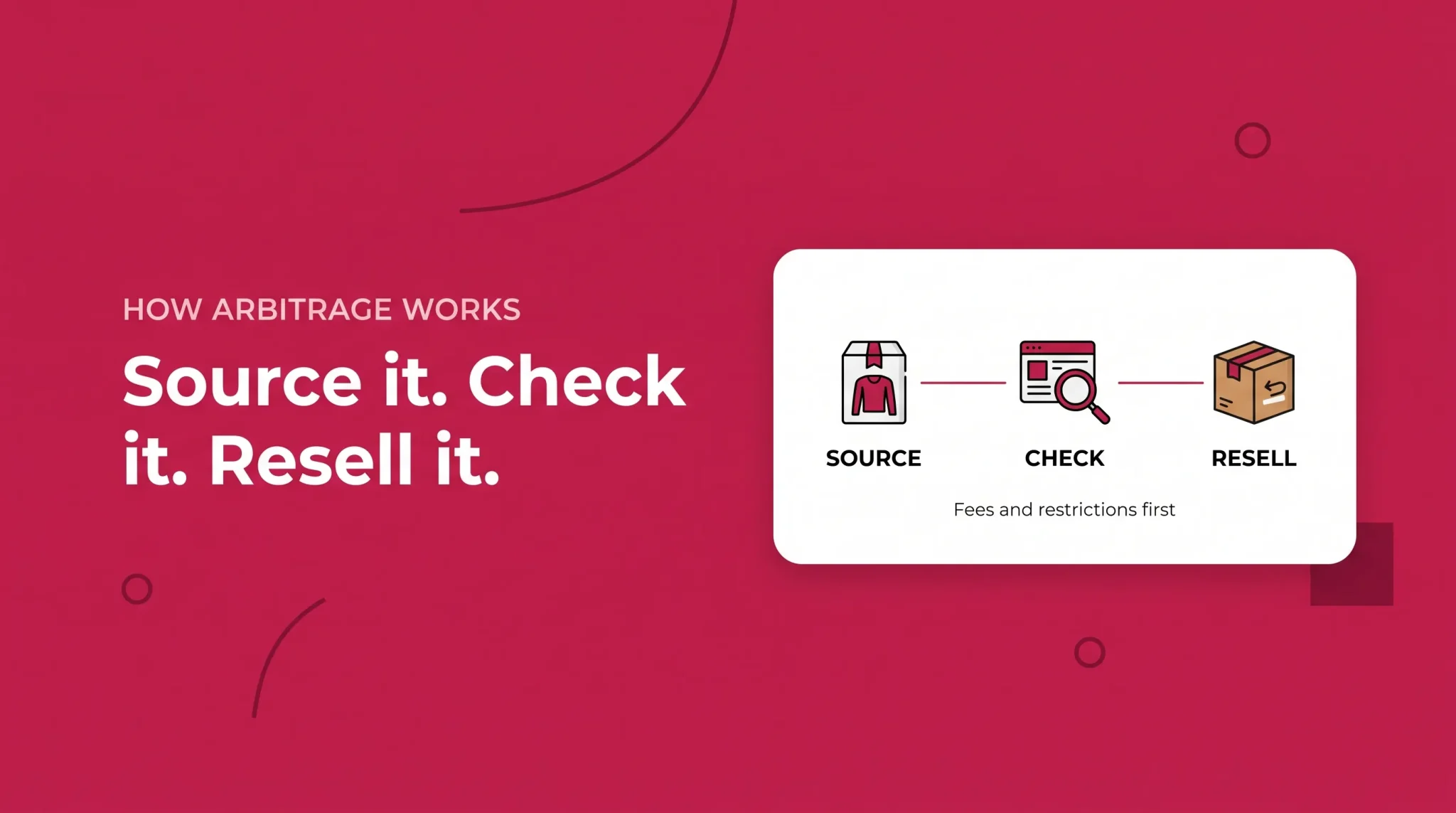
Arbitrage means buying inventory at one price and reselling it at a higher one on Amazon. You take physical possession of the goods, you own them, and you resell them on an existing Amazon listing created by the brand or another seller. You are not creating a product, you are not building a brand, and in most cases you are not creating a listing either. You are adding your offer to a product page that already exists.
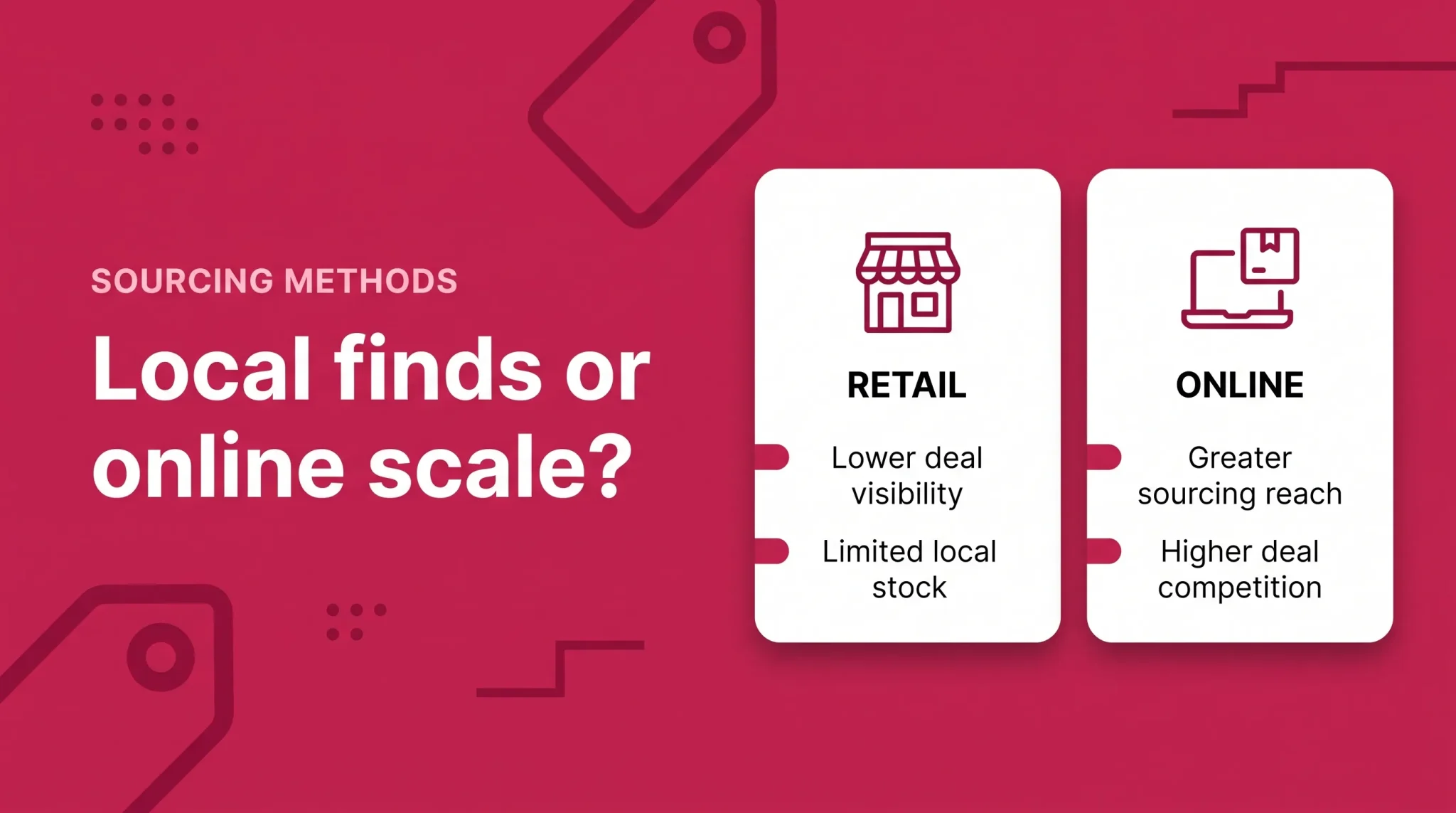
There are two variants. Retail arbitrage means sourcing from physical stores. Online arbitrage means sourcing from online retailers. Both are the same commercial model with different sourcing mechanics, and most sellers who stay in this eventually do some of each.
The distinguishing feature against every other Amazon model is inventory ownership combined with unpredictable supply. Unlike wholesale or private label, you cannot reorder. When the clearance run is gone, that product is gone, and the work of finding the next one starts again. This is the single most important thing to understand about arbitrage as a business: it does not compound the way a branded catalog does, because every unit sold has to be replaced by a fresh sourcing decision.
How this differs from dropshipping. Arbitrage means you buy the inventory first and handle it. Dropshipping means a supplier ships to the customer and you never hold the product. The two get confused because of a specific practice that sits between them: sourcing from a retailer and having that retailer ship straight to the Amazon customer. That is not arbitrage, and it breaches Amazon's Drop Shipping Policy, which requires that only your business appears on packing slips, invoices, and packaging. If you are considering that route, read a dedicated dropshipping guide first, because the compliance rules are entirely different from the ones in this article.
Is Amazon Arbitrage Legal, and Does Amazon Allow It?
There are four separate questions here, and sellers get into trouble by answering the first one and assuming it settles the rest.
Resale legality. Reselling genuine goods you lawfully purchased is generally permitted in many jurisdictions, and in the United States this principle is commonly discussed under the first-sale doctrine. That said, exhaustion rules, parallel import treatment, and exceptions vary by country and by product type, so this is not a universal guarantee and it is not legal advice. If you are operating outside the US, or dealing with products subject to specific regulation, take advice on your own situation.
Amazon marketplace policy. Amazon does not prohibit reselling. Third-party sellers list products they did not manufacture as a matter of course. But Amazon's permission to sell any given item is separate from your legal right to resell it, and Amazon can restrict listing privileges for reasons that have nothing to do with legality.
Brand, category, and ASIN restrictions. This is the practical constraint. Amazon gates products at multiple levels, and approval at one level does not carry to another. As one Amazon seller forum contributor put it in a thread where Amazon moderators were participating, being ungated for a category does not mean being approved for the many brands inside that category, each of which can carry its own restriction. You can be approved for a category, still see "Apply to sell" on a specific product, and be asked for further documentation for that brand.
Documentation. Amazon can ask you to prove where your inventory came from, and it can ask long after the sale. This is where arbitrage is structurally disadvantaged, and it deserves its own treatment below.
The short version: legal to resell does not mean allowed to list, and allowed to list does not mean you will never be asked to justify it.
Retail Arbitrage
Retail arbitrage means sourcing from physical stores. In practice that means clearance aisles, end-of-season markdowns, store closures, seasonal resets, and regional overstock at big-box retailers, pharmacy chains, discount stores, and grocery outlets.
The workflow is straightforward. You walk the store, scan barcodes to pull up the Amazon listing and its economics, and buy the items where the numbers work and you are approved to sell. Then you take the stock home, prep it, and either send it to Amazon or fulfill it yourself.
Its real advantage is inventory that is not visible to everyone else. A markdown in one store in one city is not indexed anywhere. That local, temporary, physically-bound supply is exactly why retail arbitrage still works for some sellers when online deals are picked over within minutes of being posted.
Its constraints are just as concrete. Availability is unpredictable, which means a productive trip and an empty one look identical until you arrive. Quantities are shallow, so a product that works might only work for six units. Your capacity is bounded by driving time, and the work does not delegate easily. And the model resists automation almost entirely, because the sourcing step is a person physically standing in a store.
That gives retail arbitrage a hard ceiling. It can generate real income for a hands-on operator. It scales only by adding hours or adding people, and the economics of paying someone to walk stores are considerably tighter than they look.
Online Arbitrage
Online arbitrage means sourcing from online retailers, marketplaces, and brand websites, then having the goods delivered to you or to a prep service before they reach Amazon.
The obvious appeal is that it runs from anywhere, at any hour, without travel. Deal research can be systematized, stock depth is often greater than a single store's clearance rack, and you can buy quantities that make the sourcing time worth spending.
The equally obvious problem is that every other online arbitrage seller can see the same deal. A publicly visible discount attracts multiple sellers to the same ASIN, and the resulting competition tends to compress the selling price at precisely the moment several sellers' inventory arrives. Speed matters more here than in retail sourcing, which is a poor foundation for careful decisions.
There are also costs the retail version does not have. Inbound shipping to you, then outbound shipping to Amazon, is two legs rather than one. Prep centers charge per unit, which is worth it for the workflow but has to be in the math. Returns to the original retailer are slower and more procedural when something is wrong.
On workflow. Sellers generally route online-sourced goods one of three ways: to their own address for inspection and prep, to a prep center that receives, inspects, labels, and forwards to Amazon, or occasionally direct to Amazon where the supplier is a genuine wholesale relationship able to meet Amazon's inbound requirements. Having a retailer ship directly to your Amazon customer is not one of the options, for the policy reasons noted earlier.
Retail vs Online Arbitrage Compared
Retail arbitrage | Online arbitrage | |
|---|---|---|
Where you source | Physical stores, clearance and markdown | Online retailers, marketplaces, brand sites |
Deal visibility | Local and largely invisible to others | Visible to anyone looking, often widely shared |
Competition on the same buy | Lower, limited by geography | Higher, and often simultaneous |
Typical quantity available | Shallow, sometimes a handful of units | Deeper, sometimes limited only by budget |
Time cost | Travel and in-store hours | Screen time, faster per deal evaluated |
Additional costs | Fuel and time | Inbound shipping, prep fees |
Speed to inventory | Immediate, you leave with it | Days, subject to delivery |
Automation potential | Very limited | Partial, research and monitoring can be systematized |
Delegation | Difficult and expensive | Easier for research and prep |
Main risk | Wasted trips, thin quantities | Price tanking when several sellers buy the same deal |
Neither is better in the abstract. Retail suits someone with time, local retail density, and patience for variance. Online suits someone with capital, willingness to compete, and the discipline to pass on deals that too many people have already seen. Most sellers who last do both, using retail for the finds nobody else has and online for depth.
Evaluating a Product Before You Buy
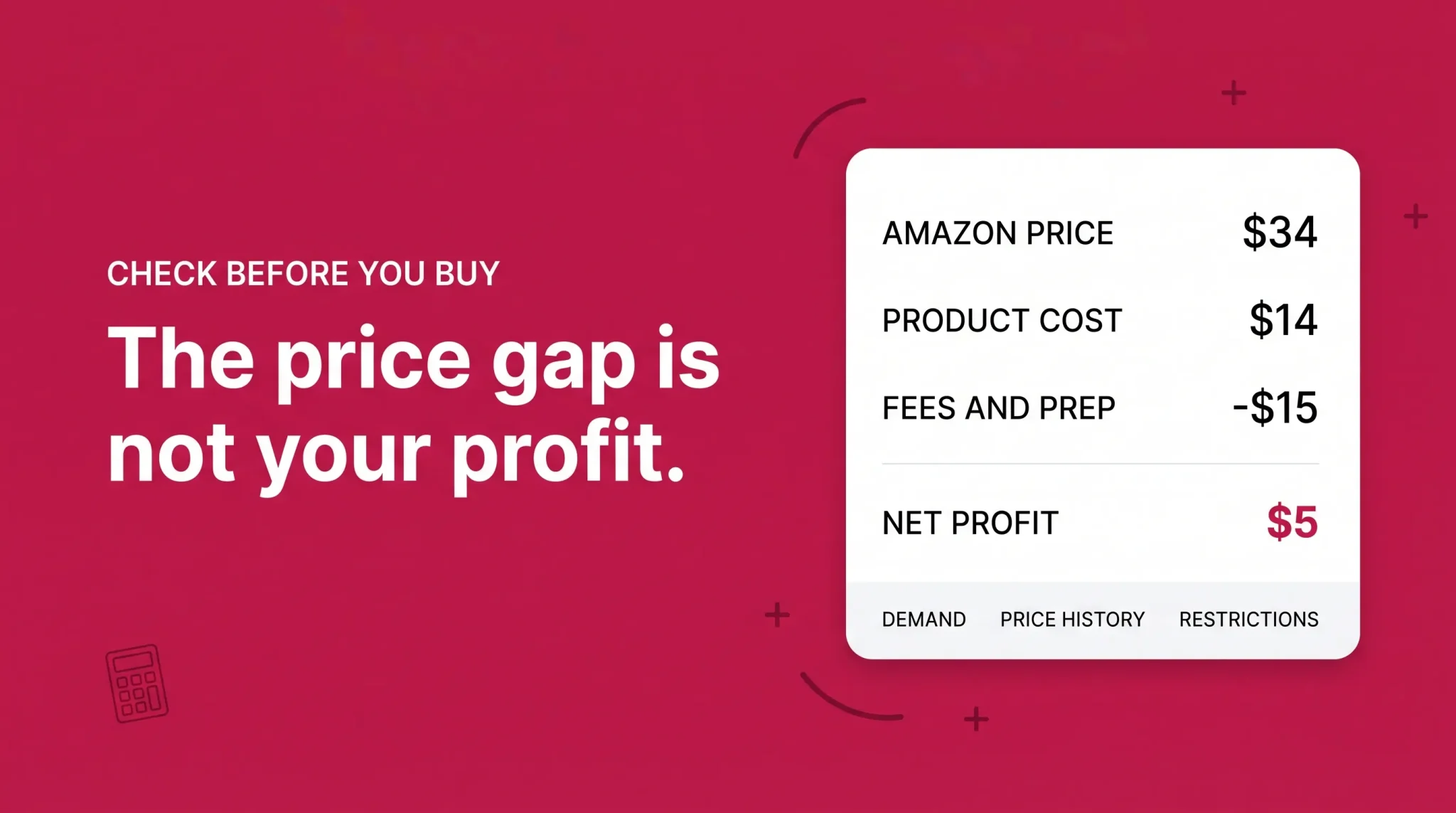
This is where arbitrage is won or lost, and it is the step beginners compress into a glance at two prices.
Start with the arithmetic, because it is unforgiving:
Net profit per unit = Amazon selling price minus referral fee minus fulfillment cost minus cost of goods minus inbound shipping and prep minus an allowance for returns and storage
Return on investment matters more than margin percentage in this model, because your capital recycles. A product returning 30 percent on cost in six weeks does more for a small operation than one returning 50 percent over six months, since the first freed up the cash to buy again. Sell-through speed is not a secondary consideration here, it is half the return.
Beyond the math, work through these before committing money.
Demand and sell-through. Sales rank within the product's own category gives a rough sense of movement, but rank means different things in different categories and it is a snapshot rather than a trend. What you want to know is roughly how many units the listing moves in a month and whether your quantity can clear in a reasonable window.
Competing sellers. Count how many sellers are on the listing and how much stock they appear to hold. A listing with a dozen FBA sellers is a queue you are joining at the back. If Amazon itself is selling the item, expect to compete for the featured offer on unfavorable terms.
Featured offer dynamics. Winning the sale generally means holding the featured offer position, and offers rotate. On a crowded listing your share may be a fraction of total sales, which stretches your sell-through window well beyond what a rank estimate suggested.
Price history. Current price is the least reliable number on the page. What matters is where the price has sat over the past several months, how volatile it is, and whether the current price is an outlier that will revert. Buying against a temporary spike is one of the most common ways to lose money here.
Restrictions. Check whether you can list the product before buying it, not after. In Seller Central, attempting to add the product will show whether approval is required. This check takes seconds and prevents the most avoidable loss in arbitrage.
Inventory depth and seasonality. Ask whether the quantity available justifies the sourcing time, and whether demand is about to fall off a cliff. Seasonal goods bought at clearance are cheap for a reason, and holding them until next season means storage cost and locked capital.
Return risk. Categories with sizing, fit, or compatibility variance return at higher rates. A returned unit in arbitrage frequently cannot be resold as new, which converts a sale into a full loss plus fees.
Condition and packaging. Retail-sourced goods carry clearance stickers, shelf wear, opened boxes, and price tags. Anything you list as new has to genuinely arrive as new, and residue from a sticker you failed to remove becomes a customer complaint about condition.
A visible price gap is not a margin
Three short examples make the point better than argument.
The gap that was never there. An item sells at a retailer for $14 and shows $34 on Amazon. The apparent gap is $20. Subtract a referral fee on $34, a fulfillment fee for the size and weight tier, inbound shipping, and a prep allowance, and the remainder is a few dollars per unit before any return occurs. One return across a small batch can erase the batch. The gap was real. The margin was not.
The gap you cannot access. The same math works beautifully, and then the listing shows "Apply to sell." The brand is gated, and the documentation Amazon will accept is not a retail receipt. The stock is now yours and unsellable on Amazon at the price you modeled.
The gap that closed. Twelve sellers spot the same online deal in the same week. All twelve send inventory. The price on the listing falls as sellers undercut each other to move stock, and by the time your units are receivable the selling price no longer supports the purchase you made against it. Nothing went wrong operationally. The deal was simply too visible.
Restrictions, Documentation, and Account Risk
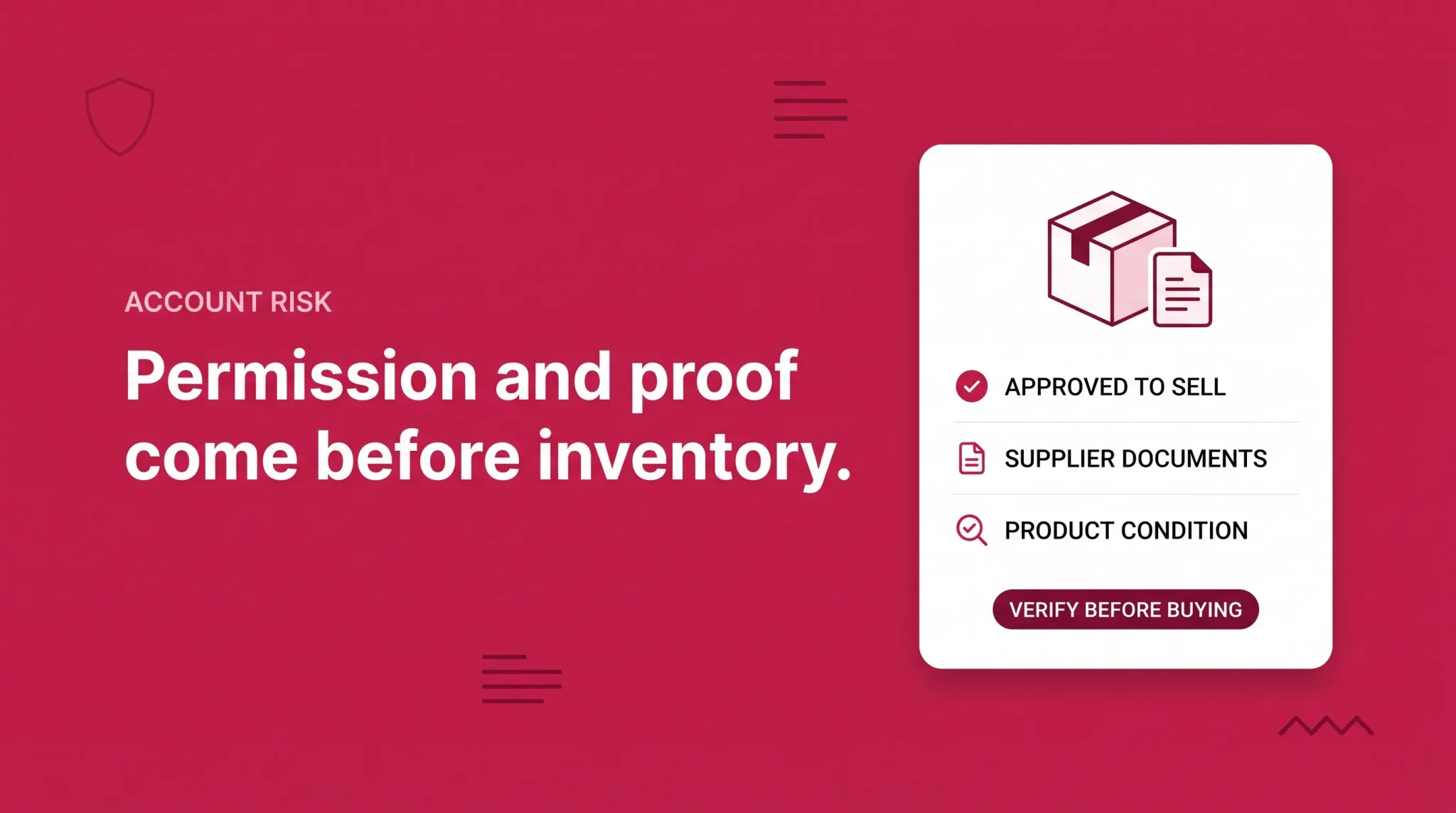
This section matters more for arbitrage than for any other Amazon model, because arbitrage sourcing produces exactly the kind of paperwork Amazon tends not to accept.
Gating operates at several levels. Restrictions can sit on a category, on a brand, or on an individual ASIN. Clearing one does not clear the others. This is a recurring source of confusion in the Amazon seller forums, where sellers approved for a category find themselves still unable to list a specific brand within it and are asked for further documentation.
Retail receipts are the core problem. When Amazon asks a seller to substantiate sourcing, it generally expects a commercial invoice from a supplier it can verify: a real business name, address, and contact details, with the invoice matching the business details on the seller account and showing that it has been paid. A till receipt from a retail store does not look like that. Sellers routinely report that retail receipts are rejected in approval and verification processes, and Amazon moderators responding in the forums direct sellers to the Seller University material on invoice requirements rather than endorsing retail proof of purchase. Requirements also vary by category and brand, and unit minimums have been reported at different levels in different cases, so treat the specifics in your own account as the authority.
The practical consequence for an arbitrage seller is straightforward. Your sourcing may be entirely legitimate and your documentation may still fail an Amazon review. Keep every receipt and record regardless, since having imperfect documentation is better than none, but do not build a business on the assumption that receipts will satisfy a verification request.
Intellectual property complaints. Brand owners can file complaints against listings and sellers. A complaint does not require that you did anything wrong, and defending one usually requires exactly the documentation discussed above. Reselling a brand that actively polices its distribution is a known risk in arbitrage, not an unlucky accident.
Authenticity. Inauthentic-item claims are among the more serious issues an account can face, and they are resolved with supply chain evidence. Sourcing from unfamiliar online sellers or grey-market channels raises this risk considerably.
Condition and safety. Products must match the condition you listed them in. Separately, recalled or unsafe products cannot be sold, and the obligation to check sits with you. Clearance is sometimes clearance because a product is being withdrawn.
Account health. Late shipments, cancellations, condition complaints, and IP notices all feed the same account health picture. Arbitrage tends to involve many small purchases across many listings, which means many opportunities for a single problem.
Nothing here makes arbitrage unworkable. It does mean the compliance checks belong before the purchase, not after the complaint.
FBA and FBM for Arbitrage Sellers
Most arbitrage sellers use FBA, and the reasons are practical rather than ideological.
With FBA you prep the units, label them, ship them into Amazon's fulfillment network, and Amazon handles storage, picking, packing, shipping, customer service, and returns. Your offer becomes Prime eligible, which matters on competitive listings. The trade is that you pay fulfillment fees and storage fees, you carry the inbound shipping cost, and you must meet Amazon's prep and labeling requirements, which vary by product type. Units sitting unsold accrue storage costs, and long-term storage on slow movers is a real drag on arbitrage returns.
With FBM you keep the stock and ship each order yourself. You avoid fulfillment and storage fees and you keep control over condition and packaging, which suits fragile, bulky, or low-value items where FBA fees would consume the margin. The cost is your time on every order, your responsibility for delivery performance and returns handling, and generally weaker competitiveness on listings where most offers are Prime eligible.
Many arbitrage sellers run both: FBA for the bulk of stock, FBM for oddly shaped items, very small quantities, or products where they want to inspect before shipping. The decision is per product rather than per business, and it should be made with the fee math in front of you.
The Tools Arbitrage Sellers Use
Tooling in arbitrage exists to answer one question faster: is this specific unit worth buying right now. The categories below describe what sellers use rather than endorsing particular products, because the market changes frequently and the right choice depends on your sourcing method and volume.
Tool type | What it does | Where it matters |
|---|---|---|
Scanning apps | Read a barcode and pull up the matching Amazon listing, current price, and your eligibility to sell it | In-store, retail arbitrage |
Fee and profit calculators | Estimate referral and fulfillment fees for a product to produce a net figure before buying | Both, at the point of decision |
Price and rank history | Show how price and sales rank have moved over months rather than today | Both, to avoid buying against a spike |
Sales and rank analysis | Estimate how many units a listing moves and how competitive the offer pool is | Both, for sell-through planning |
Sourcing and deal research | Scan online retailer catalogs against Amazon data to surface candidate products | Online arbitrage |
Repricing | Adjust your price automatically against competing offers | Both, once you hold multiple listings |
Inventory and accounting | Track cost of goods, units on hand, and actual realized profit per product | Both, once volume outgrows a spreadsheet |
Amazon provides several of these itself. The Amazon Seller app includes scanning and listing functions and is where many sellers start, and the FBA Revenue Calculator lets you model fees and margins for a product before committing. Product Opportunity Explorer gives demand and niche data inside Seller Central. Starting with Amazon's own tools is a reasonable way to learn what the paid alternatives are actually adding before you subscribe to anything.
One caution worth stating plainly. Tools produce estimates. Rank-to-sales conversions, competitor stock levels, and projected featured offer share are all inferred rather than known. Treat them as inputs to a judgment rather than as answers, and be particularly careful with any tool that presents a single profit number without showing its assumptions.
Can Amazon Arbitrage Actually Be Profitable?
It can be. Whether it will be for you depends on variables nobody publishing a number can know.
Profitability in arbitrage is a function of sourcing quality, fee structure in your categories, how fast inventory turns, and how much competition arrives on your listings. Two sellers with identical capital and identical effort can produce very different results because one found a supply source others had not, and the other bought deals from a widely circulated list.
Here is what erodes returns in practice, in roughly the order it catches people out. Fees are larger than expected, particularly fulfillment on bulky or heavy items. Price drops after purchase, driven either by competing sellers or by the brand's own pricing. Unsold inventory that ties up capital and accrues storage. Returns, which in this model frequently cannot be resold as new. Prep and shipping costs that seem trivial per unit until multiplied. And business costs that exist whether or not the month went well: the selling plan, tooling subscriptions, prep services, and taxes on whatever you do make.
You will find plenty of published figures claiming specific margin ranges or monthly incomes for Amazon arbitrage. Treat them as marketing. There is no credible dataset isolating arbitrage profitability, the sample of people publishing their results is heavily self-selected, and the sourcing conditions that produced any specific result are rarely reproducible. Model your own numbers on your own products and let a few months of real data tell you whether this works at your scale.
What can be said fairly: arbitrage has a genuinely low barrier to entry, it teaches the mechanics of selling on Amazon quickly and cheaply, and it produces real income for hands-on operators who source well and count carefully. It also has a structural ceiling, because every sale must be replaced by new sourcing work, which is why many sellers eventually move toward wholesale or their own brand.
Starting Responsibly
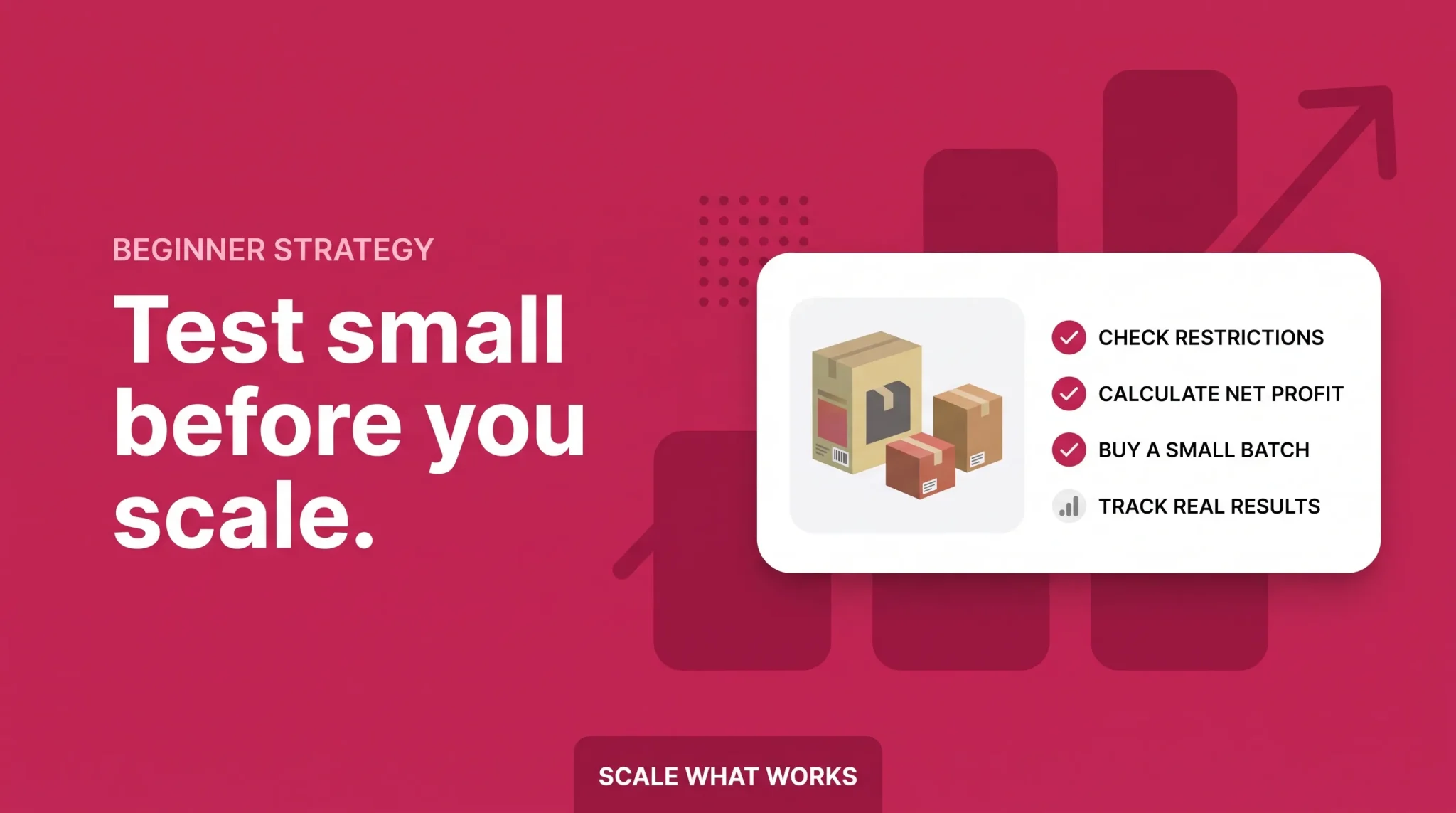
A practical sequence for a first three months:
Open a seller account and choose a selling plan appropriate to your expected volume rather than defaulting to the cheaper option
Learn where restrictions sit before sourcing, and make the "can I list this" check a habit rather than an afterthought
Pick one sourcing method to start with, retail or online, and get good at it before adding the second
Research every candidate properly: demand, competing offers, price history, fees, and restrictions
Calculate net profit per unit and return on cost, not the price gap
Buy a small test quantity on your first purchases, even when the numbers look excellent
Keep every receipt, invoice, and record from day one, filed against the product
Prep and list to Amazon's condition and labeling requirements, removing all retail stickers and packaging
Choose FBA or FBM per product based on fee math and product characteristics
Track actual realized profit after fees and returns, not projected profit at purchase
Monitor price, competition, and sell-through weekly, and be willing to exit a product at a loss rather than hold indefinitely
Scale only the products and sourcing routes your own data proves out
The discipline that separates sellers who last is unglamorous: they check restrictions before buying, they test small, and they measure what actually landed in the bank rather than what the calculator predicted.
Arbitrage rewards the boring parts: checking restrictions before you buy, counting fees honestly, and knowing your real return rather than your projected one. If you want a second opinion on whether a sourcing approach or a specific category is worth committing capital to, book a free strategy call.
Frequently asked questions
Buying products at a lower price from retailers or online sources, taking physical possession of them, and reselling them on existing Amazon listings for a margin. It covers both retail and online sourcing methods.