 Bilal Siddiqui

Key takeaways
Dropshipping is a low-investment business model where sellers list products they don’t own.
Amazon allows dropshipping under strict guidelines.
Choosing the right niche, supplier, and tools is essential for success.
Automation, brand building, and policy compliance will shape dropshipping in 2025.
Dropshipping is probably the most misunderstood way to sell on Amazon. Search the term and you will find two contradictory answers within the first page of results: that Amazon bans it, and that it is a low-effort route to a passive income. Neither is accurate. Amazon permits dropshipping under a specific written policy, and most sellers who lose their accounts over it did so by running a version of the model that was never compliant to begin with.
The gap between those two ideas is where this guide sits. What follows covers what Amazon’s policy actually requires, how a compliant setup works order by order, how to evaluate suppliers, what the economics look like once every cost is counted, and where the real risks are. It is written for someone genuinely weighing whether to do this, not for someone looking to be sold on it.
What Amazon Dropshipping Is
Dropshipping is a fulfillment method, not a business model in its own right. You list a product on Amazon without holding stock. When a customer orders it, you place a corresponding order with your supplier, and the supplier ships the item directly to your customer.
Amazon describes dropshipping as a fulfillment method where you outsource inventory operations and sell online without managing products yourself, which avoids purchasing products that might not sell, but which also brings limited control over product quality, fulfillment processes, and shipping timelines. That second half of the sentence is the part most guides omit, and it is the source of nearly every operational problem in this model.
The important framing for Amazon specifically: dropshipping does not change your status as a seller. You are a third-party seller on the marketplace, with the same account health obligations, the same performance metrics, and the same customer service responsibilities as a seller who stores and ships their own stock. Outsourcing the physical work does not outsource the accountability.
Is Amazon Dropshipping Legal, and Is It Allowed on Amazon?
These are two separate questions and they deserve separate answers, because conflating them is how sellers end up confidently doing something that is perfectly legal and still gets their account deactivated.
Legality. Dropshipping is a legal fulfillment arrangement. Amazon states that dropshipping is a legal form of fulfilling orders in the Amazon store and beyond, subject to applicable laws and regulations in the countries or regions where you sell. Nothing about paying a supplier to ship goods to your customer is inherently unlawful. Standard business obligations still apply: sales tax where you have obligations, product safety and labeling rules for your category, and any import requirements if goods cross a border.
Marketplace policy. This is the binding constraint in practice. Amazon states that dropshipping is allowed in the Amazon store as long as you follow Amazon’s Drop Shipping Policy. Legality gets you nowhere if your setup breaches the policy, because Amazon does not need a law to have been broken in order to restrict your selling privileges. The policy is a contractual condition of using the marketplace.
So the honest answer is: legal, permitted, and conditional. The conditions are specific and they are not difficult to understand. They are difficult to satisfy with certain kinds of supplier.
Amazon’s Drop Shipping Policy: What It Actually Requires
Amazon’s policy turns on a single concept. Drop shipping, or allowing a third party to fulfill orders to customers on your behalf, is not acceptable unless it is clear to the customer that you are the seller of record.
Everything else follows from that. If you intend to fulfill orders using a supplier, a third-party logistics company, or a drop shipper, Amazon requires that you do the following.
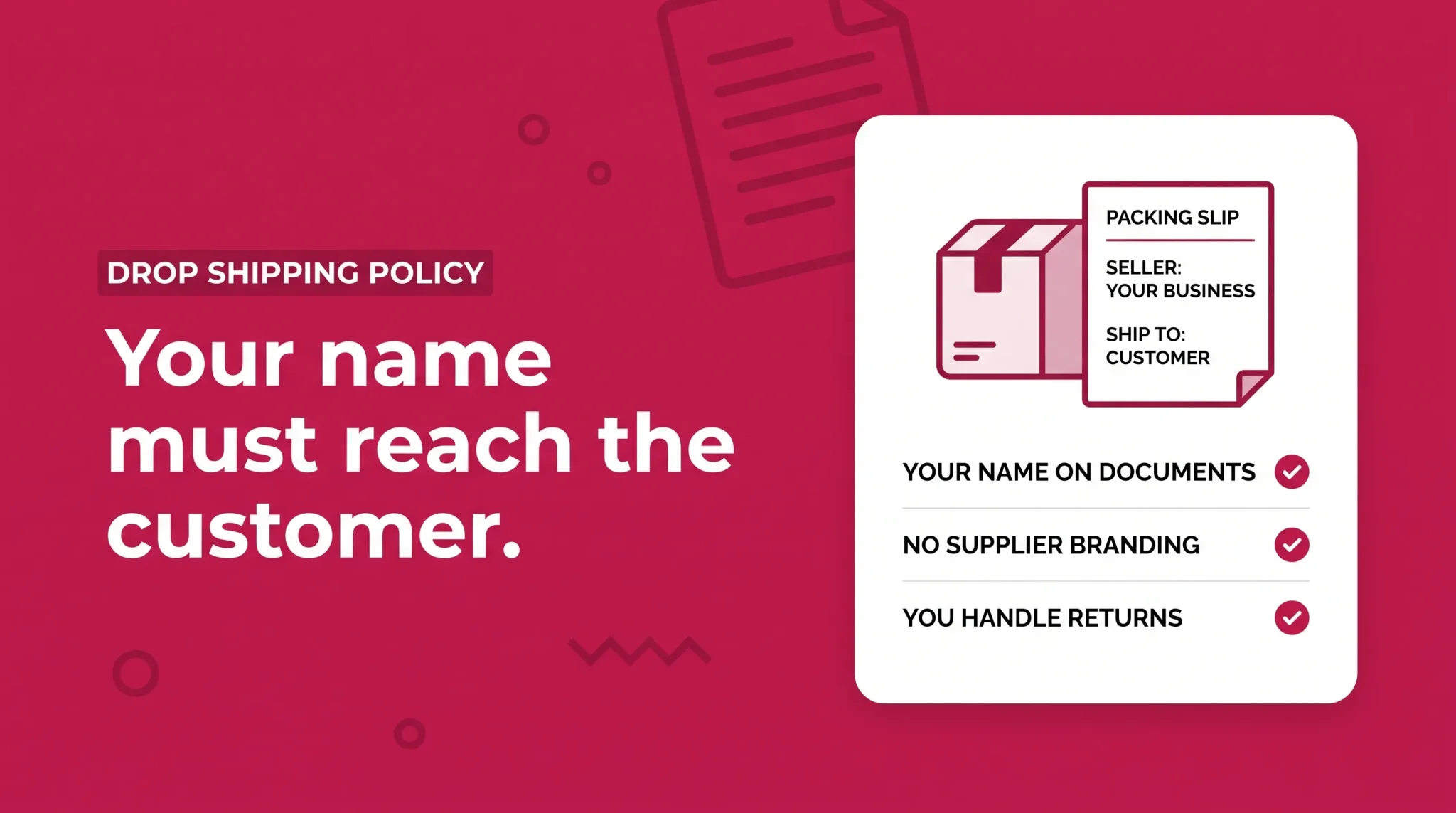
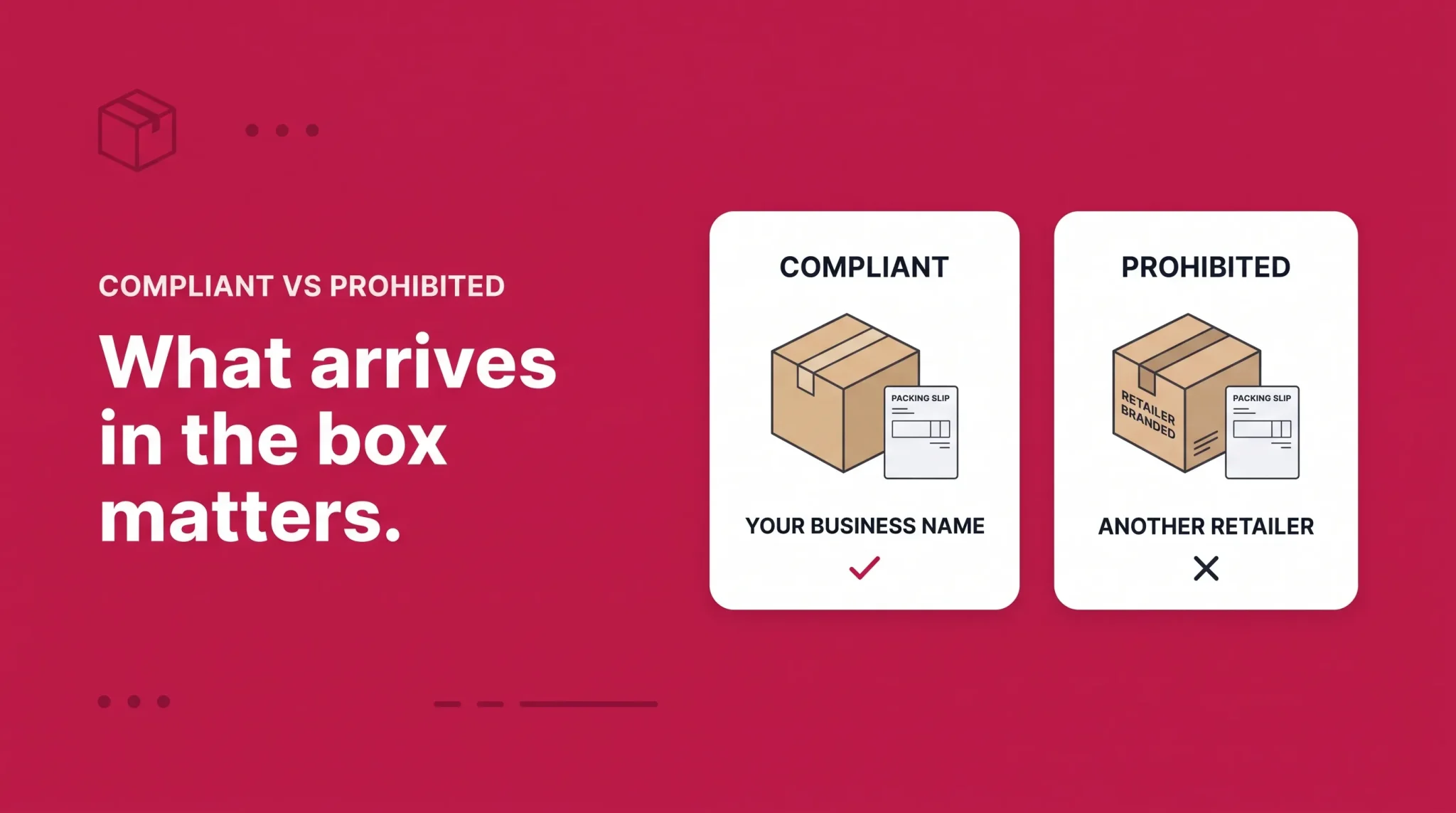
Have an agreement with your supplier that they will identify you, and no one else, as the seller of your products on all packing slips, invoices, external packaging, and other information included or provided in connection with the products. Remove any packing slips, invoices, external packaging, or other information identifying a third-party drop shipper prior to shipping the order. Be responsible for accepting and processing customer returns of your products. Comply with all other terms of your seller agreement and applicable Amazon policies.
Amazon expands on what being the seller of record means commercially. It means you own the products before customers purchase them, and that you are responsible for setting the price, recording the purchase as revenue, and handling sales tax. That is a meaningful test. An arrangement where you never take ownership and simply pass an order through to another retailer does not satisfy it.
Amazon also names the prohibited patterns explicitly. Purchasing products from a third party, including Amazon or another seller in Amazon’s stores, and having that third party ship directly to customers, if the shipment does not identify you as the seller of record or if anyone other than you appears on packing slips, invoices, or external packaging, is strictly prohibited without exception. Shipping orders with packing slips, invoices, external packaging, or other information indicating a seller name or contact information other than your own is also strictly prohibited.
The consequences are stated just as plainly. Amazon has said that any violation of the Drop Shipping Policy will negatively affect your account health and your ability to fulfill future orders using the Merchant Fulfilled Network. In practice, sellers also report full account deactivations citing drop shipping violations, sometimes alongside a Seller Code of Conduct violation, and those appeals are widely regarded as among the harder ones to resolve.
Two things are worth stressing here. First, "strictly prohibited without exception" is Amazon’s phrasing, not an interpretation. Second, no supplier, service, or automation tool makes a setup compliant by itself. Compliance is a property of the whole arrangement: who is named on the paperwork, who owns the goods, who handles returns. A supplier advertising Amazon compatibility or blind shipping is a necessary condition at best, never a sufficient one.
Where Sellers Actually Get Caught
The single most common failure is the retail-to-customer pattern. A seller lists an item on Amazon, waits for an order, buys the item from another retailer’s website, and enters that customer’s address as the shipping destination. The customer receives a box with another retailer’s branding, a packing slip with another retailer’s name, or a gift receipt. That is a policy violation, and it is one Amazon can detect from a single customer message.
It is worth being direct about why this pattern is so common: it requires no supplier relationship, no negotiation, and no minimum order. It is also the version of dropshipping that Amazon names first in its list of prohibitions. Ease and compliance point in opposite directions here.
Three shorter versions of the same problem:
A compliant arrangement. You have a written agreement with a wholesale supplier or manufacturer. Your business name appears on the packing slip and any invoice inside the box. There is no third-party branding on the external packaging beyond neutral carrier labeling. You take ownership of the unit, set the price, record the revenue, and process returns to your own address or an agreed return location. Amazon’s policy is satisfied.
A clear violation. You buy from a large online retailer and have them ship to your customer. Their name is on the slip and the box. It does not matter that you paid for the item, that the customer received it on time, or that they were happy. Amazon’s wording covers this case without exception.
An arrangement that looks fine and is not. Your supplier agrees to ship blind, but occasionally an order routes through a fulfillment partner whose branded insert ends up in the box, or an invoice with the supplier’s letterhead is included on higher-value orders. Nothing was intended, but the customer still sees a name that is not yours. Because compliance is judged by what the customer receives, intermittent slips carry the same risk as deliberate ones. This is why the supplier agreement and periodic test orders matter more than a verbal assurance.
How Amazon Dropshipping Works, Step by Step
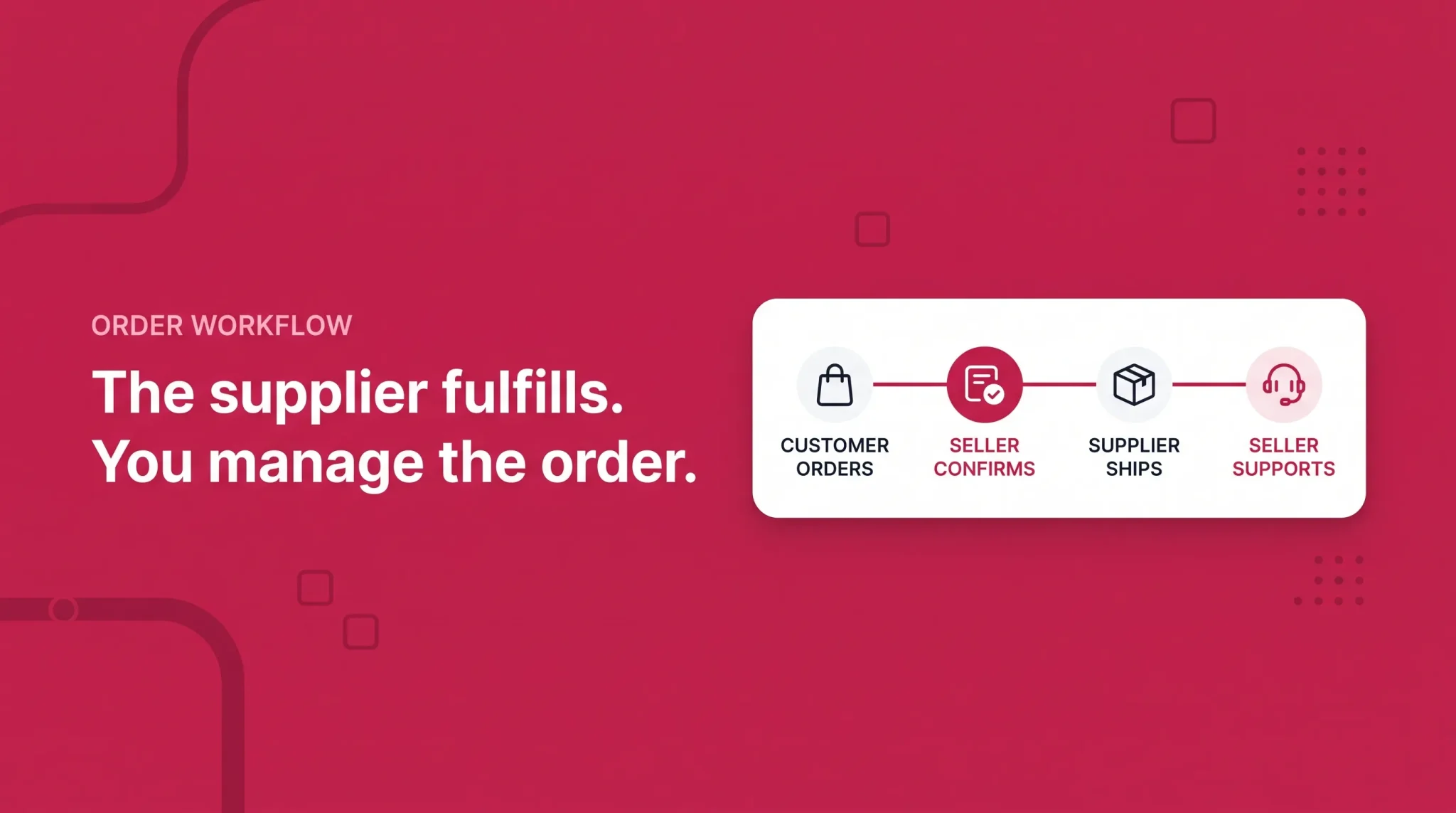
A compliant setup runs through the same sequence on every order.
1. Product selection and listing. You choose products from a supplier’s catalog, or identify products you want to sell and then find suppliers for them. You either match an existing Amazon listing or create one. Pricing is yours to set and yours to maintain.
2. The customer order. A shopper buys from your offer on Amazon. At this point you are the seller of record and the transaction is between you and that customer.
3. Placing the supplier order. You place a corresponding order with your supplier, who then ships the order directly to the customer. The lag between these two steps is where handling time and late shipment risk live, so it needs to be either automated or reliably fast.
4. Fulfillment and tracking. Your supplier ships. You need valid tracking uploaded within Amazon’s expected window, and the shipment needs to arrive within the delivery promise attached to your listing. The package must carry no identifying information other than yours.
5. Customer service. Messages, questions, and problems come to you, not to your supplier. Response time expectations do not change because you are dropshipping.
6. Returns and refunds. Amazon’s policy places this on you explicitly. Amazon states you must be responsible for accepting and processing returns and providing customer service that meets or exceeds Amazon’s policies. How the physical return is handled, whether the supplier accepts returns, who pays return shipping, and what happens to a returned unit you never physically possessed are all questions to settle in the supplier agreement before your first sale, not after your first return.
Notice how much of that sequence is yours. The supplier does one thing: pick, pack, and ship. Everything customer-facing remains your responsibility, which is exactly what Amazon’s policy is designed to guarantee.
How Dropshipping Differs From Arbitrage
These get confused because both involve reselling products you did not manufacture, and because a specific bad practice sits at their intersection.
Arbitrage means buying inventory at a lower price, taking physical possession of it, and reselling it on Amazon at a higher price. The seller handles the goods, and typically ships them into FBA or fulfills them personally. Dropshipping means never taking physical possession, with the supplier shipping directly to the customer.
The dangerous middle ground is what some sellers call arbitrage dropshipping: sourcing from a retailer the way an arbitrage seller would, but having that retailer ship straight to the customer instead of to you. That is not arbitrage and it is not compliant dropshipping. It is the exact pattern Amazon’s policy prohibits. Arbitrage as normally practiced, where you buy the stock and handle it yourself, is a different model with its own sourcing, restriction, and invoicing considerations, and it belongs in a dedicated arbitrage guide rather than here.
Choosing Suppliers
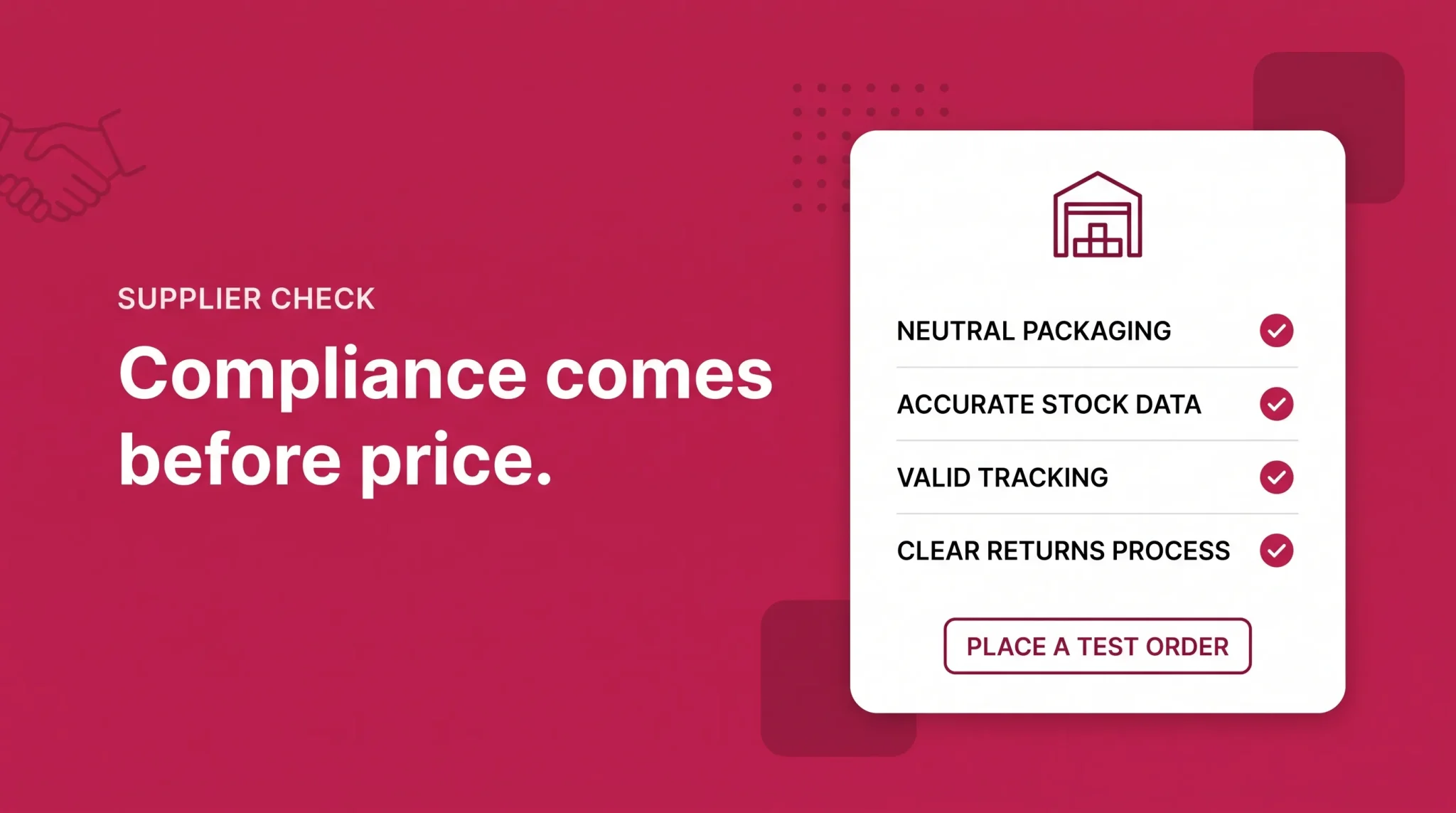
Supplier selection is not a shopping exercise. Your account health depends on decisions a supplier makes daily without consulting you, so the evaluation should be as rigorous as hiring.
Amazon’s own guidance suggests researching dropshipping services, exploring directories, and networking with manufacturers and wholesale suppliers at events such as trade shows, and asking whether a prospective supplier has experience working with Amazon sellers and is familiar with Amazon policies. That last question is the one to lead with. A supplier who cannot immediately explain how they handle packing slips and branding has probably not thought about it.
What to evaluate | What to actually ask or check |
|---|---|
Policy compliance | Will they name your business, and only your business, on packing slips, invoices, and external packaging? Get it in the written agreement, not an email reply |
Branding leakage | What inserts, catalogs, promotional materials, or branded tape do they include by default? What happens on orders routed through a partner warehouse? |
Inventory synchronization | How often is stock data updated, and by what mechanism? Daily file drops are not adequate for fast-moving items |
Handling and shipping speed | How long from order receipt to dispatch, and what carriers and service levels do they use? Compare against the delivery promise you intend to display |
Tracking | Is valid tracking provided automatically and quickly enough to meet Amazon’s expectations |
Returns process | Do they accept returns, to what address, who pays, and what is the window? Settle this before launch |
Pricing stability | How much notice do you get on cost changes? Frequent unannounced increases will quietly destroy your margin |
Order accuracy and defect rate | Ask for their error rate and check it yourself with test orders over several weeks |
Product authenticity and documentation | Can they supply invoices that would satisfy an Amazon authenticity or sourcing review |
Capacity and concentration | Can they absorb a spike, and are you dependent on a single supplier for most of your catalog |
Two practical habits separate sellers who survive this model from those who do not. Place test orders to your own address periodically, including after any change to your supplier’s operations, and inspect exactly what a customer would receive. And avoid single-supplier dependency where you can, because a supplier’s stockout or policy slip becomes your account problem instantly.
On supplier names: this guide deliberately does not publish a ranked list of dropshipping suppliers. Supplier quality varies by category, region, and account, directories go stale quickly, and a supplier that works well for one seller’s products may be a poor fit for another’s. The criteria above will serve you better than a list.
Which Products Suit Dropshipping
Amazon notes several product considerations specific to this model: you likely will not have much control over storage conditions, so perishable goods or products with special requirements such as temperature control may need to be avoided; certain products such as dangerous goods can be problematic for dropshipping; and you typically cannot customize dropshipped products because they ship directly from the supplier.
Beyond those, the practical filters are margin and fragility. Low-priced items rarely survive the fee and shipping structure once returns are counted. Fragile or bulky items expose you to damage and shipping cost volatility you cannot inspect or control. Products with high return rates, such as apparel with sizing variance, are difficult when you never handle the unit and the return logistics sit with a third party.
Category restrictions and gating apply exactly as they would for any other seller. Being a dropshipper does not change what you are approved to sell, and it does not exempt you from providing sourcing documentation if Amazon requests it. That last point rules out a lot of otherwise attractive products, because you need a supplier who can produce acceptable invoices.
Costs and Profitability
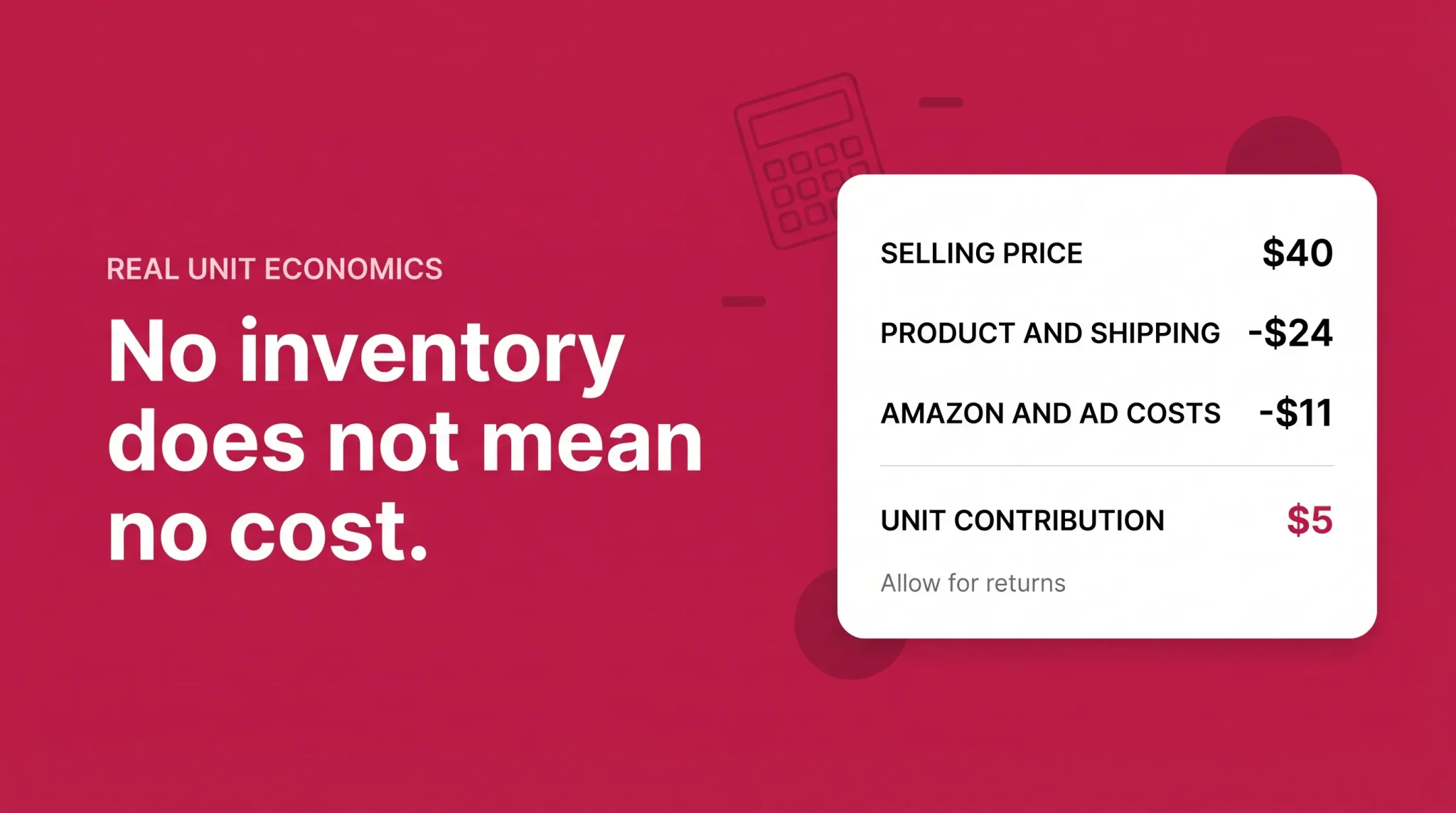
The appeal of dropshipping is that it removes inventory investment. It does not remove cost, and the cost base is easy to underestimate because most of it arrives after the sale rather than before it.
Amazon states there are no costs or fees specific to dropshipping. Selling in the Amazon store starts with a Professional selling plan at $39.99 per month plus other selling fees, with additional costs possible from optional programs. Supplier costs vary and can include product cost, storage, and shipping. Operating costs can include accounting, legal, insurance, website, and advertising expenses.
Here is the full picture per unit:
Unit contribution = selling price minus supplier product cost minus supplier shipping minus Amazon referral fee minus an allowance for refunds and returns minus advertising cost per unit sold minus software and automation cost per unit
Work through those last three, because they are the ones sellers leave out.
Refunds and returns are not an occasional event to be absorbed. In a dropshipping setup you often cannot resell a returned unit, because it went from a supplier to a customer and back somewhere you do not control. A return can therefore cost you the full product cost plus shipping both ways plus the refunded amount, which means a handful of returns can erase the margin on many clean sales. Build a realistic allowance into every product’s model before listing it.
Advertising matters because a dropshipped product is usually a product other sellers can also list. Where you are competing on an existing listing, organic visibility depends on winning the featured offer, and where you have created your own listing, you are launching an unknown product with no reviews. Either route often needs paid traffic, and that cost belongs in the per-unit math rather than in a separate marketing budget you tell yourself is temporary.
Software and automation is where the model’s operational reality shows up as a line item. Manual order forwarding does not scale past a small volume, and stock synchronization between supplier and listing is the difference between a healthy account and repeated cancellations. Whatever you spend on tooling is a real per-unit cost.
Then there is margin pressure. You are typically reselling a product available to other sellers from the same or similar suppliers, which means price is the main lever anyone can pull and everyone eventually does. Supplier cost increases arrive without warning while your listing price stays where you set it, so margins erode quietly unless someone is watching. This is structural to the model rather than a sign of doing it badly.
On profitability claims. Amazon’s own dropshipping guidance says the model can be very profitable and then cites figures showing independent sellers in the US averaged more than $375,000 in annual sales in 2025. Read that carefully: those figures describe all independent sellers in the Amazon store, not dropshippers specifically, and they describe sales rather than profit. Amazon publishes no data isolating dropshipping profitability, and neither does anyone else with a credible methodology. Anyone quoting a specific margin percentage or monthly income for Amazon dropshipping is estimating. Build your own model on your own products and treat every published figure as marketing until proven otherwise.
FBA and FBM in a Dropshipping Context
Dropshipping runs through Merchant Fulfilled Network, because your supplier is shipping the order. That matters for one specific reason: the stated consequence of a Drop Shipping Policy violation is a restriction on your ability to fulfill orders using MFN, which is the only fulfillment route a dropshipping operation has.
FBA is a different arrangement. Amazon describes FBA as requiring you to purchase inventory in advance, shipping it into Amazon’s fulfillment network where Amazon handles storage, packing, shipping, customer service, and returns, with the Prime badge available as a result. That is not dropshipping, because you bought and hold the stock.
The two are not mutually exclusive. Amazon notes that sellers can mix fulfillment methods, for example testing a product idea with dropshipping and then scaling with FBA, or using FBA for faster-selling products while reserving dropshipping for slower-moving items to avoid long-term storage. That is arguably the most sensible use of dropshipping for a serious operator: as a low-commitment way to validate demand before committing capital to inventory, rather than as the permanent shape of the business.
The Risks Worth Taking Seriously
Account health. Dropshipping concentrates several metrics in a party you do not control. Late shipment rate, pre-fulfillment cancel rate, and valid tracking rate all depend on your supplier’s execution. A supplier having a bad month becomes an account health problem for you.
Policy violations you did not intend. As covered above, an unexpected branded insert or third-party invoice is a violation regardless of intent.
Stock mismatches. Selling an item your supplier no longer has is the most common operational failure in this model. It produces cancellations, which damage metrics directly.
Slow fulfillment. Delivery promises made on your listing are your responsibility. If your supplier’s dispatch time slips, the resulting late deliveries are attributed to you.
Customer experience. You cannot inspect quality, you cannot control packaging, and you often cannot investigate a damaged item because you never saw it. Negative reviews accumulate on listings where the underlying product is inconsistent.
Thin margins. Covered above, and worth repeating because it is the reason many otherwise well-run dropshipping operations quietly stop being worth the effort.
Single points of failure. One supplier, one product, or one listing carrying the business means one problem ends it.
None of this makes the model unworkable. It does mean that describing Amazon dropshipping as easy, passive, or low-risk is wrong on all three counts. It is a real operating business where you have outsourced the part you can see and retained all the liability.
A Beginner Workflow That Stays Policy-Conscious
If you have read the above and still want to proceed, work in this order:
Read Amazon’s Drop Shipping Policy in Seller Central in full, in your own marketplace, before anything else
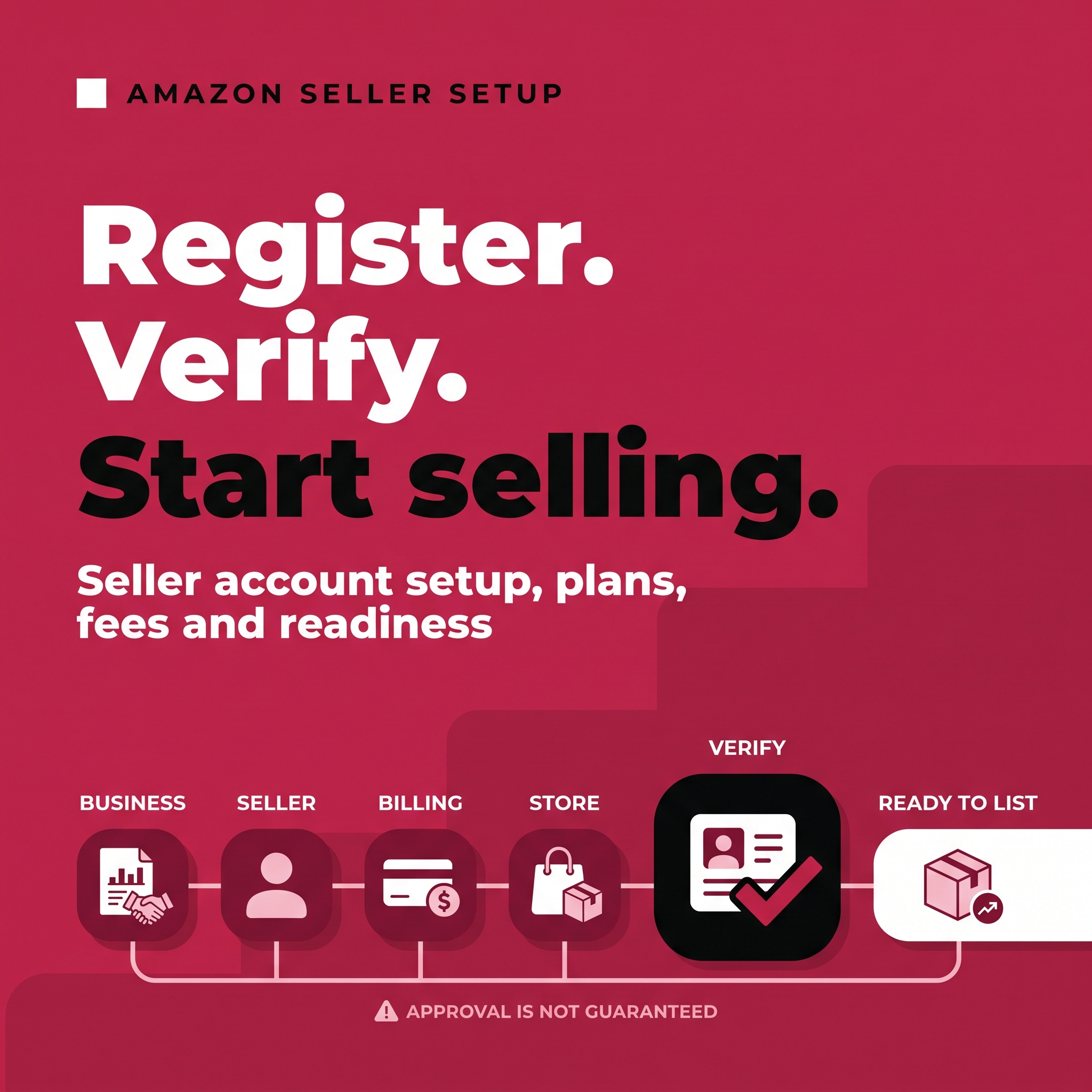
Register a selling account and choose a selling plan appropriate to your expected volume
Identify a product category you can realistically evaluate, avoiding perishables, hazmat, and anything needing customization
Confirm you are approved to sell in that category and can obtain acceptable sourcing documentation
Approach suppliers and ask the compliance questions first, before discussing price
Get the seller-of-record and packaging terms into a written agreement
Place test orders to yourself and inspect exactly what a customer would receive
Model unit economics fully, including a realistic returns allowance and advertising cost, before listing anything
Start with a small number of products and a delivery promise you are confident your supplier can beat
Set up stock synchronization and order forwarding before volume, not after
Monitor account health metrics weekly and treat any supplier-caused slip as urgent
Re-run test orders periodically, especially after any change on the supplier’s side
If a step in that list feels like it can be skipped, it is usually the one that ends the business.
Most of the difficulty in Amazon dropshipping sits in two places: finding a supplier who will genuinely operate inside Amazon’s policy, and building a per-unit model honest enough to survive contact with returns and advertising costs. If you want a second opinion on whether a specific product or supplier arrangement holds up before you commit to it, book a free strategy call.
Frequently asked questions
Yes. Amazon permits dropshipping provided you follow its Drop Shipping Policy, which requires you to be the seller of record, ensure only your name appears on customer-facing materials, and handle returns and customer service yourself.