 Bilal Siddiqui
Key takeaways
Amazon product research is a structured validation process, not a search for one promising number. Every idea should be tested against demand, competition, customer need, economics, operational feasibility, and compliance.
Use broad sources such as Best Sellers, social trends, supplier catalogs, and customer complaints to generate ideas, but validate them using first-party Amazon data, including Product Opportunity Explorer, review themes, return reasons, and purchasing behavior.
Low competition does not automatically indicate an opportunity. It may reflect weak demand, while strong demand may still be difficult to enter when a few established products control most shopper attention.
Calculate contribution margin using the complete cost structure, including landed cost, Amazon fees, fulfillment, storage, advertising, promotions, returns, and working capital. Revenue and estimated proceeds do not confirm profitability.
Reject or pause a product when demand is weak, differentiation is unclear, economics rely on optimistic assumptions, returns appear structural, operational exposure is too high, or selling approval, compliance, and intellectual property risks remain unresolved.
Most product research fails at the same point. Someone finds an idea that looks promising, checks two or three numbers that seem to confirm it, and places a purchase order. The numbers were real. They just were not enough.
The pattern is easy to recognize once you have seen it. A category looks uncrowded, so it gets read as an opportunity, when the actual reason nobody is there is that customers do not care. A product shows strong demand at a comfortable price, and the landed cost, fees, returns, and advertising quietly consume the margin. A review section is full of the same complaint, and fixing it costs more than customers will pay.
Product research is not a search for a number that says yes. It is a sequence of tests an idea has to survive. This guide covers where Amazon product ideas should come from, how to validate them using Amazon's own first-party data, and when to reject one before money is committed.
Find Ideas Broadly, Validate Them Narrowly
These are two different activities, and collapsing them is the most expensive habit in Amazon product research.
Idea generation should be wide and cheap. Browse, notice, collect. Bad ideas cost nothing at this stage. Validation should be narrow and skeptical, because this is where money starts moving.
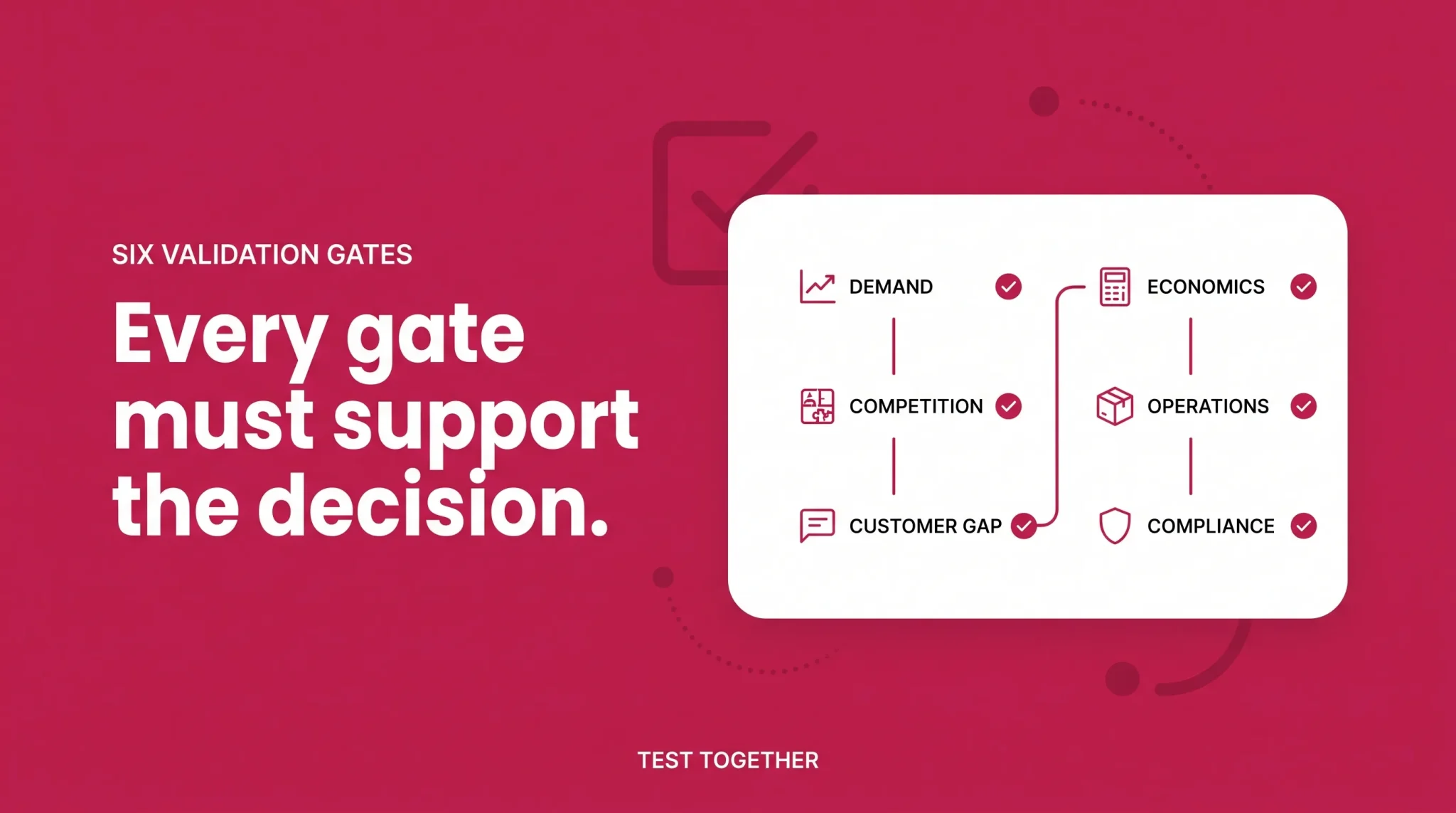
The question for validation is this: does this product opportunity survive demand, competition, customer need, economics, operational feasibility, and compliance when all six are tested together? Not sequentially, where a strong result on one gate excuses a weak result on another. Together.
The output is never "winning product." It is one of five decisions: reject, needs more evidence, validate supplier economics, prototype or sample, or prepare for launch.
The Six Validation Gates
Demand asks whether there is repeatable evidence customers want this solution, at a level that fits the business you are building.
Competition asks whether a new product can realistically earn attention without simply copying what exists.
Customer gap asks whether there is a product, value, quality, usability, or expectation problem worth solving.
Economics asks whether a realistic selling price leaves room after the full cost structure, not after Amazon's fees alone.
Operational feasibility asks whether you can source, ship, store, replenish, and maintain this product reliably.
Eligibility and compliance asks whether this exact product can legally and operationally be sold in the target Amazon store by you.
Two checks run across all six rather than sitting in one: differentiation, meaning whether the product has a defensible reason to exist, and trend or seasonality risk, meaning whether demand will still be there when inventory arrives.
Validation gate | Core question | Evidence to collect | Red flag |
|---|---|---|---|
Demand | Do customers want this at a scale that fits the business? | Niche demand signals, search behavior, purchase behavior, trend direction, seasonality | Interest exists but purchasing behavior is thin |
Competition | Can a new product realistically earn attention here? | Attention concentration, credible substitutes, ratings, pricing, product maturity | A few established products absorb nearly all attention with no visible weakness |
Customer gap | Is there a problem worth solving? | Recurring review themes, return reasons, unaddressed use cases | Complaints are minor, unfixable, or already solved |
Economics | Does the realistic price support the full cost stack? | Landed cost, Amazon fees, fulfillment, storage, returns, advertising | Contribution only works under optimistic assumptions |
Operational feasibility | Can we source, ship, store, and replenish reliably? | MOQ, lead time, freight, dimensions, fragility, quality consistency | Lead time or MOQ creates exposure the business cannot absorb |
Compliance | Can this be sold legally and on Amazon, by us? | Selling approval status, certifications, testing, labeling, import rules | Requirements are unclear or their cost is unknown |
Differentiation | Would a customer understand why this is better for them? | Feature, quality, usability, configuration, or segment advantage | The only difference is branding, color, or a lower price |
Trend and seasonality | Will demand still be here when inventory lands? | Demand history, seasonal pattern, sourcing lead time | The trend likely peaks before the first shipment arrives |
Idea Sources Versus Validation Sources
Keep these separate, because they answer different questions.
Idea sources include Amazon Best Sellers, Movers & Shakers, Hot New Releases, Most Wished For, discovery browsing in Product Opportunity Explorer, customer reviews, everyday product frustrations, creator communities, social trends, supplier capabilities, and gaps in your own catalog. They answer one question: what might be worth investigating?
Validation sources include Product Opportunity Explorer niche evidence, Amazon search and purchasing behavior, click concentration, review themes, return reasons, realistic Amazon fees, landed cost, selling restrictions, compliance requirements, supplier economics, and operational feasibility. They answer a different question: should we commit money to this?
A Best Sellers page, a viral video, an influencer launch, a forum thread, or a supplier catalog can all generate a good idea. None is validation. Best Sellers tells you a product sells well. It says nothing about margins, competitive difficulty, or whether a new entrant can win anything.
Amazon's public lists are worth reading for what they actually show. Best Sellers reflects strong relative sales positions now. Movers & Shakers reflects recent rank movement, which is momentum rather than durability. Hot New Releases shows newer products gaining traction, which does not mean the space is easy to enter. Most Wished For is a soft interest signal. Use them to notice things, not as a copy list.
Product Opportunity Explorer
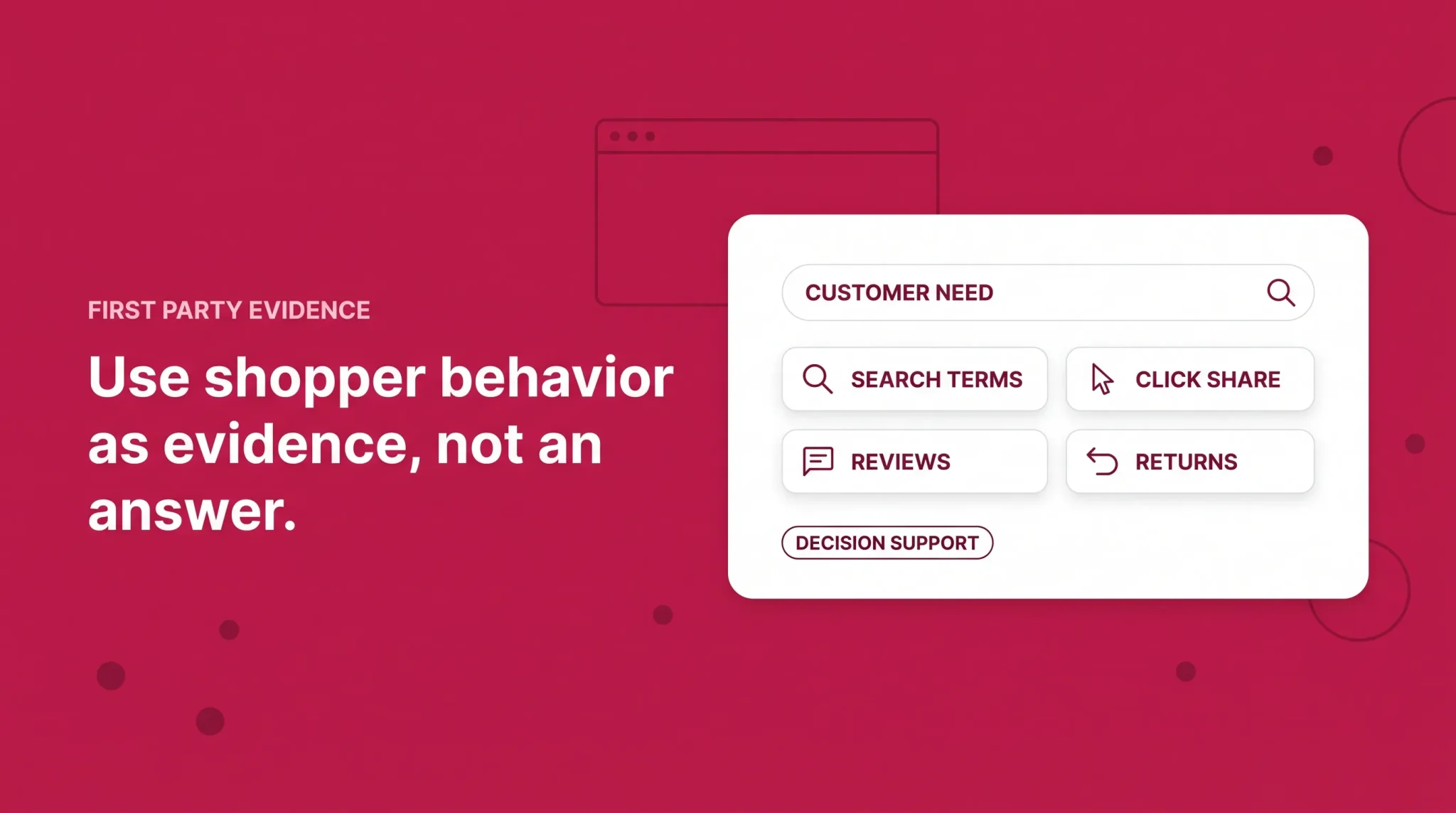
Product Opportunity Explorer is Amazon's first-party research tool and the anchor of a serious validation process, because it is built on shopping behavior that actually happens in the store rather than on estimates derived from public pages.
Access requires a Professional selling account, and you reach it from the Seller Central main menu under Growth. Amazon designed it to help sellers evaluate estimated customer demand and identify potential unmet customer needs using Amazon discovery and purchasing behavior.
The framing matters, and Amazon states it directly: this is decision-support information and it does not guarantee sales or outcomes. Many factors influence what it surfaces, including price changes, demand shifts, and changes in competing offers. It is not a winning-product finder, a profit predictor, an exact competitor sales database, or an automatic launch recommendation. It is a far better starting point than guesswork, and it is still evidence rather than an answer.
There are two useful ways in. Start from a customer need, exploring a niche to understand demand, competition, reviews, and returns. Or start from an existing product, searching an ASIN to see where it participates and what Amazon associates with it.
Inside a niche, the Products view surfaces products receiving meaningful clicks and purchases after customer searches, with signals such as launch date, click share, price and offer context, and product click trends. The strategic question it answers is narrow but important: is shopper attention concentrated around a small number of products, or distributed across many viable alternatives? Click share describes attention within that scope. It does not convert into revenue or market share.
The Search Terms area shows customer language, intent, and the demand themes inside a niche, which answers whether enough relevant search behavior supports the concept at all. Keyword placement, titles, backend terms, and ranking execution belong to Amazon SEO work rather than to product research.
What Amazon Means by a Niche
Amazon's definition matters more than it first appears, because it is not what most sellers mean by the word.
A niche in Product Opportunity Explorer represents a specific customer need. Amazon builds niches by grouping search terms based on overlap in the products customers click or purchase after searching. The grouping comes from behavior, not from the catalog tree.
So a niche is not a category, not a single keyword, and not a label you invent. A single product can participate in more than one customer need, which is why the same item appears in multiple niches with different competitive dynamics in each.
That changes the research question. Instead of asking which Amazon category looks easy, ask what problem the shopper is trying to solve. The first question leads to categories where you have no advantage. The second leads to a customer situation you might serve better than what exists.
Unmet Demand
Product Opportunity Explorer surfaces unmet demand opportunities, which Amazon defines as collections of related search terms converting below the benchmark, indicating strong customer need alongside relatively low competition.
This is genuinely useful and also the feature most likely to be misread. Lower conversion can mean an opportunity. It can also mean the need is inherently difficult to serve. Products in that space may be expensive to make well, may carry expectations nothing on the market meets, may have structural return problems, or may be hard to explain on a detail page.
Treat an unmet demand signal as a research lead, not a conclusion. It still has to clear economics, customer expectations, product complexity, returns, supply, compliance, and actual differentiation. What it does is tell you where to spend validation effort, which is worth a great deal on its own.
Demand Validation Without Magic Thresholds
There is no minimum monthly sales figure that makes a product viable, no minimum search volume, and no niche revenue floor. Any guide publishing one is applying a number from someone else's situation to yours.
Required demand depends on your price, margin, MOQ, fixed costs, desired scale, replenishment model, advertising cost, return exposure, working capital, and category economics. A higher-priced product with strong margin and low MOQ needs a fraction of the demand a low-priced commodity item does. Both can be good businesses, and neither is validated by the same threshold.
What replaces the threshold is evidence stacking. Look at niche demand signals, the language and volume of search behavior, which products actually receive clicks and purchases, trend direction over time, seasonality, and whether the space shows continued new-product activity. Then classify what you see.
Proven demand means customers already spend meaningfully on this need. Emerging demand means signals are rising but stability is unconfirmed. Fad demand means attention is moving faster than your sourcing timeline can follow. Seasonal demand is real but timing-dependent, with cash flow implications. Weak demand is the dangerous one, because it often looks like low competition.
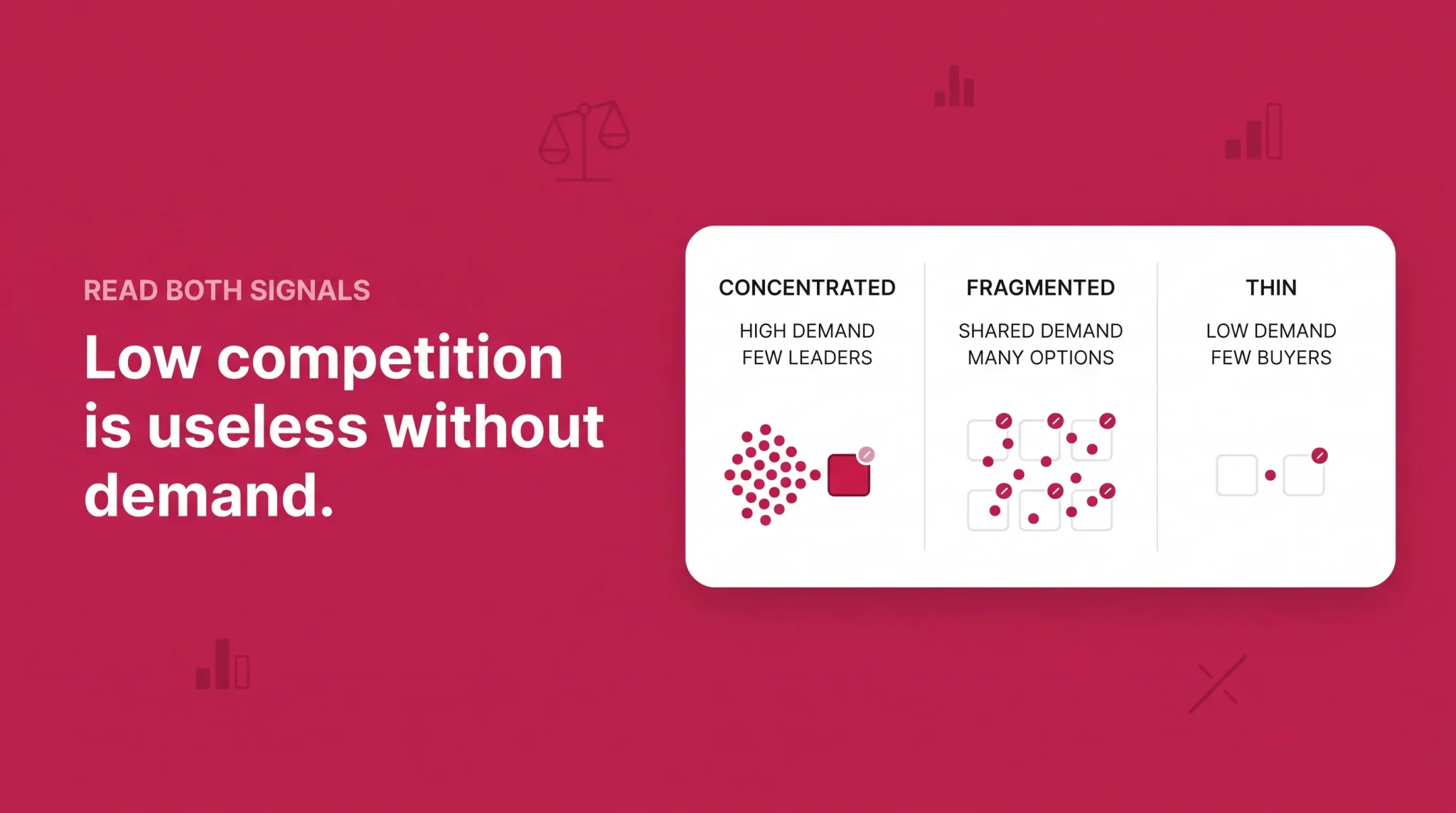
That last point deserves stating plainly. Low competition without meaningful demand is not an opportunity. It is an empty room, and it is empty for a reason.
Consider a hypothetical seller who finds a space with almost no established products and reads it as open field. Search behavior is thin, the few existing products receive minimal clicks, and purchasing activity barely registers. The correct decision is rejection, and it should feel like a win, because the alternative was inventory nobody wanted.
Competition Validation Without Review Thresholds
The rule that fewer than a certain number of reviews means manageable competition is one of the most persistent bad ideas in Amazon research. Review count measures how long a product has been selling and how many customers chose to write something. It does not measure how hard that product is to displace.
A competitor with a modest review count can be very difficult to beat if it holds strong brand demand, prices aggressively, ships faster, or has a genuinely better product. A competitor with thousands of reviews can be beatable if its product has a known weakness customers keep mentioning.
Read competition across multiple signals instead: how concentrated attention is, how many credible substitutes exist, prices, ratings, review depth, product maturity, how similar the leading products are to each other, offer quality, availability, and new-product activity.
Three shapes are worth recognizing. A concentrated niche has a few products capturing most attention, which is hard when those products have real advantages. A fragmented niche spreads demand widely, which can mean easier entry but can also signal commoditization. A thin niche has few competitors because demand itself is small.
Competition and demand always have to be read together. Deeper competitive strategy, including share measurement and ongoing monitoring, belongs in the Amazon competitor analysis guide.
Customer Review Insights
Customer Review Insights inside Product Opportunity Explorer aggregates customer feedback into themes and subtopics, with positive and negative review snippets and rating-impact context, at both niche and individual product level.
This is where product hypotheses come from. What do customers repeatedly value across products rather than in one listing? What do they repeatedly dislike? Does the same problem appear across multiple credible products, or is it one manufacturer's defect? Does the issue actually affect satisfaction, or is it a minor annoyance people mention and buy anyway? And is it technically and economically solvable at a price this market accepts?
The failure mode is reading one-star reviews and treating every complaint as a feature request. Aggregated themes are more useful precisely because they show which problems are structural to the category rather than specific to one product.
Purchase Drivers
Purchase Drivers is a distinct and underused signal. Amazon surfaces up to ten relevant positive or negative product features that appear associated with unit sales performance within a niche. The features are derived from product content such as product names, descriptions, and bullet points, and Amazon compares estimated sales for products carrying a feature against average units sold in the niche.
Used carefully, this identifies attributes associated with stronger or weaker sales performance in a specific competitive space, which beats guessing which features matter.
Used carelessly, it produces a false conclusion. This is an association derived from Amazon's methodology, not proof of cause. A feature appearing on higher-selling products does not mean the feature produced the sales. It may correlate with stronger brands, higher price tiers, older listings, or heavier advertising. Adding it will not automatically increase your sales.
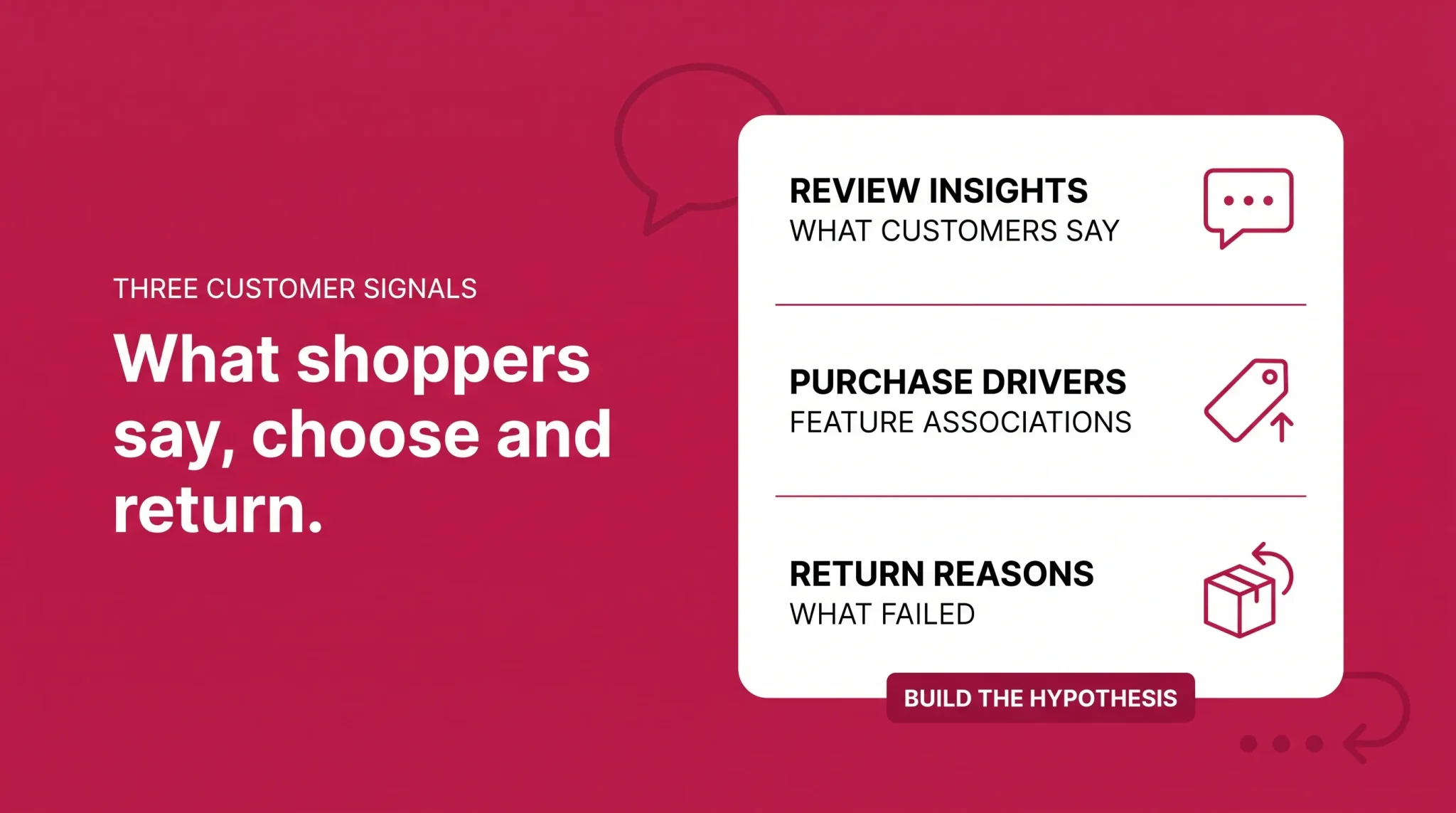
The three signals answer different questions. Customer Review Insights tells you what customers say about products. Purchase Drivers tells you which features Amazon currently associates with stronger or weaker estimated sales in the niche. Returns tell you why customers send products back. A feature becomes interesting when customers request it, products implementing it appear to perform well, and it introduces no major return or operational problem. Even then, the economics decide.
Returns as Research Evidence
The Returns view provides common buyer return reasons within a niche and their frequency relative to returns in that niche. Treat this as a separate validation layer rather than another flavor of negative review data, because returns measure something reviews do not: what went wrong badly enough that someone shipped the product back.
The questions are structural. Is sizing inherently difficult here? Does compatibility create repeated returns? Is durability a recurring failure? Is the product easy to misunderstand from a detail page? Are expectations difficult to meet at any price? Is transit breakage a category-wide problem?
Strong demand combined with high return friction can still produce a bad opportunity. Returns consume margin, damage ratings, create operational work, and in some categories scale faster than sales. Returns data is the only place that shows up before you own inventory.
Problem-Solving Product Ideas
Repeated customer frustration is one of the strongest sources of product ideas. When people keep working around the same limitation or buying two things to do one job, there is usually a concept in there.
That is where the usefulness ends and validation begins. A problem-solving concept still has to clear demand, economic viability, operational feasibility, differentiation, compliance, and evidence that customers value the improvement enough to pay for it.
What is not true is that problem-solving products automatically convert better, create loyalty, generate word of mouth, or reliably become best sellers. Plenty of well-designed solutions sell poorly because the problem was not painful enough, the fix was too expensive, or the customer could not tell from a photograph that it had been solved.
Specialized, customizable, handcrafted, or small-batch products deserve a brief mention in the same spirit. They often reveal customer needs that broad mass-market analysis misses, because the people buying them describe requirements the mainstream catalog ignores. That is an idea-generation advantage, and the concept goes through the same six gates.
Community and creator signals work the same way. Repeated audience questions, recurring use cases, product requests, and creator-developed solutions can surface needs before they reach category-level data. But social attention is not Amazon demand validation. Follower counts, views, and engagement do not tell you whether Amazon shoppers will buy profitably.
Trend Signals Versus Durable Demand
Trends are worth watching and dangerous to chase, and the deciding factor is usually lead time rather than the trend itself.
A trend becomes interesting when demand looks sustained rather than spiking, when supply can reach the market before attention moves on, when you can differentiate rather than arriving as one of forty identical entrants, when the economics work at the price the trend established, and when category restrictions are manageable.
Run the arithmetic honestly. If production takes weeks, freight takes weeks, and receiving takes more, inventory may land after the peak has passed. That is not a marketing problem you can solve later. It is a timing problem you can only avoid now.
Pricing and Unit Economics
There is no Amazon-friendly price band. The claim that products should sit between two particular numbers is arbitrary, and applying it eliminates viable businesses at both ends.
Start by validating what shoppers currently accept in the niche. Compare product format, quantity, size, features, pack architecture, rating and review strength, active offers, delivery, and price per relevant unit. That tells you the band your product would enter and what a customer expects to receive at each point in it.
Then build the cost stack: selling price at the top, then product cost, freight, duties where applicable, referral fees, fulfillment, inbound costs, packaging and prep, storage, returns, advertising, promotions, a defect allowance, overhead if you allocate it, and working capital cost where material.
The correction that matters more than any number: revenue is not profit, and net proceeds are not necessarily final business profit. A product can look healthy at the top of that stack and be negative at the bottom.
There is no universal margin percentage that makes a product viable, and replacing one arbitrary target with another would repeat the mistake this guide exists to correct. The requirement depends on your price point, capital, ad intensity, return rate, replenishment cycle, and what the business needs to sustain.
A hypothetical case shows the failure. Demand looks solid, competition moderate, the price band comfortable. Then landed cost comes in above estimate, the category's return rate turns out to be meaningful, and advertising to reach a new product's first buyers costs more than planned. Contribution lands near zero. The correct move is rejection or a redesigned cost structure, before a purchase order exists.
Revenue Calculator and Its Limitations
Amazon's Revenue Calculator is the right first-party tool for the fee side of that stack. You can search existing Amazon products or define one not yet listed, entering dimensions, weight, category, price, and shipping charges. You can compare fulfillment methods, preview applicable Amazon fees, enter estimated sales volume, and add your own cost inputs to estimate per-unit and total proceeds. Where the relevant inputs are supplied, it can also estimate U.S. FBA inbound placement costs.
Amazon states plainly that results are estimates and actual costs can vary.
The limitation worth understanding is what it does not automatically include. Amazon's current guidance lists items outside the calculation, including monthly subscription fees, return processing fees, unplanned service fees, refund administration fees, high volume listing fees, and other less common fees. Taxes or VAT are generally not included unless specified. The tool does provide fields for seller-entered costs such as cost of goods, shipping, and miscellaneous costs, which is where the accuracy actually comes from.
The calculator is only as realistic as the assumptions you enter. Model separately what it cannot know: advertising, promotions, defect rate, supplier price movement, and returns exposure. A calculator result is a fee estimate, not a profitability verdict.
Operational Feasibility
A product can have real demand, a genuine customer gap, and workable margins, and still be a poor Amazon business to operate.
Work through the physical and supply realities: size, weight, fragility, shelf life, expiration, dangerous goods implications, batteries, temperature requirements, packaging complexity, and dimensional cost exposure. Then MOQ, production lead time, freight, customs, replenishment reliability, and whether quality can be produced consistently across runs rather than in the sample.
The old advice that small and lightweight products are always better is a simplification. They are easier in some logistics models, which is not the same as better. Larger or more complex products can be attractive where margin and competition support the economics, and they often face less competition precisely because they are harder to handle.
Selling Restrictions, Compliance, and IP
This gate gets skipped more than any other, and skipping it is how sellers end up with inventory they cannot list.
Amazon's Add Products workflow gives the practical answer for your account and the specific product. You will generally see one of three states: an option to sell the product, meaning no additional approval is currently required in that context; an option to apply to sell, meaning approval is required; or an indication the product is not available, meaning you cannot create the offer under current conditions.
Restrictions can apply at the level of an individual ASIN, a brand, a brand within a category, a category, or a subcategory, and more than one approval requirement can apply to the same product. Which is why a static list of open categories is not useful. The answer is account-specific, product-specific, and subject to change.
Where Amazon publishes example review timelines for applications, treat them as examples rather than a sourcing schedule. Approval time varies by product, documentation, seller, marketplace, category, and compliance requirement. The research question is narrower: is approval required, and can you satisfy it?
Compliance runs alongside at screening depth: product safety, certifications, testing, labeling, batteries, chemicals, cosmetics, food, children's products, regulated claims, and import restrictions. On intellectual property, consider trademarks, patents, copyrighted creative, protected designs, and whether branded sourcing is authorized.
Two things to be clear about. This guide does not provide legal conclusions, and Amazon approval is not the same as legal or regulatory compliance. Where risk is material, get qualified advice before committing to tooling or inventory. Product-market demand does not override IP or safety risk.
Review-Gap Methodology and Feature Creep
When review evidence suggests an opportunity, work it through in order. Find a recurring complaint. Confirm it appears across multiple credible products rather than one. Determine whether it can actually be solved or is inherent to the product type. Estimate what solving it adds to product and operational cost. Determine whether customers appear to value the improvement enough to pay the difference. Check whether a competitor has already solved it, which happens more often than the review section suggests. Then recalculate economics and compliance with the fix included.
Use Customer Review Insights, Purchase Drivers, and Returns together at that point, since each strengthens or undermines the hypothesis differently.
The discipline this requires is resisting feature creep. Not every complaint belongs in the product. Adding features increases cost, weight, failure points, packaging complexity, regulatory burden, returns, quality control difficulty, and customer confusion. Each addition also makes the value proposition harder to communicate on a detail page, which is where the sale happens.
The research question is which problem is important enough to solve profitably, not how many can be addressed at once.
The Validation Decision Matrix
Signal | What it may mean | What to verify next |
|---|---|---|
High demand, attention concentrated in few products | Demand is real but incumbents may be hard to displace | Whether those products have a visible weakness worth attacking |
High demand with a repeated customer complaint | Potential improvement opportunity | Whether the fix is solvable, affordable, and valued |
Low competition with low demand | Probably not an opportunity | Whether purchasing behavior exists at all, not just interest |
Acceptable price band with weak net economics | Reject or redesign the cost structure | Landed cost, fees, returns, and advertising in one model |
Strong demand with high return friction | Structural product risk may erase the sales | Return reasons, whether they are fixable, and their cost |
Rapid trend with long sourcing lead time | Timing may destroy the opportunity | Whether demand persists past your arrival date |
Good economics with unresolved compliance | Do not proceed yet | Approval requirements, certifications, and IP position |
Strong demand with no differentiation | The product lacks a reason to exist | Whether a defensible advantage can be built at acceptable cost |
Kill Criteria
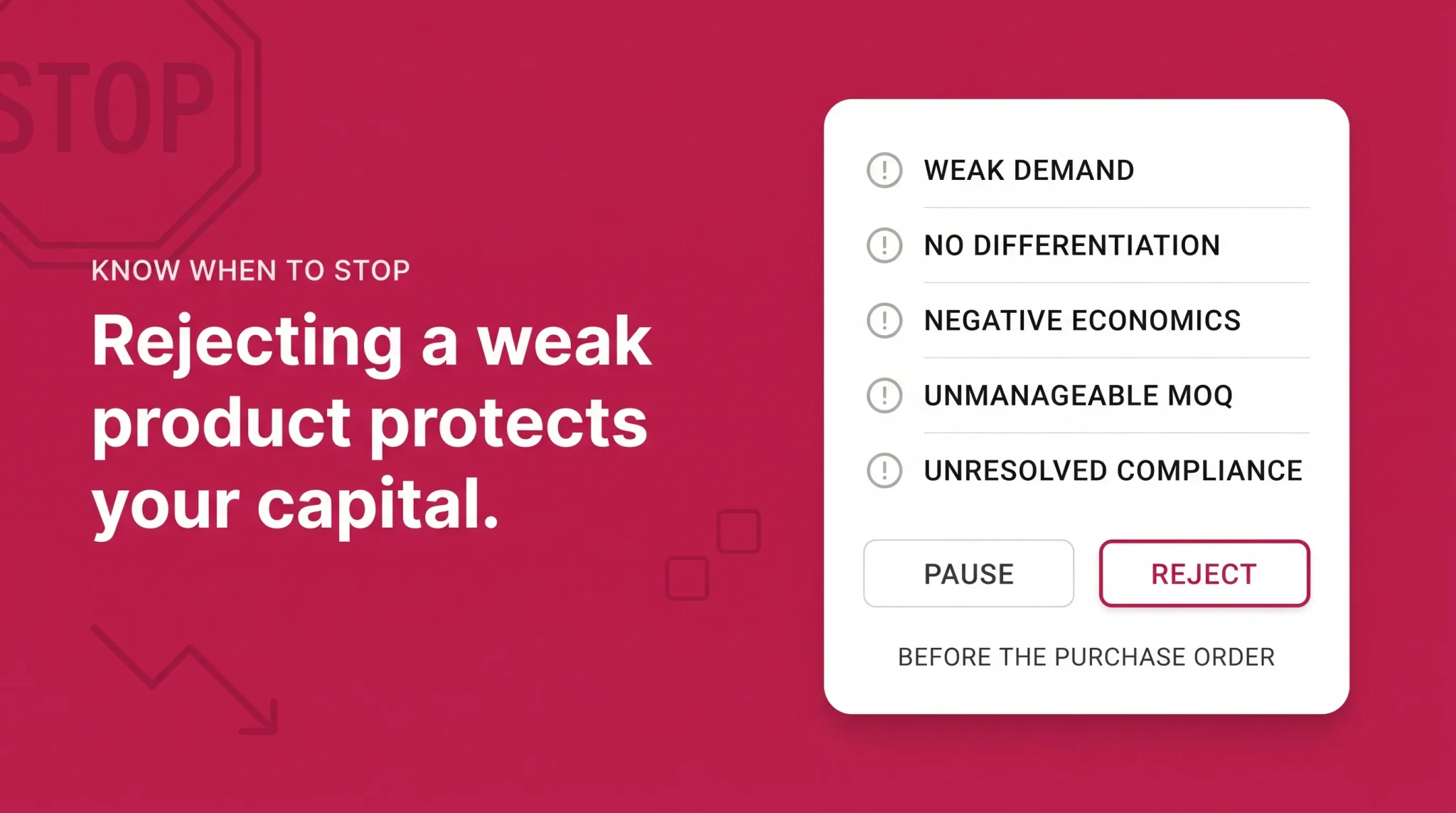
A research process without reasons to stop is not a process. Reject or pause a product when demand is too weak for the business you are building, when demand is heavily concentrated with no credible differentiation available, when the customer problem is not materially solvable, when the price customers accept cannot support realistic economics, when MOQ creates exposure the business cannot absorb, when lead time makes demand too risky to forecast, when returns appear structural rather than fixable, when compliance burden or cost is too high, when selling approval cannot be secured, when IP risk remains unresolved, when quality cannot be produced consistently, when the product depends on a trend likely to fade before launch, or when the working capital requirement exceeds the size of the opportunity.
None of that is failure. Rejecting a weak product before inventory is purchased is a successful research outcome, and it is the outcome most product research should produce. A rejected idea costs a few hours. A bad purchase order costs cash, storage, time, and the opportunity you did not pursue instead.
When Research Ends
Once a product has cleared demand, competition, customer gap, economics, operational feasibility, and compliance, research is finished and execution begins. Listing readiness, review planning, advertising sequencing, launch inventory, and the first ninety days of measurement are covered in the Amazon product launch strategy guide.
For sellers who already operate an eligible brand, Brand Analytics can add first-party search and customer behavior evidence when expanding an existing catalog. Useful context, not a prerequisite.
The Product Research Checklist
Customer need defined in one sentence, as a problem rather than a category
Amazon niche identified around that need
Multiple demand signals reviewed rather than one figure
Seasonality and trend durability assessed against sourcing lead time
Competitive attention concentration and credible substitutes reviewed
Recurring review themes summarized across multiple products
Return reasons reviewed separately from review sentiment
Purchase Drivers considered as a hypothesis where available
Differentiation hypothesis written down and defensible to a shopper
Target price validated against the niche's accepted range
Revenue Calculator scenario built with real cost inputs
Landed cost modeled including freight and duties
Advertising, promotions, and return allowance included in contribution
MOQ, production lead time, and reorder timing checked against cash
Selling approval verified in Add Products before committing inventory
Compliance requirements and IP risk screened, with advice sought where material
Kill criteria applied honestly and the decision documented
Product research is mostly the discipline of rejecting things, which is difficult to do alone once you have spent weeks liking an idea. If a second opinion would help before inventory is committed, Flairox can work through it with you: analyzing niche demand and competitive concentration, reviewing customer review and return evidence for real product gaps, modeling Amazon fees and contribution against a realistic price, assessing operational and compliance feasibility, and deciding which of your candidate ideas actually deserves the purchase order. Schedule a call if that would be useful.
Frequently asked questions
Generate ideas broadly from Amazon lists, reviews, and everyday frustrations, then validate narrowly against demand, competition, customer gap, economics, operational feasibility, and compliance using Amazon's first-party data before committing inventory.