 Bilal Siddiqui
The same product can be profitable at one marketplace price and completely unworkable at another. A unit that clears a healthy margin at an Amazon selling price can lose money once it is pushed into a low-price environment where the expected price, the promotions, the fulfillment path, and the returns all pull in the same direction. That is the real question behind Temu versus Amazon for a seller, and it is not the question most comparisons answer.
Most Temu versus Amazon content is written for shoppers deciding where to buy. This is written for the operator deciding where to sell. A low headline fee does not tell you whether your product survives, and neither does a big marketplace name. What matters is whether your product, your margin, your brand, and your operation can withstand the specific pressure each marketplace applies. This guide walks through those pressures so you can hold your own product up against each one instead of trusting a verdict written for someone else.
Temu and Amazon as operating environments
Amazon is a mature marketplace built around high-intent search. Shoppers arrive looking for something, compare options, lean on reviews, and expect fast, reliable delivery. For sellers, that maturity shows up as an established set of systems: two selling plans (the Individual plan at $0.99 per item sold and the Professional plan at $39.99 per month in the US), category-based referral fees that vary by product category, price, and tier, fulfillment through FBA or your own shipping, Brand Registry and Brand Stores and A+ Content for brand owners, advertising, and detailed analytics. The tradeoff is that all of this sits inside a competitive, policy-governed environment where visibility is contested and account health matters. You can verify the current plan and fee details on Amazon's selling plans and fees page.
Temu is a younger, discovery-led, price-first environment. For a US seller evaluating it in July 2026, the relevant entry point is Temu's current Local Seller program rather than the older cross-border arrangements. Temu's US Seller Center currently states that individual sellers can apply, along with corporations, partnerships, and sole proprietorships, and that US identity, address, tax, bank, and business verification may be required. Approved sellers can create and manage a Temu store, manage products and orders through Seller Center, and select from the fulfillment methods available to their account, with eligibility and available workflows varying by country and account. Older or separate arrangements such as cross-border, consignment, or fully managed models exist in Temu's history and in other markets, but a US seller should not assume free choice between programs. The program available to you is the one your account is approved for.
It is worth noting that the low-price competitive pressure is not unique to Temu. Amazon is building its own controlled low-price experience, Amazon Haul, a dedicated low-price shopping surface that is currently invitation only for eligible sellers, with its own price, category, dimension, and weight requirements, fulfilled by Amazon rather than by standard seller shipping. Amazon is developing its own low-price environment, so Temu is not the only marketplace applying pressure to low-cost product economics.
Pressure one: demand and customer behavior
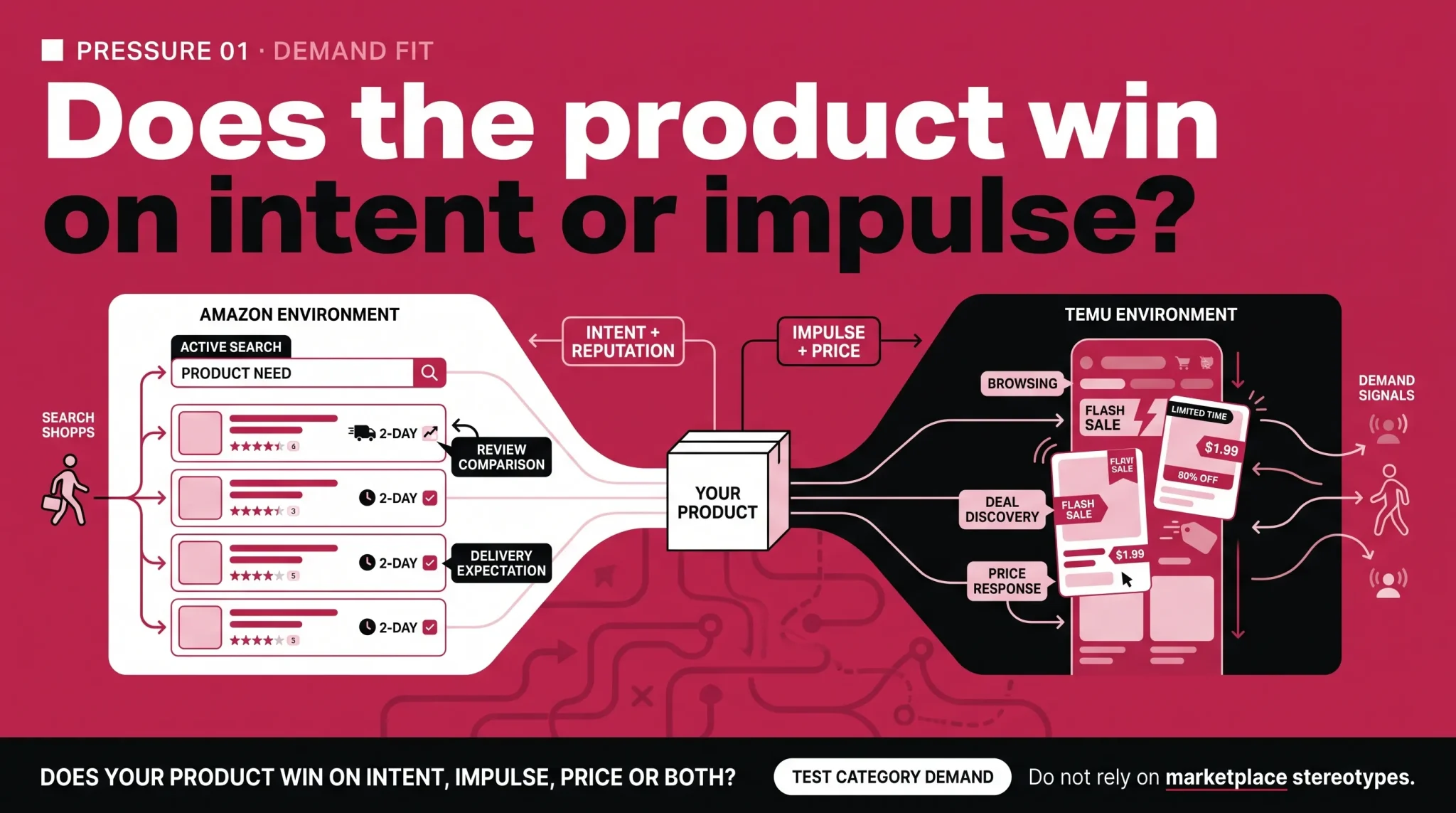
The first pressure is whether the marketplace's demand actually fits your product. Amazon is generally more search-led, which suits products people look for by name, category, or need, and where reviews and delivery speed drive the decision. Temu is generally more discovery, promotion, and price-led, which suits products that catch attention in a browsing, deal-hunting context. These are descriptions of platform positioning and observed marketplace patterns, not universal laws of customer behavior, and they should be treated as strategic inference rather than fact.
That distinction matters because a product that thrives on high-intent search may get little traction in a discovery feed, and a product built for impulse and price may struggle where shoppers compare carefully and read reviews. Rather than lean on stereotypes about who shops where, test your actual category demand on each platform. Pressure-test question: does your product win on intent and reputation, on impulse and price, or on both, and does that match where you are considering selling it?
Pressure two: price and contribution margin
This is the pressure that decides most Temu versus Amazon outcomes, and it is where headline fees mislead people most.
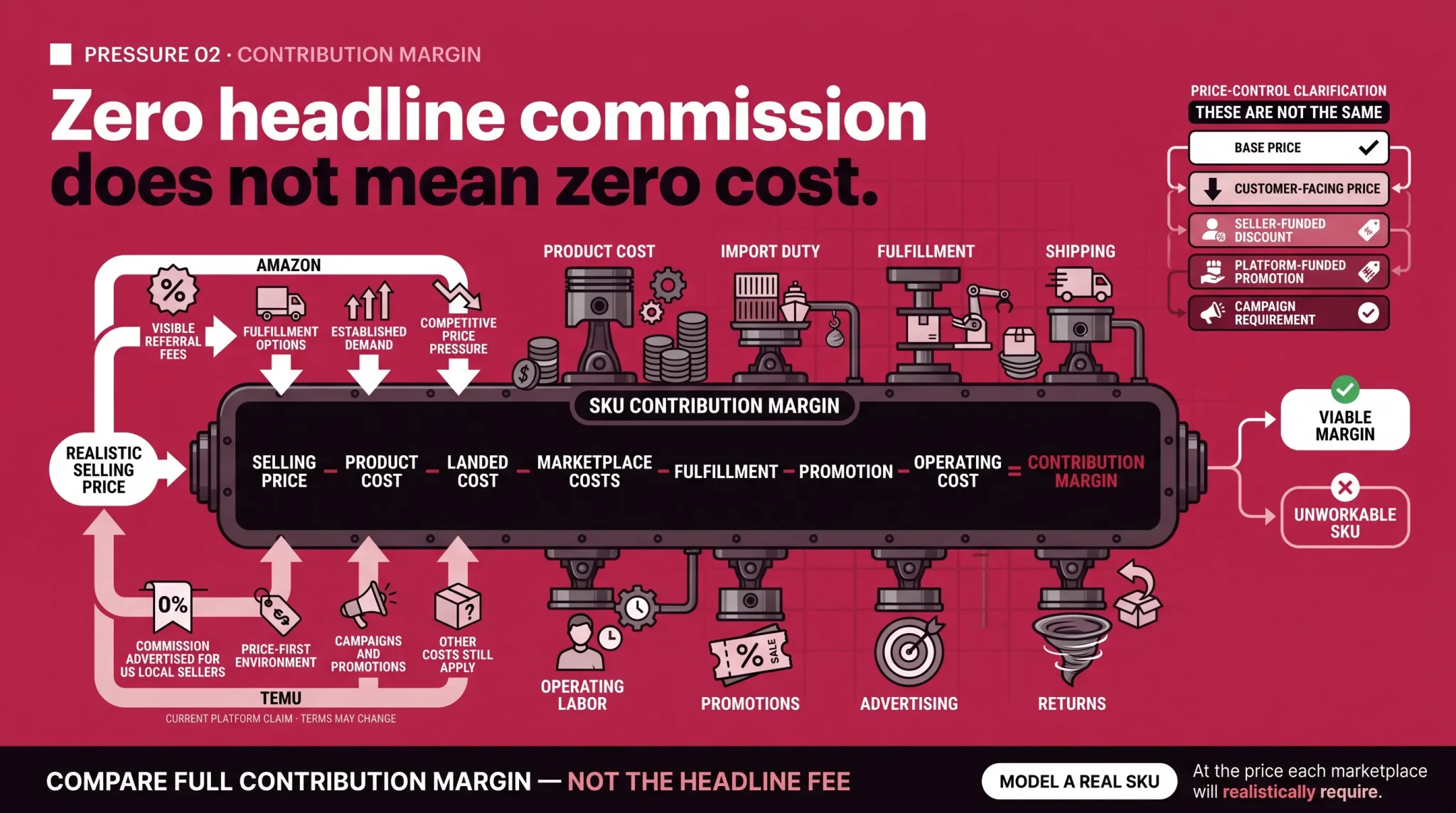
A low headline marketplace fee is not an advantage if the required selling price, promotions, fulfillment, returns, and operating cost leave no contribution margin.
Start with the fee that gets quoted. Temu's public US local-seller page currently advertises 0% commission fees and free registration. Treat that as a current Temu platform claim verified in July 2026, not a permanent universal promise, and read it in context: sellers should still review the agreement and terms shown inside their own Seller Center account, because fees, incentives, advertising, shipping, discounts, returns, integrations, and other costs can vary by program and may change. A zero headline commission is not the same as selling for free.
The honest comparison is contribution margin, not commission. On either marketplace you are absorbing some mix of product cost, import duty and landed cost, marketplace fees, fulfillment, shipping, storage, returns and refunds, advertising, promotions and coupons, seller-funded discounts, packaging, compliance testing, customer service, inventory losses, and operating labor, plus the cash-flow effect of settlement timing. A simple way to hold this in view is a single line:
Selling price - product cost - landed cost - marketplace costs - fulfillment - promotion - returns allowance - operating cost = estimated contribution margin
Run that on a real SKU for each marketplace before deciding anything. A low or zero headline commission does not guarantee a healthy seller margin, and a higher Amazon referral fee does not automatically make Amazon less profitable. The marketplace with the lower visible fee can still deliver a thinner margin once price pressure, promotions, shipping, and returns consume the difference, and the one with higher visible fees can still work if it supplies demand, fulfillment efficiency, trust, or stronger conversion.
Price control is part of this pressure and needs to be stated carefully. Pricing control depends on the seller program, agreement, campaign, and promotional terms. A seller may provide or manage product pricing, while Temu may apply platform rules, recommendations, campaign requirements, eligibility checks, or platform-funded promotions. It helps to keep the pieces separate: your base or list price is not the same as the customer-facing selling price, which is not the same as a platform recommendation, a seller-funded discount, a platform-funded promotion, a coupon, or a campaign requirement. There is also a cross-platform concern, since a low selling price required on one marketplace can create price conflicts with your Amazon listing. Where the exact control cannot be verified publicly, review the commercial and campaign terms inside your own Seller Center. Pressure-test question: at the price each marketplace will realistically require, does your contribution margin survive after every cost above?
Pressure three: brand, trust, IP, and the customer relationship
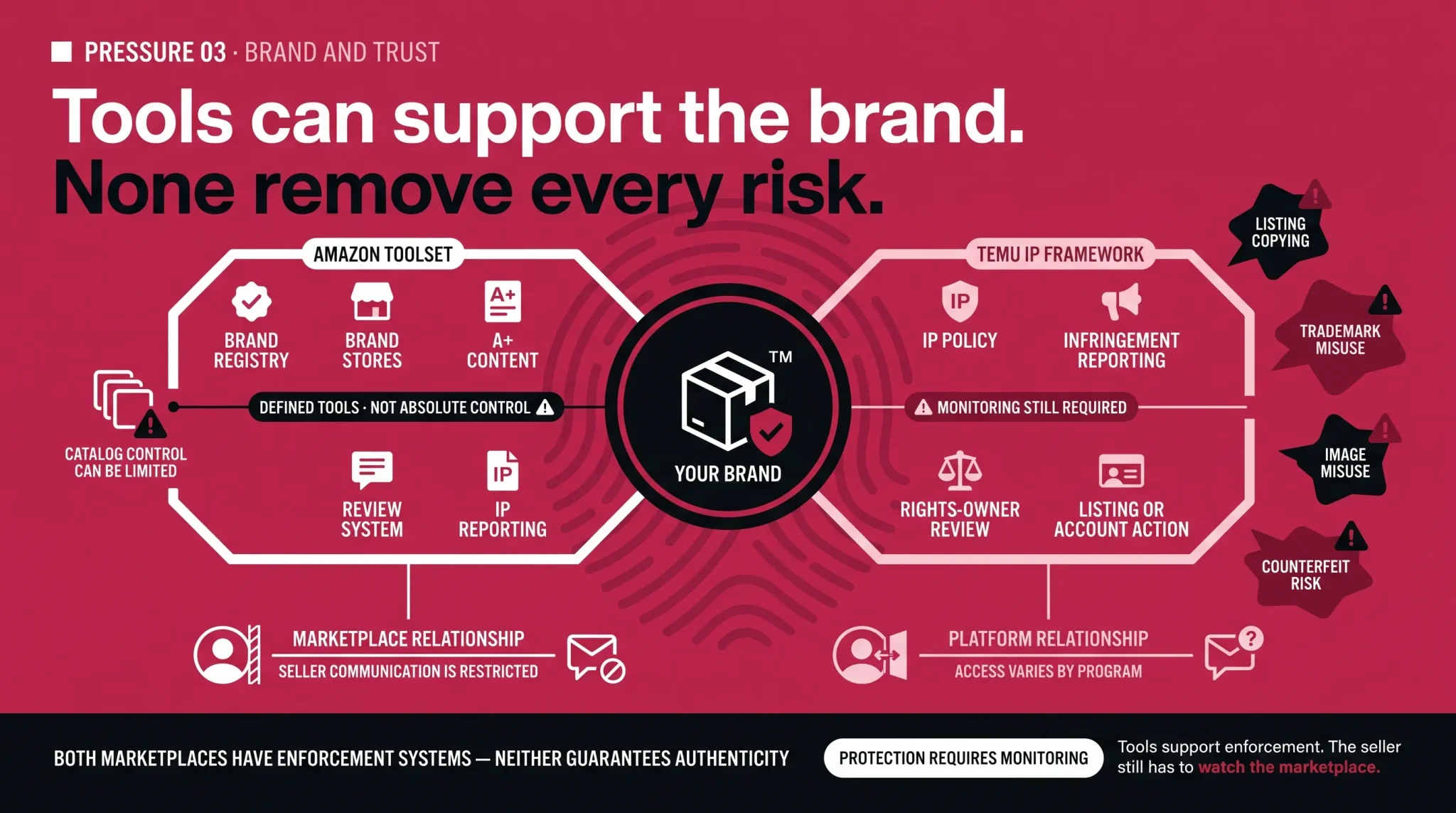
The third pressure is how much brand you can build and protect, and how the customer relationship works. Amazon gives brand owners a defined toolkit through Brand Registry, Brand Stores, and A+ Content, along with a review system shoppers rely on. That toolkit is real but not absolute. Brand Registry does not give a seller complete control over shared catalog data, and it does not guarantee that infringement will never occur. Amazon also restricts how sellers communicate with customers, so the marketplace relationship stays largely with Amazon.
Temu has a current intellectual-property policy and a reporting workflow through which rights owners or their authorized agents can report alleged infringement. Temu can investigate reports, listings or content may be removed following valid reports, sellers may have complaint or response routes, and Temu can take action against accounts connected to infringement. You can review the framework on Temu's intellectual-property policy page. The existence of that policy does not eliminate the real risks, though: counterfeit listings, listing copying, trademark misuse, unauthorized use of images, product-design infringement, and enforcement delays can all still happen, and the seller keeps the responsibility to monitor the marketplace for its own brand. The accurate framing is that both marketplaces operate IP and authenticity systems and both still carry exposure, so neither guarantees authenticity and neither should be described as generally counterfeit. Pressure-test question: can you present and defend your brand on each marketplace, and do you have the capacity to monitor and enforce against misuse?
Pressure four: fulfillment and returns
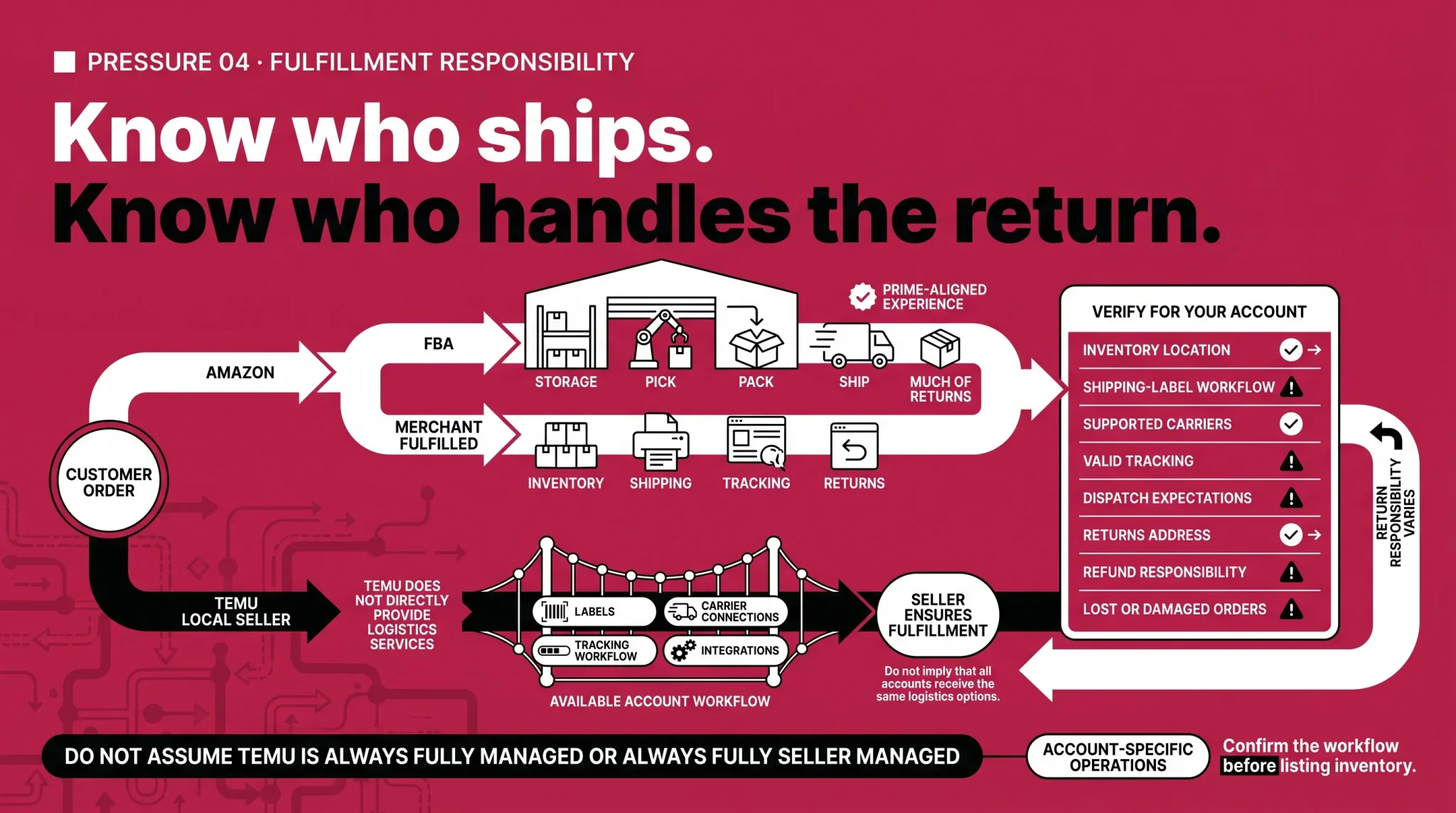
The fourth pressure is who does the work of getting the product to the customer and handling it when it comes back. On Amazon this is familiar: FBA handles storage, pick, pack, ship, and much of returns, with Prime eligibility and delivery expectations attached, while merchant fulfillment leaves those responsibilities with you. Either way the model and its costs are well documented on Amazon's fulfillment pages.
Temu's current US local-seller model works differently and is easy to misread. Temu's Seller Center states that Temu does not directly provide logistics services. It offers integrated logistics solutions and lets sellers choose from the fulfillment methods available to their account. In practice, the seller remains responsible for ensuring the order is fulfilled according to Temu's requirements. Temu may provide supported labels, carrier connections, integrations, tracking workflows, or other logistics tools, but the exact shipping and return arrangement depends on the seller account and the current program. That makes several operational details worth checking for your specific account rather than assuming: where inventory is warehoused, the shipping-label workflow, which carriers are supported, what counts as valid tracking, the dispatch and delivery expectations, the returns address, who owns refund responsibility, and how lost or damaged shipments are handled. It is a mistake to assume Temu fulfillment is always slow, and equally a mistake to assume it is always fully seller-managed. Pressure-test question: for your account and program, do you know exactly who is responsible for fulfillment, tracking, and returns, and can you meet those requirements profitably?
Pressure five: platform control, imports, and regulatory risk
The fifth pressure is the risk that comes from operating inside someone else's platform and someone else's trade environment.
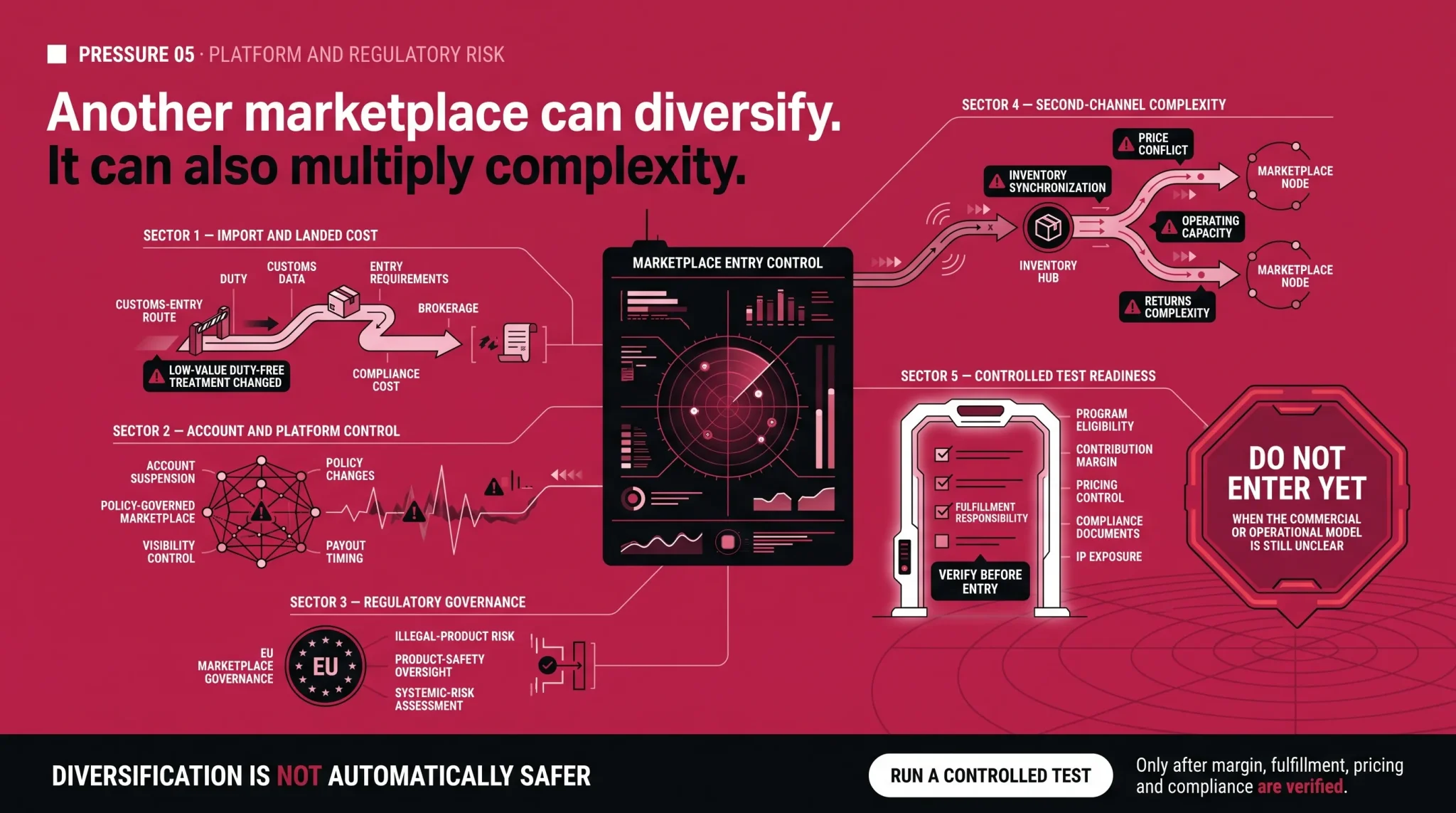
The import piece changed materially and affects landed cost directly. Duty-free de minimis treatment ended for qualifying China and Hong Kong shipments effective May 2, 2025, the US suspension expanded globally effective August 29, 2025, and CBP issued regulations effective June 24, 2026 implementing an indefinite suspension for low-value shipments across postal and non-postal entry modes, published in the Federal Register. The seller implication is concrete: low-value direct-import economics changed materially because qualifying shipments no longer receive the previous automatic duty-free treatment, so duties, entry requirements, customs data, brokerage, and compliance costs can now affect the landed cost. This did not single-handedly cause Temu's local-seller expansion, but the policy change increased the commercial importance of domestic inventory and local fulfillment models. You can review current treatment through US Customs and Border Protection.
Regulatory governance is a related consideration for sellers operating in the EU. The European Commission designated Temu as a Very Large Online Platform under the Digital Services Act on May 31, 2024, and issued a 200 million euro Digital Services Act fine on May 28, 2026, concerning Temu's failure to adequately assess systemic risks involving illegal products and resulting consumer harm. This is a marketplace-risk and compliance-governance point for EU-operating sellers, not a verdict that every Temu product is unsafe, that every seller violates product-safety law, that Temu has no compliance systems, or that Amazon products are automatically safe.
Beyond imports and regulation, both marketplaces carry the ordinary platform risks a seller should weigh: account suspension, listing removal, pricing pressure, policy and fee changes, promotion dependency, platform-controlled visibility, limited customer-data access, fulfillment dependency, inventory concentration, payout timing, chargebacks, and demand volatility. Running two marketplaces can reduce reliance on one channel, but it also adds inventory and operational complexity, so diversification is not automatically safer. Pressure-test question: have you priced the import and compliance cost into landed cost, and can your operation absorb the platform and regulatory risk of a second marketplace?
Where each marketplace applies pressure
The table below summarizes the five pressures in one view. Read the final column as what you need to evaluate for your own product, not as a score.
Decision factor | Amazon | Temu | Seller implication |
|---|---|---|---|
Demand model | Largely search and intent-led | Largely discovery, promotion, and price-led | Test whether your product wins on intent or on impulse and price |
Pricing environment | Competitive, seller sets price within market pressure | Price-first, with platform rules, campaigns, and promotions that vary by program | Model the realistic selling price each marketplace will require |
Seller cost structure | Selling-plan and category referral fees plus fulfillment and ads | 0% commission advertised for US local sellers as of July 2026, with other costs still applying | Compare full contribution margin, not headline fees |
Promotion pressure | Deals and ads are optional levers | Promotions and campaigns are central to visibility | Confirm who funds discounts before committing |
Brand presentation | Brand Registry, Stores, and A+ Content, not absolute control | IP policy and store tools, with less mature brand infrastructure | Check whether you can present and defend your brand |
Customer relationship | Largely held by Amazon, restricted seller contact | Held by the platform, varies by program | Do not expect to own the customer on either |
Fulfillment | FBA or merchant fulfillment, well documented | Seller responsible, with integrated logistics tools, varies by account | Confirm exactly who ships and how, for your account |
Returns | Structured FBA or seller returns | Depends on program and account | Verify the returns address and refund responsibility |
Advertising and visibility | Mature ad and organic system | Promotion and campaign-driven | Budget for the visibility each marketplace actually requires |
Data and reporting | Detailed seller analytics | Varies by program and account | Confirm what data you can see before you rely on it |
Platform and regulatory risk | Policy enforcement, account health | Platform rules plus import and EU regulatory exposure | Price in landed cost and account risk |
Four product-fit examples
These are short hypothetical illustrations, not predictions, and each explains the pressure-test logic rather than naming a universal winner.
A lightweight, low-cost accessory with simple fulfillment and little need for brand education can survive a price-led environment because its cost to ship and return is low and it does not depend on reputation to convert. The logic is that low operational and returns cost gives it room where price pressure is highest.
A differentiated branded product with an established Amazon position, strong reviews, and a protected price faces a different calculation. Pushing it into a low-price environment can undercut the price and brand equity it already earns on Amazon, so the pressure to watch is cross-platform price conflict and brand dilution, not fees.
A bulky or return-prone product with thin margin is exposed on both marketplaces, but especially where price pressure is high, because shipping and returns can erase the margin entirely. The logic is that fulfillment and returns cost, not commission, decides whether it works.
A regulated product with documentation requirements has to clear compliance and safety obligations on either marketplace, and those costs and responsibilities belong in the margin math before anything else. The logic is that compliance burden and marketplace enforcement, not demand, gate the decision.
Do not enter yet
Delaying a Temu test is the right call when any of these is still true:
Your current program eligibility is unclear.
Contribution margin has not been modeled for the realistic selling price.
Pricing and promotion control is not understood.
Fulfillment and returning responsibility is unclear.
Required product documentation is incomplete.
Inventory cannot be synchronized safely across channels.
Existing Amazon pricing or channel agreements could be damaged.
The team cannot operate another marketplace.
Intellectual-property exposure has not been assessed.
Entering before these are resolved usually creates margin and operational problems faster than it creates sales.
Seller due-diligence checklist
Before committing to a Temu test alongside Amazon, confirm you have verified:
Current seller eligibility and the exact marketplace model your account is approved for.
The category fee, settlement terms, and cash-flow timing.
Pricing and promotion control, and who funds discounts.
Contribution margin at the realistic selling price.
Fulfillment and returns responsibility for your account.
Product restrictions, safety, and compliance records.
Intellectual-property protection and your monitoring capacity.
Inventory availability and synchronization across channels.
Price conflicts with Amazon and other channels.
Data and reporting access.
Internal capacity to manage another marketplace.
Deciding whether a Temu test is worth it
The sellers who get this right do not chase a low headline fee or avoid a marketplace on reputation. They model contribution margin at the price each marketplace will require, confirm who controls pricing and fulfillment, and check the decision against their Amazon position before committing. If you want help evaluating product and marketplace fit, modeling contribution margin, reviewing your Amazon performance, identifying pricing conflicts, and planning a controlled marketplace test, Flairox works across Amazon growth and multichannel strategy. Book a call and we will help you decide whether a Temu test is commercially justified for your business.
Frequently asked questions
Neither is universally better. Amazon offers mature demand, brand, and fulfillment systems at higher visible fees. Temu offers a price-led environment with a low advertised commission. The right fit depends on your product, margin, and operating capacity.